

Gardening Tips for Early Spring from ‘The English Lady’

Tulips and pansies make a colorful spring display.

“Those March winds shall blow, and we shall have snow and what will the Robin do then poor thing?
He’ll hide in the barn and keep himself warm and hide his head under his wing.”   

Maureen Haseley-Jones

March was a month of “wait and see” as we anticipated walking around our gardens. This morning, I walked outside, into a westerly breeze and a gentle sun. I took a deep breath and as I did, I caught the rich fragrance of the soil beginning to awaken.

All of us are itching to get into the garden and I believe that foray will be earlier than last year since frost did not penetrate deep into the ground. 

Please wait until April to clear the winter debris from your borders, as beneficial insects like the bees are hibernating there. Bees are our life blood; they pollinate 70% of the world’s food and we are losing them in the millions, due to climate, pollution, poisonous herbicides and insecticides and just human carelessness.

The sodden soil will dry out in the next few weeks, so tread gently on our precious commodity.  I also am asking that you do not till the soil, as tilling damages soil structure and can break friable root systems. 

Please be patient right now! I know you are chafing at the bit to get your hands into the soil, but, at this moment, continue planning for the upcoming season. Planning means organizing, which helps to prevent costly gardening mistakes during the growing season.  

When you go outdoors to take a walk around the garden, check the trees and decide which ones might need pruning. For example, decide which limbs might need to be removed or the canopy lifted to allow more sunshine into a shady area of the garden. Having made some of those decisions, I suggest that you call in an arborist for tree work in March and April before foliage emerges. With a blank canvas, the work will be accomplished faster and is therefore less expensive.

You can use this time to check on broken or dead limbs and which branches require cabling. And if a tree appears to be 50% dead, then it should be removed. 

A medium shade area can be changed to a dappled shade area, allowing more sunlight in by thinning out the upper tree branches or tree canopy.

Perhaps you would like a tree removed to transform a shady area to a sunny spot, giving you a larger choice of plants. 

I always hesitate to remove a healthy tree, but sometimes a tree has been planted too close to the house which often results in the roots undermining the home’s foundation and the shading over the roof has resulted in mold and mildew. 
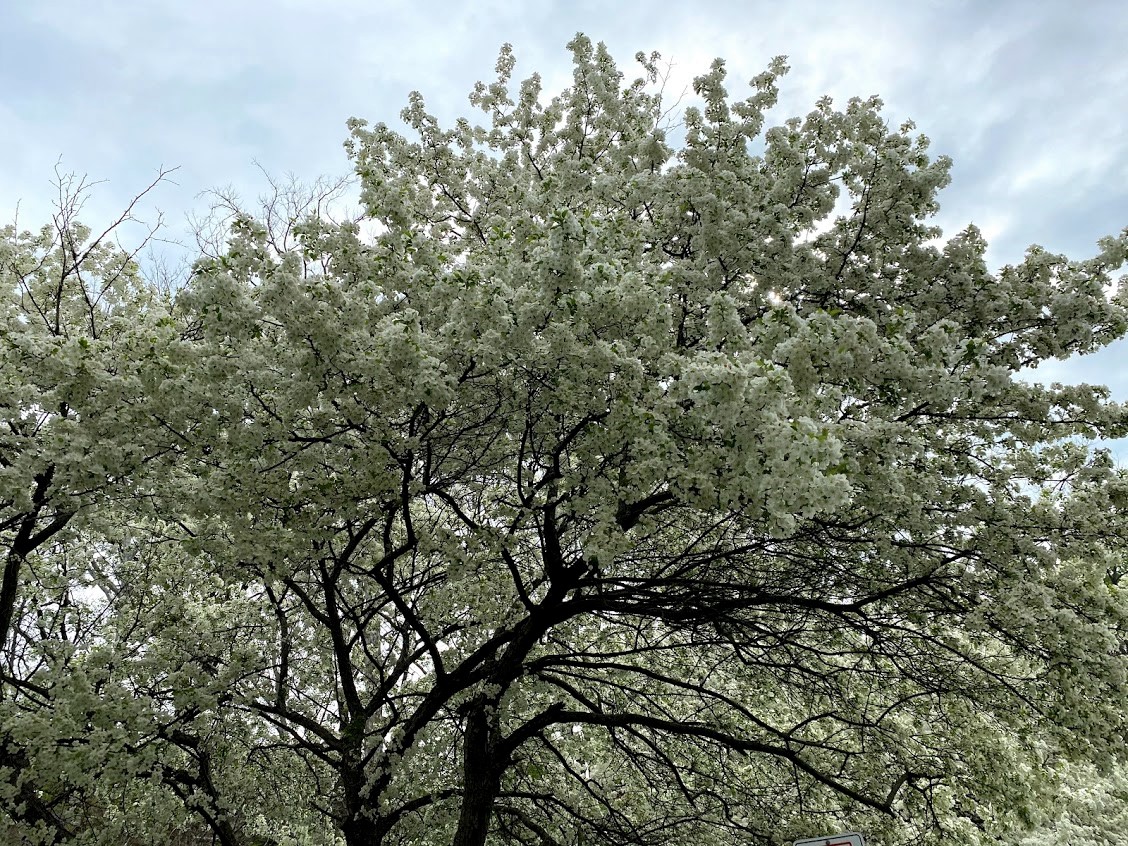
Careful pruning allows trees to bloom freely.

At this juncture, I must point out that there is an art to tree work in knowing how, when and why to cut. Work on the trees should be carried out by a professional so that at the completion of the work, the effect is both practical and aesthetically pleasing. An experienced arborist will also take into consideration the health of the trees. Also by employing an arborist, you can avoid injury to yourself, from falling from ladders or avoiding tree branches or trees falling on you.

Pruning

Pruning is one task that you may feel you are able to accomplish yourself. Some tips include:

  • Hedges can be sheared for shape, so that any stubby ends will be concealed by new spring growth. 
  • Please keep to the natural shape of the shrub – no round balls. 
  • Prune Spirea to six inches from the ground.
  • In April, prune lavender down to three inches.
  • In late March, prune sweet pepper bush (Clethra), cutting out the oldest branches.
  • Lilac – Prune back all old branches to various lengths before leaf growth begins, from two to five feet, keeping to a natural shape. Sprinkle lime around the base of the lilac and add manure in May. Lilacs enjoy alkaline soil and  benefit from a small amount of lime sprinkled about a foot away from the base of the lilac.  
  • Prune butterfly bushes to two feet from the ground now and in May apply composted manure around the base. 
  • Prune forsythia after it has bloomed, pruning out sparse flowering old wood.
  • Prune roses when the forsythia blooms. If the roses have only been in the ground for one year, do not prune, wait until October.

Do not remove the protective mulch from around the base of the roses. Wait until mid-May, and then apply a dressing of manure and fine bark mulch, about a foot away from the base of the rose.  

You may be asking, “Why wait until May to apply manure?” The answer is that the soil needs to warm up to 55 degrees, otherwise the nutrient benefits of the manure bacteria that work with plant roots and soil organisms are not activated. I suggest you invest in an inexpensive soil thermometer to check the soil temperature. When the soil temperature reaches 55 degrees, apply a 3- to 4-inch layer of composted manure. 

Tread carefully 

When you have cleared away the debris in April, treading carefully on the soil, make a clean edge to the borders with a sharp spade; this makes such a difference to the look of your garden. 

The best tool to use for this task is a sharpened lawn edger. The blade is a half-circle 9 inches wide and 4.5 inches deep with a flat top that creates a deep edge. Face the bed and thrust the edger down to its full depth and push the cut soil into the bed. Continue along the soil edge and then remove the spade and surplus clumps of soil and grass. 

Edging was one of the first lessons I was taught at our family nursery in England; my great grandfather was a strict taskmaster standing over me, until I got the edge done to his particularly proper standard.  

If you are contemplating locating a new planting bed or expanding an existing one, here are some tips:

  • Think about where you spend your leisure time outdoors, and where you may choose to sit, near to the new bed, enjoying the bloom, fragrance and structure of your plantings. 
  • From indoors are you able to view and enjoy the new border?
  • Is it an area where there will not be drainage problems, erosion concerns or water pooling?
  • Is it convenient to tend and enjoy where you place a bench or chair?
  • Will you be able to water it with relative ease?

For an informal garden I prefer a curved bed – a curved line gives grace and fluidity. Lay out a garden hose in the desired shape and size of bed, adjusting the hose until you are satisfied with the gentle curves. 

Manure

Rich manure works wonders for many plants and vegetables. Photo by Kyle Ellefson on Unsplash

When it comes to manure, many of you, who have been my radio listeners and lecture audiences, know how I feel about that wonderful natural product. Manure is not a fertilizer – it builds soil structure, aids in drainage and its bacteria encourage the millions of soil animals below the surface to come alive and work with the manure bacteria to produce nutrients for the roots of the plants.

Types of manure: 

Poultry manure – I know the odor can be rather objectionable; however, this manure contains about 2% nitrogen, one of the highest levels in any manure. If you have access to poultry manure, allow it to age for two months and by that time, the odor will have dissipated and then add it to the garden.

Horse manure is about 0.5% nitrogen. If you obtain horse manure from a stable, which has sawdust on its floors – it should be pretty weed free. What I have done in the past is obtain horse and cow manure from stables and farms in April.  When you get it home, spread manure out in a flat area (not in a planting bed) then cover it with a tarp for a month.  Using this method, the tarp will suffocate the weed seeds and the sun on the tarp encourages the manures to continue to decompose. A week before using the horse and cow manure remove the tarp to allow the sun to further decompose it. 

Cow manure is 0.25 % nitrogen and is the most available manure.  If you get horse and cow manure from the farm, ask the farmer to give you manure from the bottom of the pile so that it is already partially decomposed. 

Compost pile – If you do not have a compost pile, maybe it could go on your list for this season. Vegetable waste from the kitchen, plus grass clippings, and wood pruning can be added to the pile. The high temperature in the compost kills the weed seed and cooks all those other necessary ingredients.  The ratio of compost and manure for your garden is 1 part compost to 3 parts manure – but if you do not have compost – manure will do the trick. 

**DO NOT apply fresh manure to the garden, as it will burn the plants.  If you do not have a source of manure from a farm, purchase composted manure in bags from the garden center.

In order to produce the best-planting environment, resulting in a soil that is ‘black gold’, apply three inches of composted manure to all planted areas in May, July and October.    

Natural fine bark Mulch can be added later in May, the benefits of this mulch is that it helps to retain the beneficial moisture in the soil and aids to retard weeds. Regarding weeds, I also use a natural product, Bradfield Organics, which is a corn gluten weed pre-emergent, which keeps weeds sprouting  for a few weeks.  

Please do not use cocoa mulch, which is poisonous to dogs and cats, also do not use the chemically colored red mulch.  

The Humus Component

I know I have written about the importance of the humus component for the soil but I feel I must continue to stress this fact.

In your own garden you can build and retain a rich growing environment by building the humus component as outlined last month. We are all carbon-based creatures as is all life on earth. Not only humans but also our soil microbes need carbon to flourish. To attract carbon from the atmosphere into your soil you need to build the humus component when the soil has reached a temperature of 55 degrees.  If the soil has not reached that temperature, the soil organisms are not able to work with the bacteria in the manure to produce nutrients for the roots of the plants.  

This year, as we have not experienced deep frost, the soil temperature may therefore reach 55 degrees by the end of April or early May.  

Once again, I’m getting a little ahead of myself. So back to a cloudy day right now, when you may gradually begin to remove protective covering from shrubs and small trees. In exposed garden areas, where wind is a problem, leave the covering on until mid April. Cold wind is more damaging and drying to plants than extreme cold and frost.   

Frost Heave

If some perennials, trees and shrubs have heaved out of the ground, cover the roots with fresh topsoil or mulch until mid May when they can be settled back in place.   

I just walked around the corner of my house to check on my trellis on the chimney where I have roses and clematis planted together. Roses and clematis are a delightful combination in a companion planting. This planting method means that the rose and the clematis planted together have the same growing requirements, “feet in the shade and heads in the sun.” Beginning in May, add manure and mulch around the base of both. Discontinue feeding roses and clematis in mid-August; this enables both plants to go into a necessary slow dormancy. 

Raking and Aerating

When the lawn has dried out in April, rake lightly to remove excess debris such as leaves and dead twigs. Raking gently raises the mat of the lawn, which enables the emerging grass to breathe. Aerating machines are useful to develop a healthy lawn.  Puncture holes with the aerator which pulls out plugs of soil every four to six inches; following this treatment, root development takes off and thatch is reduced.  Do not use  large thatching machines, as these machines damage the grass.  

Grass

In April, apply organic fertilizer, lime and organic grub control before the grass begins to grow. Reseed bare or sparse spots after gently loosening the soil, liming and fertilizing, then cover the seed with salt hay to keep the seed warm and to prevent wind from blowing the seed away.  Water the seed for the first three weeks. Do not blast the area with water, which scatters the seeds. As with lilacs, grass enjoys alkaline soil which is why we use lime together with fertilizer and grub control.  

Moles

To keep the mole population to a minimum in your garden; apply organic grub control once a month from March for two months which results in less food for the moles. When you see signs of moles, find the mole holes and insert Exlax, which contains senna, an organic herb. The moles eat the Exlax and become dehydrated from defecation and die.  

Apply organic pre-emergent crabgrass killers in March and April.  

Voles 

Spread castor oil around the base of plants and keep mulch away from the base of the plants so that voles, which are canny creatures, are not able to hide there and gnaw on plants and roots. 

Deadhead

Do not cut off the leaves of the crocus as they bloom; the leaves make food for the bulbs for next season’s bloom.

Daffodils

One of the joys of Spring—”A host of golden daffodils.”

When the green shoots emerge, spread composted manure around the plants.    

For daffodil displays indoors, cut the stems at an angle before adding daffodils to an arrangement, and leave them in a vase half filled with lukewarm water for a couple of hours. This is because the stems release a sap like “goop” that harms other flowers. Discard that water and add the daffodils to the other flowers.  If you recut the stems you will need to repeat the process. Change the water in the vase often.  

Perennials

In May when perennials are about four inches above soil level and when the soil is 55 degrees, apply composted manure around them to encourage healthy growth.    

Dividing Plants

At the end of April or beginning of May, you can divide late blooming perennials that have been in the ground for four years or more; these new divisions encourage stronger bloom.

Discard the older inner parts of the clumps and plant the new outside portions.  Do not plant the new divisions any deeper than they were originally in the ground. 

When dividing irises, barely cover the root system so they do not fall over. If irises are planted too deep in the soil, they will not bloom.   

It is best to pick the flowers of pansies regularly to encourage more bloom.

March or early April are the time to plant the following seeds indoors: gaillardia, salvia, marigold, zinnia, petunia, snapdragon, stock and verbena. Before planting these seeds, soak them in warm water and plant them in sphagnum moss or coir. Coir is the outer shell or fiber of the Coconut, either of these two mediums prevents a disease called “damping off”, which can cause seeds to rot before germination.

Cover pots and seed trays loosely with plastic wrap, which creates a mini greenhouse, providing moisture which seeds require to germinate.  

NOTE: Remove the plastic once the seeds have germinated, as the soil needs to drain and needs air circulation around the emerging stems.  

If you are going away on business or on vacation, reapply the plastic wrap over the pots and trays and prop some sticks or skewers in the corners. While you are away the seedlings will stay moist, and the sticks or skewers ensure that the seedlings do not encounter the plastic. 

Dormant Spring Spraying

Spraying of fruit trees, flowering cherry, crabapples, hawthorn, mountain ash and lilac can be done before the leaf buds open. Call a professional company and request that they use only organic products.  

Houseplants

Prepare your geraniums that have spent the winter indoors for the move outside perhaps to add color to a pot like this.

Repot them if they need repotting in April.    

If you brought geraniums indoors at the end of last season, check them for new side shoots, then cut them back to four inches and repot them in clean pots about an inch and a half larger with fresh potting soil.   

Well, fellow gardeners, I know you are getting excited to be in your gardens this season and I hope that these tips have given you plenty to think about to keep you busy for a while. Enjoy photos of lovely gardens that my son Ian has designed. If you wish, contact him for a consultation at landscapesbyian.com.

Enjoy being outdoors in spring sunshine and I look forward to seeing you in your garden in April.     

About the author: Maureen Haseley-Jones is a member of a family of renowned horticultural artisans, whose landscaping heritage dates back to the 17th century. She is one of the founders, together with her son Ian, of, The English Lady Landscape and Home Company. Maureen and Ian are landscape designers and garden experts, who believe that everyone deserves to live in an eco-conscious environment and enjoy the pleasure that it brings. Maureen learned her design skills from both her mother and grandmother, and honed her horticultural and construction skills while working in the family nursery and landscape business in the U.K. Her formal horticultural training was undertaken at the Royal Botanic Gardens at Kew in Surrey.

Death Announced of Tanner T. Hunt, Jr.; Lawyer at Texas Firm for 57 Years, Father of Faulkner Hunt of Lyme

Tanner T. Hunt, Jr.

Tanner T. Hunt, Jr. slipped away very peacefully on April 6, 2025, surrounded by his three children. He was 89 years old. Born in Port Arthur on March 3, 1936, Tanner lived in Beaumont for most of his life – one of the many reasons he felt lucky in life. His parents, T.T. Hunt, Sr., and Velma Welch Hunt, were hard-working, kind, and doted on their only child. After attending Averill Elementary and Dick Dowling Junior High, Tanner graduated from Beaumont High School in 1954 where he played on the basketball team (decent), and the golf team (atrocious). He then moved to Austin to attend the University of Texas. During two glorious college summers, he worked as a guide for students who were touring across Europe. Another summer, he and some high school friends moved to Greenwich Village in New York, where Tanner had a job with the New York Times as a gopher.

As an only child, Tanner was bookish and considered following in his father’s footsteps as a journalist and Editor-in-Chief of The Beaumont Enterprise. However, after graduating with a B.A. in English in 1958, Tanner went to law school at the University of Virginia instead, ultimately completing his J.D. at UT Law School in 1962. Tanner and his first wife, Anabel Stelfox, moved to Washington, DC, where Tanner worked in Robert Kennedy’s Department of Justice, and where his first child, Tanner Truett (Truett) Hunt III, was born.  Also born in Washington was his love of bluegrass and folk music, which would remain a consuming enthusiasm throughout his life. And with many thousands of others, Tanner stood in the crowd as Martin Luther King delivered his “I Have a Dream” speech. 

He and Anabel returned to Beaumont in 1964, where again he had the luck (despite having, by his own admission, too much fun in law school) to be offered a job at Wells, Duncan and Beard, the firm where he remained for the entirety of his 57-year private practice. He respected and learned from founding partners Peter Wells, George Duncan, and Louis Beard, whom he called “fine and honorable lawyers.” Another stroke of luck occurred when Tanner became the attorney for South Park ISD, which later merged with Beaumont ISD, a client for 35 years. Other school districts followed. He felt fortunate to discover a niche early in his career and believed that school board members were often a community’s unsung and wisest leaders.

Tanner and Anabel went on to have two additional children, Faulkner and Meredith, before divorcing in 1973. More luck came his way when he reconnected with his high school sweetheart, Mary Ellen Phelan McKaughan. Marrying in 1978, Mary Ellen was and is a lovely and loving stepmother to his three children, for which he was always grateful. 

Through the years, Tanner enjoyed, well just about everything; playing handball at the Y, writing reviews to books no one ever read and letters to the editor that some did, playing poker at The Beaumont Club (he won some), running for State Representative (he lost decidedly), performing with local bluegrass band The Barflies and the Maids, presiding enthusiastically over a literary club with Lamar University professors he entitled “Town Meets Gown,” and, most notably, hosting a weekly bluegrass show called “Saturday Night with the Folks,” which aired on KVLU for more than 40 years. He joked that most of the listeners resided in the local prison. Tanner always stressed to his children the importance of having roots in a community, and he certainly did that. He and his family lived in Beaumont for almost 100 years.

Tanner’s greatest joy was his children and grandchildren. At times, they tested his limits (at one point, there were five teenagers living under his roof), but he took limitless pleasure in spending time with them and was interested in every single aspect of their lives. Tanner rarely gave advice, but he did share the wisdom of his experience, such as: the importance of an education, the value of broadening one’s horizons, and the freedom of being one’s own boss. Most importantly, he showed his children who he was by his genuine and heartfelt interest in other people’s lives – whether he was in a courtroom, a classroom, a party, a poker table, a late-night school board meeting, the Y, the office, the radio station,  or the drive-in window at Dunkin Donuts – Tanner made many friends throughout his long life. If he liked you, you knew it. 

Tanner’s family would like to express our sincerest gratitude to the many helpers who made his life better and were like family to him, especially toward the end of his life: Angela Hamilton, Debra Leblue, Jerry Phillips, Herlinda Uz, Alex Torres, the Richard family, Tracie Bullock, and Cele Stevens.

Survivors:
Survivors include his wife of 47 years, Mary Ellen Hunt; his sons and daughter and their spouses (Truett & Leah Hunt, Faulkner Hunt & Ann Lightfoot, Meredith Hunt & Charlie Flatten); and his beloved grandchildren: Joab, Henry, Agatha Hunt, Beatrice Hunt, and Silas Flatten. He is also survived by Mary Ellen’s five children (Pete Musgrove, Ma’Lise Gonzalez, Richard McKaughan, Amanda McKaughan, and Tim McKaughan) and their families.

Memorial Service: 
A memorial service in Tanner’s honor will be held on Saturday, May 10, 2025, at 3 p.m. at the family home in Beaumont.

In lieu of flowers, please consider donating to KVLU Public Radio, The Lincoln Project, or a charity of your choice.

Lyme-Old Lyme HS Weekend Sports Round-Up: Baseball Victorious in Thrilling Game

Girls’ Tennis, Boys’ Lacrosse Win Convincingly; Golf Lose in Nail-biter, Boys’ Tennis Defeated

BASEBALL

Lyme-Old Lyme Varsity Wildcats Defeats Old Saybrook Varsity Rams On Back Of Clutch Display From Rowen Meisner (2-3, 5 RBI, 1 R, 1 HR)
Lyme-Old Lyme-14 Old Saybrook-13

On Friday, April 11, Rowen Meisner drove in five runs on two hits to lead Lyme-Old Lyme past Old Saybrook. Meisner hit a grand slam to left field in the seventh inning, scoring four runs, and singled in the fourth inning, scoring one.

Lyme-Old Lyme collected seven hits and Old Saybrook tallied four in the high-scoring game.

Old Saybrook got on the board in the top of the first inning after Old Saybrook scored on a wild pitch, Lyme-Old Lyme committed an error, and Vince Bibisi (1-3, 2 R, 1 BB) scored after tagging up, each resulting in a run.

Old Saybrook added to their early lead in the top of the third inning when Noah Nygard (1-2, 2 R, 2 RBI, 1 BB) singled, scoring one run, another error scored two runs, and a third error scored a run.

Old Saybrook scored six runs on one hit in the top of the fifth inning. Nygard drew a walk, which scored a run, Connor Barry (0-3, 1 R, 1 RBI) hit a sacrifice fly, scoring one run, James Ashe (0-3, 1 R, 1 BB) drew a walk, scoring one run, Charlie Carmichael (1-4, 2 R, 1 BB) drew a walk, scoring one run, and a fourth error scored two runs.

Lyme-Old Lyme flipped the game on its head in the bottom of the seventh, scoring 10 runs on four hits to take the lead and walk-off14-13. The biggest moment in the inning was a grand slam to left field by Meisner that drove in four.

Ben Frazier (3-4, 5 R, 1 RBI, 2 BB) set the tone at the top of the lineup, leading Lyme-Old Lyme with three hits in four at bats including having the walk-off hit. Aidan Carpentino (0-1 2 R, 1 RBI, 4BB) led Lyme-Old Lyme with four walks. Giovanni Winters (1-4, 1 R, 1 RBI, 1 BB) and Frazier each stole multiple bases for Lyme-Old Lyme (Ben with 3, Gio with 2). Lyme-Old Lyme collected eight stolen bases total for the game.

Nygard led Old Saybrook with two runs batted in. Bibisi, Carmichael, Lucas Hedge-Terrei (1-4, 1 R, 1 RBI), and Nygard each collected one hit for Old Saybrook . Old Saybrook had four stolen bases for the game.

GOLF

On Thursday, Old Lyme narrowly lost to Haddam-Killingworth  187 — 89  on Lyman Orchards Player Course, which has a Par 36. The scores were as follows:

Old Lyme
Jonah Scheckwitz  45
Elliot Dunn-Sims   47
Carter McGlinchey 50
Manu Geronimo 47

Haddam Killingworth
Cameron Moore 47
Axel Kolcio 44
Braylon Rodriguez 43
Robert Krahn 53

GIRLS’ TENNIS

On Thursday, April 10, Old-Lyme Girls Tennis crushed Morgan High School 7-0. Full scores were as follows:

1st Singles:
Katherine Zhang vs Tessa Gebauer 6-1, 6-1 
2nd Singles: 
Emma Arelt vs Rachel Spaziano 6-7, 6-0, 6-0
3rd Singles: 
Mari Munster vs Paige M onty 6-1, 6-1
4th Singles: 
Rose Dimmock vs Fran Limauro:  6-2, 6-0

1st Doubles: 
Stella Young / Addy Morosky vs Kate Gardner/ Margaret Limauro: 6-0, 6-0
2nd Doubles:  
Katie Ferman / Ainsley Rinoski vs Giovanna Riera / Eva Morse: 6-0, 6-0
3rd Doubles:
Allegra Schaedler / Caterina Wilson vs Mia Zhiminaicela / Gabby Sabatini: 6-1, 6-2

BOYS’ TENNIS

On Thursday, Old Lyme Boys’ tennis was defeated by Morgan 1-6

Singles:

1. Nate Miller (M) defeated Andy Sicuranza (OL) 6-1, 6-0
2. Micah Bass (OL) defeated Nick Vetrano (M) 6-7 (4),7-5, 10-4
3. Nate Kinser (M) defeated Rowan Hovey (OL) 6-4, 6-3
4. Andy Alvarez (M) defeated Oliver Wyman (OL) 7-6 (10), 6-4

Doubles:

1. Ryan Gray/Nick Hicks (M) defeated Chris Dagler/Gavin Gray (OL) 6-2, 6-3
2. Mekai Howard/Jude Watson (M) defeated Ryan Olsen/Ryan Miller (OL) 1-6, 6-2, 7-5
3. Hendrick Bausch/Zhen Wu (M) defeated James Dahlke/John Turick (OL) 6-4, 6-3

BOYS’ LACROSSE

On Thursday, April 10, Old Lyme trounced Cromwell 16-0

The following boys scored, assists are shown in parentheses after goals.

Hayden Grethel 2 (0)
Alex Krol 3 (1)
Ben Goulding 3
Quinn Sprankle 1
TJ Sousa 1
Payton Burr 1
Judah Waldo 1
Kevin Hou 1
Will Burgess 1
Brendan Landry 2 (1)
TOTAL 16 (2)

Lyme-Old Lyme Schools BOE Reinstates Sixth Music Teacher to Proposed Budget with No Increase to Bottom Line

OLD LYME – The Lyme-Old Lyme Schools Board of Education on Thursday voted unanimously to reinstate an elementary school music position to the district’s $39.7 million 2025-26 proposed budget while calling for harmony between the music department and district administration. 

The district school board called for the special meeting amid vocal opposition from some community members after the position held by Mile Creek School music teacher Matthew Guevara was not included in the proposed budget. The school board approved the spending plan in February. 

There are currently six music teachers in the district, including Guevara. He was hired in January. 

Superintendent of Schools Ian Neviaser on Friday said the bottom line of the 2025-26 budget proposal will remain the same despite the added position. The cost, which he valued at $70,201 in salary and benefits, will be absorbed in the proposed budget. 

It hasn’t yet been decided exactly where money will come from, according to Neviaser. 

The budget proposal represents an increase of $2.7 million, or 7.39 percent, over the current spending plan. It’s the highest increase among comparable schools in the shoreline area, according to a presentation given by Neviaser earlier this week. 

He said $1.8 million of the $2.7 million increase is attributable to debt payments for the renovation project happening in all district buildings except the high school. 

The move to reinstate the music position came after school board members heard from members of the music department about how to enhance the program using the existing ensemble of six teachers. 

The school board members were receptive to the music department’s plan and surprised it was the first they were hearing of it. 

School board member Chris Staab, who made the motion to add the sixth teaching position and to require the administration and music department to work together in coming up with an implementation plan, voiced concerns about the dynamic he was seeing in the district. 

“The departments don’t seem to be working in conjunction with the administration, at least in this case, and that’s concerning to me,” he said. 

Kristine Pekar, music department chair and Lyme-Old Lyme High School choral teacher, said members of the department have not been asked for their thoughts like this before.

“It’s the first time anybody’s hearing it because when we put ideas out there, it doesn’t feel like they are really looked at for what they can do for kids,” she said. 

Neviaser has cited underenrollment, rather than cost cutting, as the reason the district could not maintain current staffing levels. 

Pekar said she’s heard over and over that the cut wasn’t a financial decision. 

“We’re not asking for more finances,” she said. “We’re asking for the opportunity to grow this program.” 

Critics said eliminating the music teacher at Mile Creek School would have negative implications at all grade levels by spreading the five remaining teachers too thinly across the district’s five schools. 

Pekar gave an hour-long presentation on the structure of the district’s music program and how it compares to area districts. She also laid out how the program could better serve students whose musical education had been interrupted by the COVID-19 pandemic with lasting effects. 

Some of the strategies to more fully utilize existing staff included introducing instrument lessons, band rehearsals and chorus classes earlier in elementary school; scheduling one-on-one lessons for students with disabilities at the middle school; and promoting existing music electives at the high school to make more students interested in taking them. 

Key to increasing enrollment at the high school is classifying the high school’s music theory class as a Science, Technology, Engineering and Math (STEM) credit students can choose from to satisfy graduation requirements, Pekar said. 

She used the example of a current student planning to study music in college who signed up for marine biology as his STEM credit. 

“He’s going into music education and he had to take marine bio to fulfill his STEM credits, instead of taking music history to get ready for college, or AP music theory to get ready for college. And I think that is a huge disservice to our students,” she said. 

Pekar pointed to data showing 121 of Lyme-Old Lyme High School’s 368 students, or 33%, are enrolled in chorus or band ensembles. She said the number compares favorably to area districts, including 11.7% in East Lyme and 20.4% in the Region 4 school covering Chester, Deep River and Essex. 

Members of the school board agreed they can still cut the music position after the proposed budget is approved by voters if the administration and music department doesn’t come forward with a compelling plan for implementing the ideas laid out at the meeting. 

Neviaser on Friday remained focused on enrollment.

“We look forward to building upon the creative ideas presented by the music department last night in order to grow student enrollment in this area,” he said.

The board did not discuss a suggestion from Mary Powell-St. Louis, a former district school board member from Lyme, to offset the cost of the sixth music teacher’s salary by paying for the high school sound system and middle school lighting system out of the district’s undesignated fund balance, or rainy day fund. 

She said the move would end up lowering the overall budget increase to 6.85%.

There is $3.1 million in the undesignated fund balance, according to Neviaser.  

He said it is “yet to be determined” whether the district will consider Powell-St. Louis’ suggestion.

The referendum on the proposed budget will be held May 6.

Halls Rd. Overlay District Proposal Faces Uncertain Future in Old Lyme, Overflow Crowd Overwhelmingly Opposes Project

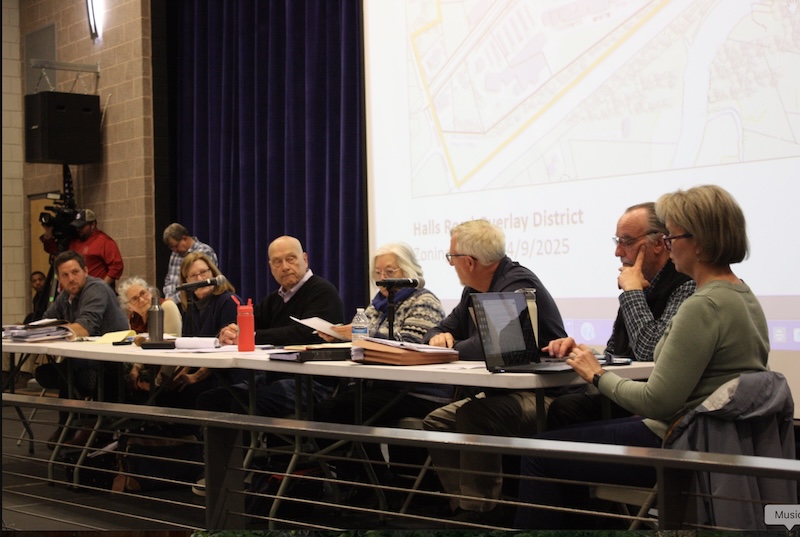
The Old Lyme Zoning Commission closed the public hearing on the Halls Road Overlay District application April 9, 2025 in front of a packed auditorium at the Lyme-Old Lyme High School. All photos by E. Regan.

OLD LYME—About 550 people converged in the Lyme-Old Lyme High School auditorium Wednesday evening, many of them armed with “Vote No” signs and deeply-held ideals about preserving their small town’s character, as they fought a plan to bring apartments and condominiums to Halls Road. 

The Old Lyme Zoning Commission voted unanimously to close the public hearing on the Halls Road Overlay District around 9:45 p.m. after roughly 40 people got up to speak. The subject was a highly controversial application for the creation of an overlay district on Halls Road that could allow as many as 40 housing units per acre to be built above, or behind, ground-floor businesses set close to the street in the 40-acre zone.  

Residents and vocal project critics Ron and Julie Malloy said they had about 500 of the “Vote No” signs printed. By the start of the meeting, only a few were left in their stack. There were also up to 100 people waiting in the hall because Old Lyme Fire Marshal Dave Roberge, per state fire code, could let no more people inside the room. 

The intent of the proposal, which has evolved over multiple years under the guidance of the Halls Road Improvements Committee (HRIC) and its chairwoman Edie Twining, is to create over time a vibrant, walkable neighborhood where strip malls now stand. 

The overlay district proposal, created by the HRIC, was approved by the Old Lyme Board of Selectmen in a 2-1 vote in November. The application to the Zoning Commission was signed by First Selectwoman Martha Shoemaker. 

The HRIC was represented at the hearing by Attorney William Sweeney, who told the commission he’s been working with the group since 2022. 

The long-awaited meeting was the culmination of a process that had invited public input since January. No new information can be presented now that the hearing has concluded. The commission has 65 days to consider the evidence and reach a decision.

While demands for a town wide referendum on the issue have been a popular refrain on social media and in public meetings, Land Use Coordinator Eric Knapp said that’s simply not possible. 

Once a town creates a zoning commission, according to Knapp, state law is clear that only the zoning commission has the power to make or amend regulations. 

“You can’t call a referendum on this. The only choice you have at this point is abolish the zoning commission, abolish zoning regulations and start over,” he said, adding, “Which I don’t recommend.” 

Opposition Arguments

Differing interpretations of the overlay proposal estimate there could be anywhere from 200 to 1,200 apartments built if the plan goes into effect. But even on the low end, opponents decried what they characterized as a disastrous effect on the environment, school enrollment, traffic and their overall quality of life in the rural community of 7,628 year-round residents. 

The lack of sewer service in the area was also cited as a roadblock by many residents.

Proponents argued the proposed district would bolster the local economy and meet a vital need in a state where demand for housing exceeds the supply — and in a town where a vast majority of places to live are single-family homes. They said young adults, who grew up here, can’t afford to come back and older people looking to downsize, can’t stay. 

The arguments in favor of the overlay district didn’t sway an immigrant from Argentina, a young adult living with her grandmother, and a San Diego transplant who each called for Old Lyme not to change. 

Elizabeth Rex said she couldn’t afford to live in California again—even if she wanted to. 

“I couldn’t even afford a studio apartment there now. But I’m not going to go home and demand that housing is built to accommodate me because I want to move back,” she said. “No! I moved to glorious Connecticut, which I love. I love this small town. It’s stunning. I love the farms nearby. I love the rivers. It’s gorgeous. Keep it this way.” 

Maddie Sylvestri came to Old Lyme to live with her grandmother after growing up in Pittsburgh. She said the component of the overlay plan, which calls for 10% of the housing units to be rented out at rates considered affordable by state standards, won’t make a dent in the housing problem. 

“Only 10% affordable living is just not going to meet the needs of young people in this economy,” Silvestri said.  

Under the affordable housing provisions of the proposed overlay district, a single person making $69,840 a year would qualify for a rent of $1,746 per month for a studio apartment, according to the most recent rent limits set by the US Department of Housing and Urban Development. 

Resident Russell Todd, a member of the Historic District Commission who said he was speaking only for himself and his wife, said the proposal, “Represents a significant shift toward urbanization.” 

He said the amount of housing, the size of the buildings and the lack of attractive green space threaten Old Lyme’s small-town identity that drew the couple to Old Lyme in the first place. 

Robin Breeding, a familiar name on social media in posts bringing attention to the overlay district proposal, said the plan is full of contradictions.

“On one hand, advocates of the overlay say their plan calls for only a couple of hundred new apartments on Halls Road. On the other hand, they insist again, against the advice of this commission, to include parking garages,” she said. “That would only make economic sense if they build over a thousand units.”

She also argued against the contention that the overlay district would prevent construction of new gas stations and highway services. That’s because the underlying commercial district is still in place as an avenue for those who don’t want to build mixed-use developments on Halls Road.

The Pros

Proponents of the plan outlined a vision for a Main Street-type feel that was characteristic of nearby Lyme Street before most commercial offerings were pushed off the historic, tree-lined expanse and onto Rte. 1. They said the proposed regulation includes more modern requirements to protect the environment and relies on design guidelines that go further to enhance the town’s rural feel than the existing commercial zone. 

In similar fashion to Breeding—but this time, supporting the proposal—Kimberly Thompson, chairwoman of the Old Lyme Democratic Town Committee, spoke of contradictory information from those against the plan.

She cited concerns from opponents about the lack of space for septic systems, proximity to the river and ensuring that open space remains protected.

“By definition, those things are going to limit the development in this area,” she said. “And I support the overlay district because those things exist, because there’s going to be review of septic and wastewater plans, because The Lieutenant River is governed by the Gateway Commission, and they are going to have input on what can go there. And because the land trust owns spaces here and their mission is to preserve that space.”

Alex Twining, a successful real estate developer and brother of the Halls Road Improvements Committee Chairwoman, said Halls Road is currently functional but not inviting. 

“Imagine a better vision: A tree-lined Halls Road with sidewalks, bike paths, and shops you can stroll between, park once, stop in a few stores, meet your friend at a cafe, and maybe keep walking to the river or boat landing. Less driving, less hassle, and more pleasant,” he said. 

This vision won’t happen overnight, and places like Big Y will be there for a long time. But with time, new shops and restaurants can begin to open along the street,” he added. 

The businessman invoked the ire of the raucous crowd, which was again reprimanded by Zoning Commission Chairman Paul Orzel, to be respectful. 

Edie Twining has been the subject of speculation on social media by those, who accuse her of seeking financial gain for her family, by advocating for the overlay district. 

Nell Twining stood up to defend her husband and sister-in-law against what she described as, “Paranoid speculation, conspiracy theories, and repulsive accusations.” 

“Neither Alex nor I own property nor have any financial interest on Halls Road or in the proposed overlay district,” Nell Twining said. 

“And to those who express suspicions of why my sister-in-law has worked so hard as a volunteer on the Halls Road Committee: Volunteer community service has been important in the Twining family for generations,” she added. 

The 550-person capacity of Lyme-Old Lyme High School ‘s auditorium was reached Wednesday night before the Old Lyme Zoning Commission’s Public Hearing on the Halls Road Improvements Committee Overlay District proposal began.

Being Heard

The public hearing had been open almost three times as long as the 35 days authorized in state statute. The commission was forced to close it when an extension already granted by the applicant was not renewed Wednesday. 

Multiple people had called for the hearing to remain open so those who had been turned away would have time to hear and be heard. 

Knapp, the land use coordinator, explained early in the meeting that technological limitations at the high school made it impossible to broadcast the meeting remotely.

The move to close the hearing came after Zoning Chairman Orzel, at the request of member Michael Miller, asked if the applicant would be willing to extend the public hearing. State statute specifies all extensions must be approved by the applicant. 

Sweeney said his client was “not interested in extending” the hearing. 

Edie Twining could not be reached for comment Thursday, and Sweeney said he was not authorized to speak for the committee. 

Shoemaker, Old Lyme’s First Selectwoman, on Thursday acknowledged calls by residents like Shaun Mastroianni for her to withdraw the application she’d signed in November. 

Mastroianni ran an unsuccessful campaign for state Senate as the Republican candidate in the 20th District race against Democrat Martha Marx. 

Mastroianni used his two minutes at the microphone during the public hearing to emphasize he does not want to see Old Lyme become another Mystic and to ask residents to reach out to the Board of Selectmen to get them to withdraw the application. 

“I urge you, tonight, tomorrow, to write to your first selectwoman that is sitting – hiding – in the back,” he said. 

Shoemaker said she was in the first row of the balcony. 

“I wasn’t hiding,” she said. “I was listening.” 

Shoemaker said she would hold off on making any decisions on rescinding the proposal until Thursday’s 7 p.m. meeting of the Halls Road Improvement Committee was over. 

“I’m waiting to hear their thoughts,” she said. “And I think that because they had put so much time and effort into it, I owe them the time for discussion.”

Editor’s Notes: i) Visit this link for our brief story published earlier today shortly after Wednesdays’ meeting ended.
ii) Visit this link to read our preview story of Wednesday evening’s meeting, which contains a great deal of background to the current situation.

iii) Visit this link for a reminder of Our Policy on Comments.