Old Lyme senior Jack Porter shoots—and makes—his sixth three-pointer in Old Lyme’s game against Portland played Tuesday evening in the Lyme-Old Lyme High School gym. The Wildcats ultimately won 69-41. All photos by A. Hine.
OLD LYME — The Old Lyme boys secured a big 69-41 win at home over Portland Tuesday night with Wildcat senior Jack Porter making a major contribution scoring six three-pointers in his game-high 23 points.
The action was intense in Tuesday night’s game. Old Lyme senior Eli Sahadi (#23) fends off a Portland player to make a shot while senior Leland Hine (#25) moves down the court to pick up a possible rebound.
Senior Leland Hine and freshman Eddie Fiske were also key contributors to the Old Lyme team with 11 and 10 points respectively.
Sophomore Colman Curtiss-Reardon looks to score more points for Old Lyme with this shot.
The Wildcats advance to a 7-3 in Shoreline Conference play and an overall record of 8-4.
The boys’ next game is at home on Friday, Feb. 2, against Hale-Ray.
OLD SAYBROOK—UPDATED 1/29 with full obituary David G. Brown,artistand farmer, 70, of Old Saybrook, CT died peacefully in his home at the Hay House Farm in Old Saybrook on January 19, 2024. David was born in Englewood Cliffs, NJ, on March 27, 1953 to George and Mary (Wyda) Brown. He graduated from Old Saybrook High School in 1971, 2nd in his class. David started college at Middlebury, where he began to paint portraits and still lifes. He longed to see the world though and took a year off to travel overland across Asia. He visited India, Turkey, Pakistan, Iran and Afghanistan, where he saw the Buddhas of Bamiyam, and he trekked through Nepal. This journey would change his life. Upon returning, David attended Dartmouth College, and graduated Summa Cum Laude in 1976 having studied World Geography and Food Problems. He later received a Master of Arts in Liberal Studies from Wesleyan University in 1989.
David returned to Nepal to teach at the Village School in Syrabu from 1976-1978. The residents were refugees from the Tibetan Village of Happiness. He was amazed by how genuinely happy the Tibetans were, despite having so little. During his travels, David took photographs for UNICEF and Save the Children that were later published in a children’s book. When he returned to the U.S., he sought a similarly simple lifestyle, starting a farm in 1986 in Old Saybrook. He moved into a home built from hay bales covered in stucco, which was without plumbing or electricity. There he created his own personal sanctuary, the Hay House Farm, where he melded art and farming into his everyday life. The message of the Hay House was, “this is more than enough”.
From 1987-1991 David taught social studies and art at the Hammonasset School in Madison. One year, he brought his students to Nepal for a month to work at the Tibetan refugee camp. The group brought with them duffel bags full of clothing for distribution. In October, 1991, Tenzin Gyatso, the 14th Dali Lama was invited to Yale to receive an honorary degree. David was asked to drive the Dali Lama and the Tibetan Cabinet around New Haven. At the end of 1992, David helped resettle 20 Tibetan families in Old Saybrook. From 1992-1997, David worked as the Operations Director for the Tibetan Culture Center of CT. From 1993-1997, he served on the Old Saybrook Board of Education. David built the first Buddhist stupa in Connecticut at the Hay House Farm to serve as a place of meditation for the community. It was dedicated in 2007.
David was a talented painter. His work was displayed at the New Britain Museum of Art in 1999, and at the Discovery Museum in Bridgeport in 2000. In 2004 he was featured at an open house at the Florence Griswold Museum where he created “The Installation”, a life-size still life of the inside of the Hay House with the outside painted in the four seasons. The Installation was accompanied by 365 paintings of sunrises from the past year, and a big grid of portraits of his friends – his everyday heroes. He was the recipient of numerous best in show awards in Guilford, Essex, and at the Yale Art Gallery in New Haven. He displayed his work at several solo exhibitions throughout Connecticut.
“Farmer Brown” became a fixture of the Connecticut shoreline community and was well known for his jam, eggs, produce, honey, paintings, and Lhasa Apso-derived dogs (a breed originating in Tibet). He hosted an annual “daffodil brunch” every spring at The Hay House, when tens of thousands of daffodils bloomed throughout the farm. He was a regular vendor at numerous farmer’s markets in the region, most recently in Chester. David was also the author and illustrator of the children’s book, “Getting Along like Cats and Dogs: Kitty and Puppy at the Hay House.” He inspired countless residents of Connecticut and beyond to respect the earth, live simply, and do what you love.
David was preceded in death by his parents, and his sister, Marjorie Szerlip. He is survived by his sister, Audrey Brown and her husband Peter Cummin of Mystic, and his nephews Aaron and David Szerlip and their wives and children.
A celebration of his life will be in the Spring when the daffodils are in bloom.
Editor’s Note: The following text and photo is our original article published Jan. 26, prior to receiving the full obituary.
This file photo of David Brown was taken Jan. 23, 2017 when he joined the throng of protesters at a ‘Sister March ‘in Old Saybrook. The march was, in many ways, a response to the November 2016 election of President Trump.
OLD SAYBROOK — David G. Brown, age 70, of Old Saybrook, Conn. passed away on Friday, Jan. 19, 2024. He lived and died in The Hay House in Old Saybrook, which had neither electricity nor plumbing. He was an accomplished painter and a deeply spiritual man. He sold flowers, jams and more at numerous local markets. He was a remarkable man.
An obituary and details of services have not been posted yet. We have been promised them by David’s sister as soon as they are available, and will publish them immediately after receiving them.
If you did not know him, it is hard to explain why there is such a widespread and extensive outpouring of grief in response to David’s unexpected passing. Perhaps the tribute that Carol Adams posted on Facebook may help. Carol is the founder and owner of Ashlawn Farm Coffee—we publish her words here with her permission.
First of all, it seems that anything anyone may say about David Brown is sure to fall short and be an understatement. With that in mind, I just would like to express that it still just doesn’t feel possible that David Brown is not walking this earth anymore.
What an incredible life!
He was hugely present in our community: as a talented and dedicated painter, an organic gardener, a farmer, a teacher, a caretaker of the earth, a dog breeder, a spiritual person, a helper, an organizer, a constant thinker, an idealist, a philosopher and a friend.
And you would just run into him everywhere.
I don’t think I’ve ever met anyone who didn’t know David or at least know of him!
My coffee house is blessed to have his painting of our farm (where the coffee business started and thrived for the first 15 years) above the Cafe entrance and we think back fondly on the many years of David’s annual art shows before Christmas at Ashlawn!
David was a main character and a favorite at the Lyme Farmer’s Market at our farm in Lyme, and it was from him that we got our sweet little doggy Princess, a Malti-Shit who is a side character in his now-almost-famous children’s book.
David also painted my three children, works that we will always treasure. He surely was a special guy, one of a kind.
So many of us will sure miss David! What a void he leaves by going too soon, but he enriched our lives, his town, this whole area, and the lives of lots and lots of people.
Old Lyme Resident State Trooper Matt Weber (second from left) and members of the Old Lyme Police Department gather for a photo with Mahmoud (back row, center) and Fadia (seated, right) Alkhalawi during a welcome visit to the Alkhalawi’s at their home. Juliette Meus, Co-Chair of the Lyme-Old Lyme Refugee Resettlement Committee, sits to the left of Fadia.
OLD LYME—UPDATED 1/28 with donation information and additional names in photo above: Old Lyme Resident State Trooper Matt Weber and his team of Old Lyme Police Department (OLPD) officers recently took time out of their busy schedules to visit with the recently-arrived Alkhalawi family, who are refugees from Syria.
The OLPD presented the family with a restaurant gift-card as a welcoming gesture to the Lyme-Old Lyme community. The family enjoyed the visit by the OLPD and were especially appreciative of the gift card.
The family is being assisted by the Lyme-Old Lyme Refugee Resettlement Committee in a variety of ways.
After the visit, Howard Margules, who is a member of Refugee Resettlement Committee, shared an email with LymeLine that had been sent to both State Trooper Weber and Old Lyme First Selectwoman Martha Shoemaker, which read as follows: “On behalf of the Lyme-Old Lyme Refugee Resettlement Committee, I want to thank Resident Trooper Matt Weber and his team of officers for taking the time to visit with the Alkhalawi family, and for their kind offer of support.”
The email continued, “Mahmoud and Fadia were so pleased to have the opportunity to meet the officers, and it was very reassuring for them to know that people in authority care for them. They thank the officers for the restaurant gift card and I am sure the family will savor the meal.”
In conclusion, the email stated, “The visit was greatly appreciated!”
Editor’s Notes: i) For further information about the Lyme-Old Lyme Refugee Resettlement Committee, visit this link. ii) To donate online to the Lyme-Old Lyme Refugee Resettlement Committee, visit this link on the First Congregational Church of Old Lyme website and select Refugee Resettlement in the dropdown Fund menu. iii) To donate by mail to the Lyme-Old Lyme Refugee Resettlement Committee, make your check payable to: First Congregational Church of Old Lyme with Refugee Resettlement Committee in the memo line. Mail to P.O. Box 172 Old Lyme, CT 06371
Well, here we go, as you sit in your arm chair and dream about fragrant bloom and delicious vegetables in your garden. However, it is never too early to plan for this season in your garden. My motto has always been to plan, before action and production.
Mother Nature is waiting for us with her gifts of renewal, growth and nourishment as we begin to plan for the coming season. She tells us that in this wonderful pastime called ‘gardening,’ we can escape from the trials and tribulations of our world. Each day we move gradually from the dark into the light to a longer, brighter day to welcome spring.
A few weeks ago, I retrieved my second batch of Narcissi from the brown paper bag in the refrigerator and planted them on pebbles, with just enough pebbles to anchor the bulbs in place, or you may use potting soil. I use tall glass vases, and make sure to keep the pebbles moist with just enough water to cover the bottom of each bulb.
I brought my Rosemary plant indoors in September; Rosemary is not hardy outdoors in Zone 6. I spray the plant twice weekly with warm water and run a cold-water humidifier and two germ guardian air cleaners with UV lights for personal health and the health of my plants.
Photo by Jonathan Diemel on Unsplash.
After planting the paper white Narcissi, I placed them in a dark, cool closet until the foliage was about four inches tall. Today I moved them from the dark closet to a cool room, that has indirect light and where the temperature remains at about 65 degrees.
When the buds are almost ready to open, I will place them in a brighter area to be enjoyed, not only for their bloom but also the heady fragrance which permeates the house. The new bloom draws me out of the winter doldrums and their gentle fragrance lifts my spirits.
As you know the severe negative changes that are occurring with global warming, together with pollution in the air, water and the earth, are severely damaging our planet. Your personal contribution to saving our planet is to tend the soil organically with compost, manure and natural brown mulch, which builds the humus component in your soil. With this organic method, your plants and vegetables will thrive … as will you.
Throughout the year, allow your garden to anchor you, connecting heart, body, mind and spirit to Mother Nature’s life-giving bountiful gifts and spiritual energy.
The cold harsh winds of January and February extract moisture from trees and shrubs, especially the evergreens. These winds are more harmful to plants than cold temperatures, not only causing plant breakage but also soil erosion. To help counteract these effects, it’s useful to have a few bags of topsoil and mulch in the garage. With these items on hand, any roots can be covered after they become exposed by wind or frost heave. Roots exposed to the elements for any length of time can kill the plant, so when you notice exposed roots, quickly cover exposed areas with the soil and mulch. When spring arrives and the earth warms up, the plant can be resettled in place together with composted manure and natural brown mulch to provide protection and nutrition.
On a sunny day this January, take a walk round the garden and breathe in the freshening air—as you walk, make some notes and decide what worked for you last year and what you will never try again.
Later, back indoors, relaxing in your armchair, browse through the catalogues that began arriving a few months ago. You have already begun making lists of plants that you are thinking of buying. However, a word of caution when gazing at the photos, which are meant to tempt you with their lovely but “doctored” pictures of plants. Do not allow your imagination to run amok and be caught up in the fantasy of the high-maintenance garden pictures you see in the catalogues.
Instead, suit your garden to your lifestyle as to what will work within your own time-frame and physical abilities. If you follow that construct, you will have the time to sit, relax and smell the roses, and not being exhausted by too much garden toil and quite often disappointed in the final results.
As you sit and plan for the coming season, it’s important to keep your budget in mind. It’s hard to believe as you look outside at the muted landscape, that in a few months, sunshine and gentle breezes will warm the soil and new growth will appear.
When the soil is dry enough to tread on, winter debris can be carefully be cleared away. Then, cut a clean edge on the borders; this simple task makes such a difference to the look of a garden. Then in mid-April, add that lovely layer of manure and compost (the ratio being three parts manure to one part compost). With that preparation completed, you are ready for the fun stuff—the placing and planting!
For those of you, who are vegetable gardeners and look forward to a bountiful year with fruits and vegetables, spring rain, extra irrigation and sunshine will produce that delicious bounty.
As spring advances so will the appearance of both good and bad insects—moles, voles and other critters—that can be dealt with naturally. I will share my remedies for this problem in an upcoming gardening letter.
Your memory of your garden from last season may be lost in the enthusiasm of a new season, therefore, I am asking you to be kind to yourself. If last year you became overwhelmed with too much work labor and no time to relax and enjoy your garden; the following are some ideas, you can enact to rectify that problem:-
A prairie meadow-type border can still include color. Photo by Calin Oancea on Unsplash.
For example, send some of your borders back to grass, and if you are tired of grass-mowing, spread wildflower seeds in the grass and enjoy the pleasure of a prairie meadow.
Also, make some of the high-maintenance perennial borders into mixed shrub borders. To accomplish this, take out some of those perennials and donate them to a worthy cause. In their place, plant small and medium size evergreen shrubs; some green, blue and some of the lovely gold species of evergreens. With these shrubs, which display all-season beauty, add small flowering deciduous trees and shrubs that begin flowering in April and successively through June.
The Carlesii viburnum, also known as Korean Spice, is a favorite small shrub of mine, with its white buds that open to a pale pink with the most delightful fragrance.
Plant a Ben Franklin tree with its white cup like blooms and gold center that flowers in August through September.
Nestle three Blue Mist shrubs in the mixed border; this plant will delight with purple blooms and fragrant leaves into September.
On a fence or trellis, plant white autumn clematis.
Add a groundcover as an evergreen framework – my favorite is Myrtle with its glossy leaves and miniature blue flowers that bloom in April.
This youngster is looking for fairies in Hartmann Park. Photo by Lisa Niccolai.
For the children or grandchildren in your family, I believe it is never too soon to introduce your children and grandchildren to the wonders of the garden by bringing garden fairies into their lives. Through the years I have asked children to draw a picture of the garden fairy and make a list of questions to ask the fairies, who live in the wild patch in the garden. We all have a wild patch in the garden; and at this point you may be saying, “Maureen, my garden is one large ‘wild patch!’
Children became so excited and enthused about their lists and pictures of the fairies; as what you are showing them is nature’s transformation of science into magic. These days we seem to have forgotten about fairy tales, dreams and magic; it’s way past time to bring those wonderful energies back into our lives and into the lives of our children.
In spring and through summer, I would find my children or their friends impatiently checking the garden wanting to see their own planting efforts come into bloom. In the vegetable garden they gathered to check what was ready to eat from the produce they had planted. I have found that this introduction to the garden has inspired the children and when they become adults, they enthusiastically plant and tend gardens of their own.
My son Ian is a great example of this as he has partnered with me through the years in the garden and is living proof of the old adage, ‘The student is better than the teacher.’ Ian is a designer par excellence and I invite you to check his website at LandscapesbyIan.com and his Facebook page for lovely examples of his work.
In my March gardening tips, I’ll offer you some suggestions of ornamental trees, shrubs and long blooming perennials. With that list in hand, I suggest that you buy your plants from local garden centers as these centers carry tried and true plants that will flourish in Zone 6.
Mixed shrub borders are often a good solution for low-maintenance gardens.
On the other hand, if you feel that over the years, you have been throwing good money after bad and you are becoming desperate as you feel that your garden, no matter what you do, never looks right. Then, get in touch with a landscape company, who will keep your budget in mind whether you want to do your own work, or wish for a design to install yourself.
On the other hand, when you are planning your garden for this coming season, there are important facts to keep in mind:
What are the requirements for sun, shade, soil, and water of the plants?
Will they survive in this zone, Zone 6?
What are the growth patterns of the plants? Do they grow fast or slow?
You do not want a 50 ft.tree up against the house with tremendous roots that will play havoc with the foundation of your home. Or do you want that lovely but very large, Catawbiense Rhododendron, all 10 ft. of it, climbing through your dining room window in five years?
To find those facts, either check the plants in a book, on the Internet or read the labels attached to the plants in the nursery.
Check every aspect of the plant before you buy. The red or green Lace-Leaf Japanese Maple looks lovely in spring but is it something you can enjoy, without its leaves in the winter? Personally, I not only enjoy the foliage of plants and trees, but also the shape and bark of trees without foliage in winter.
For those of you just beginning to garden, I must be honest and dispense with the myth that gardening is always a relaxing hobby. At the end of that first day of digging, lugging soil, manure and fertilizer, and planting everything at the proper depth; you will feel somewhat exhausted.
At that juncture, you remember that you still need to water the newly-installed plants as you drag your tired body to switch on the hose. Thank goodness, the mulching can wait until tomorrow or next weekend.
Watering the garden can be truly meditative to some. Photo by Markus Spiske on Unsplash.
Watering can be meditative to some of us, myself included. Imagine that the hose is your umbilical cord so that as you nourish the earth and the plants, the earth can nourish you.
By now the sun has gone down, and you trudge indoors muttering to yourself, “What the heck did I get myself into?” To this comment I say, “You did not have to tackle all of the garden in one day”.
In gardening, there is always tomorrow, or next week, and even though the label says to plant it by the end of May or June, believe me folks, a few weeks later does not matter, the garden will wait for you.
You may be saying to yourself at this point, “Maureen, are you trying to put us off gardening”? No folks, but I would remiss, as someone who has gardening in my blood (as well as manure!) for over 400 years to tell you, however reluctantly, not only the pleasures, but some of what can cause aches and pains.
The idea is not to bite off more than you can chew. For first-time gardeners, don’t scatter your energies all over the garden, rather tackle and complete one area at a time. That area should be priority one until it is complete.
If you have a new home with no landscaping, some hardscape may be required. Hardscape is walls, walkways, patios, ponds, decks and so on. The sound and look of a water feature in the garden is delightful and need not be elaborate—a fountain is fine—the reflection of water is Mother Nature’s mirror. If you are not able to do this construction yourself, get in touch with a landscape contractor now, so that a plan can be done now, installed and ready by spring. I say to connect now as Ian tells me that many landscape products are short on supply this year.
These endeavors mean you getting yourself in shape physically, so get off that couch, put away the catalogues and your plant lists, stretch, then wrap yourself up in warm gear and take that walk.
As you walk, look at the trees in winter, the elegant shape of them, the lichen on the stonewalls, and the moss tucked in cracks and crevices. Clear your mind and allow nature’s spirit to surround you. As you walk, look at a few gardens in your neighborhood; gardens that you have admired when they were in bloom, and see what they look like in winter.
I remember one of my professors saying to me when I studied at the Royal Botanic Gardens at Kew, “In winter, you can tell a really good landscape by its bones, without the flesh of flora and foliage.” In spring, get in touch with those neighbors whose gardens you admired and ask them some of the secrets of their garden. They will be happy to talk with you, not only of their successes but their failures—true gardeners are realists when they speak about their gardens and love to share.
Well folks, I’ve given you plenty to think about right now so enjoy your daydreaming of the season to come and I’ll see you next month in your garden.
About the author: Maureen Haseley-Jones is a member of a family of renowned horticultural artisans, whose landscaping heritage dates back to the 17th century. She is one of the founders, together with her son Ian, of, The English Lady Landscape and Home Company. Maureen and Ian are landscape designers and garden experts, who believe that everyone deserves to live in an eco-conscious environment and enjoy the pleasure that it brings. Maureen learned her design skills from both her mother and grandmother, and honed her horticultural and construction skills while working in the family nursery and landscape business in the U.K. Her formal horticultural training was undertaken at the Royal Botanic Gardens at Kew in Surrey.
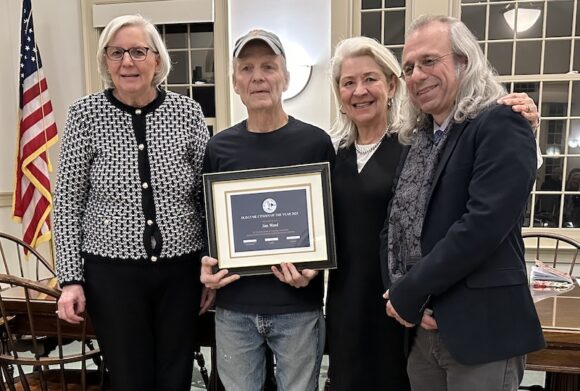
Jim Ward, founder and president of the Lyme-Old Lyme Food Share Garden, was named Old Lyme’s 2023 Citizen of the Year at Monday night’s Annual Town Meeting. Ward, second from left, stands with the Old Lyme Board of Selectmen after being presented with his award. Old Lyme First Selectwoman Martha Shoemaker is at left, Selectman Jim Lampos at right and Selectwoman Judith Read is second from right.
OLD LYME — UPDATED 11:30 a.m. with Ward’s response to receiving the award and more photos: James ‘Jim’ Ward, founder and president of the Lyme-Old Lyme Food Share Garden (LOLFSG), was named Old Lyme’s 2023 Citizen of the Year at Monday night’s Annual Town Meeting held in the Meeting Hall of Old Lyme’s Memorial Town Hall.
Despite the cold, many friends and supporters of Ward turned out to celebrate his success, although, in keeping with years of tradition, he himself knew nothing about the impending award. Ward was tricked into attending the meeting having been advised that a friend was receiving it!
Old Lyme First Selectwoman Martha Shoemaker opened her announcement of the 2023 honoree for the award with the words, “In my opinion, choosing the Citizen of the Year award is one of the hardest decisions the board of selectmen make all year. The reason for that is because we have so many deserving citizens in Old Lyme.”
She noted that the board of selectmen appreciated all the letters of recommendation for the 2023 Citizen of the Year that were sent this year.
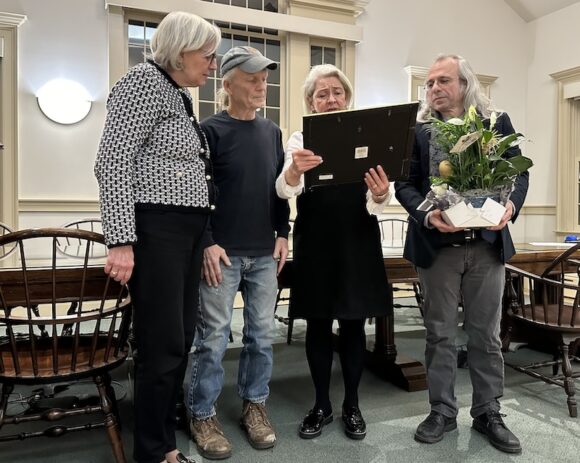
Old Lyme Selectwoman Jude Read studies the text of the proclamation naming Jim Ward (second from left) as Old Lyme’s 2023 Citizen of the Year.
Shoemaker continued, “As a teacher, I always taught my students to not judge a book by its cover. Our 2023 Citizen of the Year has been called by his neighbors, “A quiet man.”” She then gently joked, “After hearing his accomplishments, you may wonder how he can be quiet.”
Quoting Mahatma Gandhi’s famous words, “In a gentle way, you can shake the world.,” Shoemaker said, “This year’s recipient is a master at figuring out how to create and lead a non-profit organization, build grassroot financial support, and oh, rally people to grow, harvest, and send over 5,000 pounds of fresh vegetables to food banks across the region. All on an accelerated timeline.”
She then announced, “Our 2023 Citizen of the Year is Old Lyme resident Jim Ward, President of the Lyme-Old Lyme Food Share Garden, and a Champion for creating community around local environmental and food security solutions.”
Asked early Tuesday morning, his reaction to being named to the honor, Ward responded via email, saying, “Having processed last night I would like to thank my better half, Sheila, the LOLFSG Board of Directors, the garden volunteers and all those who have supported us financially.”
He added, ” It takes a village to raise a community garden. It is has been an honor for me personally and for the garden community to be recognized as the Citizen of the Year.”
Ward concluded, “Thanks to all who nominated me and wrote letters of support and to the Board of Selectpersons for their selection.”
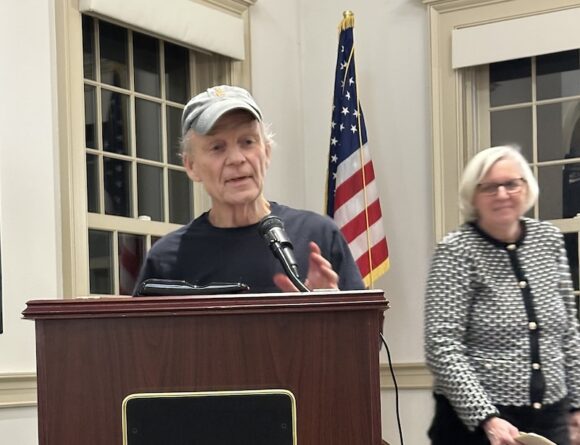
Old Lyme’s 2023 Citizen of the Year, Jim Ward, addresses the audience after overcoming the surprise of being named recipient of the honor.
The full text of Shoemaker’s explanation of and justification for Ward being this year’s honoree follows in italics:
A passionate environmentalist, Jim quietly takes actions to help others learn how to make a difference in our environment, because teachers believe every moment is a teachable moment – The catalyst for his community building efforts began when Jim participated in the 2020 UConn Master Gardening Program. Jim’s required outreach hours for the program were met by volunteering at the Food for All garden in Clinton.
His admiration for how the Food For All garden and other similar gardens in the region met the increasing needs of community food banks was equaled by his appreciation for the sense of community they created. This was something Jim thought the Lyme-Old Lyme community could replicate.
In seeking a potential site for a food bank community garden here, Jim presented his ideas to the Old Lyme Parks & Recreation Commission and the Inland Wetlands Commission; and through his thorough and considerate presentations to both, gained support to utilize a parcel of land at Town Woods Park for his envisioned community garden. He and his wife Sheila thought the location perfect because of its close proximity to the onsite playground, sports fields, and the Lymes Senior Center, making the garden accessible to all ages in both towns.
In March 2021, Jim held a Zoom meeting open to all residents to plan the food bank community garden at Town Woods Park. The goal would be to provide fresh produce to help alleviate food insecurities and support healthy nutrition to families in Old Lyme, Lyme, and surrounding communities.
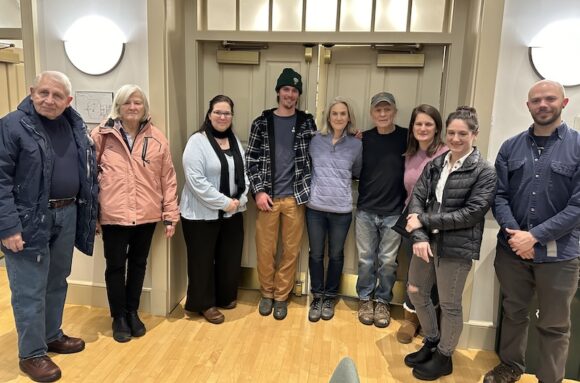
Friends and supporters of Jim Ward, who braved the cold to see him accept the award, gathered round him after the presentation to celebrate hiis success. From left to right are Ward’s neighbors, the Gotowkas—Tom and Christina, and Elizabeth Rubitski, Ward stands fourth from right and his wife Sheila McTigue-Ward is to his left. (Editor’s Note: We will add the additional names when we have confirmed them.)
That Zoom meeting resulted in a handful of volunteers ready to take on Jim’s challenge. The rest of 2021 was spent raising money, building garden fencing, and preparing the soil. In 2022, their first growing season, the Food Share Garden logged more than 700 hours of volunteers’ time in producing and donating over 2500 pounds of fresh produce to the Shoreline Soup Kitchens & Pantries, and the United Way of Southeastern Connecticut.
During this past year’s second growing season, Jim’s leadership contributed to 31 volunteers logging over 1000 hours, again producing more than 2500 pounds of produce, and converting over a thousand pounds of food waste to compost for next year’s garden.
Still in just its second growing season, the Lyme-Old Lyme Food Share Garden was one of three giving gardens to receive the Innovation Award from the United Way of Southeastern Connecticut.
Liz Rubitski, has volunteered with Jim and the LOLFSG for three years and says it’s been an absolute pleasure. She goes on to say “Jim’s leadership style is impressive. He balances inclusivity with decision making so that everyone stays focused and this results in accomplishing tasks efficiently with high quality. This can be seen with how far the garden has come in just 3 years. In addition to board leadership his hands-on work ethic is inspiring, he literally never shies away from getting his hands dirty.”Liz concludes with “and as if that wasn’t enough, Jim is fun to be around!”
Peter Hunt who serves on the Board of Directors for the Lyme Old Lyme Food Share Garden was happy to share that,“Jim is a down to earth guy with a great idea and the drive to realize it. Jim is a good leader in that he can set an agenda but be flexible and a good listener. He shares decision making and credit for accomplishments. He really works year-round on the garden and is there early and stays late during the season.”
From the beginning, Jim’s holistic thinking for the garden included not just growing vegetables, but also ensuring the garden was healthy through pollination and compost initiatives. Early in the planning process Jim reached out to Pollinate Old Lyme to promote the future food share garden as a public pollinator garden where people could visit and see what a pollinator meadow looks like. Cheryl Poirier, a co-leader of Pollinate Old Lyme said, “Jim reached out to us as soon as the Town Woods property was secured to talk about supporting a pollinator meadow. Suzanne Thompson and I stood with Jim out amidst a tangle of invader species and the occasional native plant and heard Jim’s vision for not only the vegetable garden that would support food banks, but also for a pollinator garden that would attract the butterflies and bees that would naturally pollinate the proposed vegetable plants. That February afternoon in 2021 it was clear there was still a long way to go, including building his team. But you look at that garden today with the adjacent pollinator meadow of native asters, milkweed, rudbeckia, and more, and you think wow, here is someone who can make things happen.”
Suzanne Thompson added,“Jim Ward is visionary, pragmatic, and resourceful. He is a quiet source of inspiration and has a can-do attitude. He accomplishes big things. We are fortunate to have Jim and his wife Sheila living in town.”
WFSB TV personality, Attorney and Old Lyme resident Eric Parker served as Moderator for the event.
Jim also serves our town as co-chair of the Solid Waste and Recycling Committee. Although this committee doesn’t have the most glamorous of names, we rely on them for policy recommendations and opportunities to reduce the Town’s trash, which is not just important for our environment but also for our taxpayers’ wallets. One important way to reduce trash is to encourage our residents to compost their food waste. Jim’s enthusiasm for nature’s way of recycling led to his creation of a pilot composting program in his Library Lane neighborhood. Just this summer, the neighborhood collected over 700 pounds of food waste for composting. As Suzanne Thompson added, “Jim is showing the rest of us that yes, we can do this.”
And stay tuned, this committee is working to bring us closer to better composting options for all our residents.
Jim will always be the first to give others credit and there are many people who have become involved in these projects whether making financial donations or digging in the dirt. But the success of any volunteer endeavor depends on someone who can provide enthusiasm, guidance, and recognition to others. Jim’s neighbors Christine and Tom Gotowka said, “We are impressed that he always acknowledges the role of his core team and the large cadre of volunteers in what has certainly been a successful endeavor that has reflected well on our community.”
And as Peter Hunt further shared, ” Old Lyme is blessed to have the nonprofit sector and schools that it does, but the blessing would not be possible without the contributions and leadership of folks like Jim.”
Growing, Caring, Sharing. These are the guiding words of the Lyme-Old Lyme Food Share Garden. These three words also represent why the Board of Selectmen is happy to present Mr. Jim Ward with the 2023 Citizen of the Year award.
Shoemaker concluded, “Jim, I am sure your family, friends, and your fellow citizens of Old Lyme, will join me in thanking you for not just thinking about solutions for food insecurity and environmental issues, but for also taking action and bringing the rest of us along for the ride. Congratulations Jim!”
Editor’s Note: We add our own hearty congratulations to Jim — such a well-deserved award for a truly remarkable man. Well done, Jim!