
“The Story of Edgar Sawtelle” by David Wroblewski

Lots of people think that the book our Jen selected this week, “The Story of Edgar Sawtelle,” by David Wroblewski, is very good, including Stephen King who noted he doesn’t re-read many books, but will be doing so with this one. Yet again Jen’s review has tickled our fancy too and we think we’ll also be reading it very shortly.

I had dinner a few weeks ago with a gentleman who said this was his favorite book.  My step-mother liked it but thought the middle a tad long-winded.  Stephen King said he,” flat out loved it.”  How could I resist?
Ultimately, I agree with them all. OK – done.

Kidding.The Story of Edgar Sawtelle by David Wroblewski is a hell of a book.  Long, but good-long.  A young boy growing up in Wisconsin has to face some very serious issues.  His family has bred dogs for generations and lived an idyllic life until the black sheep (read total psycho) of the family returns.  Edgar, the boy, is in the teacup when the tempest arrives.
Born mute, his considerable intellect is torn asunder by death and deceit.  His Uncle Claude is the tempest and the Sawtelle dogs are the grounding rod.  Edgar must find himself using their strength of character and his own.
Wroblewski paints a truly involving portrait of the mind.  The outside world is beautiful: the postcard-perfect farm, the shamanistic woods, the magnificent barn … but the story is the human mind.  How to handle extreme adversity?  How to stay focused and self-reliant without capitulating to fear or self-loathing?
Edgar and the dogs are it.  We are with them.  My favorite personality—and its subsequent depictions and thoughts—is Almondine.  Edgar’s dog, and he is her boy, is so remarkably wonderful I am hard pressed to say how much I loved knowing her.  The chapters from her perspective are remarkable.  I do not look at my dog with the same eyes anymore. Almondine is a character who will resound within me forever.  More than Claude, more than Edgar, she is the touchstone for the story.  For me, at least.
As good as the plot is, the training of the dogs is fascinating as well.  These dogs are all so tangibly individual it is a pleasure to witness their actions.  They are as much individual characters as the humans.
When I was young, my great-grandfather had a barn like the Sawtelle’s.  It was magic and I would still be in it if it were possible.  It was a world unto itself and the sense of safety and promise is so well described by Wroblewski that I felt home.
The magic of this book is larger than a simple story.  The barn is not just a barn.  The dogs are not just dogs.  Edgar is not just a victim.  His story is the story of faith.  The story of redemption and come-uppance.  The story of love and magic.  It does get long-winded, but don’t forget how hard it must be to write such a book.

Read every word.  You will miss it when it’s over.
“Olive Kitteridge” by Elizabeth Strout

Jen takes on Olive this week (no, not the kind with pits but rather one-of-a-kind Olive Kitteridge, who lives in Crosby, Maine) and finds herself captivated by the tangled web into which she ventures.  Author Elizabeth Strout won a 2009  Pullitzer for this book and we’re thinking, if there were a Pullitzer for book reviews, our Jen would win one hands down. 

This is collection of stories all involving at some point the same character, namely Olive Kitteridge.  What we see is the world of Crosby, Maine, through the eyes of many of the residents at various times in both their personal and the town’s history.
Olive is the common denominator and we see her through many eyes as well.

Elizabeth Strout is a very good writer.  From the first page I was completely in tune with the characters and Crosby.  Like a small town movie, you walk right in and can go have coffee with anyone you like.

It is slightly maudlin, but not disheartening.  Lives are hard and people are sometimes sad, but you are never tempted to leave or be disdainful.  These are inherently good people and you want to be with them.

Unlike a straightforward novel, the bits and parts of small stories make a perfect venue for Crosby.  We are presented with insight we could not ordinarily have and have a veritable kaleidescope of offerings.  However, it never feels anything but straightforward and palatable.  No flash, no tricks.  Strout isn’t attempting to dazzle us with craft she just moves us along.

Every transition is smoothly done.  No shocks, no, “What the heck? Now where are we?” moments.  The painting of Crosby, Maine, and Olive Kitteridge is, forgive the analogy, like an impressionist one.  A canvas filled with pointilist dots that creates a whole.  Like a Chuck Close or Seurat, Strout has a real gift for this and the result is beautiful.

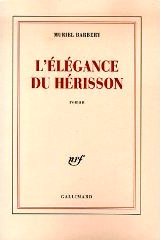
“The Excellence of the Hedgehog” by Muriel Barbery

L'elegance_du_Herisson_161x240Mon Dieu. To fluctuate between my passion for the written word and my passion for the story at large is to grow accustomed to a weekly barrage of, dare I say, potential malarky.

Will it be Twilight or Sartre?  How can we know?

L’Elégance du Herisson has the appeal of the popular and the allure of the erudite.  Ooh, that sounds snotty but it is so good.

It took me two weeks to keep my head clear enough to read this book.

I must admit, all pontificatory preconceptions aside, I am not bright enough to breeze over the ideas presented on most pages of this book.  In fact, I felt rather moronic—an all too frequent occurrence lately—to even appreciate this book without putting it down way too often.

I loved it.  I did not put it down because I did not want to keep reading.  I put it down to think about it … why is Renée referred to as the Hedgehog?*

An aside: (Went to look this up at the suggestion of a poor man who mistakenly asked what I was currently reading.

“The Hedgehog and the Fox” is the title of an essay by Isaiah Berlin, regarding the Russian author Leo Tolstoy’s theory of history.

The title is a reference to a fragment attributed to the ancient Greek poet Archilochus: πόλλ’ οἶδ’ ἀλώπηξ, ἐχῖνος δ’ἓν μέγα (“The fox knows many things, but the hedgehog knows one big thing”).  Renée loves Tolstoy and, in fact names her cat Leo.   Monsieur Ozo names his cats Kitty and Levin.  It is feline homage to Anna Karenina.)

Where was I?  Oh yes, my page by page questions … Why is Phenomenology so off-putting?  How did I not fully appreciate Anna Karenina?  Does a pricey education make the student better than others?  Are the rich inherently better and more deserving or is grace God-given?  What the hell is the point of playing Mozart as you pee?

Every page made me feel uneducated—and not in a bad way.  I am very well educated, but this book, by nature of the self-proclaimed, autodidactic protagonists is a scream for more.  I know nothing!  I need to know more!  It was a fabulous challenge rather than a trauma.

The plot, that of two quietly brilliant women (Renée and Paloma) hiding their true intellectual selves, brought together by a new tenant (Kakuro Ozu) in the building, is wonderful.  Their stories alone would make an excellent book.  Factoring in the format, that of dueling personal essays, takes it to truly excellent.  Much like James Joyce’s Ulysses, wherein the format is half the story, The Elegance of The Hedgehog is so damned clever it appeals across the board.

I hesitate to mention that I have not even finished … I don’t know what I will do without it.  I took it from the Library but will go buy it to peruse again at will …

Take a minute, or a month to appreciate this book for all of its worth.  It won’t let you down.

* A father of a friend made reference to what I had previously failed to realized is a central thematic reference to the novel.  Why am I always the last to realize I lecture sans platform?  Don’t tell my kids….