
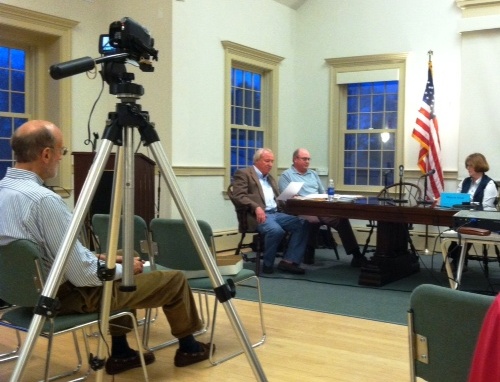
Bob Dunn reads his and Phil Neaton’s resignation letter to the Old Lyme Board of Selectmen at yesterday’s meeting.
Town Woods Operating Committee Chairs Claim Ban is Destroying Fields, Increasing Costs
Robert Dunn and Phil Neaton, respectively Chair and Vice Chair of the Town Woods Operating Committee, resigned publicly yesterday evening (Feb. 21) at the Old Lyme Board of Selectmen’s regular meeting after presenting evidence that the pesticide ban at Town Woods Park is resulting in destruction of the $2 million field investment made by the Towns of Old Lyme and Lyme at Town Woods Park. They also demonstrated their contention that the current pesticide ban is creating significantly higher costs for taxpayers.
Dunn and Neaton made a detailed presentation highlighting the problems at the fields, showing how, according to Dunn, the fields have become subject to “Extremely high usage,” which was not anticipated at the time of their construction. Dunn said the fields now require, “Intensive turf maintenance due to their nearly continuous use over three seasons.”
He compared three possible options for maintenance of the fields. The first was the one prepared by the field construction engineers, Vollmer Associates, which calls for low pesticide use, and “When the application has been done, Don Bugbee (Old Lyme Park and Recreation Director) notified everyone that the Park will be closed for a day.” Dunn stressed, “Everything is benign out there. There’s nothing to be feared out there,” adding, “There are no scientific studies that show any harm.”
This proposal has been followed since the fields were opened and has successfully controlled weeds and kept the fields in pristine condition. Dunn commented that he wanted, “To clear the record,” regarding this plan and remind everyone it had, “Been cost-effective.”
The second option was a “hybrid” proposal whereby the Town, “Experiments to see how the ban on pesticides would work on one field, rather than all the fields.”
The third option is the one being followed now under which only organic treatments are applied. Dunn pointed out that this latter is not only the most expensive choice, but also, “When the ticks and bugs move in … the fields will be a total loss.”
Neaton commented that the pesticide ban, “Takes the chemistry out of the program,” noting, “I just don’t see it working.” He also pointed out, “A lot of organic products are not reviewed by the EPA [Environmental Protection Agency] … they’re foul-based [made from chiecken faeces and skeletal material] and smell like what it is.” He added, “I don’t know what’s in there … there’s very little oversight in their manufacturing.” This situation is in stark contrast to that regarding pesticide application where only, “Licensed professionals,” can apply them under state law.
Neaton went on to present a financial analysis that showed the pesticide ban would require an additional “15 grand” in funding, which is not in the current Town budget. He also pointed out that the Vollmer proposal was, in his opinion, “Effective and economical.”
Dunn summarized what he believes will be the effects of continuing the pesticide ban policy, saying, the field quality will continue to deteriorate, “There will be a reduction of available practice and game time,” District 18’s usage will be, “Limited or eliminated,” rotation of the fields will be “called for” with one field, “Closed each season for repair,” and finally, “There will be a significant increase in costs for the taxpayers.”
Lyme First Selectman Ralph Eno noted a Bill was being discuss in the Connecticut House Wednesday, which was to reconsider the application of pesticides because the question of “Sustainability versus risk is causing arguments statewide.” Eno noted, “I personally support the Bill,” contending it seemed the Town Woods fields, “Could not be maintained adequately” under the current regime.
When the selectmen discussed the proposals, they were appreciative of the work done by Dunn and Neaton. Arthur “Skip” Sibley questioned whether it was correct that the pesticide ban is not required by the state for high school students, which was confirmed. Dunn also pointed out that as a park, Town Woods is not subject to the ban, but First Selectman Bonnie Reemsnyder noted the previous board of selectmen had adopted the ban because District 18 students are using the fields.
Neaton countered, “A lot of people are willing to take the risk [to play on fields treated with pesticides.]”
Dunn again proposed adoption of the hybrid plan and Reemsnyder noted, “It’s a very big issue for a lot of people … it ultimately falls on what the town has theappetite to do.”
Selectman Mary Jo Nosal agreed, “Keeping the fields playable is most important,” but added, “I’m concerned that neighboring states have mandated organic.”
Neaton responded, “A lot of legislation is based on emotion — not science,” stressing that the scientific aspects of pesticides are understood unlike those of organic products.
After Reemsnyder had clarified that the board of selectmen would keep looking at the issue, but was not going to change its decision regarding the pesticide ban, Dunn requested permission to, “Mention one more thing.” Reemsnyder agreed and Dunn pulled a letter from his pocket and read aloud, “Phil and I have been proud to serve as volunteers for the past 10 years as Chair and Vice Chair of the Town Woods Building Committee, and then as Chair and Vice Chair of the Town Woods Operating Committee.
However, we feel the recent actions by the Old Lyme Selectmen, including the decision to ban the use of herbicides and insecticides at Town Woods Park, prevent us from being able to fulfill our responsibilities to successfully maintain high quality athletic fields.
Therefore, we have decided to resign from the Town Woods Operating Committee, effective immediately.”
The discussion ended abruptly at that point. Nosal queried whether the men would be willing to stay on and help sort out the problem. Dunn responded that Reemsnyder had already said the decision had been made not to change anything, adding, “We don’t want to be associated with something that’s not working.”
In an earlier portion of the meeting, Old Lyme Conservation Commission Chairman Tom Sherer had submitted a letter to the selectmen on behalf of the Commission, requesting the appointment of a Conservation Manager to oversee the fields. Sherer also acknowledged in his letter that there would be “rancour” in the town about the condition of the fields.
The Conservation Commission believes a pesticide-free maintenance is required for the safety of the adults and children who play a variety of sports on the fields.
Outside the Meeting Room after the discussion inside had moved onto the next agenda item, coaches from a variety of sports gathered with Park and Recreation members to share their dismay at the outcome of the meeting. Park and Recreation Committee Chairman Glyn McAraw spoke for the group when she told LymeLine, “I find this very upsetting. Bob and Phil have worked unbelievably hard — all the facts show we’re not doing anything to harm anyone. To have fields worth at least two million dollars and have worked so long and so hard [to get them to such good condition], it’s very sad to have this happen to them.”
Tim Gavin, physical education teacher at Center School and also a Park and Recreation coach added, ” I’m upset they [the Town Woods Committee and the Conservation Commission] can’t come to a compromise.” He suggested perhaps just high school students and older should be able to use the facility, which would then permit the use of pesticides, adding emphatically, “It’s beyond me why they can’t compromise.”
Lauralyn Lewis of the Conservation Commission then joined the animated conversation maintaining organic treatments can be done “within cost.” When challenged, she said compromise was not possible because the Commission had to protect the aquifer on which Town Woods is situated and whic it shares with Rogers Lake.
McAraw argued, “It doesn’t make sense that we can’t compromise.” Gavin added, “There is no documentation that any damage [to the aquifer] is caused by Town Woods.”
Regarding cost, Lewis countered, “The initial costs of organics may be more expensive, but it’s less expensive five years out.”
Saying, “We’re not done,” Lewis commented, “I applaud the decision of the selectmen for having the courage and foresight to go forward with this.” An unimpressed Gavin responded tacitly, “The fields are now close to unplayable.”
 Have you ever wondered why it becomes increasingly challenging to maintain a healthy diet during the winter months? The combination of reduced physical activity, a tendency to eat more comfort foods and an increased urge to hibernate, wreaks havoc with your mood, leaving your body a “heavy” price to pay in springtime.
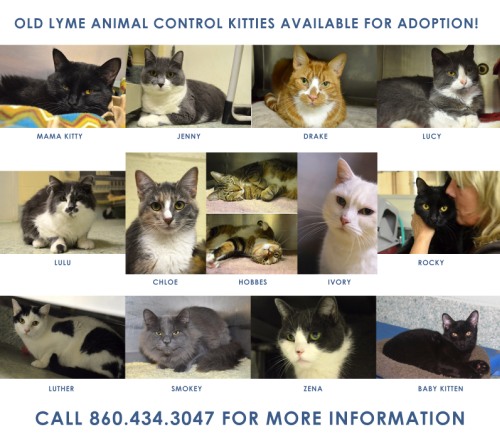 Old Lyme Animal Control has an excess of cats and kittens available for adoption at present. In order to assist the process, we are glad to publish a postcard featuring a number of the animals and also some individual photos of the cats in question.