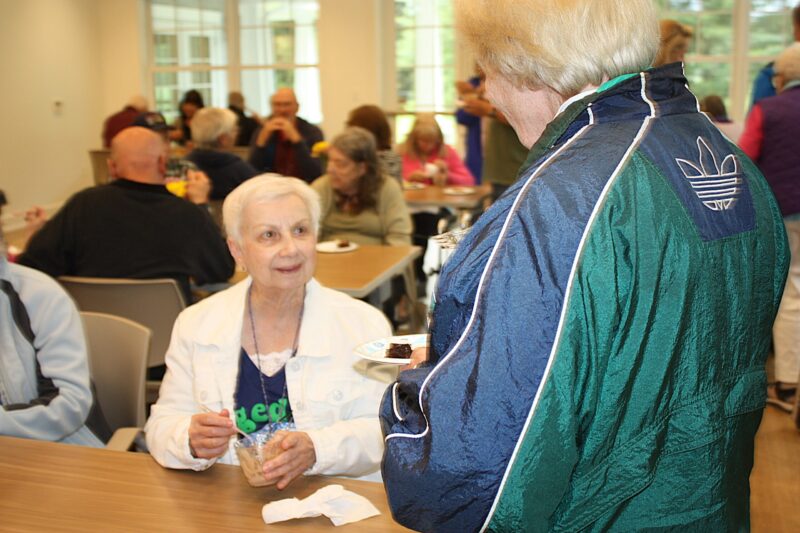
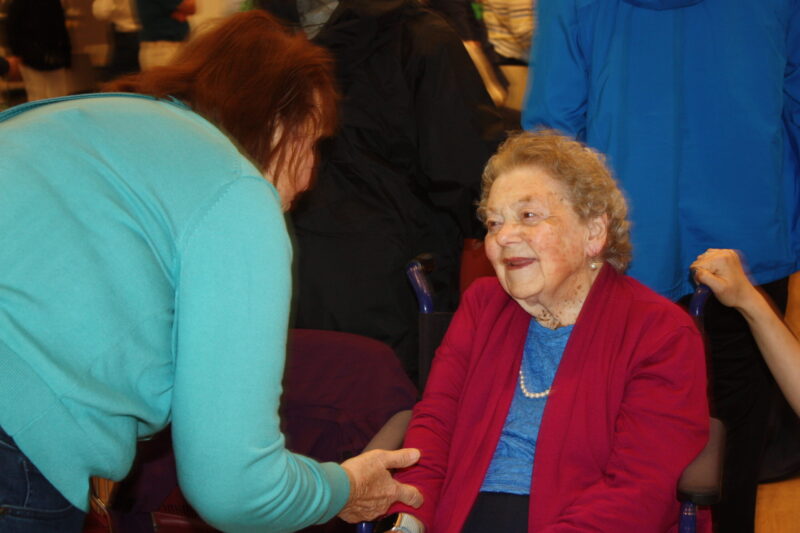
Marcia Higgins chats with a friend at the Lymes’ Senior Center during the Grand Re-Opening Ceremony Saturday afternoon.
LYME/OLD LYME–Lorraine Wilcox and Marcia Higgins are among those who refer to the Lymes’ Senior Center as a lifesaver.
Now, with 3,265 additional square feet and a layout that allows for multiple programs to be held at once, more older adults than ever can experience the resuscitative power of friendship.
While eating ice cream at the Center’s Grand Re-Opening Ceremony Saturday, Wilcox recalled becoming a member after the death of her husband almost eight years ago.
“It was a lifesaver,” she said. “I was depressed, and I could come be with other people, do things.”
“It’s a great way to make new friends,” she said.
Wilcox line dances. She takes exercise classes with up to 30 others in a space dedicated to the likes of weight training, Tai Chi and yoga. She sits quietly in the library room with a book. She gathers with others to await transportation to places like the JFK Museum in Boston, the mansions of Newport, RI, and the Christmas Spectacular at Radio City Music Hall where the Rockettes are the stars of the show.
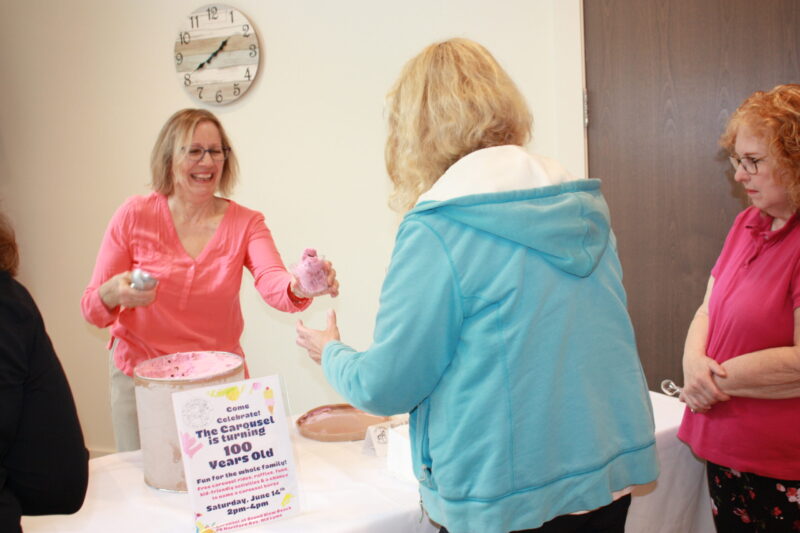
The Lymes’ Senior Center Grand Re-Opening Ceremony culminated with ice cream in the new dining room.
Higgins said she found herself in the same boat when she became a widow.
“It is a lifesaver,” she agreed.
The Center reopened earlier this month after being closed for a year and a half. The women credited Center Director Stephanie Gould and Assistant Director Caitlin Perkins with ensuring a full slate of activities from satellite locations across both towns during the closure.
“We were all over the place,” Wilcox said.
But Gould and Perkins kept the needs of all older adults front and center, according to Wilcox and Higgins.
“I think they love us,” Higgins said with sly certainty. “And we love them.”
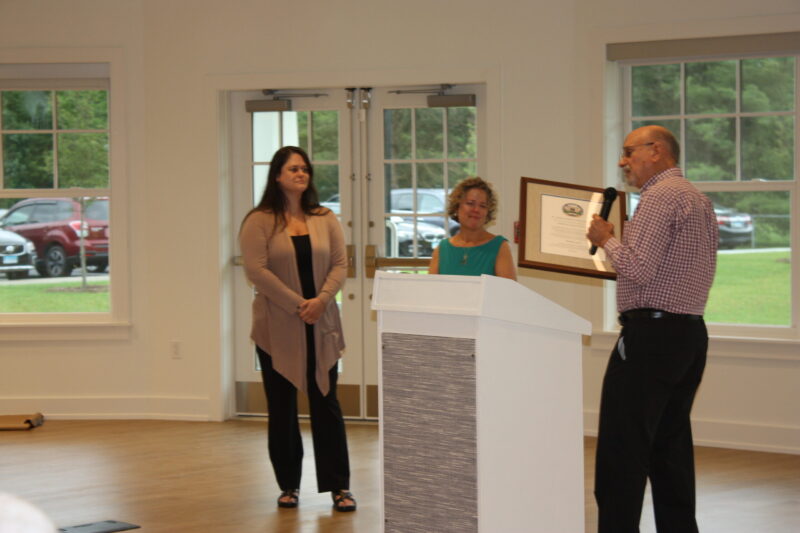
Lymes’ Senior Center Director Stephanie Gould and Assistant Director Caitlin Perkins receive a citation for their work from Board of Directors Chairman Peter Lucchese.
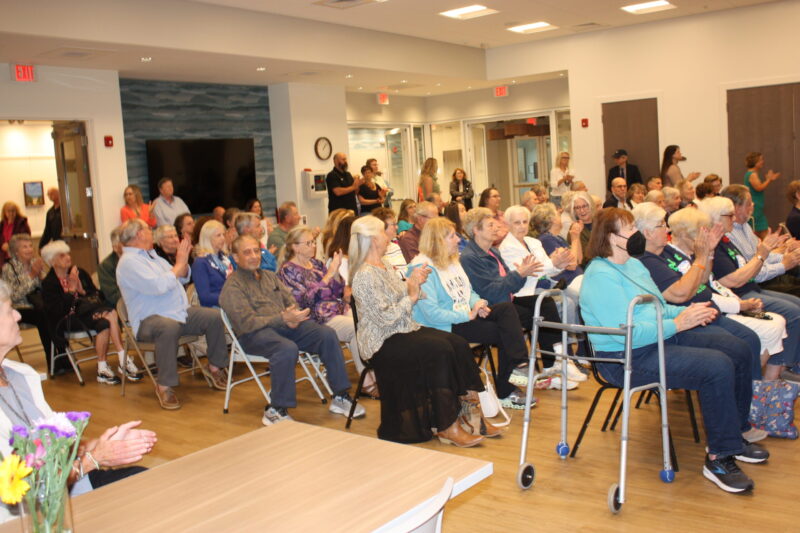
Jeri Baker, chairwoman of the Lymes’ Senior Center Building Committee, took the podium during the early afternoon ceremony in front of a full house.
“We were focused from day one on one thing: That the seniors in these two communities didn’t get just what they needed, they got what they deserved,” she said.
Through the years, Baker has repeatedly described the committee’s vision for an open, airy layout marked by retractable walls and expansive windows to let in the light. The vision was tested by cost overruns and a slow grant funding process, but remained a priority for taxpayers in both towns through multiple votes on what added up to a $6.4 million project.
One million dollars is covered by state funding through a program that supports small town, quality of life projects.
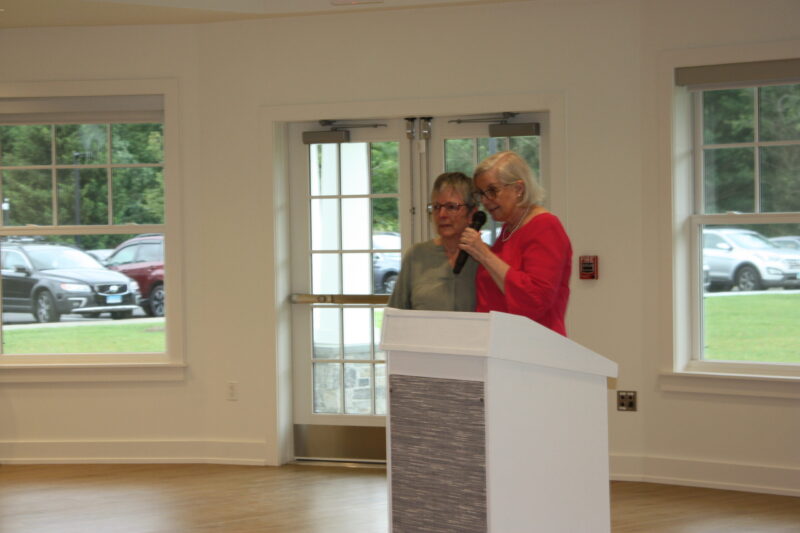
Old Lyme First Selectwoman Martha Shoemaker, right, brings Lymes’ Senior Center Building Committee Chairwoman Jeri Baker to the podium to recognize her for five years, seven months and 12 days of service on the project.
State Sen. Martha Marx, D-New London, told the members they deserve the new space where they can be with others.
“We all know loneliness is hard. It’s hard for a lot of seniors,” she said. “When you have such a beautiful place like this where you can all come together, it’s going to change lives.”
Baker, Old Lyme First Selectwoman Martha Shoemaker, Lyme Selectwoman Kristina White and Lymes’ Senior Center Board of Directors Chairman Peter Lucchese all stood up to thank the dozens of people who made the renovation happen.
Shoemaker said there were about 1,100 members before the renovation. They combined for roughly 550 visits per week.
“In short, the Center was being used more frequently by more people than at any point in the history,” she said. “And at the same time, it had not undergone any renovation to its original structure since it opened in 1996, except, I believe, for a screened-in porch.”
Ruth Young was an original Lymes’ Senior Center member, who raised money for the building in the 1990s.
The project was designed by Old Lyme-based Point One Architects and managed by Newfield Construction of Hartford.
Shoemaker acknowledged two garbage cans in the dining room to catch water from a leak in the ceiling related to the heating and cooling system.
“Anyone who’s built a house, done a home remodeling project, we all know that turning things on for the first time is a surprise,” she said.
The system is under warranty, according to Shoemaker.
Members and supporters of the Lymes’ Senior Center applaud during the re-opening ceremony.
When Gould, the Center’s Director, got up to give thanks, nobody ranked higher on her list than the seniors themselves.
“I want to thank our members, you guys, who I lovingly think of as ‘my seniors,’ for believing in this project and coming out in numbers to approve both referendums,” she said.
She credited their positive energy, understanding and support with keeping staff members in good spirits through the transition.
“This one’s for you,” she told the crowd.
The Day in Pictures
Lymes’ Senior Center Assistant Director Caitlin Perkins and member Mary Buttery stand in front of Buttery’s painting. Members’ art lines the walls of the newly renovated facility.
Lymes’ Senior Center Board of Directors Chairman Peter Lucchese gives a tour of the Lymes’ Senior Center.’s new kitchen.
Members sit at tables in the lobby of the newly renovated Lymes’ Senior Center, where they can start each day with free coffee and tea.
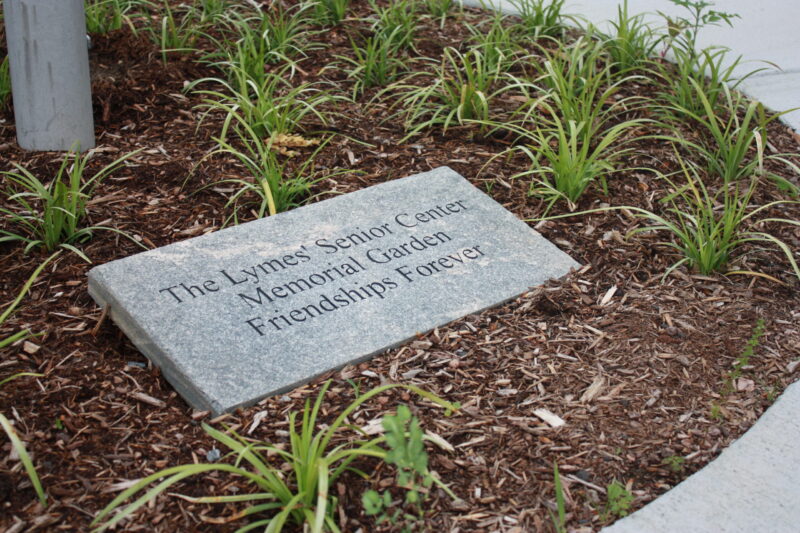
The memorial garden surrounds the flag pole in front of the Lymes’ Senior Center.
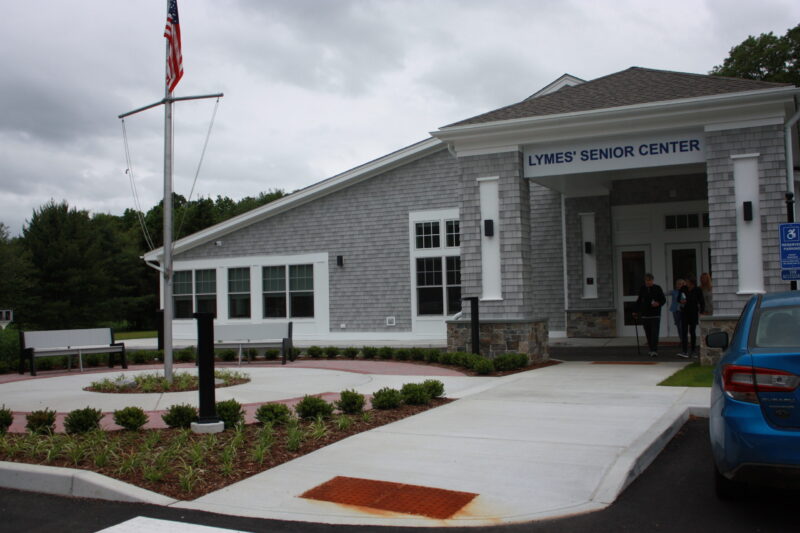
The newly renovated, $6.4 million Lymes’ Senior Center is open again after closing its doors a year and a half ago for the upgrade.
5/31 UPDATE: Details of the funeral service for Mrs. Lewis have now been announced. It will be held Saturday June 7, at 11 a.m. at St. Ann’s’ Church in Old Lyme. A luncheon will follow the service.
Joan Griswold Park Lewis, most recently of Merrimack County Nursing Home, Boscawen, New Hampshire passed away peacefully with family at her side on the first day of spring, March 20, 2025.
Mrs. Lewis was born in Erie, Pennsylvania on March 30, 1930, daughter of William B. Griswold and Jessie Griswold. Rosalie Griswold McCook was her dear step mother.
The family moved to Old Lyme, Connecticut in 1945. She graduated from St Margaret’s School in Waterbury, Connecticut in 1948. In 1952, she graduated from Bouve Boston School of Physical Therapy and Tufts University in Medford, Massachusetts as a registered Physical Therapist. She was married in 1953 to James B Park of Concord, New Hampshire. They moved to Sugar Land, Texas where Mr. Park was a banker and Mrs. Park was a physical therapist.
In 1975, she moved back to Old Lyme where she had her own physical therapy office and worked at Chesterfield Convalescent Home as a therapist for 18 years.
She moved to Concord, New Hampshire in 1996. Over the years, she enjoyed many hobbies including gardening, knitting, hiking, photography, crafts and traveling. Her greatest passions were her grandchildren and the Boston Red Sox!
Survivors include five children: James G Park and Lane P Litchford of Lynchburg, Virginia; David B. Park and daughter-in-law, Sidney of Albuquerque, New Mexico; Tracy P Barrett and son-in-law Chris of Loudon, New Hampshire; and William H. Park (Paula Hoch) of Denver, Colorado. A brother and sister-in-law David and Elaine Griswold of Old Lyme, Connecticut. Six grandchildren, Erin and Caitlin Barrett, Megan and Boyce Litchford (Jessie and Aiden), Brittany Litchford Guill (Austin Guill), and Cassandra Park; and one great grandchild, Berkley Guill. Two nephews, Jeffrey (Kim Forbes Griswold) and Eric Griswold (Maddy Farkas), and one niece, Laura Griswold Wentz (Joshua Wentz). Three great nephews, James, Daniel, and Matthew Wentz. She was pre-deceased by a brother, William B Griswold, Jr, and a half-brother, Lawrence Lee.
A private graveside service will be held later this spring at the Griswold Cemetery followed by a service at St Ann’s Episcopal Church in Old Lyme, Connecticut. In lieu of flowers, donations may be made to the McCurdy Salisbury Educational Foundation in Old Lyme.
Soprano Lisa Williamson moved attendees with her performance of the American spiritual “Steal Away” and gospel hymn “His Eye is on the Sparrow.” All photos by LymeLine.
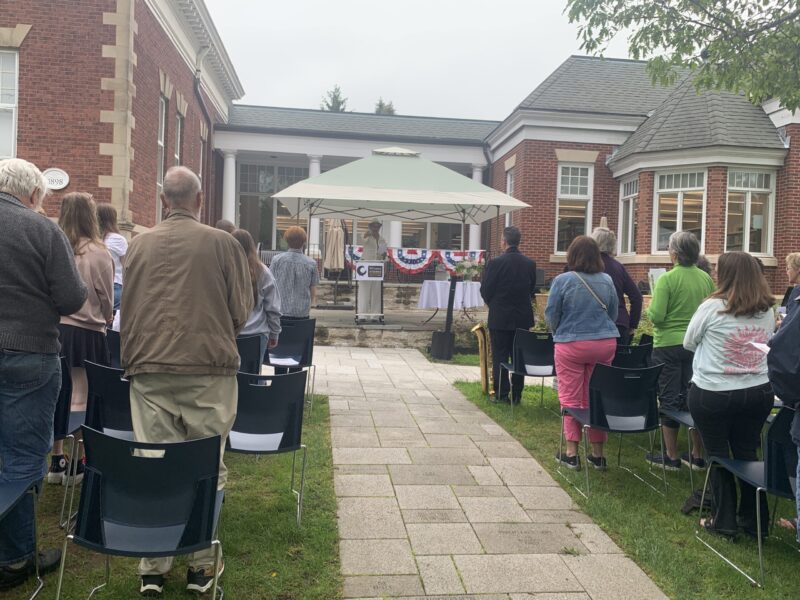
OLD LYME–Ten small brass plaques installed Friday morning on the Sill Lane Green are there to fill holes left by untold stories.
Cesar was about 15-years-old when he was purchased for 80 pounds by Reynold Marvin Jr. in 1730. Zacheus Still, born enslaved to Richard Lord Jr. in 1726, served in the French and Indian War and the American Revolution. A 26-year-old known to history only as ‘Negro Woman’ was recorded as being healthy and “capable at housework” when she was sold in 1802 by Enoch Lord Jr.
The information was culled from scant references in land records, emancipation certificates, and other primary sources, according to the Witness Stones Old Lyme organization that for five years has been working to unearth the town’s history of enslavement.
The group on Friday held its fifth installation ceremony on the grounds of the Old Lyme Phoebe Griffin Noyes Library. The Sill Lane Witness Stones join 50 others laid in Lyme and Old Lyme since the organization began in 2020 as an offshoot of the wider Connecticut-based Witness Stones initiative.
The local group marks sites of enslavement and engages students in telling the stories behind the stones.
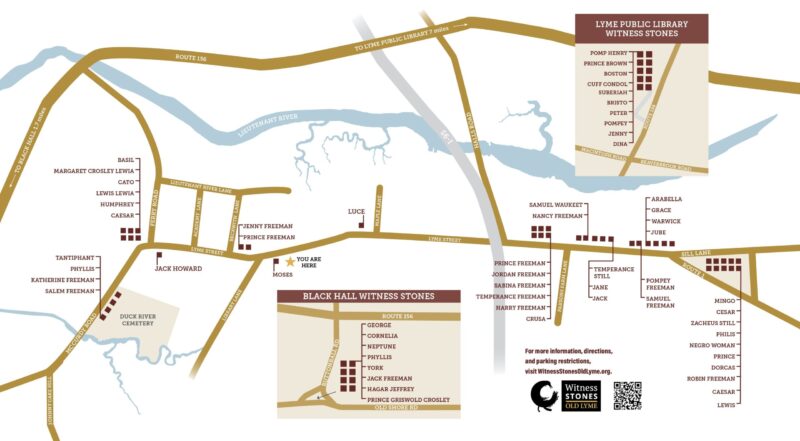
Witness Stones Old Lyme over the past five years has installed 60 plaques in locations shown here.
Witness Stones Old Lyme Chairwoman Carolyn Wakeman said the ceremony would be the last of its kind as the sun sets on the five-year-project.
“Together, we have restored missing history,” she said.
Wakeman described the map of Witness Stones as a wide circle extending from Lyme Street, past the Lower Town Green to McCurdy Road, south to the Black Hall section of town, north to Lyme and the East Lyme border, and back to Lyme Street’s northern end at the Sill Lane Green.
The 12 most recent installations were located on Sill Lane and at the Florence Griswold Museum.
“Even though we could easily place another 60 plaques to commemorate additional enslaved persons, the Witness Stones website will continue to provide new information about local enslavement, and middle school students will continue in the years ahead to engage with the Witness Stones curriculum and to focus on primary documents in the history of our town,” she said.
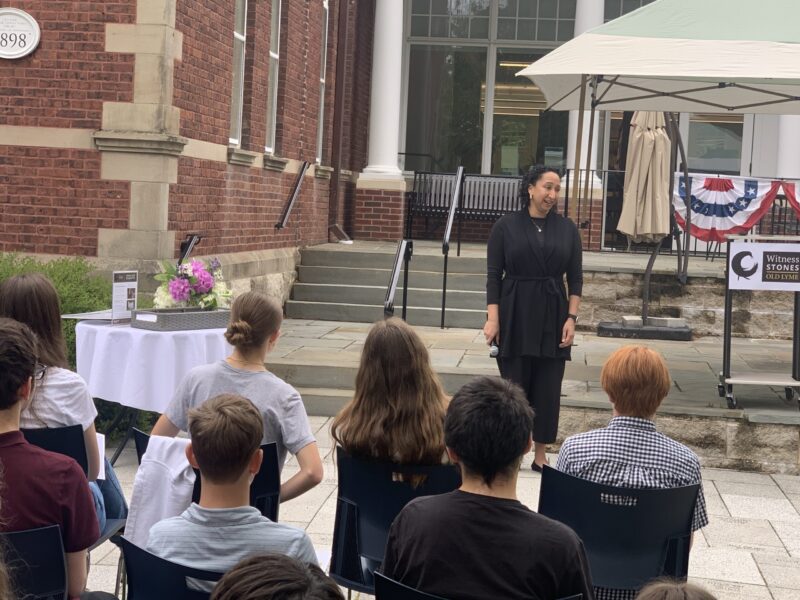
Poet Kate Rushin reads “Fishing for Shad” at the fifth and final Old Lyme Witness Stones installation ceremony.
Kate Rushin, a poet and Connecticut College professor, read her poem “Fishing for Shad” as one of four artists selected to remember in verse people enslaved on Lyme Street.
Rushin, along with Antoinette Brim-Bell, Marilyn Nelson and Rhonda Ward, are the Witness Stones Old Lyme poets. The group received a Health Improvement Collaborative of Southeastern Connecticut (HIC) Partnership Grant for Racial Equity.
Rushin wrote the poem from the perspective of Jack Howard. He was born enslaved to Samuel Mather Jr. in 1795 and willed to Mather’s son James in 1809.
She said she used Wakeman’s research, her own understanding of others, and her experiences to imagine how she might feel if she were the enslaved child.
“I don’t know where I belong/but I know I don’t belong here,” she wrote in the poem’s opening lines.
Led by Kate Rushin, the audience repeats the name of each enslaved person honored in the final installation ceremony.
Rushin is also the author of Meditations on Generations, written for Jane. Born enslaved to Joseph Peck Jr. in 1726, Jane was sold for 25 pounds at the age of 3. No more information about her has been discovered.
“I’ll remember you, Jane,” she wrote in the poem’s final lines. “You were here./I will honor you, respect you;/hold you in my words.”
The poet, who identified herself as the great-granddaughter of an enslaved woman and the free man who released her from bondage, grew up in the first incorporated African-American town in New Jersey.
“This project is very personal to me, as it is to the other Witness Stones poets,” she said.
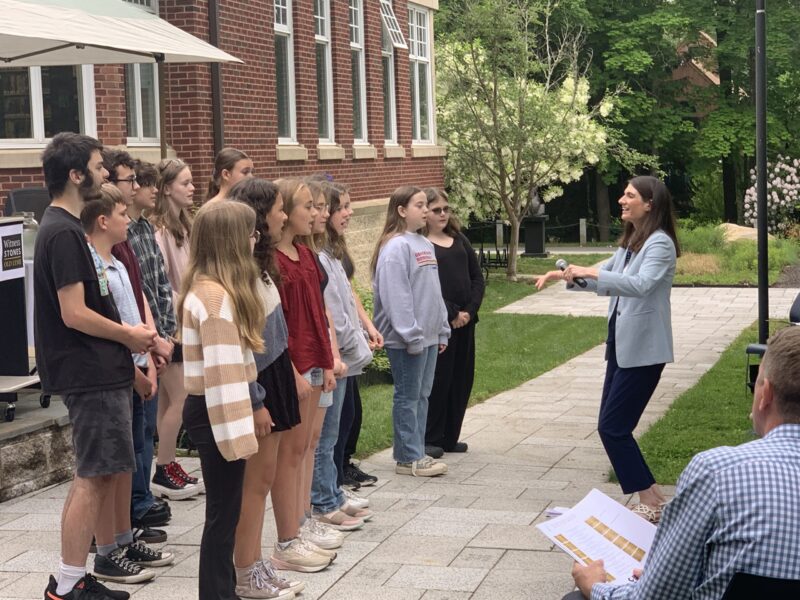
The Lyme-Old Lyme Middle School Chamber Choir, under the direction of Laura Ventres, sing a medley of American spiritual songs.
Eight Lyme-Old Lyme Middle School students followed Rushin with their own poems honoring those whose plaques were laid Friday.
Michelle Dean, curriculum director for the Lyme-Old Lyme Schools, described the five-year collaboration between Witness Stones Old Lyme and the schools as a shared commitment to telling the stories of “those whose voices for far too long have gone unheard.”
She said historical documents allowed students to confront complex truths and explore diverse perspectives that shaped the history of Lyme and Old Lyme.
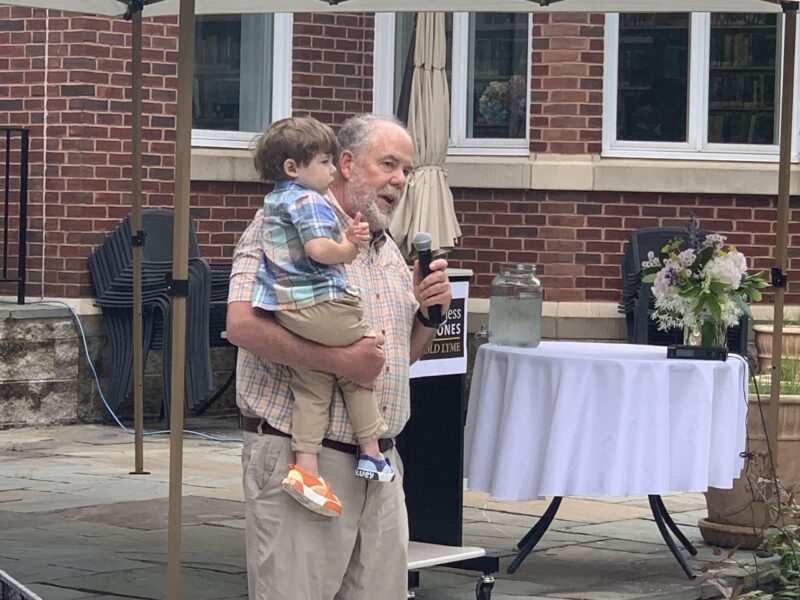
Witness Stones Project founder Dennis Culliton, with grandson Joey Tomanelli, lauded the Old Lyme group as a model for other cities and towns. He is retiring from the Witness Stones Project next month after eight years.
“If our past is indeed our greatest teacher, then let it teach us this: We each have the capacity to honor others with dignity and respect,” she said. “Let us honor the past and our future by choosing humanity every day.”
Editor’s Note: This article was updated with the most recent Witness Stones Old Lyme map and to correct Wakeman’s name in one reference.
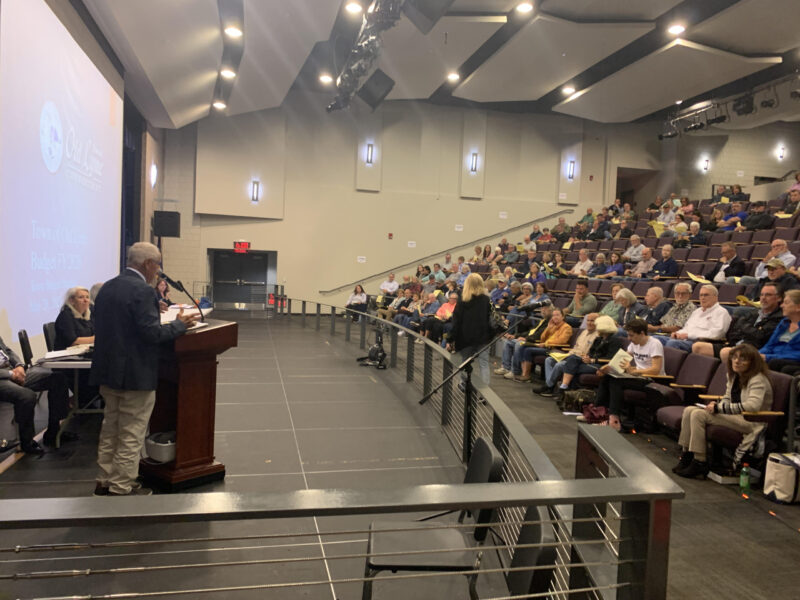
Old Lyme-based Attorney Fran Sablone served as moderator at Wednesday’s Town Budget Meeting.
OLD LYME–Two young men sitting with their parents in the auditorium of the Lyme-Old Lyme High School Wednesday night were recognized at the end of the 2.5-hour Town Budget Meeting for making it through a crash course in the New England town meeting form of government
First Selectwoman Martha Shoemaker acknowledged the boys after a record-setting crowd of more than 200 residents and taxpayers approved the $45.39 million 2025-56 budget and five new or amended ordinances.
No meeting in the last seven years had drawn more than 60 people, according to Shoemaker.
“You have received the best education in what a town meeting can be like,” she told Joseph Jewett, 11, and Joshua Jewett, 9.
The budget passed 167 votes to 40 in a year when a property revaluation left a majority of homeowners in town facing a tax hike in excess of 4.7%. Those whose property values rose more than average are looking at relatively higher tax increases.
The town meeting is a form of direct democracy that allows all eligible voters 18 years old and up to discuss and decide important matters rather than letting elected officials do it for them.
While October 2024 data from the state Office of Policy and Management shows that 103 towns in the state have a town meeting form of government, many of them leave the ultimate budget decision up to a machine vote at a day-long referendum as a way to encourage more participation.
Shoemaker applauded the Jewett family for showing the boys that their “voices matter.”
“Even though (the votes) may not go the way you want, your voices are heard,” Shoemaker said.
Fire Marshal Dave Roberge said he counted 222 people in the auditorium Wednesday night. With 207 people voting on the budget, that leaves about 15 people like the Jewett children who were there to watch and learn.
Procedural questions about how to vote dominated the early part of the meeting, with an early motion to use a paper ballot on all seven questions failing by a vote of 87 to 110.
Voters decided to use a hand vote for the budget, which proved the most contentious issue on the call to meeting. They raised fluorescent green chits in the air to signify their voting status as Democratic Deputy Registrar of Voters Katherine Thuma and Republican Deputy Registrar of Voters John Mesham counted the chits row by row.
When the results of the vote to approve the budget were counted, Town Meeting Moderator Fran Sablone put it this way: “The motion carries.”
Voting down the budget would have required the town to bill taxpayers based on the current budget until a new spending plan was approved, according to town officials. That means the town would be locked into paying its share of the Region 18 education budget, which voters passed in a referendum earlier this month, even though the expense wouldn’t be reflected in tax bills.
Board of Finance Chairman Bennett J. Bernblum, who during the meeting used the word “stupid” to describe such a scenario, was asked to clarify what he meant.
“It would be stupid because it would put us into disarray,” he said.
The meeting, originally scheduled for May 19, was postponed due to overcapacity at the Town Hall. Fire code there allows only 124 people in the meeting room and lobby.
Tax Impact
The finance board immediately after the Town Meeting convened to set the tax rate for the coming year at 16.23 mills.
The current tax rate is 24.4 mills. After taking the property revaluation into account – and if spending did not increase at all in the coming budget – the tax rate would have been 15.5 mills.
A mill represents $1 in tax per $1,000 of assessed property value.
Bernblum in his presentation said a house appraised at $400,000 with a valuation mirroring the average 57.4% increase to the grand list is now worth $629,600. The tax bill for that homeowner based on the 2025-26 budget will be $7,153 – an increase of $321, or 4.7%, over the current tax bill.
Assessor Melinda Kronfeld has said 3,312 properties in town will see their tax bills go up more than 4.7%, while 2,331 properties will be looking at an increase less than that, or even a tax decrease.
The finance board last month voted to use $800,000 from the town’s predicted $14.2 million ‘Rainy Day Fund’ to help mitigate the impact to taxpayers. The vote was a compromise between Republicans, who wanted to use less, and Democrats, who wanted to use more.
Bernblum said the town’s healthy savings helped secure a AAA bond rating from S&P Global Ratings, which translates to the most favorable interest rates when the town goes out to bond. He said he was advised that the finance board’s decision to dip into the Rainy Day Fund should not adversely affect the town’s rating.
Bernblum said the $800,000 allocation, combined with $171, 350 in cuts identified by Shoemaker and town hall department heads at the request of the finance board, reduced the original budget proposal’s impact on taxpayers by almost a million dollars.
New and Amended Ordinances
The remaining issues on the meeting call were determined by voice votes. The most controversial was an ordinance codifying golf cart use in the Sound View and Hawk’s Nest beach areas.
The golf carts must be outfitted with numerous safety features to qualify as the kind of “low speed vehicle” authorized last year by the state to operate on any public roads with speed limits of 25 mph or less.
Previously, state statutes left it up to cities and towns to decide if they wanted to allow golf carts on local roads. Now, it’s up to those municipalities to specify if they don’t want them – or to limit where they can travel.
Shoemaker said the ordinance adds several streets in Hawk’s Nest Beach to a program established by the Sound View Commission a few years ago in cooperation with the previous administration of the Board of Selectmen.
Golf carts registered with the town will be allowed to travel on town-owned roads in the beach areas from sunrise to sunset.
There will be an initial fine of $90 for those caught driving an unregistered golf cart, driving outside the allowed areas and hours, or missing necessary equipment. The second offense comes with a $180 fine, while the third offense will result in the golf cart being impounded.
Golf carts must be registered annually and can only be operated with a valid driver’s license.
Sound View Commission Chairman Frank Pappalardo said the program has “worked out very, very well safety-wise” without being a hardship on residents. He cited 25 golf carts registered currently, with more joining each year.
Shoemaker described the ordinance as a way to keep communities safe in a town with only six full-time police officers to patrol the streets. She said voting the proposal down would result in the Board of Selectmen, which serves as the local traffic authority, outlawing golf carts completely.
“A ‘no’ vote will mean that we will prohibit golf carts in the Soundview and Hawks Nest area,” she said. “Because we cannot have people riding around in golf carts without some rules.”
Resident Steven Ross objected to the take-it-or-leave-it approach on what he described as an overly restrictive ordinance.
“That’s a threat. It’s heavy-handed. It’s inappropriate,” he said. “I think this ordinance should be reviewed and redrafted and brought to another town meeting.”
Shoemaker said the town can consider expanding the ordinance to include the Rogers Lake area in the future if enforcement goes smoothly this summer.
Joseph Jewett after the meeting said he ended up at the meeting with his brother because their parents, Dave and Daphanie Jewett, didn’t give them a choice.
While 9-year-old Josh Jewett said he really didn’t think they learned anything, Dave Jewett said the kids got a lesson about the importance of voting and having a say in where tax dollars go – even if they didn’t realize it.
Dave Jewett said he voted in support of the budget.
“I’ve been in the town my whole life,” he said. “Now I’ve got my kids growing up in this town.”
Editor’s Notes: i) Bennett Bernblum is a financial supporter of LymeLine.com, but has no input to the editorial process, which remains completely independent.
Christina and I attended a program at Phoebe Griffin Noyes Library on Tuesday, April 29: “Oral History: Kent State, 1970,” presented by Mike Alewitz, who as a student anti-Vietnam War organizer at Kent State University and a founder and chairman of the University’s Student Mobilization Committee Against the War, witnessed the bloodshed that occurred there on May 4, 1970 — 55 years ago.
Mike is now a New London resident and Professor Emeritus of mural painting and street art at Central Connecticut State University. He was subpoenaed to testify before the Presidential Commission on Campus Unrest. (below)
Mike’s presentation was very moving and triggered fraught memories for Christina and me; and I am certain, for other members of the predominantly “Baby Boomer” audience of about 30 or so.
His remarks motivated me to take a fresh look at that other dark period in American history and expand on his observations. I examine the events and actions that may have precipitated what has often been regarded as the “Kent State massacre” in this “View;” and then consider the factors and incidents that led to America’s entry and increased involvement in Vietnam; and the War’s dire outcomes in a subsequent essay.
And so, these are my “lest we Americans forget ‘Views’.”
Predisposing Events:
The 1967 March on the Pentagon:
The National Mobilization Committee to End the War, a coalition of anti-war groups organized what was, at that point, the largest antiwar rally ever staged for Saturday, October 21,1967 in Washington, D.C. The event began with more than 100,000 protesters gathered at a rally on the National Mall near the Lincoln Memorial.
The March was notable for its diverse coalition of participants. This was an ecumenical crowd: white and middle-class, middle-aged, young students, some clergy, and a group of political and social activists; — including Norman Mailer, Benjamin Spock, folk singer Phil Ochs; and counter-cultural figures Jerry Rubin, and Abbie Hoffman, co-founders of the Youth International Party; — i.e., the Yippies; who have been described as a theatrical, anti-authoritarian, and anarchist youth movement of “symbolic politics”.
Near 6 p.m. about 50,000 streamed across the Arlington Memorial Bridge toward the Pentagon.
There, most remained non-violent; but a smaller segment stormed ahead and scaled or toppled the fences surrounding the Pentagon; forcing their way onto the grounds past military policemen who were standing at 10-foot intervals. Six hundred and eighty-two demonstrators were arrested.
Garden Plot: The Department of Defense Civil Disturbance Plan (aka GARDEN PLOT) was a wide-ranging U.S. Army and National Guard plan to respond to major domestic civil disturbances within the United States. The plan was developed in the mid-1960s in response to a series of domestic civil disorders and provides Federal military and law enforcement assistance to local governments.
RMN and the Cambodian Incursion:
Richard M. Nixon defeated Hubert Humphrey in 1968; campaigning on a platform of achieving “peace with honor” in Vietnam; and positioning himself as the “law and order” candidate, who would restore domestic peace and stability amid the protests, riots, and rising crime rates of the 1960s.
By 1968, there were already over 500,000 American troops on the ground in Vietnam, and more than 31,000 Americans killed. This was the first televised war and television coverage was a major factor in American society ‘s perception of the war.
He entered office against a backdrop of a well-organized anti-war movement, which he had denounced and demeaned during his campaign.
In July, 1969 he promised to withdraw 150,000 troops; but despite that pledge, announced on a televised address on April 30, 1970 that American forces had invaded Cambodia after months of intense bombing to disrupt North Vietnamese supply lines
His secret expansion of the War drew immediate worldwide condemnation and intensified protests by antiwar activists at Kent State and many other college campuses across the United States; with marches, rallies, and clashes with law enforcement.
The Kent State Shootings- Chronology of Events:
On Friday, May1; — the day after Nixon’s announcement, an anti-war rally with about 500 students began late morning on the Commons, a traditional free speech area in the center of the campus. The rally started peacefully but expanded into the town and escalated into vandalism of storefronts and violence between protesters and the local police force, who eventually succeeded in using tear gas to disperse the crowd from the downtown area; compelling them to move several blocks back to the campus. Additional demonstrations were expected through the weekend.
By Saturday morning, Kent city officials and downtown businesses had received threats and abundant rumors of radical revolutionaries with caches of arms, plots to spike the local water supply with LSD, and of students building tunnels to blow up the town’s main store.
Kent Mayor, LeRoy Satrom feared that local law enforcement would not be able to handle the anticipated disturbances; and declared a state of emergency. He requested assistance from Ohio Governor Jim Rhodes, who decided to call in the National Guard to occupy the Kent State campus and restore order. The Guard did not arrive until 10 p.m., and by that time, a large demonstration was underway and the boarded-up ROTC building was set afire.
There were reports that some Kent firemen and police officers were struck by rocks and other objects while attempting to extinguish the blaze. Several fire engine companies were called in because protesters had cut the fire hose. The arsonists were never apprehended.
By Sunday morning, 1000 National Guardsmen were on campus. Governor Rhodes had flown in for a press conference at which he said, “We’re up against the strongest, best-trained, militant, revolutionary group that has ever assembled in America; — set on destroying higher education in Ohio.”
During the day, a small group of students came downtown to help with clean-up efforts. Mayor Satrom, under pressure from residents and business owners, ordered a curfew.
Another rally began on the Commons near 8 p.m., and confrontations amongst the Guardsmen and demonstrators escalated. By 8:45 p.m., the Guardsmen had dispersed the crowd with tear gas; but the students reassembled for a sit-in at the busy Kent intersection of Lincoln and Main.
At 11 p.m., the Guard announced that a curfew had gone into effect and began forcing the students back to their dorms. There were arrests, mostly for curfew violations; at least one student was slightly wounded with a bayonet.
School administrators, with the Governor’s backing, prohibited the rally scheduled for Monday, May 4th.
Early Monday, University officials distributed 12,000 leaflets declaring that the rally event had been canceled.
Defying the ban, about 2,000 students gathered again on the Commons, with another 1,000 behind them on “Blanket Hill”. A small contingent began ringing the campus’s iron Victory Bell just before noon, marking the start of the rally. A campus security officer, accompanied by three Guardsmen, approached the crowd in a National Guard Jeep, and ordered them to disperse. They were met with stones, curses, and the pealing bell.
At about the same time, more than 100 Guardsmen in gas masks assembled at the base of Blanket Hill. The Guard attempted to disperse the crowd via bullhorn. The protesters again ignored the order, and the Guardsmen began firing tear gas. They were then ordered to march forward up Blanket Hill; — with M-1 rifles “locked and loaded” and bayonets raised; compelling the protesters to move up the slope.
The Guard crested the hill and started downward. The crowd scattered, many of them towards a nearby parking lot. The Guard following the moving crowd into the nearby practice football field and lobbed tear gas canisters at the demonstrators, who yelled and threw rocks and other debris at them.
After several minutes, the Guardsmen begin to move back up Blanket Hill, having achieved their objective of clearing the Hill.
At 12:24 p.m., after again reaching the crest, the Guardsmen turned, aimed, and fired into the crowd of unarmed students. Twenty-eight Guardsmen fired 67 rounds over 13 seconds, killing four students and wounding nine others, one of whom suffered permanent paralysis.
Some claimed hearing an order to fire; but in repeated testimony, there was no evidence of an order.
Some said they fired because they were in fear of their lives. However, the students who had been shot by the Guard were from 70 to 495 feet away and were shot in their backs or sides.
Note: there is an iconic Pulitzer Prize winning photograph taken by Kent State photojournalism student John Filo showing teenager, Mary Ann Vecchio, kneeling over the bleeding body of Kent State student, Jeffrey Miller.
The Aftermath:
Kent State Administration immediately shut down the campus, and it remained closed for the remainder of the spring semester.
The shootings triggered immediate and massive outrage on campuses around the country and increased participation in the student strike that began on May 1. Ultimately, more than 4 million students participated in organized walk-outs at nearly a thousand universities, colleges, and high schools.
All in all, the anti-Vietnam War protests had drastically intensified due to the U.S. invasion of Cambodia, coupled with the Kent State University shootings.
Nixon backed down on threats to escalate the War, but concerned that backing down might make him appear weak to the Soviets, called a secret worldwide nuclear alert as a show of force.
On June 13, 1970, President Nixon established the “President’s Commission on Campus unrest,” which became known as the Scranton Commission after its chairman, former Pennsylvania governor William Scranton. It concluded that “the shootings at Kent State were unjustified;” and said: “Even if the guardsmen faced danger, it was not a danger that called for lethal force. The 67 shots by 28 guardsmen certainly cannot be justified. Apparently, no order to fire was given, and there was inadequate fire control discipline on Blanket Hill. The Kent State tragedy must mark the last time that, as a matter of course, loaded rifles are issued to guardsmen confronting studentdemonstrators.”
The massive demonstrations against the War and the bloodshed at Kent State turned the Nixon White House into a fortress. Two rings of city buses parked bumper to bumper encircled the mansion, and the 82nd Airborne was stationed in the adjacent Executive Office Building.
“If The Government Won’t Stop the War, We’ll Stop the Government.”—The 1971 May Day Protests: Woodstock hit the streets in 1971 for a series of wide-ranging civil disobedience actions in Washington, D.C.; and Nixon responded with force. The protests began on Monday morning, May 3rd and ended on May 5th.
12,000 anti-war demonstrators came to Washington D.C. — the culmination of several weeks of activity in the City. They were met by 5,100 city police and 1,400 National Guard soldiers, with 10,000 more Army and Marine troops held in reserve.
The goal of the protests was to disrupt the functioning of the federal government through nonviolent action; with an immediate focus on snarling traffic to prevent government employees from getting to work on Monday morning. Small groups would block major intersections and bridges; and protesters roamed downtown D.C., dodging huge tear-gas barrages. They created small barricades and left disabled cars in roadways, or temporarily blocked intersections with mobile sit-ins.”
By Monday night, more than 7,000 protesters had been arrested across the city; 5000 more were arrested on May 2, 4 and 5. Protesters filled jails beyond capacity; and were detained in makeshift open-air prisons and sporting arenas—The Washington Coliseum—the practice field for RFK Stadium.
These represent the largest mass arrests in U.S. history.
Ultimately, however, only 79 people were convicted of any offence related to the protests.
Members of the Nixon administration would come to view the events as damaging because the government’s response was perceived as violating citizens’ civil rights.
Author’s Comments: The title is derived from the lyrics of the protest song, “Ohio,” which was written by Neil Young and recorded by folk rock supergroup Crosby, Stills, Nash, and Young in the immediate aftermath of the Kent State shootings. It became identified as one of the anthems of the anti-Vietnam War movement. In 2010, ‘The Guardian’ described the song as the “greatest protest record and the pinnacle of a very 1960s genre.” The lyrics evoke the turbulent mood of horror, outrage, and shock in the wake of the shootings “Tin soldiers and Nixon coming; this summer, I hear the drumming, four dead in Ohio. Gotta get down to it; soldiers are cutting us down…” (Abridged)
Editor’s Note: This is the opinion of Thomas D. Gotowka.
About the Author: Tom Gotowka is a resident of Old Lyme, whose entire adult career has been in healthcare. He will sit on the Navy side at the Army/Navy football game. He always sit on the crimson side at any Harvard/Yale contest. He enjoys reading historic speeches and considers himself a scholar of the period from FDR through JFK. A child of AM Radio, he probably knows the lyrics of every rock and roll or folk song published since 1960. He hopes these experiences give readers a sense of what he believes “qualify” him to write this column.
Sources: “Tin Soldiers and Nixon Coming”—Part 1: Amadeo, K. “Vietnam War Facts, Costs, and Timeline. The Balance.” 09/20/2024. Buhle, P. & Alewitz, M. (2002). ”Insurgent Images.” Monthly Review Press. Glass, A. “Nixon signals U.S. troop withdrawals from Vietnam, July 25, 1969.” Politico. 07/25/2012. Johnston, L. “May 4, 1970: A graphic timeline of the Kent State University shooting.” Cleveland. 05/02/2020. Kimball, J. & Burr, W. “The Movement and the Madman.” PBS.; — American Experience. 03/28/2023. McFadden, R. “Students Step Up Protests on War.” NYT. 05/09/1970. National Archives. “Vietnam War U.S. Military Fatal Casualty Statistics.” The Defense Casualty Analysis System.04/29/2008. Jones, N. Document Friday: “‘Garden Plot:’ The Army’s Emergency Plan to Restore Law and Order” to America.” National Security Archive. 08/12/2011. Klein, C. “How Nixon’s Presidency Became Increasingly Erratic After Kent State.” History Vault; — This Day in History. 05/04/2020. Levy, D. “Behind the Anti-War Protests That Swept America in 1968.” Time. 01/19/2018 Lynskey, D. (2010-05-06). “Neil Young’s Ohio – the greatest protest record.” The Guardian. 05/06/2010. Mailer, N. (1968). “The Armies of the Night.” New American Library. Pruitt, S. “Kent State Shootings: A Timeline of the Tragedy.” History.05/01/2020. Rotondi, J. “How Nixon’s Invasion of Cambodia Triggered a Check on Presidential Power.” History This Week. 04/ 27, 2020 Rudin, J. “40 Years After Kent State: Remembering Ohio Gov. James Rhodes.” NPR. 05/03/2010. Scranton, W. (1970). “The Report of the President’s Commission on Campus Unrest.” U.S. Government Printing Office. 1970. Smith, D. “How this 1967 Vietnam war protest carried the seeds of American division.” The Guardian. 10/21/2017. Thomas, C. “Bombing missions of the Vietnam War.” Environmental Systems Research Institute.09/ 25/2017. Young, N. (1970) “Ohio.” [Lyrics] On “Highway 61 Revisited” [Single 45 rpm record]. NYC: Atlantic Records.