TOP STORY: Old Lyme Board of Selectmen Need Answers Before Sending Sewer Project to Referendum

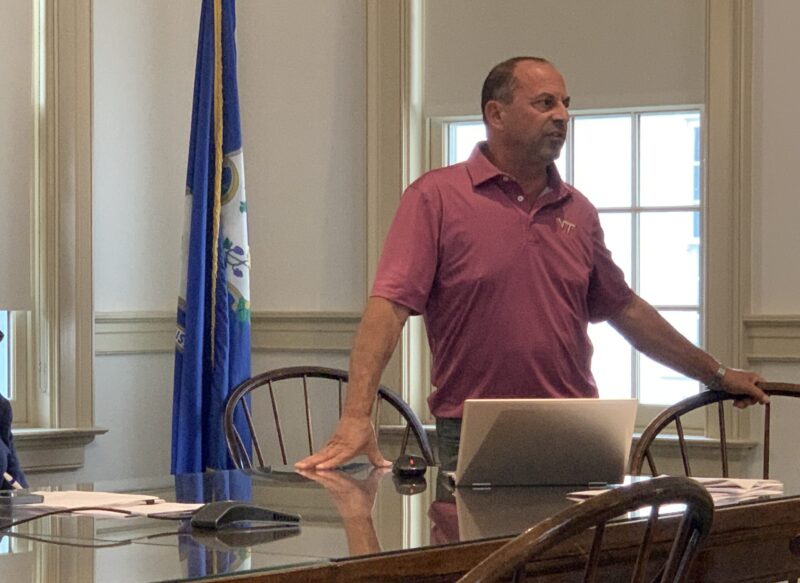
Old Lyme Water Pollution Control Authority Chairman Steve Cinami addresses concerns about a plan to bring sewers to several Old Lyme beach communities at Monday’s Board of Selectmen meeting.

OLD LYME–The Old Lyme Board of Selectmen on Monday decided they need more time – and more transparency – before a years-long push to install sewers in the Sound View Beach area comes back up for a townwide vote. 

The three-member board – composed of First Selectwoman Martha Shoemaker and Jim Lampos, both Democrats, and Republican Jude Read – declined to send to the Board of Finance a resolution that could trigger a referendum on whether to add $7.6 million to the $9.5 million approved by voters in 2019.

The costs are part of a broader plan that would require residents of three private beach associations and the public Sound View community to install sewers at a total cost of $70 million, according to estimates from the Fuss & O’Neill engineering firm released Monday.

About half of the new $17.1 million price tag for Sound View will be covered by federal grants and a forgivable loan from the state Department of Energy and Environmental Protection (DEEP). 

Shoemaker at the meeting said selectmen will not move forward until “further information is made available” by the Old Lyme Water Pollution Control Authority (WPCA), which has been working with the other beach communities to address concerns from the state that their septic systems are threatening the health of the Long Island Sound. 

Sound View residents have long asked for more specific information about how much they will have to shell out as the municipal bond is repaid over 20 years. They’ve also questioned the data underlying the state’s contention that sewers are necessary to resolve the potential for pollution in the area.

The WPCA is set to host a public information session at 6:30 p.m. on Monday, Aug. 18, to answer questions including those raised Monday by selectmen and residents. Shoemaker said selectmen and finance board members would have to agree to send the question to a public vote by Aug. 28, in order to stay on track for the tentative Sept. 9 referendum. 

WPCA Chairman Steve Cinami said about $4.05 million has been spent on the total project so far. That includes $1.1 million in shared planning costs for a pump station and force main to be located in the Sound View area, as well as $406,412 in estimated out-of-pocket expenses. The Old Lyme WPCA itself spent $615,200. 

Part of the WPCA’s urgency to hold the referendum stems from contractor quotes for the Sound View project that will expire in October, which could lead to more price increases if officials have to go back out to bid. The project has already been through multiple rounds of bids. 

The bid process for two of the three private beach associations is ongoing. 

The sewer plan stalled following the first referendum due to economic fallout from the pandemic, which had the effect of galvanizing grassroots opposition to the already expensive project.

Taxpayers approved the Sound View plan at referendum six years ago based on the assurance that only residents of the affected beach community would foot the bill. 

Sound View property owner Kathleen Tracy during a public comment portion of the meeting called for leaders to “slow down,” even as she acknowledged the project has been going on for years. 

“It’s very complex, but even in its complexity, it should be transparent,” she said. 

Mary Daley and Dennis Melluzzo, both Sound View residents appointed to the Old Lyme Water Pollution Control Authority by the current selectmen, said the authority’s membership has a history of putting a “rubber stamp” on decisions made by project leadership without public inspection or input. 

“I did not volunteer to be on the WPC board to rubber stamp documents that will change the history of this town,” Daley told selectmen. “This has to change. We need strong leadership that listens and works with the team, not in solitude.”

Sound View resident Frank Teti argued it’s unfair for residents across town to decide whether Sound View residents should be forced to pay for sewers.

“I feel that since the whole town had to vote on this referendum, it should come out of our taxpayer money.” 

Others argued officials have not done enough to explore alternative septic system options. 

Old Lyme WPCA member Andrea Lombard, speaking virtually, reiterated the “very complex” nature of the longstanding project. 

She said the authority started out with the goal to avoid sewers, but state directives narrowed the options. “For many years we explored alternative systems, and they were not accepted by DEEP,” she said.  

She acknowledged the unique position in which the Sound View residents find themselves. “There’s a lot of anger and tension, and that’s being received. We’re trying very hard to work through what we can, but we can’t always give you what you’re requesting,” she said. 

The authority’s goal, according to Lombard, is to be “100% transparent.” 

By the Numbers

The latest estimates from the authority put the project cost at around $1,939 per year over 20 years for a typical user. That’s someone whose house has one bathroom, a kitchen, and four bedrooms or less, which Cinami said applies to about 70% of Sound View households.

He said additional fees to operate and maintain the system are likely to come out to $500 to $600 per year, per household.

Expenses include the town’s portion of capital costs for infrastructure in East Lyme and New London through which Old Lyme’s wastewater will run. Also included is electricity, maintenance, and corrosion and odor control at the planned pump station in Sound View.

DEEP Project Engineer Carlos Esguerra last year said the agency sets the amount that residents can reasonably be expected to spend at 2% of the town’s median income, which he identified at the time as $122,000. That equated to $2,440 a year.

Cinami said the state does not consider annual operations and maintenance fees as part of its affordability calculation when it comes to installing a municipal system. 

Esguerra could not be reached Tuesday for more information on how the agency determines if a project is affordable for residents. 

Cinami also told selectmen the issue will not go away if they don’t act. The current plan for a shared sewer system is the result of formal consent orders from the DEEP requiring the private beach communities to fix the pollution issue, with the town participating voluntarily under the threat of a similar mandate. 

Cinami said voting down the plan at a referendum could result in fines and increased oversight from the state that would force the issue. 

“We will probably lose the 25% forgivable loan. Any delay will probably increase the cost over time. And there’s continued environmental and property risk,” he said. 

Unpopular Decisions in an Election Year

Lampos said he’d be concerned about moving this project forward without knowing the status of the bids for Miami Beach and Old Lyme Shores that will affect whether they can afford to continue with the project. Bids are expected to be opened at Miami Beach later this month, while Cinami said Old Lyme Shores has been ordered by the DEEP to award a contract by Oct. 10.

But Cinami countered that the townwide referendum is separate from what happens in the private beach associations because it is contingent on participation by all four entities. That means the Sound View project has to come back to voters with adjustments if any of the participating beach associations drops out. 

He said he expects all four entities to remain as part of the project. 

“But if one doesn’t, we will not be able to move forward without having another referendum,” he said.

Lampos emphasized the importance of getting all questions answered up front when he likened the sewer situation to another longstanding and as-yet unproductive project on Halls Road. 

Both initiatives, according to Lampos, put unfinished business from previous administrations in front of the current Board of Selectmen. 

The Halls Road Improvements Committee began under then-First Selectwoman Bonnie Reemsnyder, a Democrat, to chart a new course for the commercial strip. The committee’s plan evolved in subsequent years to include a vision for first-floor shops and upper level apartments, but the idea ended up going nowhere while Republican Tim Griswold was in office. 

Opposition to an application to modify zoning regulations to allow for the mixed-use approach on Halls Road reached a fever pitch at a meeting of the Zoning Commission attended by 550 people this spring. The proposal, which was ultimately denied by the commission, had been endorsed by selectmen in a 2-1 party line vote. 

“When Halls Road came to us, the notion was, ‘Well, this has been funded under Griswold. It was all put together before you came in. It’s been voted on in town meetings. You have to move this along,’” Lampos recounted. “And rather than bog it down here, we moved it along to zoning. In the end, we got blamed for it, or at least Martha and I got blamed for it.” 

Lampos emphasized intermunicipal agreements were signed and the previous referendum occurred under Griswold’s leadership. 

“Halls Road is just like sewers. This is going on long before this administration. But it’s in our lap, and we get blamed for it if it goes wrong. So we have to make sure that it goes right,” he said.

He reiterated there are questions selectmen need answered before they can set the referendum. Included are whether Miami Beach will remain involved in the project, whether a cost sharing agreement will be reached to the satisfaction of all parties, and whether language for the sewer ordinance is in place. 

“If we have those three legs of the stool, I would feel more comfortable moving this to a referendum because people will have the information they need to make an informed decision,” he said. 

Editor’s Note: This article was updated to correct the total project cost and clarify the cost per user.


TOP STORY: After $6.4 Million Renovation, Lymes’ Senior Center Comes Back Bigger and Better

Marcia Higgins chats with a friend at the Lymes’ Senior Center during the Grand Re-Opening Ceremony Saturday afternoon.

LYME/OLD LYME–Lorraine Wilcox and Marcia Higgins are among those who refer to the Lymes’ Senior Center as a lifesaver. 

Now, with 3,265 additional square feet and a layout that allows for multiple programs to be held at once, more older adults than ever can experience the resuscitative power of friendship. 

While eating ice cream at the Center’s Grand Re-Opening Ceremony Saturday, Wilcox recalled becoming a member after the death of her husband almost eight years ago.

“It was a lifesaver,” she said. “I was depressed, and I could come be with other people, do things.” 

“It’s a great way to make new friends,” she said. 

Wilcox line dances. She takes exercise classes with up to 30 others in a space dedicated to the likes of weight training, Tai Chi and yoga. She sits quietly in the library room with a book. She gathers with others to await transportation to places like the JFK Museum in Boston, the mansions of Newport, RI, and the Christmas Spectacular at Radio City Music Hall where the Rockettes are the stars of the show. 

The Lymes’ Senior Center Grand Re-Opening Ceremony culminated with ice cream in the new dining room.

Higgins said she found herself in the same boat when she became a widow. 

“It is a lifesaver,” she agreed.  

The Center reopened earlier this month after being closed for a year and a half. The women credited Center Director Stephanie Gould and Assistant Director Caitlin Perkins with ensuring a full slate of activities from satellite locations across both towns during the closure. 

“We were all over the place,” Wilcox said. 

But Gould and Perkins kept the needs of all older adults front and center, according to Wilcox and Higgins.  

“I think they love us,” Higgins said with sly certainty. “And we love them.” 

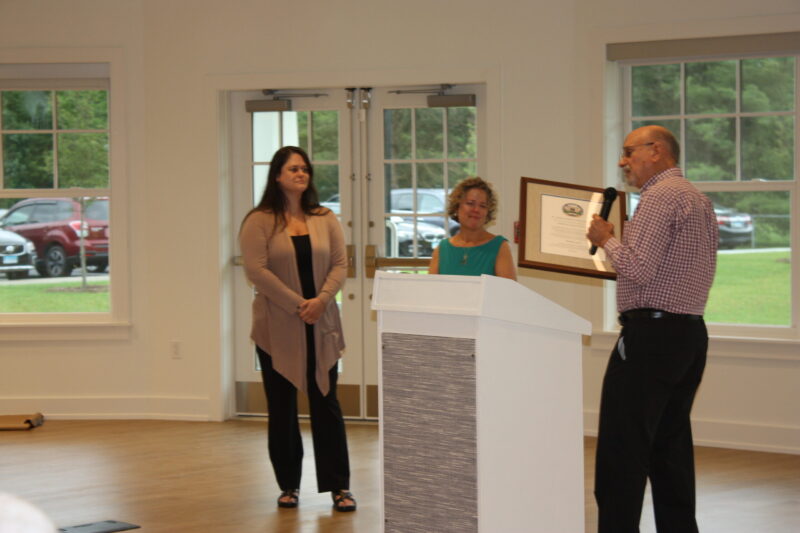
Lymes’ Senior Center Director Stephanie Gould and Assistant Director Caitlin Perkins receive a citation for their work from Board of Directors Chairman Peter Lucchese.

Jeri Baker, chairwoman of the Lymes’ Senior Center Building Committee, took the podium during the early afternoon ceremony in front of a full house. 

“We were focused from day one on one thing: That the seniors in these two communities didn’t get just what they needed, they got what they deserved,” she said. 

Through the years, Baker has repeatedly described the committee’s vision for an open, airy layout marked by retractable walls and expansive windows to let in the light. The vision was tested by cost overruns and a slow grant funding process, but remained a priority for taxpayers in both towns through multiple votes on what added up to a $6.4 million project. 

One million dollars is covered by state funding through a program that supports small town, quality of life projects. 

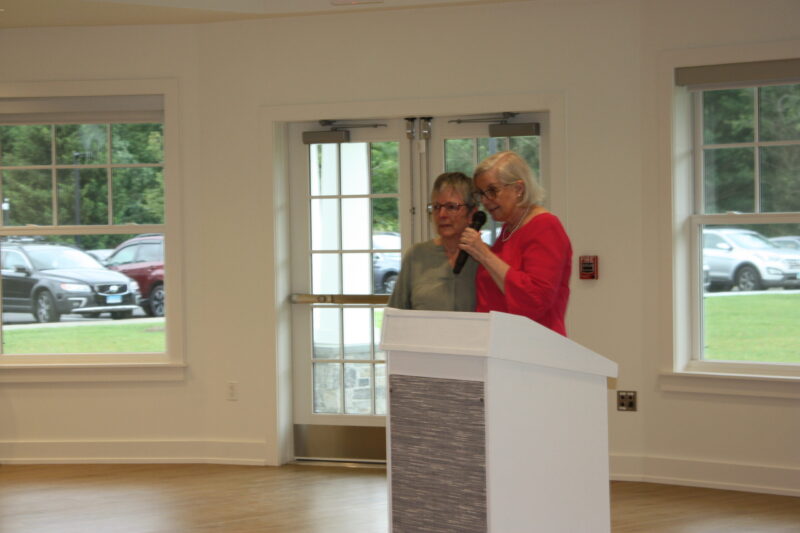
Old Lyme First Selectwoman Martha Shoemaker, right, brings Lymes’ Senior Center Building Committee Chairwoman Jeri Baker to the podium to recognize her for five years, seven months and 12 days of service on the project.

State Sen. Martha Marx, D-New London, told the members they deserve the new space where they can be with others. 

“We all know loneliness is hard. It’s hard for a lot of seniors,” she said. “When you have such a beautiful place like this where you can all come together, it’s going to change lives.” 

Baker, Old Lyme First Selectwoman Martha Shoemaker, Lyme Selectwoman Kristina White and Lymes’ Senior Center Board of Directors Chairman Peter Lucchese all stood up to thank the dozens of people who made the renovation happen. 

Shoemaker said there were about 1,100 members before the renovation. They combined for roughly 550 visits per week. 

“In short, the Center was being used more frequently by more people than at any point in the history,” she said. “And at the same time, it had not undergone any renovation to its original structure since it opened in 1996, except, I believe, for a screened-in porch.”

Ruth Young was an original Lymes’ Senior Center member, who raised money for the building in the 1990s.

The project was designed by Old Lyme-based Point One Architects and managed by Newfield Construction of Hartford.

Shoemaker acknowledged two garbage cans in the dining room to catch water from a leak in the ceiling related to the heating and cooling system. 

“Anyone who’s built a house, done a home remodeling project, we all know that turning things on for the first time is a surprise,” she said. 

The system is under warranty, according to Shoemaker. 

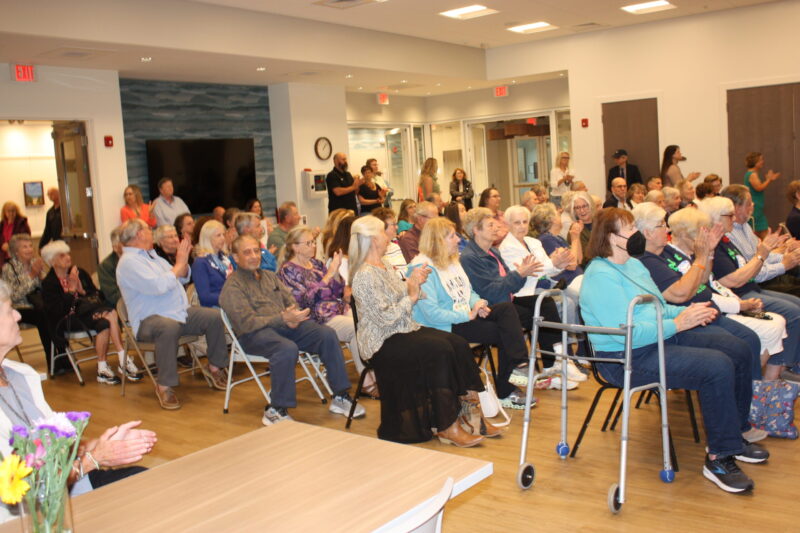
Members and supporters of the Lymes’ Senior Center applaud during the re-opening ceremony.

When Gould, the Center’s Director, got up to give thanks, nobody ranked higher on her list than the seniors themselves. 

“I want to thank our members, you guys, who I lovingly think of as ‘my seniors,’ for believing in this project and coming out in numbers to approve both referendums,” she said. 

She credited their positive energy, understanding and support with keeping staff members in good spirits through the transition. 

“This one’s for you,” she told the crowd.

The Day in Pictures

Lymes’ Senior Center Assistant Director Caitlin Perkins and member Mary Buttery stand in front of Buttery’s painting. Members’ art lines the walls of the newly renovated facility.
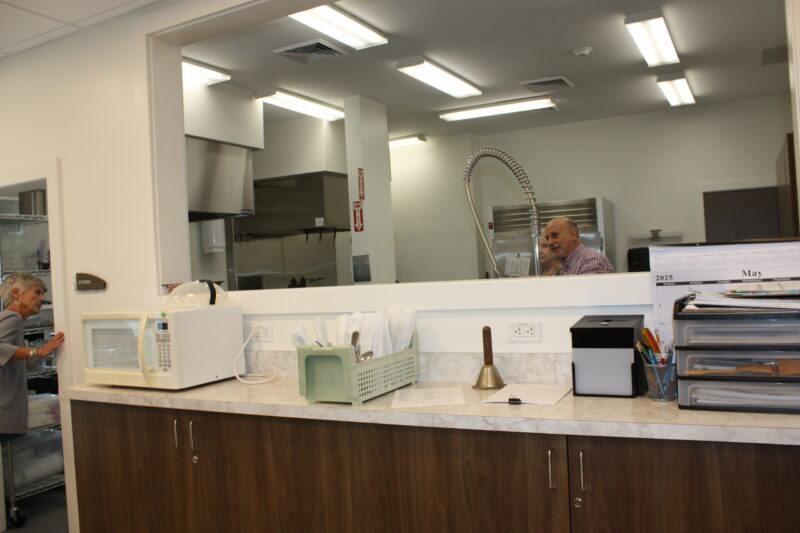
Lymes’ Senior Center Board of Directors Chairman Peter Lucchese gives a tour of the Lymes’ Senior Center.’s new kitchen.
Members sit at tables in the lobby of the newly renovated Lymes’ Senior Center, where they can start each day with free coffee and tea.
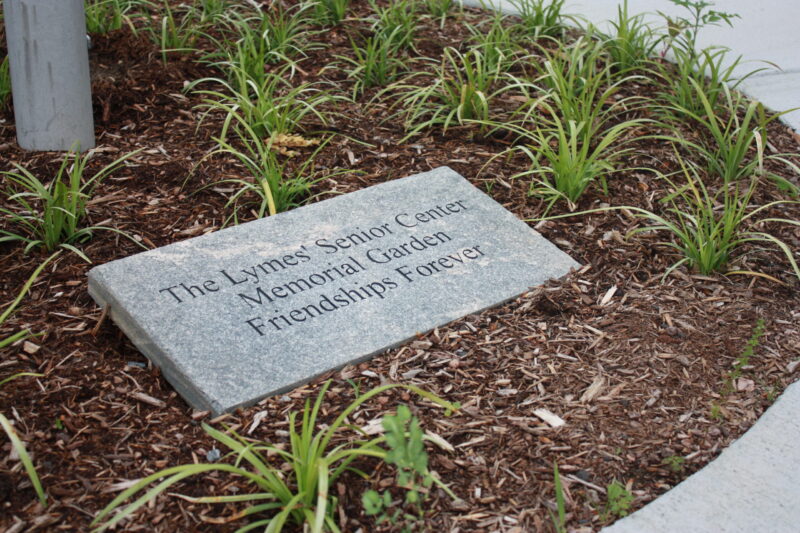
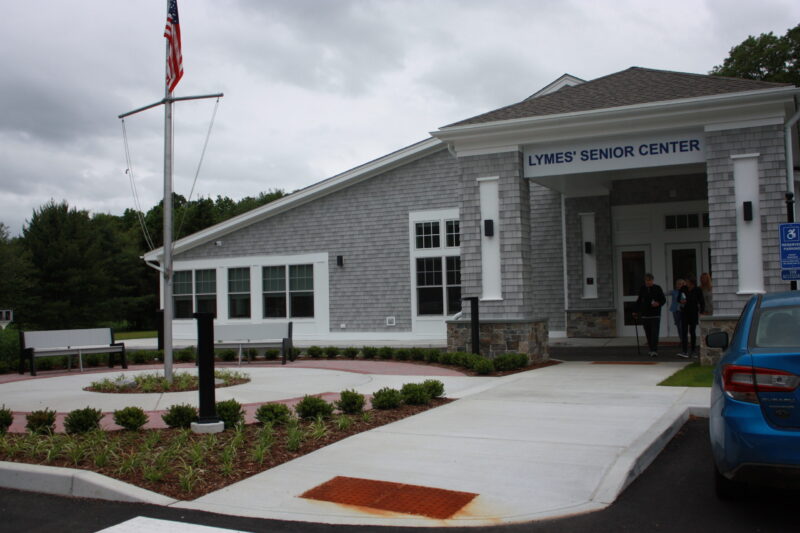
The memorial garden surrounds the flag pole in front of the Lymes’ Senior Center.
The newly renovated, $6.4 million Lymes’ Senior Center is open again after closing its doors a year and a half ago for the upgrade.

TOP STORY: Old Lyme Town Budget Passes Easily, Meeting Serves as Lesson in Small-Town Democracy

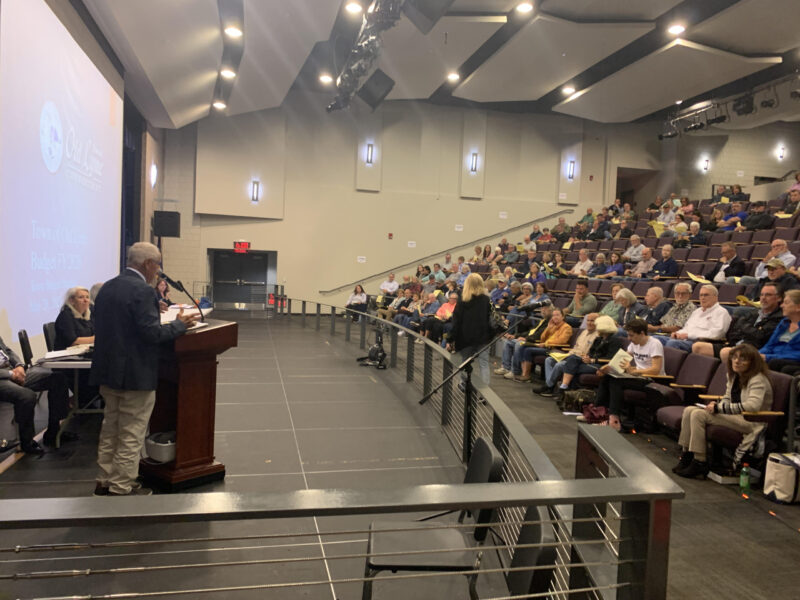
Old Lyme-based Attorney Fran Sablone served as moderator at Wednesday’s Town Budget Meeting.

OLD LYME–Two young men sitting with their parents in the auditorium of the Lyme-Old Lyme High School Wednesday night were recognized at the end of the 2.5-hour Town Budget Meeting for making it through a crash course in the New England town meeting form of government 

First Selectwoman Martha Shoemaker acknowledged the boys after a record-setting crowd of more than 200 residents and taxpayers approved the $45.39 million 2025-56 budget and five new or amended ordinances.

No meeting in the last seven years had drawn more than 60 people, according to Shoemaker.

“You have received the best education in what a town meeting can be like,” she told Joseph Jewett, 11, and Joshua Jewett, 9.  

The budget passed 167 votes to 40 in a year when a property revaluation left a majority of homeowners in town facing a tax hike in excess of 4.7%. Those whose property values rose more than average are looking at relatively higher tax increases.

The town meeting is a form of direct democracy that allows all eligible voters 18 years old and up to discuss and decide important matters rather than letting elected officials do it for them. 

While October 2024 data from the state Office of Policy and Management shows that 103 towns in the state have a town meeting form of government, many of them leave the ultimate budget decision up to a machine vote at a day-long referendum as a way to encourage more participation. 

Shoemaker applauded the Jewett family for showing the boys that their “voices matter.”

“Even though (the votes) may not go the way you want, your voices are heard,” Shoemaker said. 

Fire Marshal Dave Roberge said he counted 222 people in the auditorium Wednesday night. With 207 people voting on the budget, that leaves about 15 people like the Jewett children who were there to watch and learn.  

Procedural questions about how to vote dominated the early part of the meeting, with an early motion to use a paper ballot on all seven questions failing by a vote of 87 to 110. 

Voters decided to use a hand vote for the budget, which proved the most contentious issue on the call to meeting. They raised fluorescent green chits in the air to signify their voting status as Democratic Deputy Registrar of Voters Katherine Thuma and Republican Deputy Registrar of Voters John Mesham counted the chits row by row. 

When the results of the vote to approve the budget were counted, Town Meeting Moderator Fran Sablone put it this way: “The motion carries.” 

Voting down the budget would have required the town to bill taxpayers based on the current budget until a new spending plan was approved, according to town officials. That means the town would be locked into paying its share of the Region 18 education budget, which voters passed in a referendum earlier this month, even though the expense wouldn’t be reflected in tax bills. 

Board of Finance Chairman Bennett J. Bernblum, who during the meeting used the word “stupid” to describe such a scenario, was asked to clarify what he meant. 

“It would be stupid because it would put us into disarray,” he said. 

The meeting, originally scheduled for May 19, was postponed due to overcapacity at the Town Hall. Fire code there allows only 124 people in the meeting room and lobby.

Tax Impact

The finance board immediately after the Town Meeting convened to set the tax rate for the coming year at 16.23 mills. 

The current tax rate is 24.4 mills. After taking the property revaluation into account – and if spending did not increase at all in the coming budget – the tax rate would have been 15.5 mills. 

A mill represents $1 in tax per $1,000 of assessed property value.  

Bernblum in his presentation said a house appraised at $400,000 with a valuation mirroring the average 57.4% increase to the grand list is now worth $629,600. The tax bill for that homeowner based on the 2025-26 budget will be $7,153 – an increase of $321, or 4.7%, over the current tax bill. 

Assessor Melinda Kronfeld has said 3,312 properties in town will see their tax bills go up more than 4.7%, while 2,331 properties will be looking at an increase less than that, or even a tax decrease.

The finance board last month voted to use $800,000 from the town’s predicted $14.2 million ‘Rainy Day Fund’ to help mitigate the impact to taxpayers. The vote was a compromise between Republicans, who wanted to use less, and Democrats, who wanted to use more. 

Bernblum said the town’s healthy savings helped secure a AAA bond rating from S&P Global Ratings, which translates to the most favorable interest rates when the town goes out to bond. He said he was advised that the finance board’s decision to dip into the Rainy Day Fund should not adversely affect the town’s rating. 

Bernblum said the $800,000 allocation, combined with $171, 350 in cuts identified by Shoemaker and town hall department heads at the request of the finance board, reduced the original budget proposal’s impact on taxpayers by almost a million dollars. 

New and Amended Ordinances

The remaining issues on the meeting call were determined by voice votes. The most controversial was an ordinance codifying golf cart use in the Sound View and Hawk’s Nest beach areas. 

The golf carts must be outfitted with numerous safety features to qualify as the kind of “low speed vehicle” authorized last year by the state to operate on any public roads with speed limits of 25 mph or less. 

Previously, state statutes left it up to cities and towns to decide if they wanted to allow golf carts on local roads. Now, it’s up to those municipalities to specify if they don’t want them – or to limit where they can travel. 

Shoemaker said the ordinance adds several streets in Hawk’s Nest Beach to a program established by the Sound View Commission a few years ago in cooperation with the previous administration of the Board of Selectmen. 

Golf carts registered with the town will be allowed to travel on town-owned roads in the beach areas from sunrise to sunset. 

There will be an initial fine of $90 for those caught driving an unregistered golf cart, driving outside the allowed areas and hours, or missing necessary equipment. The second offense comes with a $180 fine, while the third offense will result in the golf cart being impounded. 

Golf carts must be registered annually and can only be operated with a valid driver’s license. 

Sound View Commission Chairman Frank Pappalardo said the program has “worked out very, very well safety-wise” without being a hardship on residents. He cited 25 golf carts registered currently, with more joining each year. 

Shoemaker described the ordinance as a way to keep communities safe in a town with only six full-time police officers to patrol the streets. She said voting the proposal down would result in the Board of Selectmen, which serves as the local traffic authority, outlawing golf carts completely.  

“A ‘no’ vote will mean that we will prohibit golf carts in the Soundview and Hawks Nest area,” she said. “Because we cannot have people riding around in golf carts without some rules.”

Resident Steven Ross objected to the take-it-or-leave-it approach on what he described as an overly restrictive ordinance. 

“That’s a threat. It’s heavy-handed. It’s inappropriate,” he said. “I think this ordinance should be reviewed and redrafted and brought to another town meeting.”

Shoemaker said the town can consider expanding the ordinance to include the Rogers Lake area in the future if enforcement goes smoothly this summer. 

Other changes outlined on the call to meeting and approved without controversy included updating the volunteer fire and ambulance tax abatement ordinance to increase the maximum amount of the abatement from $1000 to $2000 and to extend it to retirees; revising requirements regarding publication of notices of special and regular Town Meetings in newspapers read by seasonal residents; revising the Old Lyme Harbor Management ordinance to slow down boats and jet skis and increase fines for violations; and revising language affecting parking areas on private property in the Sound View Beach area to, among other things, provide for on-site attendants. 

A Learning Process 

Joseph Jewett after the meeting said he ended up at the meeting with his brother because their parents, Dave and Daphanie Jewett, didn’t give them a choice. 

While 9-year-old Josh Jewett said he really didn’t think they learned anything, Dave Jewett said the kids got a lesson about the importance of voting and having a say in where tax dollars go – even if they didn’t realize it. 

Dave Jewett said he voted in support of the budget. 

“I’ve been in the town my whole life,” he said. “Now I’ve got my kids growing up in this town.”

Editor’s Notes: i) Bennett Bernblum is a financial supporter of LymeLine.com, but has no input to the editorial process, which remains completely independent.

TOP STORY: Lyme Voters Approve $11.37 Million Budget; Finance Board Keeps Tax Rate Flat

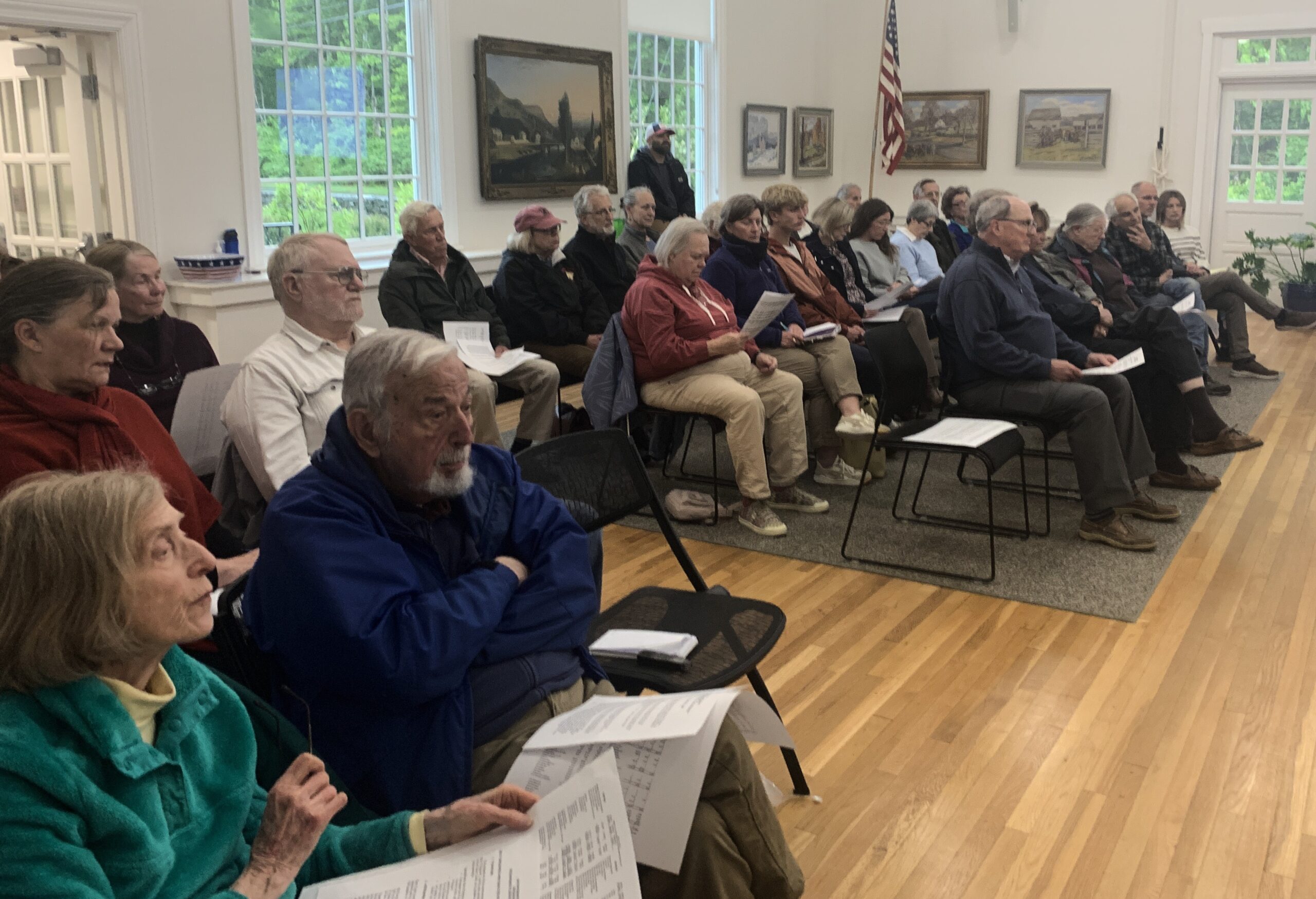
On Thursday evening, Lyme residents gathered to vote on Lyme’s 2025-26 budget. The most recent US Census put the town’s population at 2,352 residents.

LYME–About 55 people came out Thursday evening to approve the $11.37 million 2025-26 budget and raise the cap on a tax break for elderly and disabled residents. 

Members of the Board of Finance gathered immediately following the 25-minute Town Meeting to set the tax rate at 14.5 mills. The move left the rate unchanged from the current year. 

The newly-approved spending plan includes $10.84 million in town operations expenses, up $513,372 over the current budget, and $530,400 in capital costs, down $1.53 million from the current budget. 

Finance board Chairman Alan Sheiness said during the town meeting that the proposed budget anticipates ending the current year with a $200,000 surplus. 

“So what you see here in summary is that we should finish this year ahead of budget,” he said. “That we should have next year a flat mill rate for property taxes, 5% growth in operating expenses, and a large decrease in capital.” 

Included in the town operations budget is $6.96 million in education funding for the town’s estimated 231 students. That’s up $299,504, or 4.5%, from the town’s current payment to the Region 18 school district shared with Old Lyme. The increase is driven by debt payments on a multi-building renovation project approved by voters at a cost to the district of $57.5 million. 

The only opposition to the proposed budget came from Affordable Housing Commission Co-Chairwoman Carleen Gerber when she called out the $1,000 budget allotted to her commission. 

She said the commission is currently working on several plans to make it more possible for people to find an affordable place to live in town. 

“To have no foresight for affordable housing in a town where service workers and teachers cannot afford a home may be pennywise – but it’s pound foolish,” she said. w

The commission for several years has been exploring the construction of multi-family options such as duplexes or quadplexes that young people and downsizing retirees can afford. They’ve also looked into rehabilitating houses with a focus on making space available for volunteers in the local emergency services.  

But First Selectman David Lahm after the meeting said the $1,000 allocated to the commission in the town’s land use budget in the is for basic operational expenses. 

“The real money for affordable housing is in our specific fund,” he said, referring to the reserve account started with private donations to promote housing for those who live and work in town. It currently totals $200,000. 

Multiple approvals and time-intensive public notice requirements are required before the commission can access the reserve fund. Members have said the process impedes their ability to close on a property quickly when it becomes available in a hot real estate market.

Tax Break for Elderly Residents

A vote to amend income eligibility criteria in the Lyme Elderly Tax Relief Ordinance was approved unanimously. 

Lahm said the new ordinance leaves it to the state Office of Policy and Management to set annual eligibility requirements for the tax relief program. Previous income limits of $40,000 for single residents and $47,500 for married residents were unchanged since 2007. 

Lahm said the revised ordinance, pending official state numbers, will likely raise the income cap for single residents to $45,200 and married residents to $55,100. 

The finance board after the Town Meeting voted to cap the program at $65,000 per year based on criteria outlined in state statute. The cap will stay in place for the next five years.

Sheiness said the total value of the tax break for all qualifying residents in town has not exceeded $20,000 in the past. That means everyone who qualifies should receive the full tax abatement.

“We don’t anticipate coming near that $65,000 cap,” he said.

Lyme Town Meeting to Include Votes on Budget, Elderly Tax Break

LYME—The $11.37 million proposed 2025-26 budget will be among the items up for a vote at the Town Meeting on Thursday, May 22, at 6:30 p.m., in the Lyme Town Hall, 480 Hamburg Rd.

If the proposed budget is approved, members of the Board of Finance have said the tax rate will remain unchanged. They plan to set the tax rate at the current 14.5 mills at their meeting immediately following the vote.

The budget proposal is down $1.02 million, or 8.2%, from the current budget. 

The spending plan includes town operating and capital expenses, as well as Lyme’s share of the Region 18 education budget. 

Education costs in Lyme’s proposed budget come out to $6.96 million for the town’s estimated 231 students. That’s up $299,504, or 4.5%, from the town’s current share. The increase is driven by debt payments on a multi-building renovation project approved by voters at a cost of $57.5 million. 

Lyme’s $10.84 million town operations budget proposal is up $513,372, or 5.0%, over the current budget. Proposed capital spending comes in at $530,400, a decrease of $1.53 million, or 74.3%, from the current budget. 

First Selectman David Lahm has attributed the decrease in capital spending to the completion of bridge projects on Birch Mill Road and Macintosh Road that drove up the budget in previous years. 

Residents will also decide whether or not to amend the Lyme Elderly Tax Relief Ordinance to modify the income eligibility criteria.

Lahm this week said the proposed ordinance for the first time reflects income limits set by the state Office of Policy and Management each year as part of the program allowing cities and towns to offer a tax relief program for elderly and totally disabled homeowners.

He said the previous ordinance set the income cap at $40,000 per year to qualify for the tax break, and had not changed in years.

Some households receiving Social Security payments who previously qualified for the program would become ineligible when annual federal Cost of Living Adjustments (COLA) put them over the $40,000 threshold, according to Lahm.

“That wasn’t the intent,” he said. “The intent is if you’re on Social Security that you should be in this program and not get bumped out by COLAs.”

He said the change brings the definition in line with state income limits “”so that when the state program does cost of living increases, our limits will also rise with that.”

The town’s annual report for the 2023-24 fiscal year will also be officially accepted at the meeting.

A summary of the proposed budget can be viewed at this link.

Editor’s Note: This article was updated with information on the proposed ordinance and annual report.