
TOP STORY: Old Lyme Town Budget Passes Easily, Meeting Serves as Lesson in Small-Town Democracy

Old Lyme-based Attorney Fran Sablone served as moderator at Wednesday’s Town Budget Meeting.

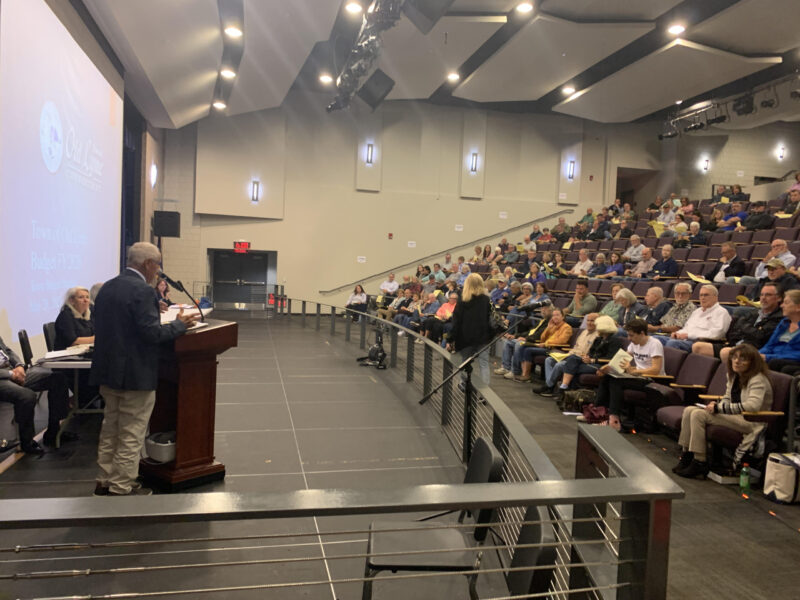
OLD LYME–Two young men sitting with their parents in the auditorium of the Lyme-Old Lyme High School Wednesday night were recognized at the end of the 2.5-hour Town Budget Meeting for making it through a crash course in the New England town meeting form of government 

First Selectwoman Martha Shoemaker acknowledged the boys after a record-setting crowd of more than 200 residents and taxpayers approved the $45.39 million 2025-56 budget and five new or amended ordinances.

No meeting in the last seven years had drawn more than 60 people, according to Shoemaker.

“You have received the best education in what a town meeting can be like,” she told Joseph Jewett, 11, and Joshua Jewett, 9.  

The budget passed 167 votes to 40 in a year when a property revaluation left a majority of homeowners in town facing a tax hike in excess of 4.7%. Those whose property values rose more than average are looking at relatively higher tax increases.

The town meeting is a form of direct democracy that allows all eligible voters 18 years old and up to discuss and decide important matters rather than letting elected officials do it for them. 

While October 2024 data from the state Office of Policy and Management shows that 103 towns in the state have a town meeting form of government, many of them leave the ultimate budget decision up to a machine vote at a day-long referendum as a way to encourage more participation. 

Shoemaker applauded the Jewett family for showing the boys that their “voices matter.”

“Even though (the votes) may not go the way you want, your voices are heard,” Shoemaker said. 

Fire Marshal Dave Roberge said he counted 222 people in the auditorium Wednesday night. With 207 people voting on the budget, that leaves about 15 people like the Jewett children who were there to watch and learn.  

Procedural questions about how to vote dominated the early part of the meeting, with an early motion to use a paper ballot on all seven questions failing by a vote of 87 to 110. 

Voters decided to use a hand vote for the budget, which proved the most contentious issue on the call to meeting. They raised fluorescent green chits in the air to signify their voting status as Democratic Deputy Registrar of Voters Katherine Thuma and Republican Deputy Registrar of Voters John Mesham counted the chits row by row. 

When the results of the vote to approve the budget were counted, Town Meeting Moderator Fran Sablone put it this way: “The motion carries.” 

Voting down the budget would have required the town to bill taxpayers based on the current budget until a new spending plan was approved, according to town officials. That means the town would be locked into paying its share of the Region 18 education budget, which voters passed in a referendum earlier this month, even though the expense wouldn’t be reflected in tax bills. 

Board of Finance Chairman Bennett J. Bernblum, who during the meeting used the word “stupid” to describe such a scenario, was asked to clarify what he meant. 

“It would be stupid because it would put us into disarray,” he said. 

The meeting, originally scheduled for May 19, was postponed due to overcapacity at the Town Hall. Fire code there allows only 124 people in the meeting room and lobby.

Tax Impact

The finance board immediately after the Town Meeting convened to set the tax rate for the coming year at 16.23 mills. 

The current tax rate is 24.4 mills. After taking the property revaluation into account – and if spending did not increase at all in the coming budget – the tax rate would have been 15.5 mills. 

A mill represents $1 in tax per $1,000 of assessed property value.  

Bernblum in his presentation said a house appraised at $400,000 with a valuation mirroring the average 57.4% increase to the grand list is now worth $629,600. The tax bill for that homeowner based on the 2025-26 budget will be $7,153 – an increase of $321, or 4.7%, over the current tax bill. 

Assessor Melinda Kronfeld has said 3,312 properties in town will see their tax bills go up more than 4.7%, while 2,331 properties will be looking at an increase less than that, or even a tax decrease.

The finance board last month voted to use $800,000 from the town’s predicted $14.2 million ‘Rainy Day Fund’ to help mitigate the impact to taxpayers. The vote was a compromise between Republicans, who wanted to use less, and Democrats, who wanted to use more. 

Bernblum said the town’s healthy savings helped secure a AAA bond rating from S&P Global Ratings, which translates to the most favorable interest rates when the town goes out to bond. He said he was advised that the finance board’s decision to dip into the Rainy Day Fund should not adversely affect the town’s rating. 

Bernblum said the $800,000 allocation, combined with $171, 350 in cuts identified by Shoemaker and town hall department heads at the request of the finance board, reduced the original budget proposal’s impact on taxpayers by almost a million dollars. 

New and Amended Ordinances

The remaining issues on the meeting call were determined by voice votes. The most controversial was an ordinance codifying golf cart use in the Sound View and Hawk’s Nest beach areas. 

The golf carts must be outfitted with numerous safety features to qualify as the kind of “low speed vehicle” authorized last year by the state to operate on any public roads with speed limits of 25 mph or less. 

Previously, state statutes left it up to cities and towns to decide if they wanted to allow golf carts on local roads. Now, it’s up to those municipalities to specify if they don’t want them – or to limit where they can travel. 

Shoemaker said the ordinance adds several streets in Hawk’s Nest Beach to a program established by the Sound View Commission a few years ago in cooperation with the previous administration of the Board of Selectmen. 

Golf carts registered with the town will be allowed to travel on town-owned roads in the beach areas from sunrise to sunset. 

There will be an initial fine of $90 for those caught driving an unregistered golf cart, driving outside the allowed areas and hours, or missing necessary equipment. The second offense comes with a $180 fine, while the third offense will result in the golf cart being impounded. 

Golf carts must be registered annually and can only be operated with a valid driver’s license. 

Sound View Commission Chairman Frank Pappalardo said the program has “worked out very, very well safety-wise” without being a hardship on residents. He cited 25 golf carts registered currently, with more joining each year. 

Shoemaker described the ordinance as a way to keep communities safe in a town with only six full-time police officers to patrol the streets. She said voting the proposal down would result in the Board of Selectmen, which serves as the local traffic authority, outlawing golf carts completely.  

“A ‘no’ vote will mean that we will prohibit golf carts in the Soundview and Hawks Nest area,” she said. “Because we cannot have people riding around in golf carts without some rules.”

Resident Steven Ross objected to the take-it-or-leave-it approach on what he described as an overly restrictive ordinance. 

“That’s a threat. It’s heavy-handed. It’s inappropriate,” he said. “I think this ordinance should be reviewed and redrafted and brought to another town meeting.”

Shoemaker said the town can consider expanding the ordinance to include the Rogers Lake area in the future if enforcement goes smoothly this summer. 

Other changes outlined on the call to meeting and approved without controversy included updating the volunteer fire and ambulance tax abatement ordinance to increase the maximum amount of the abatement from $1000 to $2000 and to extend it to retirees; revising requirements regarding publication of notices of special and regular Town Meetings in newspapers read by seasonal residents; revising the Old Lyme Harbor Management ordinance to slow down boats and jet skis and increase fines for violations; and revising language affecting parking areas on private property in the Sound View Beach area to, among other things, provide for on-site attendants. 

A Learning Process 

Joseph Jewett after the meeting said he ended up at the meeting with his brother because their parents, Dave and Daphanie Jewett, didn’t give them a choice. 

While 9-year-old Josh Jewett said he really didn’t think they learned anything, Dave Jewett said the kids got a lesson about the importance of voting and having a say in where tax dollars go – even if they didn’t realize it. 

Dave Jewett said he voted in support of the budget. 

“I’ve been in the town my whole life,” he said. “Now I’ve got my kids growing up in this town.”

Editor’s Notes: i) Bennett Bernblum is a financial supporter of LymeLine.com, but has no input to the editorial process, which remains completely independent.
TOP STORY: Lyme Voters Approve $11.37 Million Budget; Finance Board Keeps Tax Rate Flat

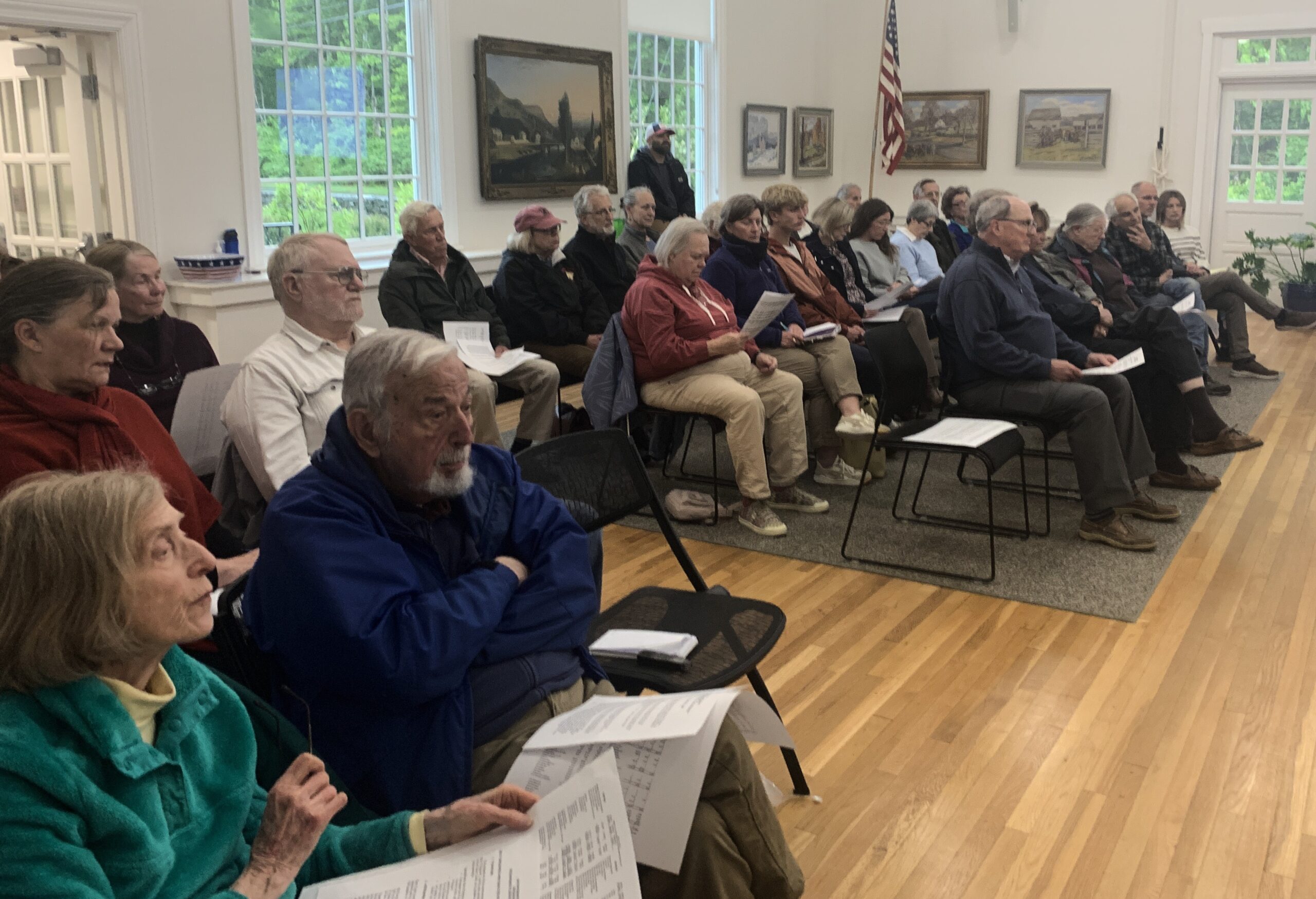
On Thursday evening, Lyme residents gathered to vote on Lyme’s 2025-26 budget. The most recent US Census put the town’s population at 2,352 residents.

LYME–About 55 people came out Thursday evening to approve the $11.37 million 2025-26 budget and raise the cap on a tax break for elderly and disabled residents. 

Members of the Board of Finance gathered immediately following the 25-minute Town Meeting to set the tax rate at 14.5 mills. The move left the rate unchanged from the current year. 

The newly-approved spending plan includes $10.84 million in town operations expenses, up $513,372 over the current budget, and $530,400 in capital costs, down $1.53 million from the current budget. 

Finance board Chairman Alan Sheiness said during the town meeting that the proposed budget anticipates ending the current year with a $200,000 surplus. 

“So what you see here in summary is that we should finish this year ahead of budget,” he said. “That we should have next year a flat mill rate for property taxes, 5% growth in operating expenses, and a large decrease in capital.” 

Included in the town operations budget is $6.96 million in education funding for the town’s estimated 231 students. That’s up $299,504, or 4.5%, from the town’s current payment to the Region 18 school district shared with Old Lyme. The increase is driven by debt payments on a multi-building renovation project approved by voters at a cost to the district of $57.5 million. 

The only opposition to the proposed budget came from Affordable Housing Commission Co-Chairwoman Carleen Gerber when she called out the $1,000 budget allotted to her commission. 

She said the commission is currently working on several plans to make it more possible for people to find an affordable place to live in town. 

“To have no foresight for affordable housing in a town where service workers and teachers cannot afford a home may be pennywise – but it’s pound foolish,” she said. w

The commission for several years has been exploring the construction of multi-family options such as duplexes or quadplexes that young people and downsizing retirees can afford. They’ve also looked into rehabilitating houses with a focus on making space available for volunteers in the local emergency services.  

But First Selectman David Lahm after the meeting said the $1,000 allocated to the commission in the town’s land use budget in the is for basic operational expenses. 

“The real money for affordable housing is in our specific fund,” he said, referring to the reserve account started with private donations to promote housing for those who live and work in town. It currently totals $200,000. 

Multiple approvals and time-intensive public notice requirements are required before the commission can access the reserve fund. Members have said the process impedes their ability to close on a property quickly when it becomes available in a hot real estate market.

Tax Break for Elderly Residents

A vote to amend income eligibility criteria in the Lyme Elderly Tax Relief Ordinance was approved unanimously. 

Lahm said the new ordinance leaves it to the state Office of Policy and Management to set annual eligibility requirements for the tax relief program. Previous income limits of $40,000 for single residents and $47,500 for married residents were unchanged since 2007. 

Lahm said the revised ordinance, pending official state numbers, will likely raise the income cap for single residents to $45,200 and married residents to $55,100. 

The finance board after the Town Meeting voted to cap the program at $65,000 per year based on criteria outlined in state statute. The cap will stay in place for the next five years.

Sheiness said the total value of the tax break for all qualifying residents in town has not exceeded $20,000 in the past. That means everyone who qualifies should receive the full tax abatement.

“We don’t anticipate coming near that $65,000 cap,” he said.

Lyme Town Meeting to Include Votes on Budget, Elderly Tax Break

LYME—The $11.37 million proposed 2025-26 budget will be among the items up for a vote at the Town Meeting on Thursday, May 22, at 6:30 p.m., in the Lyme Town Hall, 480 Hamburg Rd.

If the proposed budget is approved, members of the Board of Finance have said the tax rate will remain unchanged. They plan to set the tax rate at the current 14.5 mills at their meeting immediately following the vote.

The budget proposal is down $1.02 million, or 8.2%, from the current budget. 

The spending plan includes town operating and capital expenses, as well as Lyme’s share of the Region 18 education budget. 

Education costs in Lyme’s proposed budget come out to $6.96 million for the town’s estimated 231 students. That’s up $299,504, or 4.5%, from the town’s current share. The increase is driven by debt payments on a multi-building renovation project approved by voters at a cost of $57.5 million. 

Lyme’s $10.84 million town operations budget proposal is up $513,372, or 5.0%, over the current budget. Proposed capital spending comes in at $530,400, a decrease of $1.53 million, or 74.3%, from the current budget. 

First Selectman David Lahm has attributed the decrease in capital spending to the completion of bridge projects on Birch Mill Road and Macintosh Road that drove up the budget in previous years. 

Residents will also decide whether or not to amend the Lyme Elderly Tax Relief Ordinance to modify the income eligibility criteria.

Lahm this week said the proposed ordinance for the first time reflects income limits set by the state Office of Policy and Management each year as part of the program allowing cities and towns to offer a tax relief program for elderly and totally disabled homeowners.

He said the previous ordinance set the income cap at $40,000 per year to qualify for the tax break, and had not changed in years.

Some households receiving Social Security payments who previously qualified for the program would become ineligible when annual federal Cost of Living Adjustments (COLA) put them over the $40,000 threshold, according to Lahm.

“That wasn’t the intent,” he said. “The intent is if you’re on Social Security that you should be in this program and not get bumped out by COLAs.”

He said the change brings the definition in line with state income limits “”so that when the state program does cost of living increases, our limits will also rise with that.”

The town’s annual report for the 2023-24 fiscal year will also be officially accepted at the meeting.

A summary of the proposed budget can be viewed at this link.

Editor’s Note: This article was updated with information on the proposed ordinance and annual report.

Old Lyme Town Meeting Postponed After ‘Larger than Expected’ Crowd Exceeds Capacity of Meeting Room, Delays Budget Vote

OLD LYME–With the crowd spilling out of Memorial Town Hall onto Lyme Street Monday evening, the Annual Town Budget Meeting was postponed as town officials put out the call for a venue large enough to accommodate the response to a sharp budget increase amid rising property values. 

Fire Marshal Dave Roberge immediately put a halt to the 7:30 p.m. town meeting with his announcement that the capacity of 124 people had been reached in the Town Hall Meeting Room and its lobby. He said an additional 25 to 40 people were still waiting in line. 

Against the background of a blue screen with a presentation slide warning that the meeting would be rescheduled in the event of a “larger than expected turnout,” the three-member Board of Selectmen made its unanimous vote to find another date and time for the meeting. 

First Selectwoman Martha Shoemaker, a Democrat, was joined by Democratic Selectman Jim Lampos and Republican Selectwoman Jude Read.

Shoemaker said no budget vote in the past seven years had attracted more than 60 people. She called for postponement “so that everyone can hear what they wanted to hear, and vote on what they want to vote on.” 

The $45.39 million 2025-26 proposed budget – which is up $3.28 million, or 7.8%, over the current year – was on the agenda along with several proposed changes to the local law books. The proposals on the agenda for the evening ranged from an ordinance on golf cart usage in the Sound View and Hawk’s Nest Beach areas to a $1,000 increase in the tax abatement available to volunteer first responders. 

Outside the Town Hall as the crowd dispersed, beach area resident Laura Parent said her taxes are going up 100% due to the recent revaluation. 

Assessor Melinda Kronfeld last week said the average tax increase townwide, based on the proposed budget, comes in at 4.7%. She said 3,312 properties in town would see their tax bills go up more than that, while 2,331 properties would be looking at an increase less than 4.7%, or a tax decrease.

Parent was one of the residents with sticker shock when she saw how much her home had increased in value. 

“My taxes are going to increase at least $1,800,” she said. 

She said she was concerned with the size of the town’s $31.52 million share of the regional Lyme-Old Lyme school budget, which is up $1.99 million, or 6.72%, from Old Lyme’s current payment. The hike is driven by debt, which is just starting to come due, on a large-scale renovation project affecting four of the district’s five buildings. The expense includes heating and ventilation system work in the four schools, plus the addition of classrooms at Mile Creek School. The project was approved by voters in 2022. 

Parent said enrollment numbers have not kept pace with estimates publicized at the time of the vote, based on numbers from the New England School Development Council.

She said she felt the district justified the new classrooms by saying attendance was going to increase.

“It’s not,” she said. “But we’re paying.”

Parent acknowledged she did not vote at the referendum on the school district budget, which passed earlier this month by a vote of 457 to 297. But she will next time, she said. 

Parent’s friend Mariella Shea said the town should have “planned a little better” for a town meeting crowd attracted by votes on several ordinances as well as the budget. 

“It’s regrettable that it has to be rescheduled,” Shea said. “So many things were on the agenda that they should have known.” 

Resident Michael Hansen said rescheduling the meeting was the appropriate thing to do. 

“There was obviously a big showing. People wanted to participate in their local democracy, which anyone should applaud,” he said. 

But he described as “disingenuous” the arguments by those who are opposing the proposed budget this late in the process. 

“We agreed several years ago that we were going to update the schools,” he said. “It’s time to start paying that bill. It’s not really something up for debate. The town has the money. If people were actually upset about it, it could have been addressed at the Board of Finance.”

A public hearing last month on the proposed budget by the finance board lasted just over a half hour in front of roughly two dozen people in the Town Hall meeting room. There were only a few questions from the public. 

Also last month, the finance board agreed to use $800,000 from the town’s predicted $14.2 million ‘Rainy Day Fund’  to help mitigate the impact to taxpayers. The vote was a compromise between Republicans, who wanted to take out less from the Rainy Day Fund, and Democrats, who wanted to use more. 

Hansen was critical of those on the finance board who did not want to use more than $800,000 to lower the tax increase for property owners. 

“And then some of those members are now also being, again, disingenuous, claiming that it’s (Democratic First Selectwoman) Martha Shoemaker’s fault that the mill rate’s going up, and that’s really not the case,” he said. 

Shoemaker after the meeting said the Board of Selectmen put together a fair budget. She cited scant attendance at public meetings throughout the months-long budget planning process.

She also pointed to a request from the finance board in April for the selectwoman to work with department heads to further reduce the budget, which resulted in a cut of $171,350 to the proposed budget. 

“So we did the best we possibly could for the budget,” Shoemaker said. 

With the school district budget approved by voters, the town is obligated to pay its $31.52 million share. 

“So where do you start cutting?” she said. “Do we cut capital projects? Do we cut people? Do we cut hours? If you do those things, you’re going to cut services.” 

The Board of Finance was initially set to formalize the new tax rate immediately after the town meeting. Instead, finance board members agreed to convene again after a vote at the rescheduled town meeting. 

Shoemaker said she has reached out to Superintendent of Schools Ian Neviaser to see if he has a larger space in the schools available on May 28, 29 or 30. State law requires notice of the meeting to be published in a newspaper at least five days before the meeting. 

Asked what would happen if the budget doesn’t pass, Shoemaker said she didn’t know. 

“I will have to call up to the state to find out,” she said.

Republican Board of Finance member Andy Russell after the meeting said he can’t remember residents voting down a budget in his 32 years as a resident. 

Old Lyme Annual Budget Meeting to Include Votes on Spending Plan, Local Laws

OLD LYME–The $45.39 million 2025-26 proposed budget and several proposed changes to the local law books – ranging from an ordinance on golf cart usage in the Sound View and Hawk’s Nest beach areas to a $1,000 increase in the tax abatement available to volunteer first responders – will be up for a vote at the Annual Town Budget Meeting tonight. 

The headliner at the May town meeting is always the proposed budget for the coming fiscal year. This time around, the plan represents an increase of $3.28 million, or 7.8%, over the current budget. 

Paying off debt from large-scale renovation projects is driving much of the added expense. 

Old Lyme’s government operations expenses come in at $11.39 million, an increase of $835,260 million, or 7.9%, over the current budget. That includes debt service amounting to $702,350, which is up $271,168, or 62.9%, over the current budget. The increase is largely attributable to payments on the Lymes’ Senior Center renovation project.

The proposal includes an additional $107,000 in health insurance expenses over the current year.

Education costs in the proposed budget come in at $31.52 million, which is up $1.99 million, or 6.72%, from the town’s current payment toward the regional Lyme-Old Lyme school district budget.

The Region 18 school district’s $39.7 million 2025-26 budget was approved earlier this month in a vote of 457 to 297.

In Old Lyme, the increase to local tax bills will depend on the effect of last year’s revaluation process on each property owner. 

At an April public hearing on the budget, budget documents showed the projected tax rate to be 16.2 mills. The official tax rate won’t be set until after the proposed budget is approved by voters.

The current tax rate is 24.4 mills. After taking the revaluation into account – and if spending did not change at all in the coming year – the tax rate would be 15.5 mills. 

The town’s grand list of taxable property grew by 57.4% as a result of the revaluation, according to final assessor’s data. That means the tax increase compared to the current year will be around 4.7% for the average homeowner whose property values mirror the overall increase to the grand list. 

Assessor Melinda Kronfeld in a memo shared by First Selectwoman Martha Shoemaker said the effect of the proposed budget on individual tax bills will vary based on how homes fared in the revaluation.

She used the example of a house valued at $200,000 in 2003. The tax bill associated with the property currently comes in at $4,880.

If the house went up 52% in value, the owner would see a tax bill that is $49, or 1%, higher than the current bill. If it went up 60% in value, the owner would see an increase of $326, or 7%. If it went up 82%, the increase would be $1,024, or 21%.

On the other end, the owner of a $200,000 house that went up 40% in the revaluation – which is less than the grand list increased – would see the tax payment reduced by $336, or 7%, in the coming year.

Kronfeld on Friday said 3,312 properties in town will see their tax bills go up more than the average 4.7% increase. There will be 2,331 properties looking at an increase less than 4.7%, or a tax decrease.

The finance board last month agreed to use $800,000 from the town’s predicted $14.2 million ‘Rainy Day Fund’ to help mitigate the impact to taxpayers.

Voters on Monday will also be asked to consider one new section and four revisions to existing chapters in the local code of ordinances. 

Golf Carts in Sound View Beach Area 

Shoemaker this week said the creation of an ordinance on golf cart usage in town-owned beach areas is the local reaction to a state law passed last year. That’s when Gov. Ned Lamont last year signed allowing golf carts to be used on public roads with speed limits of 25 mph or less.

“The best thing, according to our town attorney, is to let (people) know where they’re allowed,” she said. 

The ordinance codifies existing rules in Sound View Beach and adds town-owned streets in Hawk’s Nest Beach to the regulated area. 

Golf carts registered with the town will be allowed to travel on town-owned roads in the beach areas from sunrise to sunset based on the proposed ordinances. 

There will be an initial fine of $90 for those caught driving an unregistered golf cart, driving outside the allowed areas and hours, or missing necessary equipment. The second offense comes with a $180 fine, while the third offense will result in the golf cart being impounded. 

Golf carts must be registered annually and can only be operated with a valid driver’s license. The registration fee for this season, which lasts from May 1 to April 30, is $25. Rates will be set annually. 

The ordinance specifies each golf cart must have numerous safety features to ensure drivers can see and be seen. Locking brakes, a horn, a flag, various lights and reflectors, seatbelts and a windshield are required. Children’s car seats may not be installed in the golf carts. 

Golf carts cannot be driven at night or during inclement weather, according to the proposed ordinance. Vehicles are only allowed on Route 156 if they are crossing from Hartford Avenue, Swan Avenue or Portland Avenue to the corresponding extension on the other side of the road. 

If golf cart spaces at the bottom of Hartford Avenue are taken, registered golf carts can use the town parking lot. 

Harbor Management Commission ordinance

Selectmen earlier this month gave the go-ahead to language drafted by Harbormaster Matthew Lynch to address concerns from the Sound View Commission about chaotic conditions wrought by water taxis, jet skis and swimmers at the public beach. 

New language in the ordinances limits jet skis to no more than 6 mph within 200 feet of the shore, docks, piers, floats, swim zones or moored vessels. Boats are subject to the same speed restriction within 100 feet.

The changes limit motorboats to 6 mph on the Lieutenant River, Back River, Duck River, or Black Hall River. 

The boat lane at Sound View under the proposed ordinance is limited to vessels under 35 horsepower, which means jet skis don’t qualify to be there. Approved water taxis and emergency vessels are exempted from the regulation. 

The proposed ordinance gives the Harbormaster, Marine Patrol and Police the authority to enforce the rules. 

Any violations of the ordinance come with a fine of $150 each, or up to $750 in total in the case of three or more tickets on the same day. 

Certain violations, including traveling faster than 6 mph on rivers or operating jet skis in the boat lane, come with fines of $150 for the first offense, $250 for the second offense and $350 for each subsequent offense.

‘Tax Abatement’ for volunteer first responders

Proposed amendments to the ordinance affecting members of the Old Lyme Fire Department and Old Lyme Volunteer Ambulance Association would raise an incentive meant to recruit and retain more members from $1,000 to $2,000 per year for each volunteer. 

The proposed ordinance would also allow volunteers serving for at least 25 years to continue receiving the benefit even if they aren’t active volunteers anymore. 

Old Lyme Fire Department President Robert McCarthy in an interview at the Town Hall this week said the fire and ambulance companies asked town officials to consider updating the existing ordinance on the volunteer incentive. He cited changes to state law, which was updated in 2021. 

The original $1,000 incentive was implemented locally in 2002 as a tax abatement. McCarthy said officials in 2018 worked out a plan to deposit the incentive into a retirement account for volunteer first responders instead of using it as a tax break. The plan was vetted by Town Attorney Jack Collins and an attorney with Pension Administrative Services Inc, according to McCarthy.

Volunteers that year were given the option to continue with the tax abatement or take the money in the retirement account, McCarthy said. Any volunteer who joined the fire department or ambulance association subsequent to the 2018 agreement received the benefit as retirement savings. 

The revised ordinance language again makes it possible for volunteers to choose between a tax break or retirement savings, McCarthy said. 

The 2018 retirement plan states that volunteers are vested after six years of qualified service. Benefits are paid out after members stop serving or they turn 65, whichever comes first. 

Sound View Parking ordinance 

Proposed updates to a longstanding parking ordinance in the Sound View Beach area address private parking lots leased by local businesses, such as Kokomo’s, for customer use. 

The language specifies patrons and employees in the leased lots cannot be charged a fee for parking, “nor can the normal price of goods sold by a business be increased with a special surcharge for parking.” 

The hours of operation of the leased lots, which must be monitored, cannot exceed the hours of business operation.

The proposed updates come with a $200 fine for each violation, plus $100 per day as long as the violation continues. After five repeated violations, the parking permit will be revoked by the Board of Selectmen.

Newspaper Notice

Proposed changes to the ordinance governing the publication of town meetings would reverse a provision put in place in 1958 and amended in 2003 to make it more widely known to seasonal residents when off-season votes on big-ticket items over $25,000 are scheduled. 

The current ordinance requires posting the notice of town meetings in major newspapers from November through May, according to Shoemaker. She said the cost of posting these announcements has risen in the past two years. 

The proposal would strike the requirement to post meeting notices in newspapers in Hartford and New Britain, as well as Springfield, MA. 

Shoemaker in a selectmen’s meeting late last year said a survey filled out by 341 residents revealed “not a lot of people are reading the newspapers that we are publishing in.”

She said only eight people responded that they read the New Britain newspaper.

The proposed ordinance language would require notices to be published only in newspapers in general circulation within town borders, such as The Day and The Courant.

The Annual Town Budget Meeting will be held at 7:30 p.m. on Monday, May 19 in the Town Hall Meeting Room for residents and qualified taxpayers.

Editor’s Note: i) This article was updated with additional information from the tax assessor.