Editor’s Note: On this French National Holiday, we are pleased to republish a column from our oft-times Paris-based correspondent Nicole Logan (no relation), which she wrote in 2023 about the huge parade in Paris that celebrates the most memorable day in French history when the Bastille was stormed in 1789.
Letter From Paris:
Watching the 14th of July defilé [parade] is a well-anchored tradition for the French.
This year, as always, it was a two-hour impeccably choreographed event. Each French president takes it very seriously since it is an opportunity to display the military profile of the country, the vision for its future, as well as the latest technology, and to reaffirm the fact that strategic solidarity with European allies has become a priority.
The tradition of a military parade on France’s national day — July 14th or Bastille Day — dates back to 1919, when troops marched to celebrate the victory at the end of the Great War. In its early days, the defilé took place on the Longchamp hippodrome in the Bois de Boulogne in Paris.
Today the Champs Elysées offers a majestic setting with the perspective of the modernistic sky scrapers of la Défense district, the Arc de Triomphe and the wide avenue leading to the Place de la Concorde. The TV Channel France 2 cameraman played with the hieroglyphs of the Luxor obelisk, which stand at the center of the square, before zooming down to the bleachers where President Macron, his wife Brigitte and the official personalities were seated.
Prime Minister Narendra Modi of India was on a state visit to France and a delegation of Indian troops was the first to march down the avenue. I was struck by their very unusual gait. They were not just swaying their arms back and forth but it looked as though those very arms were going full circle.
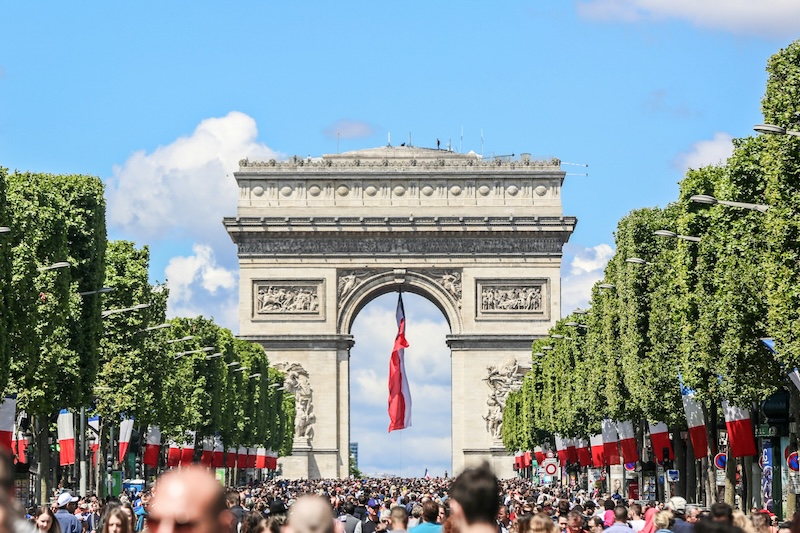
Celebrating ‘Le Quatorze Juillet’ in Paris. Photo by Yewin on Unsplash.
The military parade has a special significance for me – an officer’s daughter and the sister of an Air Force General – especially as the kickoff was done in synch with an air parade. To the delight of the crowd, two small planes flew one on top of the other, with the top one upside down.Those planes are part of the Air and Space acrobatic team of the French Air Force, who have been world champions since 2022.
The “Big Nine” of the Patrouille de France gave a spectacular performance: nine Alphajets flying in perfect unison with tricolor smoke trailing behind them. The Patrouille has existed since 1953 and is based in Salon-de-Provence.
In all, more than 6o planes took part in the event: 26 Rafales, Mirages, and Falcon aircraft and 28 helicopters, including two light helicopters Guépard. The latest generation F4 Standard Rafale demonstrate improved connectivity with satellite and intra-flights links.
The modernization of the technology was developed during the French-led Operations Serval and Barkhane in the Sahel region since 2013.
Polyvalence, info-valorization and integration principles were on display in the new military equipment such as Leclerc tanks, Cesar canons, five-tons heavy tanks, 2022 hussards for infiltration and exfiltration of intelligence, armored vehicles essential for logistics in delivering troops, and equipment, such as anti-personnel mines, anti-ballistic missiles and trailers with drones .
France already has eight aircraft carriers — the largest one being the Charles de Gaulle — along with 10 nuclear submarines.
The parade was an opportunity to display the latest equipment from the defense maritime system in existence from Belgium to both Cherbourg and Mont Saint Michel, as well as for the nuclear approach that was developed during the Harmattan Operation in the war against Libya in 2011.
More than 6,500 men and women marched down the Champs Elysées. Their superb performance required at least six hours of rehearsals. The graduates of the élite military schools like Ecole Polytechnique,Saint Cyr-Cohêtquidan (founded in 1802 by First Consul Napoleon Bonaparte in Fontainebleau), Ecole de l’Air (created in 1933 and the oldest air force academy in the world), and Ecole Navale always have a special place in the military parade.
Marching also were some of the 800,000 firefighters who are engaged in the fight against the growing danger of forest destruction. Thirty thousands of them are volunteers. In February 2023, they took part in a rescue mission to Turkey and Syria after the earthquake which killed 60,000 people. France uses 21 bi-engine bombers , including 12 Canadairs ( pioneered by Canada) to fight the fires from the air.
La Légion Etrangère [Foreign Legion] always stands out on the 14th of July. It is the only group which has its own band. The pace is strikingly slow. One soldier swirls his baton high in the air. The men from many nationalities are dressed completely in white. Some wear leather aprons. A soldier with a beard longer than his companions’ holds a dog on a leash.
The colorful contingent of the Garde Republicaine , accompanied by the noise of the horses’ hooves on the pavement is most popular with the public. Created in 1802 by (again) Bonaparte – this special corps of 3,300 men and women is part of the Gendarmerie Nationale.
The defilé ended up with quite a moving choreography of young people positioned to form a Croix de Lorraine – the declared symbol of the Résistance by General de Gaulle in 1940. The commissar of the armies read the letter of Jean Moulin, hero of the French Underground.
And finally, the crescendo of the haunting “Chant des partisans, ” a 1828 Russian melody imported by a Russian emigré to France in 1917, rose over the ceremony.
The 2023 ceremony was indeed bristling with the symbolism of France’s destiny and its De Gaulle heritage.
Editor’s Note: This is the opinion of Nicole Prévost Logan.
Nicole Prévost Logan
About the author: Nicole Prévost Logan divides her time between Essex and Paris, spending summers in the former and winters in the latter. She writes an occasional column for us from her Paris home where her topics will include politics, economy, social unrest — mostly in France — but also in other European countries. She also covers a variety of art exhibits and the performing arts in Europe. Logan is the author of ‘Forever on the Road: A Franco-American Family’s Thirty Years in the Foreign Service,’ an autobiography of her life as the wife of an overseas diplomat, who lived in 10 foreign countries on three continents. Her experiences during her foreign service life included being in Lebanon when civil war erupted, excavating a medieval city in Moscow and spending a week under house arrest in Guinea.
Editor’s Note: This article is based on the transcript of a talk on the reopening of Notre Dame de Paris given by Nicole Prévost Logan to the residents of Essex Meadows on Dec.10, 2024.
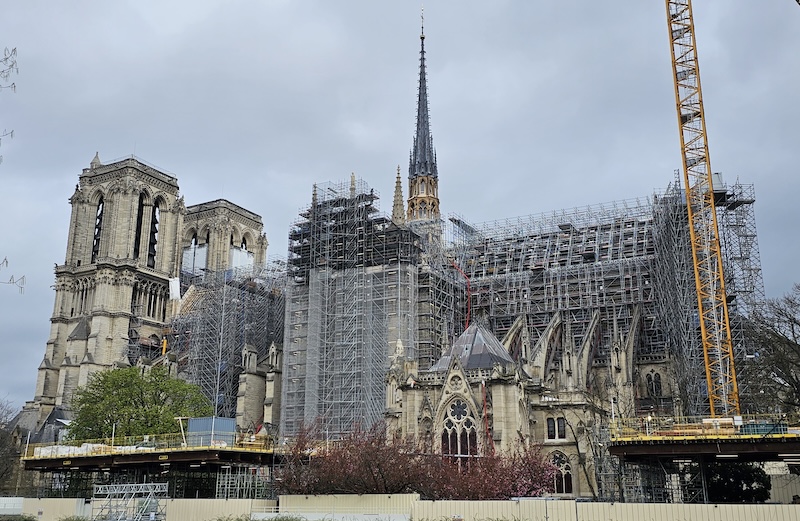
The Cathedral of Notre Dame was under extensive scaffolding during its restoration. Photo by Philip Logan.
The reopening of Notre Dame has been covered by the world media, including the New York Times, the Financial Times, National Geographic and many other publications. Striking images of the restored cathedral have been made available to all of us in numerous TV programs. The interest shown by the American public is particularly impressive.
My children and myself, dividing our time between the US and France, have been privileged to watch first-hand the restoration process. I was able to make three slide presentations in Connecticut, respectively in 2019, 2020 and 2023, using the photographs sent by my children from Paris, including the professional shots taken by my architect son. It had become a family project to cover the story.
December 7 was a day which will live in infamy, said FDR, but it marked also the joyous celebration that we had all been waiting for: the official reopening of the cathedral. I must admit I was glued to my computer to see the live report of the event on the French TV channels.
France is living through difficult times with the political deadlock and the frigid relations between Ursula Von der Leyen, president of the EU Commission and President Macron. Von der Leyen turned down the invitation to attend the ceremony and chose to be in Uruguay to promote a trade agreement with South America, which France and other EU countries strongly oppose.
Contrasting with the Middle East and Ukraine, which are being devastated and tens of thousands of people killed, the restoration of Notre Dame of Paris is an uplifting source of inspiration. Carried out by an international surge of enthusiasm, the cathedral, not only survived after being on the verge of collapse for several months but resurrected to become more beautiful than ever .
Before the fire of April 15, 2019, the monument was a decrepit old building. During the years I lived in Paris, I always saw it disfigured by scaffoldings. The apse and its flying buttresses were in bad shape and had to be repaired. The 19th century spire was crumbling and metal scaffolding had been erected to fix it. In fact, it is likely that the fire was caused by a short occurring in that pre-2019 scaffolding .
On the very evening of the fire, French President Emmanuel Macron made a promise to have the church reopened within five years. Philippe Villeneuve, chief architect of Notre Dame since 2013, supported that view. The excellent Sixty Minutes CBS show, aired on Dec. 1, 2024, stressed the importance of the president’s vision and continued support.
Another important remark made in Sixty Minutes was the excellence of the architects, artists, and artisans, who carried out the project, many of them part of The Companions duDevoir , an association dating back to the Middle Ages. They became a model and attracted the best arts and crafts workers in the world.
One of them was a carpenter named Jackson Dubois from New York (a good name for a carpenter since “bois” means wood in French.) Dedication and pride characterized the more than 2000 people, working on the restoration site of the cathedral and of the many other places throughout the country. These workers were motivated by the importance of sharing their knowledge. Tools, methods and materials were traditional. Much of the work was done by hand, and nails were not used in the making of the wooden framework for the roof and spire.
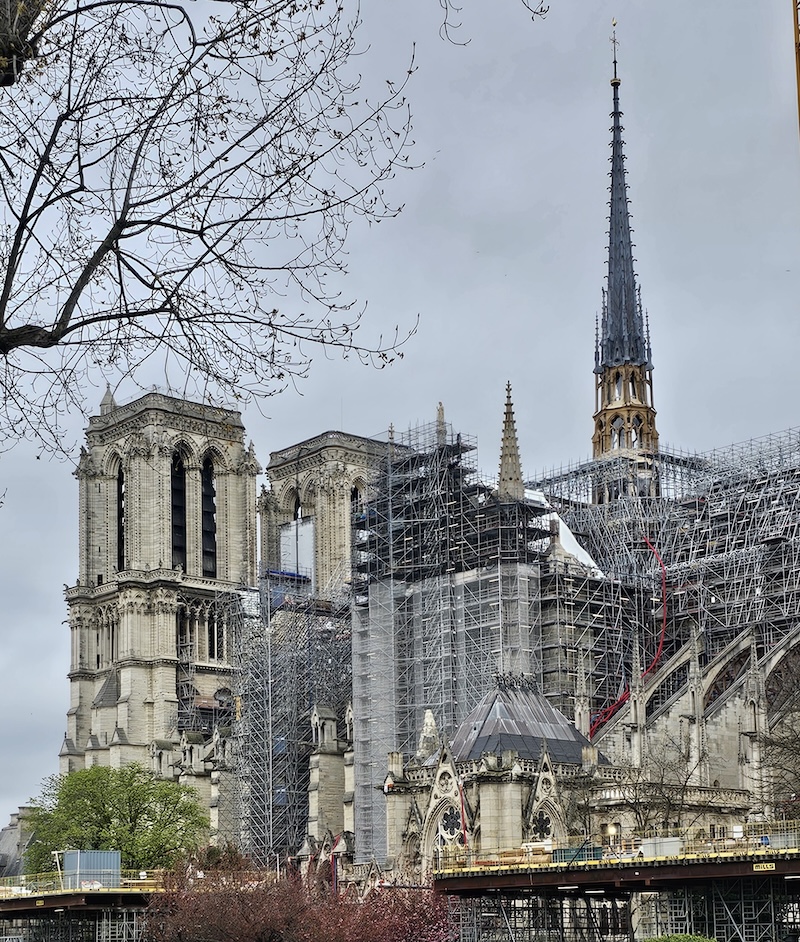
The sheer amount of work involved in the restoration is almost unfathomable. Photo by Philip Logan.
The restoration work of the cathedral was helped by an amazing amount of donations reaching 840 million Euros contributed by 240,000 donors around the world, the Americans coming in second place. Two of the richest men of France—Bernard Arnaut, the owner of luxury good LVMH, and François Pinault, another billionaire, who owns Gucci—competed.
Arnaud gave 200 millions and Pinault donated “only” 100 million, but Pinault boasted that he did not ask for tax deduction. Two years ago Peter Bulkeley, during a fascinating tour of Fenwick in Old Saybrook, pointed out the house under construction of Francois Henri Pinault, the son of the billionaire and now head of the Christie’s auction house. Pinault’s summer “cottage” overlooking the Sound in Fenwick has now been completed.
CTA BBC commentator summarized the Notre Dame project thus: no public funds, on time and on budget.
The objective of the incredible task accomplished since the 2019 fire was not only to restore the cathedral but also to integrate into the reconstruction new features to prevent any future safety threat or any disaster such as a fire.
Here are two examples. In order to avoid the run-off of rain water from the lead roof, special filters have been installed to filter that water so that toxicity will be reduced to zero. Dozens of thermal cameras have been installed in the new oak framework of the roof and of the spire. If a fire were to start, it would immediately be detected and water pipes activated to spray a mist over the area. “A fire will never happen again” declared Philippe Jost who now supervises the completion of the work at Notre Dame.
Among the events which have taken place in the cathedral, an incident is rarely mentioned. General De Gaulle, on August 26 1944, after walking down the Champs Elysees was scheduled to attend a thanksgiving mass at Notre Dame. As he approached the church, snipers started shooting. Unperturbed, the general continued to walk.
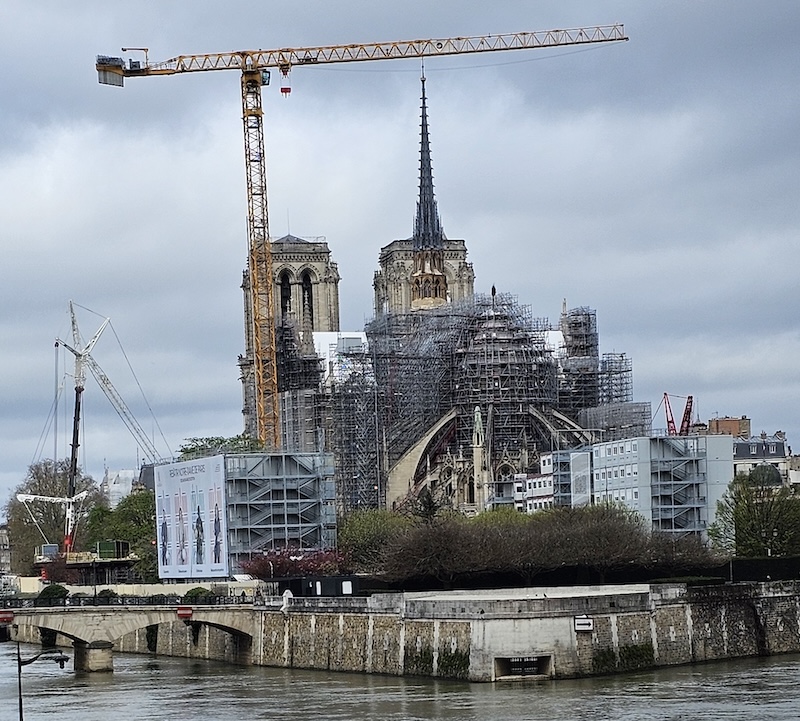
Another view of the Cathedral of Notre Dame during its reconstruction.. Photo by Philip Logan.
Should there be an admission price to enter the cathedral? Rachida Dati, French Minister of Culture and former mayor of the seventh arrondissement in Paris, suggested five euros . An interesting clipping was published in The Day discussing the pros and cons.
As a frequent visitor to Notre Dame my own experience has been of a disorganized system to face the huge lines. Everyone—that is people going to mass, individual tourists, groups—all entered through the same main portal. A single church attendant would try to handle crowds. Inside the monument, people attending mass were bothered by the herds of visitors tramping through the aisles with their cameras flashing non-stop.
The Catholic church made an alternative decision to an entrance fee: at no time there will be more than 3,000 persons inside the building , each person will have only 45 minutes allowed in, reservations will be required three days in advance, different access doors will be used for individuals versus groups, church-goers or tourists.
Hopefully this will help alleviate the nuisance caused by the even larger of visitors expected in 2025. Our cultural heritage should to be treated with care. The cave of Lascaux, in south west France, had to be closed because human presence was detrimental to the mural paintings. The Pope himself, in his letter read during the opening of the cathedral, insisted that entrance had to remain free.
I have always seen long lines of people wanting to see the view from the top of the cathedral. Someone commented : if they want to see Paris they should climb on the Eiffel Tower . Did you know that until 1889, when the Eiffel Tower was built, Notre Dame was the tallest building in Paris?
The first impression of the recent visitors to the cathedral is its luminosity. Light is pouring in. The stone, which used to have turned dark grey with grime, soot and lead dust is now blonde. Colors are the new magic. It is a shock to see the vivid blues of the stained glass Rose windows, For the first time one is surprised to see the Viollet le Duc mural paintings in some of the 26 chapels The scenes of Christ life on the carved wall which separate the choir from the deambulatory, now has colors.
In the Soviet Union, bells were silent for 70 years. People felt quite emotional when hearing them again. It was the same feeling in France after five years of silence. Emmanuel is the largest of all the Notre Dame bells. It dates from the 17th century, in Louis XIV time. It hangs in the South Tower and weighs 14 tons. It plays a low sharp F note. The eight smaller bells are in the North tower. Sound is important in a cathedral, as remarked the first violinist in the Radio France symphony orchestra which performed in concert in the cathedral The “reverberation”-or time during which the sounds lingers on- is seven seconds
Guillaume Bardet, designer of the liturgical furniture, created a minimalist altar, cast in bronze. The altar was produced in a foundry in the Rhone Valley region . The 1500 chairs, made of solid oak were designed and created in the Vautrin workshop, in the Landes region. The metal work decorating the spire was created in a Normandie foundry . The excellence of the artisans working in all these workshops in the country were an important part of the restoring team.
A final touch to the restoring process was the laying of the new, beautifully waxed checkerboard marble floor.
Now for the official opening of the cathedral. I listened and watched every minute of the proceedings so shown on the French TV, I could share with the details you in the US.
Actually three events were happening simultaneously. The ceremony was strongly affected by an uninvited guest: the Darragh storm After a brief photo op, the guests , fighting wind and a pouring rain, struggled from their cars to enter the building. The large tent with hundreds of chairs where French president had been scheduled to make a speech, was now empty.
Fifty royals, chiefs of state, and personalities from France and the entire world had been invited. An important moment for diplomatic and political exchanges. President Zelensky was greeted with loud applause. The Baltic states were all present. Prince Albert II of Monaco was there without his wife and so was Prince William of the United Kingdom, representing his father King Charles III. The presidents of Finland and Poland were there.
President-elect Donald Trump alighted from his massive armored black car. He was wearing a yellowish tie. The cameras never left him. After shaking many hands, he reached the front row in the knave.
How to sit the guests on that row must have given the protocol people an ulcer. Macron was first, then Trump, then Brigitte Macron and, next to her, Jill Biden and her daughter Ashley. The President of Georgia and her husband—she leads the pro-Europe movement in that country—were the last. Twenty years ago she renounced French nationality to become Georgian.
Elon Musk entered and disappeared from the camera’s field. I saw him later gazing at the beautifully restored arched ceiling and keystones. The presence of certain personalities shocked some, for being out of place in a religious monument. There were two noticeable absentees: Ursula Von der Leyen, president of the EU Commission, and Pope Francis.
The second theme of the ceremony was praise for all those who saved the cathedral and carried out the restoration. This is what Macron did in a brief speech. It was the first time since the Concordat of 1905, separating Church and State, that a French president has spoken inside a cathedral. The tempestuous weather left him no choice The arrival of the firefighters—in their intervention red suits—and of the Companions who worked on the site, were greeted with long and loud applause.
Finally, in the third place, the guests were invited to witness the powerful rituals marking the transmission of the secular to the religious authority over the cathedral. The Most Reverend Laurent Ulrich knocked three times with his crosier on the main portal before entering the cathedral. Emmanuel Macron returned the keys of to the archbishop.
The archbishop thanked profusely Macron for his continued support and for being there every step of the way. One remembers how the president, apparently not afraid of heights, climbed to the very top of scaffolding over the new spire. From now on Philippe Jost, as Director of the Etablissement Public, will supervise the completion of the restoration work.
“Organ wake up” the archbishop pronounced those words three times. In a dramatic way, the lights went on the 18th century great organ with its shiny 8000 pipes. Three organists sat in succession at the console in response to the exhortations of the archbishop and filled the cathedral with the most beautiful chords in the world. “This the breath of God”, concluded the bishop. When played at its fullest volume, the organ—called grandes orgues in French—makes a gothic cathedral soar.
* * *
The restoration of Notre Dame is not over. One can still see the giant cranes and the scaffoldings around the apse. The wood braces, which had been put in place to reinforce the flying buttresses, will be removed, and some contemporary stained glass windows will be installed.
The creation of a “in situ” museum is now being proposed. It would be located in parts of the Hotel Dieu hospital opening on the cathedral square and contain medieval artifacts.
Editor’s Note:This is the opinion of Nicole Prévost Logan.
Nicole Prévost Logan
About the author: Nicole Prévost Logan divides her time between Essex and Paris, spending summers in the former and winters in the latter. She writes an occasional column for us from her Paris home where her topics will include politics, economy, social unrest — mostly in France — but also in other European countries. She also covers a variety of art exhibits and the performing arts in Europe. Logan is the author of ‘Forever on the Road: A Franco-American Family’s Thirty Years in the Foreign Service,’ an autobiography of her life as the wife of an overseas diplomat, who lived in 10 foreign countries on three continents. Her experiences during her foreign service life included being in Lebanon when civil war erupted, excavating a medieval city in Moscow and spending a week under house arrest in Guinea.
How the Youngest Ever French PM was Replaced by the Oldest
As a rule, French politics are full of surprises but the summer of 2024 took the country into unchartered waters.
For weeks the search was on to find a new Prime Minister. All attempts led to an impasse. People started getting really worried: was there even a pilot on the plane?
And then, on the 51st day, President Emmanuel Macron announced his unexpected choice of a man who had spent more of his political life in Brussels than in Paris.
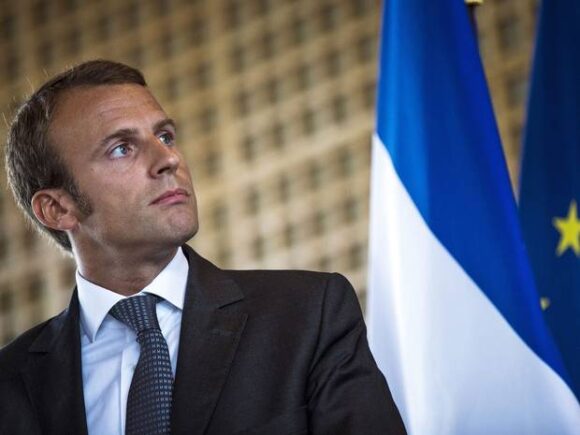
French President Emmanuel Macron. Photo via Wikimedia Commons.
On Sept. 5, a transfer of power ceremony took place in Hotel Matignon when the resigning prime minister Gabriel Attal, age 33—the youngest ever Prime Minister of the fifth Republic—turned over his functions to Michel Barnier, age 73, and the oldest.
The wait for 51 days to nominate a Prime Minister was the longest ever in French politics. What happened during that period was the exacerbation of déjà vu infighting between President Macron and the political parties.
As I explained in my 7/18 LymeLine article, the RN (Rassemblement National) hard Right populists had been denied access to power thanks to the clever voting maneuvers of the leftist NFP (Nouveau Front Populaire) at the polling station on July 8.
Everything was put on hold during the Olympic games, which appear in retrospect as a blissful interlude when the French were united and happy. The search for a Prime Minister resumed in August .
The first candidate was Lucie Castets, nominated by the NFP. Politically she is an independent, highly educated and qualified, although without any experience in government. She was received at the Elysée Palace “after a long and courteous meeting”, to quote Françoise Fressoz, editorialist at Le Monde.
It was pay-back time for the NFP which, after all, had been the main actors in stopping the RN from winning the elections. As the largest group in Parliament, they felt entitled to choose the Prime Minister, although, since they did not have a majority of seats in the National Assembly , they had no legal right to do so, according to Brice Teinturier, director of Ipsos, an international market research and public opinion firm.
From the start, Castets was feared to become a puppet for far Left Jean-Luc Mélenchon, head of LFI (La France Insoumise.) As to Marine Le Pen, she threatened an immediate Motion de Censure (vote of no confidence.) Definitely a bad beginning for this candidate …
To avoid the rapid overthrow of a government and to insure stability, Macron turned Castets down. Melanchon was furious and demanded the ‘destitution’ (similar to impeachment) of the president. According to the article 68 of the Constitution, ‘destitution’ can only be justified for “high treason” or in a situation when the president shows signs of losing his mind. That was the case in 1920 when President Paul Deschanel wandered on the railroad tracks in his nightdress, allegedly regarding a dispute with the conductor.
A second name was proposed by the president: Bernard Cazeneuve, a Socialist, former prime minister during François Hollande’s presidency. Olivier Faure, president of the Socialist sub group (part of the NFP coalition), rejected Cazeneuve. How surprising that a Socialist would be against another Socialist!
The argument was that Cazeneuve appeared too much like the continuation of Macron’s program and embodied the Hollande ‘s policy in the final days of his mandate. Again, Marine Le Pen threatened to strike the candidate with a motion de censure. Relations between Macron and Cazeneuve were frigid. Cazeneuve is definitely out.
Marine Le Pen, President of the RN (Rassemblement National.) Photo via Wikimedia Commons.
Two more names came up: Xavier Bertrand, LR (Les Republicains) President of the region of Hauts de France (formerly Haute Normandie) and Thierry Beaudet, from the Economic and Social advisory board. Laurent Wauquiez, president of the LR Republicans can’t stand Bertrand, and claims that any compromise of his own program would be crossing a red line. Bertrand and Beaudet are rejected by RN and NFP after a few hours .
At that point, someone remarked with irony: if it takes so long to designate a Prime Minister, how long is it going to take to choose a new cabinet of 35 persons or more? Furthermore , the new Prime Minister will have to deal not only with the ministers, who have resigned, plus also with the new ones. A bit overwhelming, wouldn’t you think?
The NFP complained … they stole our elections. Jerome Fourquet, heads of the Opinion department in the polling institute IFOP, comments that the political software in the Fifth Republic did not appear to function any more. When two thirds of the National Assembly (both extreme Right and Left) claim that their elections have been “stolen” (sounds familiar, doesn’t it?), there is something very wrong. Jerome Joffré, political scientist asks rhetorically: Why vote … since the election results are not respected?
By Sept. 2, dark clouds loomed on the horizon. Philippe Dessertine, renowned economist and Professor at the Institute of Administration of the Enterprises explained that France is under surveillance from the European Union (EU.) France will have to report by Sept. 16 on the country’s deficit, which is going through the roof, now standing at close to 5.6 percent of its GDP. (Under the Maestricht rule, only a 3 percent deficit is allowed.)
The International Monetary Fund is also watching France to whom it just sent an unprecedented letter of warning. Besides, on Oct. 1 the annual debate on the budget is scheduled to start.
The financial pressure on France therefore has never been so strong, stresses Dessertine. One hundred billion Euros in savings must be found before 2027. The public sector costs a lot while not functioning well. Local communities are deeply in the red. The public hospitals are falling apart. The number of bankruptcies has increased by 25 percent in recent years.
Even worse, one hears that Bercy (the Ministry of Finance) has kept financial problems hidden. There is a lack of pedagogy. The public opinion should be explained more frankly how serious the situation is.
Pierre Moscovici, President of the Cour des Comptes (the highest body in France, responsible for auditing public funds) stresses the financial situation of France is worrisome. There is positive news, however. Inflation is at a low of 1.9 percent and interest rates remain attractive at 3 percent.
Germany is now in an economic recession. It just had to close some of its car production chains and lay off more than 130,000 workers for the first time in 85 years at Volkswagen. The automobile industry is the core of the German economy.
The rest of the EU is watching the two power houses of Europe with anxiety since both are in trouble.
In a nutshell, the French Left shot itself in the foot by being so uncompromising from the start and the Socialists missed the boat by denigrating each other.
The hatred of a large part of French public opinion for Macron is notorious. As he went through a list of possible names for Prime Minister, the president was accused of all possible sins, ranging from his ” immobilisme” to being called a ‘pervert’, or simply a piece of trash.
But the violence of insults lashed at him reached new heights when he made his final choice with Michel Barnier on Sept. 5. He was then criticized for digging “fossils out of Jurassic Park”.
French Prime Minister Michel Barnier. Photo via Wikimedia Commons.
The political pedigree of Barnier is impressive. He has been a minister under several presidents including Mitterand, Chirac, Sarkozy. In Brussels he was an early precursor in the fight for the environment a former EU commissioner for the Internal market handling banking and digital matters. He was the head of the EPP (European People’s Party)—the largest party in the European parliament.
But he is best known for being the negotiator of Brexit for four years.
He comes from a Gaullist family raised in the Alps region of Savoie. He was the organizer of the winter Olympics in 1992 in Albertville, with well-known French champion skier Jean Claude Killy.
His task as the new prime minister will be challenging to say the least. The retirement reforms remain a bone of contention in everybody’s throat. His intention to raise the “pivot age” to full retirement to 65 is bound to provoke a storm. His program includes the control of immigration and bringing down the deficit. But at the same time, he plans to reach out for the low income people and will be ready to tackle social problems.
He knows everybody in Brussels. With his connections he might be able to obtain a delay in the tough EU decision to sanction France for its out-of-control deficit. He has mingled with most world’s leaders. He is widely respected … even by the British.
Relations with Macron will be sensitive. Macron does not like to be overshadowed by anybody, particularly in the regal matters of foreign affairs and defense, which usually are the prerogative of the president.
The reaction of the French public opinion was violent: choosing Barnier was a hold-up against democracy, a man coming from LR, a small right wing party of only 47 deputés, representing barely 7 percent of the elected body.
In contrast, in Brussels congratulations poured in. EU President Ursula von der Leyen tweeted a special message to Barnier. Banks, stock markets also reacted favorably.
At this point, given the urgency of the debt, whether they like him or not, Barnier, is a chance for the French to avoid falling into a downward financial spiral. France does not have the luxury of continuing denial of its disastrous finances. On Sept. 10, one of the leading European economists, Mario Draghi, sounded the alarm on the desperate situation in Europe. Does France have a choice at this point?
What does the future hold? Barnier will be under tight surveillance by the French politicians. Marine Le Pen seems now like the referee more than ever and is calling the shots. The NFP has announced it will bring a motion de censure immediately. Even former prime minister Gabriel Attal, who formed his own party in the National Assembly, may become critical of Barnier.
It seems likely that Barnier’s mission might turn out to be even harder that negotiating Brexit.
Editor’s Notes: Full photo credits for the photos are respectively: Emmanuel Macron: Belgian Presidency of the Council of the EU 2024 from Belgium, CC BY 2.0 https://creativecommons.org/licenses/by/2.0, via Wikimedia Commons Marine Le Pen: Vox España, CC0, via Wikimedia Commons Michel Barnier: European People’s Party, CC BY 2.0 https://creativecommons.org/licenses/by/2.0, via Wikimedia Commons.
The elections to the European Parliament on June 9, 2024, raised more interest, but also more concern than ever because of the rise of the populist movement in the continent.
Every five years, the 720 Members of the European Parliament (MEPs) are elected by universal suffrage in a number proportional to the size of the states’ population, e.g., France is allotted 81 seats. The parties existing in each European Union (EU) country join the seven main political groups of the European Parliament, which can be described as follows:
The centrist EPP (European Popular Party) is the largest group with 186 members. The president of the Commission—incumbent and reelected Ursula von Leyen (who used to be the Minister of Defense in the cabinet of Angela Merkel)—belongs to the EPP. The nomination of the leaders of the main EU institutions (Commission, European Council, diplomatic services, etc.) have to be approved by the Parliament, hence the importance of this legislative body.
The second largest party—S & D (Social Democrats)—has 135 members. The right-left coalition with the EPP has dominated the Parliament’s history for a long time.
In third position comes the ID (Identity and Democracy) It is a far-right group, which has just been transformed into the “Patriots of Europe” on July 8, 2024. It is growing fast, attracting populists from several countries like Hungary, the Netherlands, Austria, the Czech Republic and a few others. It has 78 members.
Giorgia Meloni and her party, the “Brothers of Italy,” as well as AfD (Alternative for Democracy) in Germany, have been keeping away from the new Patriots party until now. For the time being, they they remain in the ECR group (European Conservatives and Reformists). Although a far right prime minister, Meloni is an Atlanticist and praises pluralism—she is gradually growing more pro-Europe and wants to assist Ukraine .
The results of the June 9 elections were grim.
In Western Europe, governments of some countries are trying to adjust and contain the populists. As an example, in the Netherlands, a coalition of four right-wing parties runs the government, but Dick Schoof—the Prime Minister—is a centrist. In Germany, the left-wing AfD obtained only 16 percent of the votes whereas the ruling coalition of three parties (FPD, CDU and Greens) received 30 percent on June 9.
In Eastern Europe, however, the populists seemed to be losing steam somewhat. Donald Tusk, the Polish prime minister is working hard at undoing the societal damages done by his predecessor in the PiS (Poland’s Law and Justice Party). The right-wing prime minister of Slovakia must govern with a strong opposition and so does Viktor Orban, who now has an opponent, Peter Magyar. A liberal is heading the Romanian government.
But the populist onslaught came mostly from France. In meteoric progress, Marine Le Pen’s party the RN (Rassemblement National or National Rally) increased its number of seats in the Assemblée Nationale, from 8 in 2017, to 89 in 2022 and then to 193 on June 30, 2024.The Cac40 (French stock market) plummeted by 6 percent on June 9.
It is interesting to note that In the new landscape of the European parliament, three strong women—Marine Le Pen, Giorgia Meloni and Estonian prime minister Kaja Kallas—cannot stand each other.
On the evening of June 9, President Emmanuel Macron of France made a decision, which took everybody by surprise, including his own prime minister Gabriel Attal. He dissolved the Assemblée, which was not supposed to happen until 2027 at the end of his term.
French President Emmanuel Macron.
Actually Macron had been thinking of doing just that for several months. He believed that this decision could achieve two goals—first, give the population a chance to express its opinions through a referendum and second, gamble on the hope that the new legislative body would function better within the Elysée.
Working sessions in the Assemblée had become a dysfunctional exercise with the two extreme parties—RN and LFI (La France Insoumise, or Unbowed France.) The latter is a far-left party headed by Jean Luc Mélanchon. Both these extreme parties became allies to hamper debates with the repeated use of motions de censure (votes of no confidence.) It was a dangerous decision for the president to dissolve Parliament, but whatever the outcome, he had nothing to lose.
When Roger Cohen, the New York Times correspondent in France, declared, “The Macron era is over, a chapter is closed,” he missed the complexity of French politics, and the ability of the people to rebound and emerge from chaos.
Actually “Macronism,” consisting of holding the center and acting as a magnet for moderates in both the right and the left, is still a force to reckon with, although it had been depleted by the loss of 100 seats since 2022. Given the visceral hostility of most French people toward the president, however, Macron’s name is best left unmentioned.
The two-round French elections to elect a new Assemblée were scheduled for June 30 and July 7. Those dates coincided with the beginning of the summer vacations. Families had made plans months in advance.
The problem was solved by creating more than three millions proxies and by people voting via the internet. There was a moment of panic but somehow the French got organized in record time. A swift electoral campaign got off the ground.
Participation in the voting process was impressive, reaching 69 percent—a number unsurpassed for 40 years .
The extraordinary rise of the RN in the first round of the French election with the electoral map turning bleu marine (navy blue)—an appropriate color for Marine Le Pen—seemed to give a jolt to the population and incite it to rise up to block the hard right in the second round.
Instructions were given to candidates running for a seat in the Assemblée to withdraw from the race in the case of “triangular elections” in order to beat the RN candidate. It was quite an unusual sight to see French politicians disciplined enough to follow instructions! Since there were more than 300 “triangular elections,” the result was astounding.
The RN came out in third place with 143 seats instead of the 220 seats for which they had hoped. The former Macron ‘s majority, called today Ensemble, was second with 163 seats and the NFP (Nouveau Front Populaire or New Popular front) was first with 182 seats .
Between the two rounds Jordan Bardella, 28, the chief of the RN and protégé of Le Pen, had been trained for four years by a communications specialist. He began to behave like a prime minister during his official appearances, obviously relishing the prospect of a future “co-habitation” with the president. He considered it a done deal that he would become prime minister.
He had set the bar very high, declaring that he would not accept that responsibility unless his party obtain the absolute majority. Bardella, acting effectively as a pure demagogue, made numerous promises and commitments which Marine Le Pen—a very seasoned politician—kept correcting and toning down.
One must note that the politicians during this intense time of post elections behaved with absolute correctness. No one questioned the validity of the elections’ results. In fact Prime Minister Gabriel Attal offered his resignation immediately on the very night of July 7.
Bardella said, “We have made mistakes and that includes myself.” They did not dwell on their disappointment but rather rebounded. Le Pen declared, “I have been a politician for too long to say that I was disappointed in the result.” Attal transitioned from being a prime minister to become the leader of the Renaissance party in the Assemblée.
Bardella turned his defeat in France into an advance in the European parliament. He now is the head of the new populist group called “Patriots for Europe” in Strasbourg. Unfortunately he will be even more dangerous there than in France by threatening to undermine the EU from within. Le Pen is placing herself in pole position for the 2027 presidential election.
For several days after the July 7 elections, the political scene in France has been rather confusing. It is going through labor pains to form a government. The left-wing NFP had been the driving force in the prior elections. They feel that they have a right to nominate the prime minister since their party came out as a winner on July 7—but they do not have the majority enabling them to decide.
Furthermore their alliance is fragile and made up of socialists and hard left politicians, who do not get along. Belgian neighbors advised the French people not to be too impatient. Belgium remained one whole year with a “technical government,” which just managed routine issues . Even Germany operated for two and a half months without a government.
None of the three French groups acquired the 289 seats needed to qualify for an “absolute majority.” In the future, whether they want it or not they will have to enter into alliances with other parties in order to govern. Otherwise, ironically, they will have to use the 49-3 (equivalent to Executive Orders) for which Macron has been so criticized in recent years.
The NFP has a program, which appeals strongly to the people—raise the minimum wages or smic, return to the retirement age to 60, reduce the tva (value-added tax.) But these measures will cost billions, which France can ill-afford. Besides, when the NFP declares that it wants to promote its own program and nothing else, and rejects compromises, it is a sure recipe for stalemates.
Today the Elysée Palace looks empty. The power has shifted to parliament.
France itself saved the day—at least for now. The results of the July 7 second round of French legislative elections were greeted almost across the board in Europe with a huge sigh of relief.
Editor’s Note:This is the opinion of Nicole Prévost Logan.
Nicole Prévost Logan
About the author: Nicole Prévost Logan divides her time between Essex and Paris, spending summers in the former and winters in the latter. She writes an occasional column for us from her Paris home where her topics will include politics, economy, social unrest — mostly in France — but also in other European countries. She also covers a variety of art exhibits and the performing arts in Europe. Logan is the author of ‘Forever on the Road: A Franco-American Family’s Thirty Years in the Foreign Service,’ an autobiography of her life as the wife of an overseas diplomat, who lived in 10 foreign countries on three continents. Her experiences during her foreign service life included being in Lebanon when civil war erupted, excavating a medieval city in Moscow and spending a week under house arrest in Guinea.
Tragic link between the featured artists is that they all committed suicide
Nicole Prévost Logan
PARIS, FRANCE — The art scene in Paris during the last month of 2023 was quite intense. Three major exhibits of artists—coming respectively from France, the US and the Netherlands—attracted a sophisticated, international public. These artists have nothing in common, except that all three of them committed suicide.
Nicolas de Staël is all the rage today in Paris. The retrospective at the Museum of Modern Art in Paris is the first since 2003 when the Pompidou Center showed the artist’s early work. De Stael is considered as one of the most famous artists in France today and also the most expensive.
The large exhibit includes works coming almost entirely from private collections rather than from museums, indicating his success on the art market. This may explain the sometimes acerbic comments from art circles. Except for Braque, who became his longtime friend, de Staël was closer to writers and poets than to other artists. In contrast, the reaction of the public was gushing and unanimous enthusiasm.
De Staël was born into to the Russian military nobility in St Petersburg. In 1917, at the age of three, he left Russia with his family. After a few difficult years in exile, he found himself as an orphan at the age of eight. Wealthy friends, who welcomed Russian immigrants, helped him attend an upscale school in Brussels.
At the age of 23, he folded up his more than six foot five frame into the tiniest of all French cars—a deux chevaux ( a two-horsepower) Citroën—and drove to Spain on the first of his incessant travels, always searching for the perfect light. What he discovered in Morocco made him throw out everything he learned during his three years of study at the Royal Academy of Fine Arts in Brussels. He painted eight hours a day and destroyed everything he painted.
His life story reads like a Russian novel, full of passion, despair and drama. His flamboyant and vibrant personality was like a magnet, attracting relatives, lovers and friends and contributed a great deal to his fame as an artist. Disregarding morality conventions, he fell passionately in love with married women. The first one was a young painter, Jeanine Guillou, an adventurer, touring the Sahara desert on the back of a donkey with her husband, also a painter.
After her death in 1946 and the difficult years of the Occupation of Paris by the Nazis, he married Francoise Chapiton, 21, who was teaching English to his stepson Antek and had three children with her. A few years later without qualms, he would leave her and his three children and engaged in another passionate liaison with a married woman, Jeanne Polge.
A visitor to the exhibition is struck by the unusual journey of the artist’s creation which broke the traditional path from figurative to abstract and therefore did not fit into the accepted categories. During his earlier period, de Stael had produced a majority of black and white drawings, graphic work and then one witnesses an explosion of spectacular colors and a return to figurative work.
Actually it is deceptive:since, from a distance, landscapes, architecture, scenes with people or with activities—like a port, or a football game—may seem like figurative representations created “after the motif” but, on looking more closely, the scenes are, in fact, made up of geometrical shapes, which are close to abstraction. One of the earliest paintings where he used color was done in 1933—in the “Arbre Rouge ” (the red tree), red paint drips and makes the tree look as if shedding red tears.
His way of painting was unique. He worked on several paintings at the same time, borrowing from one to modify another. A buyer would be surprised to discover that the work he purchased from the artist was different from the one he saw at first.
Even his studio was out of the ordinary. Located on Rue Gauguet in the 14th arrondissement of Paris, close to Rue des Artists and Parc Montsouris, it had an incredibly high ceiling of eight meters. An art historian compared it to a well, a barn or a chapel.
In 1953, de Staël presented his works in New York and was celebrated by an enthusiastic public and rave reviews in the New York Times. But de Staël’s temperament clashed with art merchants. He disliked the way they speculated on his paintings even before seeing them. There was a great deal of tension at the time of hanging the paintings, which de Stael was used to insist on doing himself. Nevertheless the exhibition of 36 paintings was both a triumph and a financial success.
In 1954 he bought Le Castelet,Menerbes, a fortified manor perched on a rock in the Luberon region of southeast France. The family still owns it today.
In 1955, he continued his frenzy of travels and painting. He rented a studio in the ramparts of Antibes, overlooking the Mediterranean. Ten years earlier, Picasso had created his art studio in the Grimaldi castle also in the ramparts. Antibes was founded by the Greeks in the 5th century BC, under the name of Antipolis.
On the 16th of March, 1955, de Staël commited suicide by jumping onto the rocks.
The de Staël exhibit at the Museum of Modern Art is unusually large. It includes 11 rooms and covers his entire life. One is literally overwhelmed by the masterful works created during his last few years, painted in a wide spectrum of dazzling colors. Here are but a few of them.
“Agrigente”, 1954, 60x81cm .This Sicilian landscape, is simplified to the maximum. the colors are imaginary (purple sky, pink road, yellow hillside). An historian describes the choice of colors of de Stael as a “crashing wave of emotions.”
“Temple Sicilien”, 1954, 73x100cm. The colors are golden, softer, the architecture reduced to simple lines.
“Le Fort Carré d’Antibes”, 1955, 114x195cm. A symphony in blues and whites. The paint is light and fluid. Not much figurative work in this one, mostly geometric shapes floating between sky and sea.
“Ciel à Honfleur”, 1952, 100x73cm. The softer. shades of blues in horizontal bands under the pale sky of Normandy.
“Marseille”, 1954. 80.5x60cm bright primary colors, houses are just cubes, the Mediterranean sea is a flat deep blue
“Parc des Princes”, 1952, 200x350cm. France-Sweden soccer match. One of the master pieces of de Staël. The match takes place at night under spotlights. A ton of muscles fly around the green grass of the stadium. After many sketches, the final painting is an abstract composition of colored energy. At the 86th minute of the game France lost to Sweden.
Mark Rothko (I903-1969)
The Rothko exhibition is the blockbuster of this winter in Paris. Parisians have become accustomed to these spectacular events taking place in the museum of the Vuitton Fondation. Since its opening in 2014, it has held other breathtaking exhibits such as the collections of the two most important Russian art collectors of the Tsarist era: Morozov and Shchukin.
Photo of Mark Rothko, Yorktown Heights, ca. 1949 by Consuelo Kanaga (American, 1894-1978). Gelatin silver photograph, 10 x 8in. (25.4 x 20.3cm). Brooklyn Museum, This image was uploaded by the Brooklyn Museum as a content partnership, and is considered to have no known copyright restrictions by the institutions of the Brooklyn Museum.
An aerial picture of the Bois de Boulogne reveals that the spinnaker-shaped museum created by Frank Gehry is the only building peeping out of the green expanse of the forest. How did they ever obtain permission to build there? The fact that Bernard Arnault, the owner of LVMH—which stands for Louis Vuitton Moët and Chandon—was the richest man in the world until April 2023 perhaps helps explain why.
Twenty four years ago, the Museee d’Art Moderne in Paris had presented a full retrospective of the artist’s works. So, why a repeat in 2023? The long lines of visitors attest to the fascination of the Parisians for the American artist.
Christopher Rothko, son of Mark and co-curator of the exhibition, is playing an essential role in the present exhibition since he contributes the inside story about his father’s personality and the struggles in his artistic career. “It is a miracle”, he explained in an interview, that we were able to obtain 60 percent of the works we wanted as well as several never seen before in Paris. Besides, he added, the Fondation Vuitton helped negotiate loans, which usually have an exorbitant cost.
The Frank Gehry structure is perfect for an exhibition of this size. It allows for an easy flow of the visitors who can access painlessly the five levels of the display, thanks to the all-glass elevators located at strategic places. Personally I wish the confusing layout of the Orsay museum, with its cramped rooms, was more like this.
Learning about Rothko is to attend a course in the history of American art in the 20th century. Marcus Rotkovich Rothko was a scholar, a rebel, and a pioneer fighting for his deep philosophical and social convictions. In 1913 his family emigrated from Latvia, which was then part of Russia, to Portland, Oregon. A brilliant student, he attended Yale for three years. Until 1950 he taught children in the Brooklyn Jewish Center Association.
The exhibit starts with a huge room where his early works are exposed . For 20 years, he was a figurative artist, painting portraits, urban scenes (such as his subway scenes) and landscapes . He also liked to draw archaic figures and monsters inspired by his readings of Nietzsche and Aeschylus . He was most impressed by European artists like Matisse, Miro or Marx Ernst, the Surrealists, and later by the generation of artists—mostly Jewish—who left Europe in World War II.
In 1946 he began his “multiform” series and his definitive evolution toward total abstraction, which art historians call his “classic period” This is the period we are most familiar with, characterized by his “fields of color” .
There was a love-hate relationship between Rothko and New York. He found his inspiration in the town but was highly critical of New Yorkers for their mercantilism, calling them “shopkeepers.”. He hated the frenzy of his life as an artist. But American art was enriched by the stands he was taking.
In 1950, the Metropolitan Museum of Art organized an exhibit entitled: American Painting today” and did not even mention abstract art. Rothko joins the group of 19 “angry artists” , including Jackson Pollock and Willem de Koonig, rebelling against the conservatism of the Met. And today, what does the visitor to the Met or MoMA see? The works of Rothko seem to form the core of those museums’ collections.
The monumental sizes of Rothko’s paintings tend to overpower the viewer. One does not look at Rothko’s painting, wrote an art critic, but enters them. In the small “Philips room”, a simple bench invites the viewer to sit in front of a Roth’s painting and meditate .
The range of colors, from the luminous orange, to the maroon to the grey and black , has a strong impact on the feelings of the spectator. The canvasses are totally covered with paint The demarcation line between different strata of colors seem out focus and a zone with a fluffy texture. In the room at the upper level of the exhibition, his paintings are the most severe. We see a black sky and a grey earth transporting us into wnat one could describe as lunar scenery. The Giacometti statue of “man walking” add sto the somber feeling
Probably the most spectacular event in his career was the commission he received in 1958, to create murals for the elegant Four Seasons restaurant of the Seagram building on Park Avenue, between 51st and 52nd streets. Mies van der Hohe was the chief architect of the 37-floor skyscraper and Philip Johnson was his associate . Van der Hohe was German and the last director of the Bauhaus school in Berlin before it was forced to close by the Nazis in 1933. The innovative design of the Seagram was a steel structure on pillars with a reinforced concrete inner core. Rothko worked for months on the project in an oversize studio he had rented for that purpose. Then he abandoned the project. Later he donated nine maroon murals to the Tate Modern in London. The nine maroon murals are part o the Rothko exhibition on loan from the Tate.
His very last project, was “The Rothko chapel” in the Saint Thomas University in Houston commissioned by sthe extremely rich art collectors John and Dominique Menil (she was the heir to Schlumberger) .
At age of 66, in 1969, he committed suicide in his studio by overdosing on barbiturates and slashing an artery in his right arm.
Gallery talks, offered by art specialists or “mediators”at every level of the exhibit, provide some helpful guidance to the general public on how to analyze one’s emotions when trying to comprehend Rothko’s “Abstract Expressionism”
Vincent Van Gogh’s at Auvers-sur-Oise ( May 20—July 29 1890)
At the Orsay museum, the exhibit of the last three months of Vincent Van Gogh at Auvers-sur-Oise leaves the visitors dumbfounded at how the artist, whom we all know so well, could still impress us with paintings never seen before.
After a one-year, self-imposed stay in St Remy-de-Provence psychiatric hospital, the prospect of living in the small village of Auvers-sur-Oise around 30 miles to the northwest of Paris, and being totally free to go and plant his easel to paint wherever he pleased, was most enticing. His brother, Theo, could visit him often since Auvers was easily accessible by suburban train from Paris.
In Auvers, Dr. Gachet, who was to treat Van Gogh, became his close friend. They shared a mutual interest in Impressionist painting and even their neurasthenic (neurasthenia is a condition characterized especially by physical and mental exhaustion) tendency. Theo, who had made all the arrangements for Vincent’s stay, was optimistic as to the improvement of his brother’s condition. in such a setting.
One must go through a one small room called, “La Palette” before seeing the main exhibit for two reasons: first, saving hours of waiting in line and second, the short, three-dimensional, virtual experience conditions the visitor to plunge into Von Gogh’s haunted world.
You live through intense, almost scary, moments, with the heavy head-set on. You open an elegant, white door with a digital hand and enter a parlor furnished with a piano, a desk and a few chairs. Next, you are transplanted into the wilderness. A palette appears on your left and moves toward you, it becomes huge and threatening, with heavy blobs of paint on it. You are being attacked by it. You find yourself in a forest, surrounded by trees. Slowly you are going down, going through a layer of roots, menacing like a bunch of wiggling giant worms.
Or to use the words of Guillaume Morel’s, a regular contributor to the magazine “Connaissance des Arts,” “gnarled roots, charred trunks, twisted branches.” You are pulled down lower and lower into a bottomless pit, a wreath of trees above your head closes up the view of the sky. Still shaking, you return to the parlor. Now you are emotionally ready to affront the mob scene of the Von Gogh’s exhibit .
The theme of the small format paintings is the village, with its streets, houses and walled gardens, and the fields nearby. One of the streets is animated by two black figures of old women, followed by two young pony-tailed girls dressed in fluffy, white dresses. The 13th century church seems to be aggressively pulsating with life. On the outskirts of the small town, sleepy thatched roof farmhouses and cultivated fields seem peaceful at first.
‘Wheatfield with crows’ by Vincent van Gogh. July 1890. Van Gogh Museum, Amsterdam. This work is in the public domain in the United States because it was published (or registered with the U.S. Copyright Office) before January 1, 1929.
But the agitated brush strokes of Van Gogh turn the few trees into flames, the cottages about to collapse under the weight of their roof, the skies are torn with bizarre and tormented hieroglyphs. The use of aplats or flat areas of paint by the artist to picture the calm fields and sheaves of wheat left by the farmers are soon replaced by a stormy wheat field swept into a storm—a splash of yellow dotted with the black dots of the flying crows.
This most famous painting of all was long believed to be Vincent Van Gogh’s last one. No more. On July 27, 1890, the artist painted “Roots” (the painting the visitor suffered through during the virtual experience of La Palette). Later on that day Van Gogh shot himself in the chest. The painting was found on the easel after his death. He died two days later .
And let me leave you with this extraordinary fact—in the 70 days he spent at Auvers, Van Gogh created 74 paintings … more than one a day.
Editor’s Note:This is the opinion of Nicole Prévost Logan.
Nicole Prévost Logan
About the author: Nicole Prévost Logan divides her time between Essex and Paris, spending summers in the former and winters in the latter. She writes an occasional column for us from her Paris home where her topics will include politics, economy, social unrest — mostly in France — but also in other European countries. She also covers a variety of art exhibits and the performing arts in Europe. Logan is the author of ‘Forever on the Road: A Franco-American Family’s Thirty Years in the Foreign Service,’ an autobiography of her life as the wife of an overseas diplomat, who lived in 10 foreign countries on three continents. Her experiences during her foreign service life included being in Lebanon when civil war erupted, excavating a medieval city in Moscow and spending a week under house arrest in Guinea.