
TOP STORY: Old Lyme Committee Seeks Community Input on Safety Issues in Town

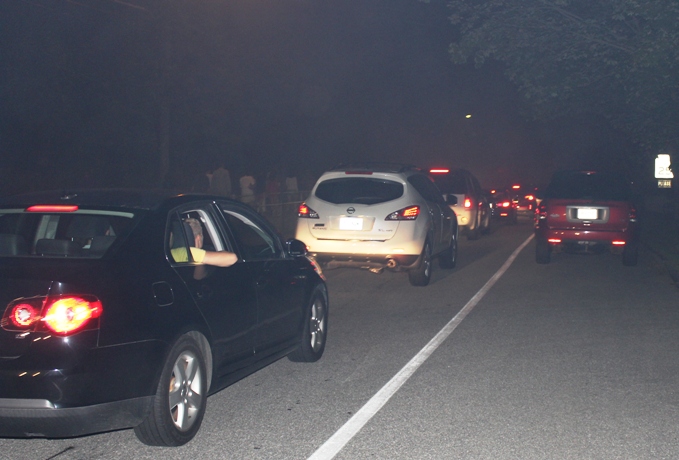
It is unusual for traffic to be backed up on on Lyme Street … but it happens. This photo was taken after a Midsummer Festival fireworks display a few years ago. The Old Lyme Road and Public Safety Committee would like local people’s thoughts on safety issues on our roads and have a launched a survey seeking public input.

Committee Launches Survey for All Road Users to Complete, Mulls Options Including Speed Cameras, Speed Humps

OLD LYME–The Old Lyme Road and Public Safety Committee would like road users’ thoughts on whether there are safety issues on local roads, and what may be done to make travel safer in Old Lyme.

In response to local complaints, and a statewide concern over vehicle speeding and serious traffic accidents, the Old Lyme Board of Selectmen created a Road and Public Safety Committee in August 2024. 

The committee, in its efforts to explore the best ways to address traffic-related concerns across town, has created an online survey for drivers, passengers, pedestrians and bikers who use Old Lyme roads.

Everyone 18 years and older is asked to take a short, anonymous survey. People may also write to the Committee with specific concerns or questions. 

Access the survey at this link:  https://www.surveymonkey.com/r/OldLymeRoadSafety or via the QR code at left. The deadline to complete the survey is July 31.

The committee is interested in whether road users believe there are safety issues on Old Lyme roads, and their thoughts on possible countermeasures.

After research and deliberation, the Committee may make recommendations to the Board of Selectmen for action items.

Since its inception, the committee has started to research driver behavior and consider various traffic safety measures that may be appropriate for Old Lyme.

Meeting minutes show the committee continues to look at options for using enforcement cameras to detect speeding cars and mail tickets to the registered owner.

Committee Co-Chairman Gregory Futoma in a Monday phone interview said the survey is a way to gauge people’s input on the scope of the unsafe driving problem in town, and where it’s most prevalent. They also want to know what kind of solutions might work in Old Lyme. 

“We’d like to basically come up with a solution that’s accepted by all,” he said. 

The committee was formed after the issue of speeding was brought to the forefront last spring by a Sill Lane homeowner, who said a 16-year-old driver wiped out eight historic shrubs and destroyed the front porch of her 18th century home. 

The committee since its inception has been looking at fixes ranging from updated signage, to speed humps, to speed cameras with ticketing technology.

Speed Cameras

State lawmakers in 2023 authorized cities and towns to install automated speed cameras and to issue tickets. 

Information on the state Department of Transportation (DOT) website specifies tickets are mailed to the owner of the vehicle. A ticket cannot exceed $50 for the first offense and $75 for each subsequent offense, with up to $15 for electronic processing. The installation of each new camera comes with a 30-day grace period during which only warnings are allowed. 

Car owners are liable for tickets even if they weren’t actually driving.

The civil fines do not appear on the car owners’ records, according to the state DOT. That means there are no points assessed against their licenses or sent to insurance companies.  

Washington became the first Connecticut town to be approved for speed enforcement cameras under the new law early this year, with Middletown joining the ranks as the first city earlier this month. 

Proponents of the cameras say they can cut down on speeding significantly. Critics describe the remote technology as a revenue generator that jeopardizes the civil liberties of those accused.  

In addition to seeking input from those who use Old Lyme roads through the survey, Futoma said one of the committee’s key priorities is to consult with towns that have implemented a speeding enforcement camera program. 

He said questions will include how the program was introduced, whether residents were resistant, and what kind of education could help ease the transition. 

“I think we’re at the beginning of what perhaps may be a more common enforcement technique in the future, but it’s still fairly new and people certainly have some questions about it,” he said. “It needs to be explained to people carefully about what the aim is, and how it might work.

The Board of Selectmen is the state-recognized traffic authority in town. Futoma emphasized that any move to institute speed cameras would require approval by Old Lyme voters through an update to the town’s ordinances and by the state, which must determine the measure is likely to improve safety in the specified locations. 

“So it’s a long road,” Futoma said. 

The committee at its June meeting said feedback from the police department indicates speed notification signs – the digital devices on various roads in town that announce drivers’ speed and tabulate data but do not send out tickets – are helping to reduce speeds. 

Speed Humps

The committee has also spoken with officials in North Stonington about multiple speed humps installed in that town over the past several years, Futoma said. 

Futoma described the traffic-calming devices as flatter and more elongated than the speed bumps already installed in some of Old Lyme’s beach areas. He said the humps are designed so that emergency vehicles aren’t slowed down or stressed by traveling over them. 

Town public works and public safety officials at the committee’s March meeting were “universally opposed” to speed humps because of concerns about response time and damage to plows and emergency vehicles, according to meeting minutes. But member Sophie Diamond said emergency services personnel in North Stonington, who were initially opposed to speed humps, did not have complaints after they were installed. 

Futoma said he welcomes input through the survey and in emails to the committee, which can be sent here

“We want to make sure that whatever we do, people view as reasonable, and they look forward to basically having the road safer,” he said.


TOP STORY: Old Lyme First Selectwoman Fined by FOI Commission for Witholding Requested Documents

Shoemaker Admits Mistake, Will Pay $250 Fine Herself

Old Lyme First Selectwoman Martha Shoemaker. LymeLine file photo.

OLD LYME–The state Freedom of Information Commission (FOIC) has taken the rare – but increasingly utilized – step of issuing a civil fine to Old Lyme First Selectwoman Martha Shoemaker for failing to turn over public records about alleged sexual improprieties at the Old Lyme Ambulance Association to a local online news outlet, CT Examiner.

The commission, charged with administering and enforcing the state’s Freedom of Information Act (FOIA) voted Wednesday to uphold a report from hearing officer Valicia Harmon. A staff attorney for almost 20 years, Harmon in an audio recording of the meeting told the commission it was only the third or fourth time she’d found a case concerning enough to warrant a fine. 

She set Shoemaker’s fine at $250.

Known colloquially as the state’s Sunshine Law, the FOIA attempts to shine light on the halls of government by preserving access to public documents and meetings. 

CT Examiner reporter Francisco Uranga at the meeting told the commission it took 168 days for Shoemaker to hand over two incident reports at the center of the case, which he said contained allegations that an intern was touched inappropriately and repeatedly by an adult emergency medical technician with the independent Old Lyme Ambulance Association. 

The employee resigned. An investigation by the Connecticut State Police was closed in December after prosecutors declined to move forward with the case, according to state police.

Shoemaker, who is in her first term as first selectwoman, said in a phone interview that she made a mistake. 

“I accept the decisions by the FOIC and I have worked diligently over the past year to educate myself and my staff as well as to improve upon our internal processes for responses to requests for town records that my office receives,” she said. 

Shoemaker received the incident reports on March 18 and 19 of last year, according to Harmon’s report. The resignation letter from the employee involved in the alleged incident came on March 19. 

The report said Shoemaker testified she didn’t provide the reports because they “didn’t come to mind” when she was asked three months later for documents related to alleged incidents of sexual harassment or assault. 

Shoemaker told LymeLine she will pay the fine personally. 

“It is not coming from the town coffers,” she said. 

FOIC Executive Director Colleen Murphy in a Thursday phone interview with LymeLine said three of the 14 cases heard by the commission this week included a fine, which she described as unusual. She said it could be evidence of a philosophical shift in a commission that historically has relied on training opportunities to try to encourage government officials to “do the right thing.” 

State lawmakers in 2023 increased the maximum fine for violations from $1,000 to $5,000. 

“In the aftermath of that legislation passing, we’re seeing some more traffic in the area of fines,” she said. 

What is Reasonable?

According to Harmon’s report, CT Examiner in June 2024 asked Shoemaker for documents including employee rosters, resignation letters and any allegations of sexual assault or harassment. Uranga and CT Examiner writer Andy Thibault the next month filed a complaint with the FOIC stating the first selectwoman had not provided all the requested information and had improperly redacted one document. 

The reporters asked the commission to impose a $5,000 fine and mandatory FOI training. 

Uranga on Wednesday told commission members the documents are important because they revealed the allegations he was investigating turned out to be about “sexual assault, not simply sexual harassment.” 

“That distinction, I think, is crucial and clearly documented in the redacted reports, and goes to the heart of why we take this case (and the delay) so seriously, and why it simply defies belief that the first selectwoman of a small, privileged town could fail to recall these incident reports until prompted by Attorney Harmon,” he said in prepared remarks at Wednesday’s commission meeting. 

Harmon in her report said it was only after the first evidentiary hearing in December that Shoemaker provided the news outlet with the two incident reports detailing incidents of alleged sexual harassment that led to the resignation of a town employee. 

“If they hadn’t filed a complaint with the commission, it’s likely that those records would never have been discovered,” Harmon told commissioners. 

Harmon told commission members that her recommended fine reflected the gravity of keeping the public in the dark on the serious matter, while taking into account the selectwoman’s willingness to put corrective measures in place. 

“I thought that the fine was small, but it was firm,” Harmon said. 

Harmon said she didn’t believe Shoemaker intentionally violated the Sunshine Law. But she said the standard for authorizing a fine doesn’t require a person to act with intent. 

The law empowers the commission to impose a fine if there are no “reasonable” grounds for withholding a document. 

“And I think that it wasn’t reasonable to not recall that there were these two investigation reports concerning a very serious incident that resulted in someone resigning,” Harmon said. 

Town Attorney Kristi Kelly, of the New London-based Suisman Shapiro law firm, told the commission she had “no knowledge as one of the town’s attorneys that an incident report even existed” until the December hearing. 

The documents were provided to CT Examiner within a week of Kelly finding out about them, she said. 

The commission’s 5-2 vote in favor of Harmon’s decision was opposed by two members with experience as local elected officials. 

Commission member Matthew Streeter, a former South Windsor mayor, who went on to become a professional town manager, said he has sympathy for elected officials in small towns. He said first selectmen often don’t have the experience that trained professionals do. 

“These are people that volunteer,” he said. 

He said the commission used to reserve fines for repeat offenders, with education for first time offenses. “But now I think that it seems that we’re changing it, that we’re going to just throw the book the first time to a first selectman.” 

Member Jonathan Einhorn, a former New Haven alderman, made a failed motion to strike the civil penalty from the report. He ultimately voted with Streeter to reject the hearing officer’s decision. 

Murphy, the commission’s executive director, said in her phone call with LymeLine that members are trying to “figure out the contours” of the legislature’s decision to allow heftier fines – and whether that means more of them. 

The commission in April issued its first $5,000 fine to a town attorney in East Haven accused of flouting the state transparency law and repeatedly defying directives from Harmon, who was the hearing officer in that case as well.

Murphy reiterated commission members have relied historically on training as a way to encourage compliance. “It’s too early to tell, but they may be headed in a slightly different direction,” she said.

Editor’s Note: 6/28: This article has been updated to note that Shoemaker is in her first term as First Selectwoman.
6/29: This article has been updated with a photo of Shoemaker.

Talking Transportation: The Health Risks of Flying

The views out of an airplane window can be spectacular but have you ever considered the effects of flying on your body? LymeLine file photo.
Jim Cameron

Think air travel is just about delays and lost luggage?  Your body has other plans. 

Forget plane crashes and fights about who gets the armrest.  If you survive TSA, a middle seat, and boarding group 9, now you have to make it through the flight itself without your body unraveling like cheap luggage on a baggage carousel. 

Let’s start with Deep Vein Thrombosis (DVT), or what they call the “Deadly Window Seat Special.”  You sit there for five hours without moving (thanks, beverage cart), and your blood turns sluggish, like airport Wi-Fi during a gate change.  Congratulations — you’re now flying DVT Airlines. The longer the flight, the better your odds of a one-way ticket to the ER.  Solution: get up every hour or so and walk.  And drink lots of water.

Feeling thirsty? You should be.  Aircraft cabins at altitude are drier than the pretzels in coach. Humidity in-flight hovers around 10%, meaning your eyeballs are shriveling and your skin is turning into parchment.  Lubricating eye-drops and moisturizer should help.

Speaking of airplane air, did you know the cabin is pressurized only to the altitude of Denver?  That’s great but only if you’re a bighorn sheep (the 787, A350 and A380 jets are an exception.)  For the rest of us, the lower oxygen can make you woozy or give your heart a surprise cardio session.  Got COPD or anemia?  Check with your doctor before flying.

Then there’s the inflight ear torture, courtesy of barotrauma.  This is why babies start crying before landing.  As the plane descends, your ears feel clogged as the pressure builds. Pop. Crackle. Pain.  But don’t worry … chewing gum, awkward jaw-stretching exercises or giving babies a bottle will probably help.  Or buy yourself a pair of EarPlane earplugs.

Crossing several time zones? Get ready for jet lag, also known as time-travel-induced dopiness.  Your body thinks it’s 3 a.m. in Hartford, but you’re eating airport sushi in Tokyo.  They say it takes one day of adjustment for each time zone you cross.

And for you frequent fliers: congratulations on your élite status … and cumulative cosmic radiation exposure.  One transatlantic flight gives you about as much radiation as one or two dental x-rays.  Not glowing, but not nothing.  Trans-polar flights leave you the most vulnerable.

Add in poor air circulation, recycled germs, and some guy sneezing in row 13 — and suddenly that N95 mask doesn’t seem so paranoid.  Still feeling like a little nosh?  Too bad.  Your guts are rebelling too. Gas expands at altitude, so avoid the bean salad.

Flying doesn’t just take you places. It slowly breaks down your body in a pressurized metal tube full of crying babies and funky air.  But hey, at least your suitcase made it to Cleveland.

PS:  While train travel is my preferred mode, extended sitting en route is still a problem.  But at least you can get up at will and stroll to the Café Car for some over-priced AmFood.  Try the cheeseburger.  It’s actually pretty good.

Editor’s Notes: i) Jim Cameron is the founder of the Commuter Action Group and advocates for Connecticut rail riders. He writes a weekly column called ‘Talking Transportation,’ which is published by a number of publications in the state.
ii) ”Talking Transportation” recently won first place in the general column/commentary category in the Connecticut Society of Professional Journalists Excellence in Journalism Contest.

Lyme Public Hall’s Exhibition on Impact of World War II on Lyme Residents Runs July 4-6

LYME, CT—2025 marks 80 years since the end of the second World War.

Visit Lyme Public Hall after the Hamburg 4th of July Parade to see a new exhibit from the Bacdayan Local History Archives exploring the impact of those war years on life and the families living in Lyme.

The exhibit will feature areas of interest such as:

  • Lyme’s WWII Veterans and Those We Lost in Action
  • Local warplane crashes
  • Lyme Minutemen & Grassy Hill Observation Tower
  • The Home Front: Grange, Rationing, Schools & More

As Jim Harding noted in the “Sound Breeze” on June 5, 1945: “… I don’t believe ever in the history of our towns have the people been scattered so far and wide.”

The exhibit will run Friday, July 4, from 10 a.m. to noon; Saturday, July 5, from 2 to 4 p.m.; and Sunday, July 6, from 11:30 a.m. to 1:30 p.m.

Lyme Public Hall is located at 249 Hamburg Rd.

TOP STORY: Old Lyme Wetlands Commission Denies Swaney’s Request to Change Permit Conditions at Three Mile River Gravel Pit

OLD LYME–More than a year and a half after environmental complaints publicly surfaced on the banks of the Three Mile River, the owner of a controversial gravel pit on Tuesday said he will undo changes local officials said he never should have made in the first place. 

The move came after the Inland Wetlands and Watercourses Commission on Tuesday declined to take up a request by 308-1 Mile Creek Road owner Ron Swaney to walk back conditions placed on an “after the fact” permit approval the agency granted in March to bring Swaney into compliance with local regulations. 

Swaney’s request, if approved, would have allowed him to sidestep the commission’s requirements to rectify unpermitted work that had taken place. This work included the addition of pavement millings to the driveway and the placement of boulders within the banks of the river, among other violations. 

The news was greeted as a victory for the contingent of neighbors and environmental advocates who have mobilized around the issue. The group includes 59 people, who signed onto a June 20 letter opposing any changes to the conditions. 

“Time and again this property has been the site of astonishingly flagrant violations, time and again the town has attempted to bring its owners to operate within the law, yet time and again as cease and desist orders are lifted the conditions ordered with these permissions have gone unfulfilled,” the letter said. 

Shore Road resident Peter Caron after the meeting applauded the commission for not amending the conditions.  

“All in all, we’re happy that the commission stuck to their guns and they want to protect the river as much as possible,” Caron said. 

Commission member Michael Aurelia during the meeting said getting Swaney to come to the table with a permit application was a labor-intensive process. 

“It wasn’t easy,” he said. “We had to actually start court action to get an application.” 

The lawsuit, which was filed in November of last year, is pending, but not active now that Swaney is working with the commission to address the compliance issues. 

William E. McCoy, Swaney’s attorney, after the meeting said he disagreed with the contention that it took a lawsuit to spur his client to act. He would not elaborate. 

Swaney declined to comment.

The Alternative

McCoy warned commission members during the meeting that enforcing the conditions could do more harm than good. 

An April 13 report from certified soil scientist Joseph Theroux proposed leaving a portion of the millings, keeping some of the boulders, and adding a new section of berm to protect the river.

Theroux was hired by Swaney to come up with a mitigation plan as required by the commission. The assessment came after he visited the site to find conditions “stable” in the areas he recommended leaving untouched. 

The millings, boulders and berm “all stabilize the erodible stream banks/road bed, partially prevent flood waters from flooding across the roadbed and silting up the ponds, and prevent erosion and sedimentation on the road bed from entering the river,” Theroux wrote. 

McCoy said his client would go along with the commission’s conditions if necessary, but emphasized Theroux’s plan, “Potentially is a better remediation program than was put together at the last meeting of the commission, when it decided this.”

The commission’s permit conditions also require Swaney to ensure the culvert near the entrance to the property remains clear to prevent flooding. Swaney and his team have blamed beavers for continually clogging the culvert with their dam activity. 

Aurelia during Tuesday’s meeting said it became obvious to him during the commission’s June 10 site walk that the culverts were failing. He said he also saw fragments of roof shingles in the road millings that commission members worried would get washed into the river. 

Commission member John Mesham said he believed the culvert is not adequately sized. 

“So if you want to not do some of this remediation, bring us an engineering report and a resizing of the pipe, because that’s what most of this goes back to,” he said. 

Mesham referenced a letter from resident Raina Volovski, who identified herself as a certified soil scientist, wetland scientist, and erosion and sediment control professional with 15 years’ experience. 

Volovski said she attended the commission’s site walk as a member of the public, where she found issues that exacerbated flooding conditions in some areas while also contributing to low water levels in the three interior ponds on the site. 

“The property is within a mapped floodplain. Flooding is supposed to happen. The unpermitted impacts and proposed mitigation are not going to eliminate the flooding and will potentially increase flooding issues and additional wetlands impacts,” she said. 

Consensus Decision

The commission did not take a formal vote based on advice from Land Use Coordinator Eric Knapp, who cautioned members that a motion on the matter would constitute an appeals process that would add another layer to the ongoing legal situation. 

The commission directed Knapp to work with consulting town engineer Geoffrey Jacobson to approve the bond Swaney must post with the town before work can begin. The amount, which is meant to ensure the commission’s conditions are met in a timely manner, was tentatively set at $10,000 by Swaney’s project engineer. 

Knapp said he will review Swaney’s work to ensure compliance, with the option to bring in a consulting expert if necessary.

A permit from the zoning department authorizing Swaney to excavate the site expired in May. Knapp on Wednesday said the Zoning Commission will not take up a permit application until Swaney has “fully complied” with the inland wetlands permit. 

Knapp noted that a surface water discharge permit from the state Department of Energy and Environmental Protection has also expired.