TOP STORY: Draft 2025 Conservation and Development Plan Shows Lyme Residents Still Prioritize Town’s Rural Environment

Report Notes Opposition to Affordable Housing is “Softening”

The image above shows the cover photo of Lyme’s 2025 Draft Plan of Conservation and Development.

LYME, CT— Residents continue to prize the town’s rural environment and natural resources above all else.

That’s according to the 35-page draft of the 2025 Lyme Plan of Conservation and Development (POCD), the town’s foundational planning document required by state statute to be updated every 10 years. 

The draft comes as local officials and volunteers work to align the local vision of Lyme – painted as a safe, rural retreat by its residents – with state directives to spread more affordable housing options across all cities and towns. 

The draft was produced as part of a roughly year-and-a-half-long process by the Lyme Planning and Zoning Commission and endorsed by the town’s Board of Selectmen last week. The draft will be filed with the town clerk and available for online review on Oct. 6, according to Planning and Zoning Commission member Carol House.

In a phone interview this week, House said the results show not much has changed since the 2015 plan. 

“People like living in Lyme, and they want to keep a lot of it the way it is,” she said.  

The draft update, obtained by LymeLine through a Freedom of Information request, is based largely on 704 responses to a survey distributed late last year to gauge opinions on topics including emergency services, open space and affordable housing. Eligible respondents live in Lyme, own property there, or volunteer with the local fire and ambulance companies. 

House said the last survey distributed a decade ago garnered fewer than 300 responses. This time around, the commission brought back some questions for continuity while adding new definitions and questions to address emerging issues. 

The draft report describes a population that remains willing to travel outside town borders for employment, shopping and services in order to keep the landscape unspoiled.

The vision statement, too, has remained largely consistent through two revisions over the past quarter century.

“Lyme will not attempt to become frozen in time, but will adjust to the demands and opportunities of modern life,” the statement reads. “As new technologies create the possibilities of new lifestyles, Lyme will adjust its regulations and requirements to allow people to work at home or to live in non-traditional family households. Change will occur as a result of our changing society, but in a way that preserves Lyme’s quality of life and natural resources.”

Still, House pointed to subtle shifts in the outlook among residents. 

Among them is a “softening” of opposition to affordable housing, according to the draft report. Authors cited an almost 19% increase among residents in favor of using town funds to increase housing options. But they acknowledged supporters, who totaled 47.9% of respondents in the survey, still do not represent a majority. 

The draft also shows new survey questions implemented this year revealed priorities not previously explored: that respondents “place a very high value on Lyme’s low crime rate and the ability to remain in their homes and community as they age.”

House, who serves as a co-chair of the town’s Affordable Housing Commission as well, said the POCD will provide guidance for the group tasked with figuring out how to diversify housing options in town. The commission has held off on proposing or implementing new plans while waiting to see what the surveys and final planning document had to say about the town’s appetite for change.

“I think all of that together will provide a clearer picture for how we need to move ahead with affordable housing,” she said. 

First Selectman David Lahm in a Thursday phone interview said the “will of the people” is evident in the draft document. 

“Open space is still the priority,” he said. 

That doesn’t mean affordable housing is not an important factor, according to Lahm. He said survey responses show that encouraging accessory dwelling units (ADUs) – also known as in-law apartments, guest houses and granny pods – and affordable single-family homes can be a solution in town. 

“The one thing they are not in favor of is multi unit housing,” he said. 

The town’s environmental ethos has remained unchanged since the publication of the first plan in 1964, when town leaders laid the groundwork for a focus on farming and conservation they hoped would keep the town’s population of 1,300 relatively steady despite the completion of nearby Interstate 95 only a few years prior. 

At the time, they feared the town’s inhabitants could number 5,000 by 1990 if left unchecked. So they put in zoning and subdivision controls restricting commercial development to existing areas in Hamburg and Hadlyme while keeping large tracts of undeveloped land intact. 

Today, U.S. Census figures count the population today at 2,352 people. Land records show more than half the town’s land mass is preserved as open space. 

Minimum lot sizes in Lyme now range from one to three acres across town in order to limit how many homes can be built. Only 4% of respondents said they believed smaller lot sizes should be allowed. 

The document calls for Lyme’s “aggressive sewer avoidance program” to continue, with regular inspections and maintenance of septic systems and required pumping.

The draft is being presented against the backdrop of a state vision, outlined in the Connecticut Conservation and Development Policies Plan, that describes thriving economies and increased affordable housing as key components of sustainable, equitable, vibrant and resilient communities. 

According to the plan’s authors, Lyme’s vision is in keeping with state goals for conservation and development.

“The State Plan is based on an overall philosophy of anti-sprawl, directing growth to those areas of Connecticut where infrastructure such as roads, public water and public sewers already exists, or where infrastructure can easily be expanded,” the document reads. “The State’s Plan also recommends that extensive growth be avoided in sensitive environmental areas and areas where little infrastructure exists. Lyme’s Plan meets both criteria.”

The draft POCD, stating that “uncontrolled growth and poor planning” can drastically change a town, emphasized the need to act in ways that preserve Lyme’s rural atmosphere. 

Recommendations include increasing the availability of housing by converting existing homes into affordable units, promoting ADUs and creating design standards for residential development. 

The plan continues to support farming, farm markets and work-from-home enterprises. Recommendations include limiting commercial development to existing zones while investigating regulations “that support local tradespeople, certain essential service providers and farm stores.” 

The draft report acknowledges more than 50% of land in town is protected as open space, but cautioned there’s still a lot of room for growth: “If future development on Lyme’s remaining available land is not carefully monitored and controlled, Lyme could quickly be transformed into a more suburban town.”

Recommendations call for strengthening land use regulations, preserving open fields and cultural features, maintaining an inventory of historic sites, and educating residents about sensitive areas. Farmland should be safeguarded through policies that protect the town’s agricultural roots and promote local food production. Open space preservation should focus on large, connected tracts managed for biodiversity through dedicated funding in partnership with local, regional and state groups. 

The POCD survey for the first time includes questions about emergency services, which exist locally as the publicly funded Lyme Fire Department and privately funded Lyme Ambulance Association.

Respondents supported continuing the volunteer-based models for the fire department and ambulance association, according to the draft report. Ambulance company leaders during a stakeholder interview said taxpayer funding for facilities and equipment will become necessary in the coming years.

Data in the report puts the number of ambulance association calls at 300 per year. The Town provides one bay in each firehouse, fuel for the ambulances, workers compensation coverage and a pension plan for those who qualify. The nonprofit organization’s operating costs and capital expenses for vehicles and equipment are funded by donations and by billing insurance companies.

Lahm credited the POCD writing committee, consisting of House, David Tiffany, Jennifer Tiffany and Mary Stone, for a job well done. 

“They put a lot of hard work into that and came up with a good product,” he said. 

A public hearing must be held no sooner than 35 days from the filing of the plan with the town clerk. A date has not yet been set, according to House. She said the commission hopes to schedule two hearing dates to ensure as many people as possible can participate. 

The draft document will then go back to the Planning and Zoning Commission for any revisions and a final vote before the new year, House said.

View a copy of the draft plan here.

Editor’s Note: This report was updated to include a copy of the full draft report.
TOP STORY: Old Lyme Pumps Brakes on New Gas Stations

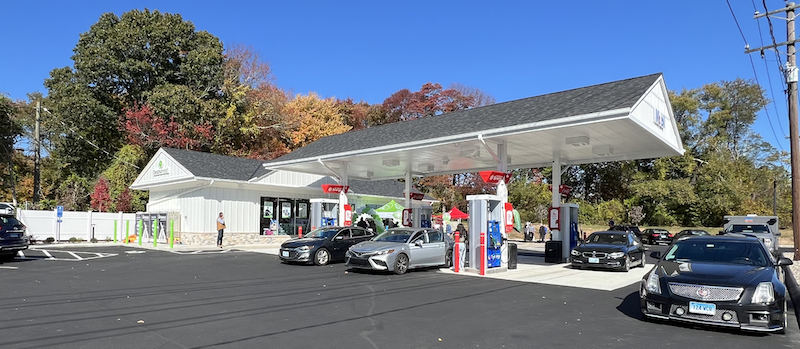
The exterior of the renovated Chestnut Market at 85 Halls Rd. in Old Lyme as seen in a 2024 file photo.

OLD LYME–Gas stations will be officially excised from the local zoning regulations, effective Aug. 11. 

The Zoning Commission on Monday voted unanimously to amend the regulations to strike gas stations from the list of businesses that can operate in town. 

Land Use Coordinator Eric Knapp said that means the existing four gas stations in town will remain, but no more will be allowed.

Gas stations were previously confined to Halls Road and certain parts of Shore Road. 

Applications for new or improved gas stations are controversial in a town where residents have long objected to development that would entice drivers to get off Interstate 95 rather than continuing on to points north or south. 

There was no comment at Monday evening’s public hearing. 

The Planning Commission in a unanimous vote last month found the move consistent with the town’s Plan of Conservation and Development. The document, updated every 10 years, is meant to guide the community’s growth based on the vision of those who live there.

TOP STORY: Old Lyme Wetlands Commission Denies Swaney’s Request to Change Permit Conditions at Three Mile River Gravel Pit

OLD LYME–More than a year and a half after environmental complaints publicly surfaced on the banks of the Three Mile River, the owner of a controversial gravel pit on Tuesday said he will undo changes local officials said he never should have made in the first place. 

The move came after the Inland Wetlands and Watercourses Commission on Tuesday declined to take up a request by 308-1 Mile Creek Road owner Ron Swaney to walk back conditions placed on an “after the fact” permit approval the agency granted in March to bring Swaney into compliance with local regulations. 

Swaney’s request, if approved, would have allowed him to sidestep the commission’s requirements to rectify unpermitted work that had taken place. This work included the addition of pavement millings to the driveway and the placement of boulders within the banks of the river, among other violations. 

The news was greeted as a victory for the contingent of neighbors and environmental advocates who have mobilized around the issue. The group includes 59 people, who signed onto a June 20 letter opposing any changes to the conditions. 

“Time and again this property has been the site of astonishingly flagrant violations, time and again the town has attempted to bring its owners to operate within the law, yet time and again as cease and desist orders are lifted the conditions ordered with these permissions have gone unfulfilled,” the letter said. 

Shore Road resident Peter Caron after the meeting applauded the commission for not amending the conditions.  

“All in all, we’re happy that the commission stuck to their guns and they want to protect the river as much as possible,” Caron said. 

Commission member Michael Aurelia during the meeting said getting Swaney to come to the table with a permit application was a labor-intensive process. 

“It wasn’t easy,” he said. “We had to actually start court action to get an application.” 

The lawsuit, which was filed in November of last year, is pending, but not active now that Swaney is working with the commission to address the compliance issues. 

William E. McCoy, Swaney’s attorney, after the meeting said he disagreed with the contention that it took a lawsuit to spur his client to act. He would not elaborate. 

Swaney declined to comment.

The Alternative

McCoy warned commission members during the meeting that enforcing the conditions could do more harm than good. 

An April 13 report from certified soil scientist Joseph Theroux proposed leaving a portion of the millings, keeping some of the boulders, and adding a new section of berm to protect the river.

Theroux was hired by Swaney to come up with a mitigation plan as required by the commission. The assessment came after he visited the site to find conditions “stable” in the areas he recommended leaving untouched. 

The millings, boulders and berm “all stabilize the erodible stream banks/road bed, partially prevent flood waters from flooding across the roadbed and silting up the ponds, and prevent erosion and sedimentation on the road bed from entering the river,” Theroux wrote. 

McCoy said his client would go along with the commission’s conditions if necessary, but emphasized Theroux’s plan, “Potentially is a better remediation program than was put together at the last meeting of the commission, when it decided this.”

The commission’s permit conditions also require Swaney to ensure the culvert near the entrance to the property remains clear to prevent flooding. Swaney and his team have blamed beavers for continually clogging the culvert with their dam activity. 

Aurelia during Tuesday’s meeting said it became obvious to him during the commission’s June 10 site walk that the culverts were failing. He said he also saw fragments of roof shingles in the road millings that commission members worried would get washed into the river. 

Commission member John Mesham said he believed the culvert is not adequately sized. 

“So if you want to not do some of this remediation, bring us an engineering report and a resizing of the pipe, because that’s what most of this goes back to,” he said. 

Mesham referenced a letter from resident Raina Volovski, who identified herself as a certified soil scientist, wetland scientist, and erosion and sediment control professional with 15 years’ experience. 

Volovski said she attended the commission’s site walk as a member of the public, where she found issues that exacerbated flooding conditions in some areas while also contributing to low water levels in the three interior ponds on the site. 

“The property is within a mapped floodplain. Flooding is supposed to happen. The unpermitted impacts and proposed mitigation are not going to eliminate the flooding and will potentially increase flooding issues and additional wetlands impacts,” she said. 

Consensus Decision

The commission did not take a formal vote based on advice from Land Use Coordinator Eric Knapp, who cautioned members that a motion on the matter would constitute an appeals process that would add another layer to the ongoing legal situation. 

The commission directed Knapp to work with consulting town engineer Geoffrey Jacobson to approve the bond Swaney must post with the town before work can begin. The amount, which is meant to ensure the commission’s conditions are met in a timely manner, was tentatively set at $10,000 by Swaney’s project engineer. 

Knapp said he will review Swaney’s work to ensure compliance, with the option to bring in a consulting expert if necessary.

A permit from the zoning department authorizing Swaney to excavate the site expired in May. Knapp on Wednesday said the Zoning Commission will not take up a permit application until Swaney has “fully complied” with the inland wetlands permit. 

Knapp noted that a surface water discharge permit from the state Department of Energy and Environmental Protection has also expired.

Old Lyme Zoning Commission Resoundingly Rejects Overlay Proposal, Calls for Cooperation in Determining Future of Halls Road

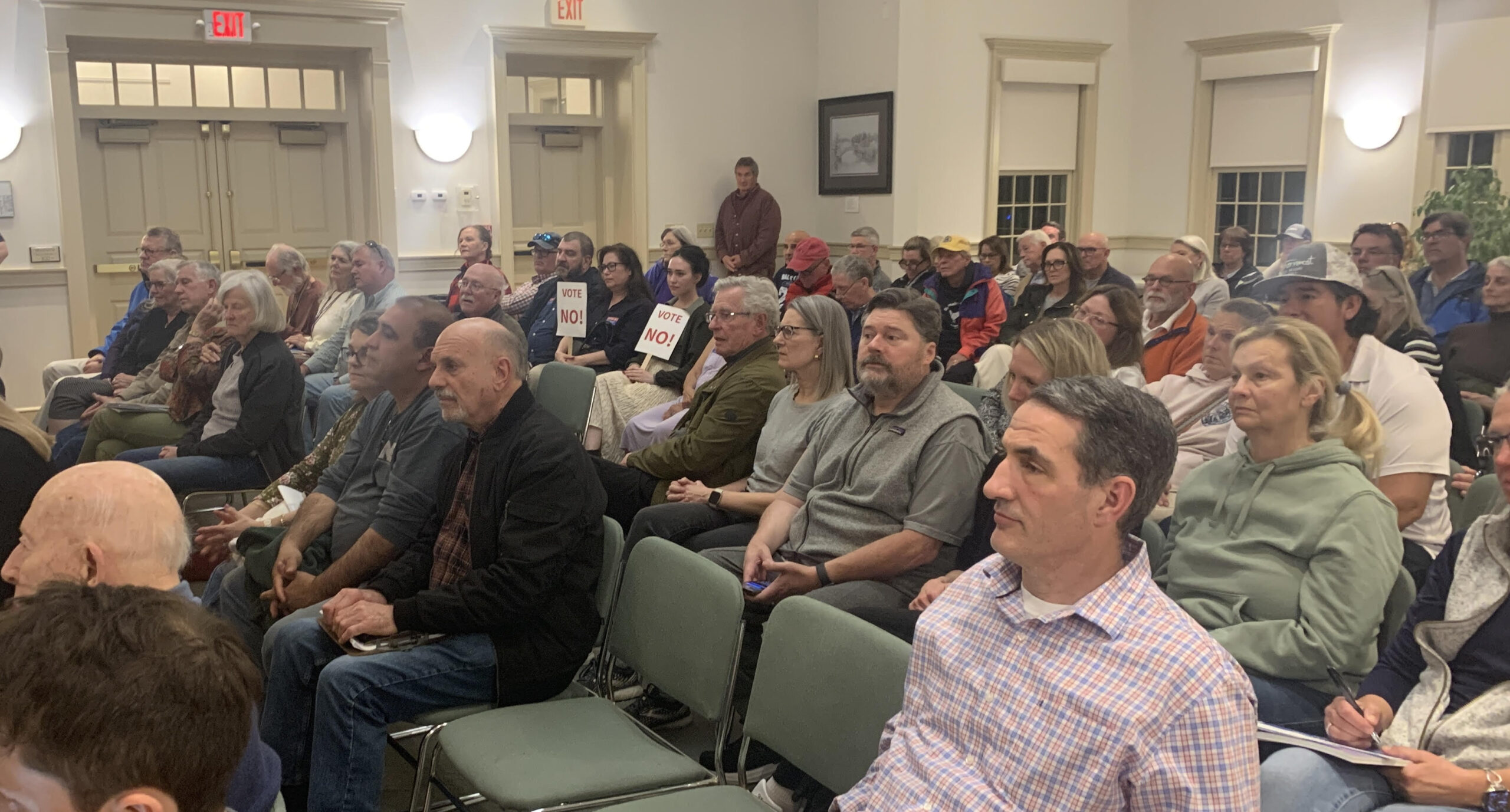
An audience of around 80 in the Town Hall Meeting Room and those watching remotely listened as the Old Lyme Zoning Commission voted 4-1 to reject the Halls Road Overlay District proposal.

Controlling Destiny … and Density

OLD LYME – Change is going to come to Halls Road, but the Zoning Commission on Monday said now is not the time. 

In front of an audience of around 80, the commission voted 4-1 to deny a proposal created by the Halls Road Improvements Committee (HRIC) for an Overlay District to allow apartments and condominiums to be built above, or behind, ground-floor businesses set close to the street. 

Commission members credited their decision to a groundswell of opposition manifested in “Overlay? No Way!” signs all over town as well as in comments on social media and at public meetings. Concerns revolved around the hazards of allowing multi-family residential development in a commercial area with limited septic availability and no sewers. Critics also called out a lack of information and not enough opportunity for residents to get involved in the process. 

Denise Savageau, a former alternate member, who was elected to a full seat last November, told commission members during their deliberations that she shared the frustration of residents that felt they were left out.

A retired environmental planner, who now serves on numerous state-level commissions concerned with natural resources, Savageau said there needs to be more involvement from the Planning Commission, Zoning Commission and other relevant agencies in coming up with changes to Halls Road regulations. And the discussions need to be conveyed clearly to the public at every step.

“I want to stress that this is not about the Halls Road Improvement Committee, but about the silos that have been created by all of the land use commissions in town,” she said. 

She described issues such as climate change and a lack of affordable housing options — both of which are subject to more state mandates with each passing year — that require local regulations to evolve. 

“The changes are going to come,” she said. “We need to plan.” 

The failed overlay district application is the latest in an effort going back more than a decade to improve the three-quarter-of-a-mile strip between two Interstate 95 interchanges that feed the town’s historic district and its shoreline. First there were calls for sidewalks; then came the possibility of village-like storefronts and apartments, a pedestrian bridge and more greenspace. Much disagreement and several discarded plans later, one of the only areas of widespread agreement is that Halls Road remains unattractive.

Some want big changes. Some want more modest aesthetic improvements. Others are fine with the way things are.

Member Jane Marsh in her deliberations recalled the commercial zone’s origin in the middle of the last century as a place people could easily access and find a place to park amid the rise of suburbanization. 

“It was created because it wasn’t going to be the most fabulously beautiful location in town. It was going to be functional and pragmatic for people, and that’s how it got built,” she said. “… It serves its purpose. It may not be very beautiful, but I don’t expect it to be beautiful, actually. I expect it to be the way it is.”

The overlay district proposal was approved by the Board of Selectmen in a 2-1 vote in November. It was endorsed 5-0 by the Planning Commission in January. 

Having a Conversation

One of the loudest voices against the overlay proposal was Robin Breeding, an artist whose social media posts and graphic design helped galvanize the opposition. Many people did not find out about the overlay district proposal until she began to publicize the issue after a sparsely attended public hearing in January. 

She welcomed the Zoning Commission’s decision in a phone interview Tuesday. 

“People didn’t know this was happening a month and a half ago,” she said of the overlay district proposal. “They thought it was going to be the sidewalks and that pretty stuff that they talked about in the beginning. And then they started to realize that it wasn’t that any longer. And they started to learn about what it was.”

She said the contention that the plan would help address a need for affordable housing was inaccurate. With the state pushing for towns to ensure at least 10% of their housing stock is affordable to lower income households, she argued the Halls Road Overlay District plan to require one out of every 10 housing units to be rented or sold at affordable rates wouldn’t advance the town’s obligation by even one percentage point. 

Only 1.58% of the town’s housing stock is currently affordable by state standards, according to data from the state Department of Housing. 

She said the overlay proposal threatened to drive out existing small businesses — many of them service providers in office settings — through its focus on new development and ground-floor retail options to be built over time if there’s enough interest from developers. 

“And so it was basically saying, ‘We don’t care about you now,’” she said of the plan. “‘We only care about some future pie-in-the-sky version of what this could be, but we can’t guarantee it.”

She said the ongoing overhaul of the zoning regulations by an outside firm presents a new opportunity for the public to learn about and become involved in the process of improving the town, including Halls Road. 

The $129,776 update of the town’s zoning regulations is being conducted by the Hartford-based FHI Studio. 

The planning and design firm was hired late last year to embark on a year-and-a-half-long project to clean up existing language in the regulations and then engage the public in discussion about potential changes as to what can be built in town, and where. 

When it comes to the kind of changes that residents of Old Lyme have a tolerance for, Breeding cited sidewalks as a good place to start. 

“And let’s have a conversation with the town, and talk to the town about how they want to move forward,” she said. 

For and Against

Commission Chairman Paul Orzel during the hearing said the public opposition brought to light some questions that have gone unanswered. 

Estimates for how many units could be built under the overlay application range from 200 to 1,200, depending on who’s doing the calculation and which variables are considered. 

“I’m a firm believer in controlling my destiny,” Orzel said. But the proposal as he saw it left too much to chance. 

Member Mike Miller applauded the residents, who spoke up against the plan. He said he shared their concerns related to the environment, tax increases and the effect of more residents on the school system and the delivery of public safety services. 

He called for a return to the basics. 

“There are many things that the HRIC brought up to our attention that are good. For example, the original charter of sidewalks and landscaping,” he said. “I think we need to have a safe corridor for pedestrian traffic for the kids from school. We have our students that come into town and work the shops. There are things that we can do.”

The lone vote not to deny the application came from Mary Jo Nosal, a former selectwoman who disputed the contention that the public hadn’t been a part of the process. She cited public surveys, various workshops, town update meetings, annual budget approvals, and reviews and input by local agencies including the Zoning Commission, Planning Commission and Board of Selectmen. 

She recalled that a master plan to guide improvements on Halls Road emerged as a response to efforts from the Federal Railroad Administration (FRA) to run high-speed trains through Old Lyme. 

Fears of the FRA’s plan slowed home sales and threatened business closures, according to Nosal. 

“The town also faced a scarcity of housing and office space options, and still does,” she said. “Long time residents had nowhere to live once they sold the family home; our children could not return to their hometown as there was nowhere for them to live and certainly afford; and community workers — teachers, healthcare workers, beauticians, grocery store workers — could not find an affordable home in town. Electric Boat was beginning its exponential growth but these professionals could not find a home here.”

She said the guiding question at the time was how to maintain and attract business and make housing more available, “While making it harder for the FRA to bulldoze our community.”

“The result was the development of the master plan for Halls Road and the effort to protect and improve our town center while being able to apply for state and federal grants for various improvements and bring in design experts to guide the process,” she said.

Nosal acknowledged many in the community feel the process behind the overlay proposal was flawed. 

“The Town of Old Lyme could look to improve the process for future town regulations and assure that more town meetings, land use joint meetings and significant planning occur as a lead-up to planning and zoning review,” she said. “But it cannot be denied nor should we dismiss the fact that many residents, the non-profits and business owners were represented in the process.”

Next Steps

After the vote First Selectwoman Martha Shoemaker said the Board of Selectmen will discuss the issue at a meeting over the next few weeks. She said Halls Road Improvements Committee Chairwoman Edie Twining has already expressed interest in working together to plan the next steps.

Twining on Monday night declined to give her own comment. But she referred to Denise Savageau’s speech on the need for town boards and commissions to work together — rather than in silos — so they could better inform and invite participation from the public. 

Twining could be seen during the meeting taking notes as Savageau spoke.

“Denise was 100% correct,” Twining said.

Editor’s Notes: i) Mary Jo Nosal is a financial supporter of LymeLine.com, but has no input to the editorial process, which remains completely independent.
ii) A reminder of Our Policy on Comments.

Halls Rd. Overlay District Proposal Faces Uncertain Future in Old Lyme, Overflow Crowd Overwhelmingly Opposes Project

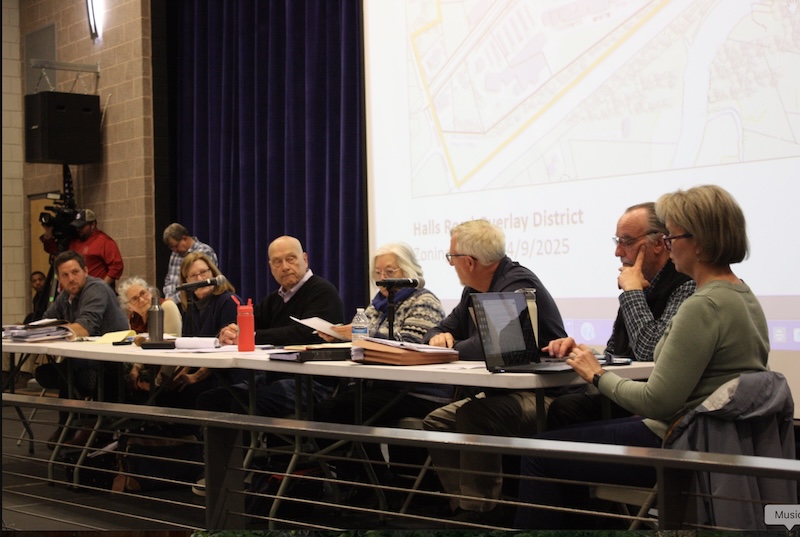
The Old Lyme Zoning Commission closed the public hearing on the Halls Road Overlay District application April 9, 2025 in front of a packed auditorium at the Lyme-Old Lyme High School. All photos by E. Regan.

OLD LYME—About 550 people converged in the Lyme-Old Lyme High School auditorium Wednesday evening, many of them armed with “Vote No” signs and deeply-held ideals about preserving their small town’s character, as they fought a plan to bring apartments and condominiums to Halls Road. 

The Old Lyme Zoning Commission voted unanimously to close the public hearing on the Halls Road Overlay District around 9:45 p.m. after roughly 40 people got up to speak. The subject was a highly controversial application for the creation of an overlay district on Halls Road that could allow as many as 40 housing units per acre to be built above, or behind, ground-floor businesses set close to the street in the 40-acre zone.  

Residents and vocal project critics Ron and Julie Malloy said they had about 500 of the “Vote No” signs printed. By the start of the meeting, only a few were left in their stack. There were also up to 100 people waiting in the hall because Old Lyme Fire Marshal Dave Roberge, per state fire code, could let no more people inside the room. 

The intent of the proposal, which has evolved over multiple years under the guidance of the Halls Road Improvements Committee (HRIC) and its chairwoman Edie Twining, is to create over time a vibrant, walkable neighborhood where strip malls now stand. 

The overlay district proposal, created by the HRIC, was approved by the Old Lyme Board of Selectmen in a 2-1 vote in November. The application to the Zoning Commission was signed by First Selectwoman Martha Shoemaker. 

The HRIC was represented at the hearing by Attorney William Sweeney, who told the commission he’s been working with the group since 2022. 

The long-awaited meeting was the culmination of a process that had invited public input since January. No new information can be presented now that the hearing has concluded. The commission has 65 days to consider the evidence and reach a decision.

While demands for a town wide referendum on the issue have been a popular refrain on social media and in public meetings, Land Use Coordinator Eric Knapp said that’s simply not possible. 

Once a town creates a zoning commission, according to Knapp, state law is clear that only the zoning commission has the power to make or amend regulations. 

“You can’t call a referendum on this. The only choice you have at this point is abolish the zoning commission, abolish zoning regulations and start over,” he said, adding, “Which I don’t recommend.” 

Opposition Arguments

Differing interpretations of the overlay proposal estimate there could be anywhere from 200 to 1,200 apartments built if the plan goes into effect. But even on the low end, opponents decried what they characterized as a disastrous effect on the environment, school enrollment, traffic and their overall quality of life in the rural community of 7,628 year-round residents. 

The lack of sewer service in the area was also cited as a roadblock by many residents.

Proponents argued the proposed district would bolster the local economy and meet a vital need in a state where demand for housing exceeds the supply — and in a town where a vast majority of places to live are single-family homes. They said young adults, who grew up here, can’t afford to come back and older people looking to downsize, can’t stay. 

The arguments in favor of the overlay district didn’t sway an immigrant from Argentina, a young adult living with her grandmother, and a San Diego transplant who each called for Old Lyme not to change. 

Elizabeth Rex said she couldn’t afford to live in California again—even if she wanted to. 

“I couldn’t even afford a studio apartment there now. But I’m not going to go home and demand that housing is built to accommodate me because I want to move back,” she said. “No! I moved to glorious Connecticut, which I love. I love this small town. It’s stunning. I love the farms nearby. I love the rivers. It’s gorgeous. Keep it this way.” 

Maddie Sylvestri came to Old Lyme to live with her grandmother after growing up in Pittsburgh. She said the component of the overlay plan, which calls for 10% of the housing units to be rented out at rates considered affordable by state standards, won’t make a dent in the housing problem. 

“Only 10% affordable living is just not going to meet the needs of young people in this economy,” Silvestri said.  

Under the affordable housing provisions of the proposed overlay district, a single person making $69,840 a year would qualify for a rent of $1,746 per month for a studio apartment, according to the most recent rent limits set by the US Department of Housing and Urban Development. 

Resident Russell Todd, a member of the Historic District Commission who said he was speaking only for himself and his wife, said the proposal, “Represents a significant shift toward urbanization.” 

He said the amount of housing, the size of the buildings and the lack of attractive green space threaten Old Lyme’s small-town identity that drew the couple to Old Lyme in the first place. 

Robin Breeding, a familiar name on social media in posts bringing attention to the overlay district proposal, said the plan is full of contradictions.

“On one hand, advocates of the overlay say their plan calls for only a couple of hundred new apartments on Halls Road. On the other hand, they insist again, against the advice of this commission, to include parking garages,” she said. “That would only make economic sense if they build over a thousand units.”

She also argued against the contention that the overlay district would prevent construction of new gas stations and highway services. That’s because the underlying commercial district is still in place as an avenue for those who don’t want to build mixed-use developments on Halls Road.

The Pros

Proponents of the plan outlined a vision for a Main Street-type feel that was characteristic of nearby Lyme Street before most commercial offerings were pushed off the historic, tree-lined expanse and onto Rte. 1. They said the proposed regulation includes more modern requirements to protect the environment and relies on design guidelines that go further to enhance the town’s rural feel than the existing commercial zone. 

In similar fashion to Breeding—but this time, supporting the proposal—Kimberly Thompson, chairwoman of the Old Lyme Democratic Town Committee, spoke of contradictory information from those against the plan.

She cited concerns from opponents about the lack of space for septic systems, proximity to the river and ensuring that open space remains protected.

“By definition, those things are going to limit the development in this area,” she said. “And I support the overlay district because those things exist, because there’s going to be review of septic and wastewater plans, because The Lieutenant River is governed by the Gateway Commission, and they are going to have input on what can go there. And because the land trust owns spaces here and their mission is to preserve that space.”

Alex Twining, a successful real estate developer and brother of the Halls Road Improvements Committee Chairwoman, said Halls Road is currently functional but not inviting. 

“Imagine a better vision: A tree-lined Halls Road with sidewalks, bike paths, and shops you can stroll between, park once, stop in a few stores, meet your friend at a cafe, and maybe keep walking to the river or boat landing. Less driving, less hassle, and more pleasant,” he said. 

This vision won’t happen overnight, and places like Big Y will be there for a long time. But with time, new shops and restaurants can begin to open along the street,” he added. 

The businessman invoked the ire of the raucous crowd, which was again reprimanded by Zoning Commission Chairman Paul Orzel, to be respectful. 

Edie Twining has been the subject of speculation on social media by those, who accuse her of seeking financial gain for her family, by advocating for the overlay district. 

Nell Twining stood up to defend her husband and sister-in-law against what she described as, “Paranoid speculation, conspiracy theories, and repulsive accusations.” 

“Neither Alex nor I own property nor have any financial interest on Halls Road or in the proposed overlay district,” Nell Twining said. 

“And to those who express suspicions of why my sister-in-law has worked so hard as a volunteer on the Halls Road Committee: Volunteer community service has been important in the Twining family for generations,” she added. 

The 550-person capacity of Lyme-Old Lyme High School ‘s auditorium was reached Wednesday night before the Old Lyme Zoning Commission’s Public Hearing on the Halls Road Improvements Committee Overlay District proposal began.

Being Heard

The public hearing had been open almost three times as long as the 35 days authorized in state statute. The commission was forced to close it when an extension already granted by the applicant was not renewed Wednesday. 

Multiple people had called for the hearing to remain open so those who had been turned away would have time to hear and be heard. 

Knapp, the land use coordinator, explained early in the meeting that technological limitations at the high school made it impossible to broadcast the meeting remotely.

The move to close the hearing came after Zoning Chairman Orzel, at the request of member Michael Miller, asked if the applicant would be willing to extend the public hearing. State statute specifies all extensions must be approved by the applicant. 

Sweeney said his client was “not interested in extending” the hearing. 

Edie Twining could not be reached for comment Thursday, and Sweeney said he was not authorized to speak for the committee. 

Shoemaker, Old Lyme’s First Selectwoman, on Thursday acknowledged calls by residents like Shaun Mastroianni for her to withdraw the application she’d signed in November. 

Mastroianni ran an unsuccessful campaign for state Senate as the Republican candidate in the 20th District race against Democrat Martha Marx. 

Mastroianni used his two minutes at the microphone during the public hearing to emphasize he does not want to see Old Lyme become another Mystic and to ask residents to reach out to the Board of Selectmen to get them to withdraw the application. 

“I urge you, tonight, tomorrow, to write to your first selectwoman that is sitting – hiding – in the back,” he said. 

Shoemaker said she was in the first row of the balcony. 

“I wasn’t hiding,” she said. “I was listening.” 

Shoemaker said she would hold off on making any decisions on rescinding the proposal until Thursday’s 7 p.m. meeting of the Halls Road Improvement Committee was over. 

“I’m waiting to hear their thoughts,” she said. “And I think that because they had put so much time and effort into it, I owe them the time for discussion.”

Editor’s Notes: i) Visit this link for our brief story published earlier today shortly after Wednesdays’ meeting ended.
ii) Visit this link to read our preview story of Wednesday evening’s meeting, which contains a great deal of background to the current situation.

iii) Visit this link for a reminder of Our Policy on Comments.