Editor’s Note: F.B. (Rick) Drake of Old Lyme submitted this op-ed to us. He is a career architect with national and international design experience in the creation of small towns.
Some candidates in the coming election are taking credit for the defeat of the HROD [Halls Road Overlay District], an easy claim to stake. After all, the most controversial debates and the final vote on the proposal took place during the current Administration’s tenure in Town Hall. Whatever was wrong with the Overlay must by association at least, if not by direct action, have been their fault, right? Maybe, but the subject’s worth at least a slightly closer look.
The Halls Road Improvement Committee (HRIC) was created in 2015 and labored for 10 years through changing memberships and five different town administrations, three Democratic and two Republican, to produce the proposal that was defeated earlier this year. Each of those administrations no doubt influenced the committee, but none made it law. The ultimate authority to accept or deny the proposal resided with the Zoning Commission. That’s certainly how events unfolded in 2024 and ’25. The HRIC was allowed to complete its work without undue interference from the current administration. Ditto the Zoning Commission, which was allowed to consider and vote on the proposal also without interference. In fact, contrary to the claims of some, the current administration acted appropriately in January not by voting to approve the Overlay per se but by voting to approve its submittal to the Zoning Commission for its consideration and conclusion. Absent that vote, the decade long process would still be ongoing and a structured opportunity to stop, reassess and reconfigure it would have been postponed yet again. Forwarding the Overlay to the Zoning Commission for a vote was the opposite of controlling the process. It was allowing that process to operate as it was meant to.
That said, the importance of an administration’s influence can’t be entirely discounted, and there are good examples that reinforce that point.
While the current administration refrained, as it should have, from directing the HRIC’s work, it used its influence in a positive way to arrange meetings between HRIC leadership and some of its most vocal critics. This author knows this to be true because he participated in some of those meetings as a critic. But even then, at the end of the day, the administration allowed the system to function and the HRIC to incorporate – or to set aside – its critics’ concerns as it, the HRIC, not the Selectmen, was charged to do.
An earlier administration’s influence, however, actually had a more direct and profound effect. One analysis of the HROD attributes many of its shortcomings to the hiring of a lead consultant put forward by that earlier administration, a consultant that was arguably unqualified to do the work. Whether the earlier administration failed to grasp the technical challenges of the HROD and/or the lack of qualifications of the consultant it put forward or not, a case could reasonably be made today that the shortcomings of the HROD were ultimately more the result of that consultant’s hiring than of many of the decisions rendered by the HRIC’s lay members, themselves.
Credit for defeat of the HROD, however, is, itself, worth a closer look. Without a town-wide vote, the party affiliations of the HROD’s opponents are unknown. Claims of credit for its defeat, therefore, or inferences to that effect by any group other than “the Citizens of Old Lyme” are unfounded and, more to the point, misleading. Opposition to the HROD, or support for that matter, crossed party lines. This author is just one of many who criticized the Overlay on technical grounds, not political (Drake letter to the ZC 2/18/25). Furthermore, an examination of the vote taken by the Zoning Commission reinforces the fact that the Overlay faced multilateral opposition. Of the four negative votes cast, two were in fact Democrat or Democrat endorsed and two were Republican. Any single group’s claims of unilateral credit for defeating the measure, therefore, or inferences of same are at best unsubstantiated if not disingenuous during an election cycle.
In time, the community may come to realize that the greatest shortcoming of the HROD experience was not the number of its housing units or the length of its buildings but rather the unwarranted politicization of the effort, an unfortunate outcome for which neither the HRIC nor the current administration is responsible. The Administration shepherded the HROD to a majority vote decision by the Zoning Commission after HRIC members had contributed incalculable numbers of hours of time and myriad personal sacrifices in an effort to improve our town. Critics might agree that some of those efforts were imperfect, but claiming they were politically motivated requires proof not innuendo. The town and the committee members in particular deserve better.
F. B. Drake
Editor’s Note: This op-ed was updated with a revised headline.
Because the Republican Party has made the HROD an issue this election season, I thought to correct a recent letter that seemed ill informed or deceptive. I offered the below to CT Examiner last week, but they have not responded. Notably, David Kelsey is listed as the principal funder of the CT Examiner on its website (1).
On October 14, CT Examiner published Emerson Colwell’s “Finance Candidate’s Backing of Halls Road Overlay Shows Lack of Judgement.” Colwell argued Board of Finance member Thompson supported the Halls Road Overlay District (HROD), and should be replaced by candidates Matthew Olson and David Kelsey.
A few facts:
Kelsey was a member of the Halls Road Improvement Committee (HRIC) from 2020-2023 (2). This was the key period in which the HROD plan as currently known was formed.
Kelsey on June 9, 2022 was THE member who motioned to forward the draft HROD to the Zoning Commission (3). This was to be the first time the Zoning Commission rejected the HROD.
HRIC minutes show Kelsey was an active HRIC participant and supported the plan.
Kelsey, a former Wall Street investment banker focused on real estate, is co-founder of an investment company headquartered in Old Lyme that owns and operates apartment complexes and other commercial properties across the United States (4).
Kelsey owns one property on Halls Road (5). I believe per the news at the time he claimed to buy it for altruistic purposes for the town. Kelsey’s company occupies another property in what could become the HROD. The property’s ownership is unclear per the Old Lyme GIS. With HROD approval, it is reasonable to believe both properties would increase in value.
I do not personally know any of the candidates Mr. Colwell mentions. I do thank the three as well as our other volunteers of all or no parties upon our behalf. Mr. Kelsey has volunteered his time to the town over the years as have the others. I only wish to correct the errors.
But, if one were to take a paranoid mindset (and I do not), then … if there is anyone living in town that has the background, acumen, financial incentive, and access to massive sources of capital from across the country to build up Halls Road to the hilt, it is Republican Candidate David Kelsey and the team of Wall Street real estate investment professionals he leads.
The HROD was the result of many years of time generously volunteered by our neighbors. They did their best. It was an open discussion with meetings, minutes, public outreach with surveys and open houses at Town Hall which many of us participated in. Greg Stroud the owner of the CT Examiner published some criticisms on legal issues, which the HRIC took to heart and made important changes. It was a non-partisan and bi-partisan effort to do something to improve things, as every generation should attempt to do for their community. Hopefully, some of its research assists the Zoning Commission in this new third round of examination of Halls Road.
What I would like to see next from the local press is an open discussion among the Republican candidates; perhaps Kelsey and a major HROD detractor. What does Kelsey think about the way things have gone down this year with his creation; it becoming a political football? Does Kelsey and his firm have a secret plan for Halls Road?
Beware of those who peddle in unsupported accusations, drama, division, and/or deception. Character matters.
Republican John Mesham is challenging incumbent Democratic First Selectwoman Martha Shoemaker in Old Lyme.
OLD LYME–In a rematch for the town’s top spot, this year’s election pits Democratic incumbent First Selectwoman Martha Shoemaker’s record of flooding fixes and open budgeting against Republican John Mesham’s calls for “common sense” improvements that don’t alter Old Lyme’s small-town identity.
Shoemaker is running on the Democratic ticket with incumbent Selectman Jim Lampos. Mesham is once again teamed up with Jude Read, the incumbent Republican selectwoman.
Shoemaker declared victory last time around with 51.8% majority. She brought in 1,820 votes compared to Mesham’s 1,697.
The first selectwoman last week at the Town Hall said she’s been accessible to residents and has worked to keep them informed through public meetings and email communications.
“I’d just really like to continue to serve the people for another two years,” she said.
From the Republican headquarters on Halls Road — a flashpoint in this year’s election — Mesham said his campaign is driven by opposition to a now-defeated proposal that would have allowed hundreds of apartments or more in the commercial zone.
“I hear from a lot of people that they’re just kind of ready for a change,” Mesham said.
Shoemaker, a retired 35-year teacher and 12-year union president, was selectwoman from 2021-23 before being elected first selectwoman. She is not running again for the regional school board, where she is finishing her second term.
Shoemaker cited solutions to multiple flood-related concerns as key accomplishments over the past two years. She said she held up a 2023 campaign promise to address flooding on Cross Lane at the Amtrak bridge underpass, where numerous closures that summer affected the ability of first responders to get to Route 156 from the Cross Lane fire station.
Town crews brought in a vacuum excavation contractor to clean out the storm drains and underground drainage lines to restore proper flow into Swan Brook, according to the first selectwoman.
“Within two days we corrected a problem that had existed for years and we’ve only had one flooding situation since then,” she said.
The town also engineered an improved drainage structure at Hawk’s Nest Beach that had been costing the town time and money for years as sand continually clogged the pipes. Voters at a town meeting last year approved the $144,500 project to rebuild the sluiceway.
She acknowledged the structure still floods at extremely high tides, but said the problem is now short-lived instead of perpetual.
She counted resurrecting the Flood and Erosion Control Board as another significant step. She said members are working to become part of FEMA’s Community Rating System, which can qualify residents for a discount on their flood insurance premiums in towns that prove they are taking steps to manage their flood risk. The board had been dormant since 2019 before meetings resumed early last year.
Transparency in the budget process is also a hallmark of her administration, she said. The Board of Selectmen now discusses budget planning with department heads in public meetings rather than having the finance director and first selectman draft the preliminary town budget without the opportunity for public scrutiny and input.
She was proud of working with department heads, at the Board of Finance’s request, to find an additional savings of $171,350 during this year’s budget planning process.
“Everybody was willing to find – whether it was $50,000 or $2,000 – something that we could eliminate that wouldn’t affect our services but would certainly help the budget. And that’s teamwork,” she said.
She cited the creation of the Road and Public Safety Committee to address speeding and other traffic-related concerns as another accomplishment. She keeps residents up to date on those and other issues in a weekly newsletter that goes out to about 500 subscribers and is posted on social media.
She said coming up with a plan for sidewalks on Halls Road will be a priority in the coming term. She also cited the need to look at the idea of dredging the Hain’s Park section of Rogers Lake that has deteriorated since her grown sons used to play there as children.
“It definitely wasn’t as shallow as it is now, but it was a great place to go in the afternoon after naps to just sort of hang out for an hour and a half and splash around,” she said. “So hopefully we can bring that back without causing too many environmental issues.”
Slow Growth, Transparency and Public Access
Mesham, a U.S. Marine Corps veteran, retired from the Connecticut State Police in 2020 as a master sergeant after 29 years in law enforcement. He is a member of the Inland Wetlands Commission and a deputy registrar of voters.
“I’m running because I’ve really been in public service my whole life, and this is an extension of that,” he said. “But specifically, I wasn’t happy, like a lot of people, with the direction of Old Lyme seems to be going, especially with overdevelopment.”
Mesham also called out Shoemaker’s administration for making what he’s called a “closed door agreement” in a years-long dispute involving a spit of land bisecting a Tantummaheag Road property that has been used by generations as a public landing on Lord Cove.
A draft agreement struck by Lampos, as selectman, and George Frampton, the owner of the surrounding property, would have allowed people to use the road on foot from 8 a.m. to sunset while limiting cars to the paved cul-de-sac at the entrance to the landing.
“We’ve had access to that property for hundreds of years, and I don’t really see a reason to try to make a deal,” Mesham said.
The town going back to previous Republican Old Lyme First Selectman Tim Griswold’s tenure has claimed ownership of the landing amid opposition from Frampton, a prominent litigator and government official with more than a half century of experience, who has signaled his intent to take the case to federal court.
Ultimately, the draft agreement failed when Read and Shoemaker voted against it, leaving Lampos as the only supporter. Executive sessions to discuss the potential lawsuit have continued.
Shoemaker refuted Mesham’s description of the draft as a closed-door agreement.
“That is a lie,” she said. “It wasn’t a backroom land deal.”
She said the draft agreement with Frampton was created through a transparent process, with all three selectmen regularly briefed in executive sessions. Once attorneys finalized a draft, Lampos shared it with the Harbor Management Commission, neighborhood representatives, and the public before selectmen voted it down.
Mesham said he has made open government as a central campaign tenet.
“Town Hall needs to definitely be transparent. I think there’s been less than transparent things going on, especially with Freedom of Information,” he said. He cited a state Freedom of Information Commission (FOIC) fine lodged this summer against Shoemaker as an example.
Shoemaker continues to take responsibility for the $250 fine after FOIC members agreed with a complaint from the Connecticut Examiner that she withheld public records related to alleged misconduct at the local ambulance association.
She said she acted in good faith when she provided all relevant information to state police within 36 hours, and went above what was required when she provided membership rosters maintained by the independent fire and ambulance companies.
She said she did not initially disclose March incident reports, which ended up at the center of the FOIC case, because she forgot about them while compiling numerous information requests in June.
She acknowledged making a mistake in not providing the information.
“As far as the FOIA is concerned, we’ve changed the process here,” she said.
Mesham, citing his experience handling public information requests as a state police sergeant and master sergeant, described himself as “dismayed as to why it was such an issue to get information out about a very public concern.”
The Sewer Question
The highest profile issue left to be resolved in the coming months revolves around a years-long effort to bring sewers to several beach communities in response to demands from the state Department of Energy and Environmental Protection.
Shoemaker earlier this month told selectmen that state elections timelines and scheduling for the registrars of voters will require pushing the public Sound View Beach portion of the sewer project to at least January. Separate parts of the total $70 million project involve three private beach associations.
She said the town is close to reaching a cost sharing agreement with the private beach associations and has a better idea how much individual Sound View users, who will be funding the town’s share, will have to spend over the 20-year life of the project loan.
Shoemaker in her election interview said approving a referendum date requires approval from selectmen and then the Board of Finance.
“Now we have to analyze it and say, ‘is this affordable for people?’” she said. “That’s something that all three of us have to decide: Jim (Lampos), Jude (Read), and I. It’s not just me.”
Meanwhile, the state has warned delays could cost millions in promised federal funding and a forgivable loan.
Mesham said it’s time to have the referendum “and let the town decide.”
“If it’s a no vote, then we need to show that we’re taking steps to address the issue. And that would be a sewer avoidance program, at least in part,” he said.
He said the state’s pressure for Old Lyme to install sewers is undermined by reports of raw sewage being introduced to the Connecticut River from treatment plants in Massachusetts and Connecticut.
He said the state agency should realize it’s “viewed right now as being pretty hypocritical with the amount of sewage coming down the Connecticut River that affects us and Long Island Sound and the communities around us,” he said.
A sewer avoidance program could involve inspections and an examination of non-conforming systems to ensure septic systems are not polluting the area, according to Mesham.
He said it’s premature to address questions about whether the town as a whole will ultimately be required to foot the bill if the state continues to push a project that is not affordable to Sound View residents alone.
“I don’t wanna get too carried away with ‘what ifs,’” he said. “I like dealing more with what’s ahead of us.”
OLD LYME–When Democratic First Selectman candidate Martha Shoemaker beat Republican challenger John Mesham by 123 votes two years ago, plans to transform Halls Road into a livable, pedestrian-friendly village center were still being hashed out in committee meetings and consultants reports.
Now, following the defeat earlier this year of a Zoning Commission application for the Halls Road Overlay District (HROD) that would have allowed developers to build apartments in the commercial zone, the issue has become a flashpoint in the rematch between Shoemaker and Republican challenger John Mesham.
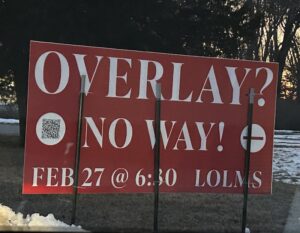
The “Overlay? No Way!” crowd was evident over the winter in signs across town and at a Zoning Commission public hearing that filled the high school auditorium to maximum capacity. A vast majority of the 550 attendees came out in opposition.
According to Mesham, it never should have gotten to that point.
“If I was on the Board of Selectmen, I would definitely not have ever voted to present that project to Planning and Zoning,” he said last week in an interview at the Republican headquarters on Halls Road.
Mesham, who spent 29 years in law enforcement before retiring from the Connecticut State Police in 2020, said experience as an executive officer in the Bridgeport and Montville barracks has prepared him to run a public agency like the Town Hall. His current term on the Inland Wetlands and Watercourses Commission has taught him about the regulatory process.
Shoemaker is a retired 35-year teacher, 12-year union president, and two-term member of the Region 18 Board of Education. She was selectwoman from 2021-23 before being elected first selectwoman.
The overlay proposal drafted by the Halls Road Improvements Committee (HRIC) was submitted to the Zoning Commission late last year by Shoemaker after a 2-1 vote of the selectmen. Shoemaker and fellow Democrat Jim Lampos were in support; Republican Jude Read cast the lone nay vote.
Lampos and Read are both running for reelection as selectmen.
Part of the Process
Shoemaker at the Town Hall last week said she followed statutory guidelines and local precedent for submitting the proposal to the Zoning Commission.
The first proposal in 2021 was submitted, and then pulled, by then-First Selectman Tim Griswold after critics described it as an overreach, and a revised 2023 version that first floated the overlay zone was later rejected by the Zoning Commission. Members cited concerns about its effectiveness and the lack of water and sewer infrastructure.
The commission is empowered to approve, deny or modify applications. Shoemaker said she put the proposal in their hands so they could do their job.
“And I know that the zoning board would have moved and pulled things out of it, or tweaked it to something that they could have been more comfortable with, because they weren’t going to put Old Lyme in jeopardy,” Shoemaker said.
Asked if she would have done anything differently in retrospect, the first selectwoman said she said she would not have delayed the continuation of the public hearing for as long as she did.
The hearing, which began in January, was initially continued to the end of February. But the meeting was postponed to April at the request of Shoemaker and the HRIC, who informed residents the move was prompted by “strong interest” in the topic that required a larger venue and more time for the commission to review communications from residents.
“I think there were a group of people who sort of defined it as something that it wasn’t, and placed fear into the minds of some of the people in this town,” she said.
Critics said the plan had the potential to create more than 1,000 apartments on 40 acres if it went through. Proponents argued topography and regulatory realities would effectively limit development to under 400 apartments at the most.
Shoemaker said she should have educated the public more about the project instead of letting misinformation spread.
“I think the most important thing is providing the facts,” she said.
Mesham during his interview disputed the idea that forwarding the project to the Zoning Commission was largely a procedural issue bound by statute and the other applications that have come before it.
“So, you know, you can say it’s part of the process, but really, part of the process is the Board of Selectmen reading the room and saying ‘we’re not gonna move ahead with this,’” he said.
Sidewalk Consensus
He said his first order of business if elected will be to call for a “shovel-ready” plan for sidewalks, lighting and “probably some greenery” to improve Halls Road.
“I think people move to Old Lyme because they like Old Lyme,” he said. “And we don’t need to drastically change Old Lyme.”
Sidewalks, too, are at the top of Shoemaker’s priority list for a second term. In May, she signed off on a grant application to the Connecticut Department of Transportation (DOT) for $800,000 to install sidewalks on the north half of Halls Road.
“I think there’s total consensus on sidewalks,” she said.
Less clear is the future of a pedestrian bridge – sometimes referred to as the bow bridge – proposed by the HRIC, according to Shoemaker.
“It’s something that’s nice to have, but is it a need or a want? And we have to weigh that out,” she said.
The state Department of Energy and Environmental Protection this year transferred ownership of the state’s property on the east bank of the Lieutenant River to Old Lyme, as long as the town puts a fishing pier and parking spaces there. The land swap is a necessary component of designs for the walking bridge and trail system funded with $135,000 in federal American Rescue Plan money and a $28,500 state grant.
“If we want the walking bridge, we have to do the fishing pier,” she said. “So do we want the fishing pier? What do we do to the environment if we start to build a fishing pier? There’s a lot of questions that still need to be answered.”
Mesham reiterated it’s time to get back to basics on Halls Road.
He said what started as a call for greenery, signage, and lighting “spun out of control” with efforts to attract developers and add large-scale improvements like the bridge.
“It clearly got too big for what people want, so I think we need to get back to the original intent of the Halls Road Improvement Committee,” he said.
The Halls Road Overlay District or HROD was fortunately defeated by the Old Lyme Zoning Commission, but only after the majority of Old Lyme voters and taxpayers made their voices known. The battle cry was: Overlay – NO WAY. Yay!
HROD would have allowed huge buildings for mixed-use housing, retail, and restaurants to be built with multi-story parking garages along the front of Halls Road. The whole scheme was an absurd attempt of a few people to forever alter Old Lyme’s character.
The fact that this proposal ever made it by the Town’s Planning Commission is staggering at best. What is more, the HROD proposal paid no attention to three main problems:
A. Halls Road is a State Road, not a town road and is the alternate traffic route through Old Lyme when I-95 backs up, a common occurrence. Traffic problems would become untenable.
B. There is not sufficient aquifer water for wells along Halls Road to support such development volume. This could lead to water quality issues for existing property owners.
C. There is not sufficient land present on Halls Road to provide adequate septic systems to make such growth feasible. This would lead to sewers being required and where would that take the town?
As a former owner (40%) of the Old Lyme shopping center for 20 years, I am very familiar with the septic situation in the area. Our system, though fragile, worked for many years, but for example, it can accommodate the sewage of only ONE real restaurant and no other major users of wastewater. As owners, we did, over the years, research the possibilities of sewage disposal in the area. Studies indicated the ground would not permit it.
I was shocked to hear of the proposed “overlay” project for so many dwellings along Halls Road in the shopping center. Had they not done their homework? Then, I was even more surprised to discover that two of our “Selectmen” were championing the crazy scheme. Martha Shoemaker and Jim Lampos were elected to “take care of the people of Old Lyme,” not to put them in jeopardy. Now, guilty of either irresponsibility or lack of sound judgment, they are asking the town to reward this incredibly dumb initiative by re-electing them. Go figure!!
This whole initiative was a boondoggle that would only have irreversibly changed Old Lyme and cost the town substantial legal and design study fees.