Op-Ed: Can Old Lyme Government Make Better, Faster Decisions? Thinking Outside The Box

Editor’s Note: This op-ed was submitted by George Frampton Jr. of Old Lyme.

The unusual partisan political divisiveness that crept into the elections in Old Lyme last week seems to have been laden, at least in part, with charges on both sides (and some public concern) about how Town government operates. 

These charges include complaints that local officials don’t move important issues forward diligently, that decisions sometimes take place ‘behind closed doors’, that the public is not provided with enough of the factual information key to those decisions, and finally, that officials omit how that information is being evaluated and processed to reach final decisions. 

Any such local disaffection can hardly be a matter of partisan ideology, however, since Republican, Democratic and unaffiliated voters in Old Lyme all favor strikingly similar goals and policies for the Town. What is more clearly responsible are the limitations imposed by the structure of the government itself.

As a resident who visited family here for decades and moved here permanently five years ago, and started off in a dispute with Town government, I have had an opportunity to observe intensively how Old Lyme government actually works (or rather, doesn’t work).  I have seen, in particular, how it has addressed two major issues facing the community over the past decade — beach sewers, and the development/zoning of Hall’s Road.

As it turns out, local government in Connecticut often doesn’t work well because state public meeting laws and traditions dating to colonial times make it extremely difficult for the main body of the community’s elected decision-makers — the Board of Selectmen (BOS) — even to communicate with one another about difficult policy decisions except at publicly noticed formal board meetings. 

In turn, the BOS struggles to communicate with the slew of semi-independent ‘commissions’ that also have an important and decentralized (even balkanized) role in final decisions. This situation creates a dynamic in which it is even harder for government officials easily to share their analysis or have robust discussions with the public. These antiquated legal restrictions seriously impede voters’ ability to review and evaluate how public officials are marshaling and analyzing the information necessary to make sound choices. 

There are some potential fixes for these built-in handicaps. But they don’t lie in partisan politics. Rather, they require leadership and innovation to institute workarounds that could at least marginally improve the decision-making process, facilitate internal and external communication, and foster a greater sense of transparency in Town government.

For major issues facing the Town, two workarounds involve centralizing leadership and making sure boards with authority work together. To accomplish both goals as they relate to major Town projects, a single ‘project director’ should be engaged — hired part-time or full-time — to manage and oversee the Town’s work under the supervision of the First Selectperson (who generally does not have the time or bandwidth to develop deep understanding or manage the necessary coordination to move such issues forward). The project manager would be working, however, on behalf of and reporting to the full Board of Selectmen and, when appropriate, to the public. 

This is an idea that has been put forward before, most articulately in an article by Howard Margules published in olwenonline.com/ last year. Given the rhetoric of the last election, now is clearly the right time to embrace it. 

For example, the future of Hall’s Road clearly requires a complete Town reset and is an important enough long-term issue — key to the Town’s personality and economy for many future decades — to justify hiring and empowering a project director. 

Then, rather than tasking the Zoning, Planning and Economic Development commissions with working together on the challenge (a necessary but virtually impossible task), the project director could engage flexibly and in alignment with each, and as the connecting link between all of these committees and the BOS —take the lead in engaging and reporting the outcome of these discussions to the public.

The first job of the Hall’s Road project manager should be simply to sketch out roughly three or four different preferred ‘visions’ for what the north side of Halls Road should look like, then conduct a quick Town survey and a workshop or two to identify the most attractive alternatives, or possibly the top two approaches. This is initially a planning issue and an economic development issue more than a zoning issue. 

The project manager would then be able to steer collaboration between all three commissions and the BOS in the upcoming overall Town-wide zoning review to design a template that maximizes the incentives for any owner-developers to implement the Town’s vision for the north side of Hall’s Road and consider more creative alternatives that might be available to ensure that the Town’s vision is realized.

Should the beach community sewer issue also require a reset, a project manager would be essential in considering the bewildering slew of bodies that have some jurisdiction over ultimate decision-making. These include several independent water/sewer bodies for the Town and beaches, the state Department of Environment (DEEP), the finance commission, the BOS, and others. 

To explore a whole new set of options is certainly going to require much more involvement with DEEP and probably other state agencies, new pollution studies and serious exploration of the new technology that has come available in the past ten years. 

A new project director would be essential to work with the relevant local boards and authorities as well as the State of Connecticut, to develop new alternatives and ensure both decision-makers and the public receive transparent information necessary to make final decisions. 

There are other more detailed ways to adjust and even revise current procedures for how Town boards bodies operate to increase public engagement, efficiency and public transparency that are well within the bounds of existing state open meeting laws. Now is the time for an administration that has just retained its mandate but needs to continue to merit public support to assess and adopt such steps. 

If Old Lyme voters want more effective Town government, the best route is not to complain and blame those in either political party, who devote substantial parts of their lives to public service in this effort, but to support innovative ways to enable them to do their jobs better.

TOP STORY: Shoemaker, Mesham Back for Another First Selectman Run in Old Lyme

Republican John Mesham is challenging incumbent Democratic First Selectwoman Martha Shoemaker in Old Lyme.

OLD LYME–In a rematch for the town’s top spot, this year’s election pits Democratic incumbent First Selectwoman Martha Shoemaker’s record of flooding fixes and open budgeting against Republican John Mesham’s calls for “common sense” improvements that don’t alter Old Lyme’s small-town identity. 

Shoemaker is running on the Democratic ticket with incumbent Selectman Jim Lampos. Mesham is once again teamed up with Jude Read, the incumbent Republican selectwoman. 

Shoemaker declared victory last time around with 51.8% majority. She brought in 1,820 votes compared to Mesham’s 1,697. 

The first selectwoman last week at the Town Hall said she’s been accessible to residents and has worked to keep them informed through public meetings and email communications. 

“I’d just really like to continue to serve the people for another two years,” she said. 

From the Republican headquarters on Halls Road — a flashpoint in this year’s election — Mesham said his campaign is driven by opposition to a now-defeated proposal that would have allowed hundreds of apartments or more in the commercial zone.

“I hear from a lot of people that they’re just kind of ready for a change,” Mesham said. 

More information on the effect of the Halls Road controversy on this year’s first selectman’s race is available here

Flood Control and Open Books

Shoemaker, a retired 35-year teacher and 12-year union president, was selectwoman from 2021-23 before being elected first selectwoman. She is not running again for the regional school board, where she is finishing her second term. 

Shoemaker cited solutions to multiple flood-related concerns as key accomplishments over the past two years. She said she held up a 2023 campaign promise to address flooding on Cross Lane at the Amtrak bridge underpass, where numerous closures that summer affected the ability of first responders to get to Route 156 from the Cross Lane fire station. 

Town crews brought in a vacuum excavation contractor to clean out the storm drains and underground drainage lines to restore proper flow into Swan Brook, according to the first selectwoman. 

“Within two days we corrected a problem that had existed for years and we’ve only had one flooding situation since then,” she said. 

The town also engineered an improved drainage structure at Hawk’s Nest Beach that had been costing the town time and money for years as sand continually clogged the pipes. Voters at a town meeting last year approved the $144,500 project to rebuild the sluiceway. 

She acknowledged the structure still floods at extremely high tides, but said the problem is now short-lived instead of perpetual. 

She counted resurrecting the Flood and Erosion Control Board as another significant step. She said members are working to become part of FEMA’s Community Rating System, which can qualify residents for a discount on their flood insurance premiums in towns that prove they are taking steps to manage their flood risk. The board had been dormant since 2019 before meetings resumed early last year. 

Transparency in the budget process is also a hallmark of her administration, she said. The Board of Selectmen now discusses budget planning with department heads in public meetings rather than having the finance director and first selectman draft the preliminary town budget without the opportunity for public scrutiny and input. 

She was proud of working with department heads, at the Board of Finance’s request, to find an additional savings of $171,350 during this year’s budget planning process. 

“Everybody was willing to find – whether it was $50,000 or $2,000 – something that we could eliminate that wouldn’t affect our services but would certainly help the budget. And that’s teamwork,” she said. 

She cited the creation of the Road and Public Safety Committee to address speeding and other traffic-related concerns as another accomplishment. She keeps residents up to date on those and other issues in a weekly newsletter that goes out to about 500 subscribers and is posted on social media. 

She said coming up with a plan for sidewalks on Halls Road will be a priority in the coming term. She also cited the need to look at the idea of dredging the Hain’s Park section of Rogers Lake that has deteriorated since her grown sons used to play there as children. 

“It definitely wasn’t as shallow as it is now, but it was a great place to go in the afternoon after naps to just sort of hang out for an hour and a half and splash around,” she said. “So hopefully we can bring that back without causing too many environmental issues.” 

Slow Growth, Transparency and Public Access

Mesham, a U.S. Marine Corps veteran, retired from the Connecticut State Police in 2020 as a master sergeant after 29 years in law enforcement. He is a member of the Inland Wetlands Commission and a deputy registrar of voters. 

“I’m running because I’ve really been in public service my whole life, and this is an extension of that,” he said. “But specifically, I wasn’t happy, like a lot of people, with the direction of Old Lyme seems to be going, especially with overdevelopment.” 

Mesham also called out Shoemaker’s administration for making what he’s called a “closed door agreement” in a years-long dispute involving a spit of land bisecting a Tantummaheag Road property that has been used by generations as a public landing on Lord Cove. 

A draft agreement struck by Lampos, as selectman, and George Frampton, the owner of the surrounding property, would have allowed people to use the road on foot from 8 a.m. to sunset while limiting cars to the paved cul-de-sac at the entrance to the landing. 

“We’ve had access to that property for hundreds of years, and I don’t really see a reason to try to make a deal,” Mesham said. 

The town going back to previous Republican Old Lyme First Selectman Tim Griswold’s tenure has claimed ownership of the landing amid opposition from Frampton, a prominent litigator and government official with more than a half century of experience, who has signaled his intent to take the case to federal court. 

Ultimately, the draft agreement failed when Read and Shoemaker voted against it, leaving Lampos as the only supporter. Executive sessions to discuss the potential lawsuit have continued.

Shoemaker refuted Mesham’s description of the draft as a closed-door agreement.

“That is a lie,” she said. “It wasn’t a backroom land deal.”

She said the draft agreement with Frampton was created through a transparent process, with all three selectmen regularly briefed in executive sessions. Once attorneys finalized a draft, Lampos shared it with the Harbor Management Commission, neighborhood representatives, and the public before selectmen voted it down.

Mesham said he has made open government as a central campaign tenet.

“Town Hall needs to definitely be transparent. I think there’s been less than transparent things going on, especially with Freedom of Information,” he said. He cited a state Freedom of Information Commission (FOIC) fine lodged this summer against Shoemaker as an example. 

Shoemaker continues to take responsibility for the $250 fine after FOIC members agreed with a complaint from the Connecticut Examiner that she withheld public records related to alleged misconduct at the local ambulance association. 

She said she acted in good faith when she provided all relevant information to state police within 36 hours, and went above what was required when she provided membership rosters maintained by the independent fire and ambulance companies.

She said she did not initially disclose March incident reports, which ended up at the center of the FOIC case, because she forgot about them while compiling numerous information requests in June. 

She acknowledged making a mistake in not providing the information. 

“As far as the FOIA is concerned, we’ve changed the process here,” she said. 

Mesham, citing his experience handling public information requests as a state police sergeant and master sergeant, described himself as “dismayed as to why it was such an issue to get information out about a very public concern.” 

The Sewer Question

The highest profile issue left to be resolved in the coming months revolves around a years-long effort to bring sewers to several beach communities in response to demands from the state Department of Energy and Environmental Protection. 

Shoemaker earlier this month told selectmen that state elections timelines and scheduling for the registrars of voters will require pushing the public Sound View Beach portion of the sewer project to at least January. Separate parts of the total $70 million project involve three private beach associations. 

She said the town is close to reaching a cost sharing agreement with the private beach associations and has a better idea how much individual Sound View users, who will be funding the town’s share, will have to spend over the 20-year life of the project loan. 

Shoemaker in her election interview said approving a referendum date requires approval from selectmen and then the Board of Finance. 

“Now we have to analyze it and say, ‘is this affordable for people?’” she said. “That’s something that all three of us have to decide: Jim (Lampos), Jude (Read), and I. It’s not just me.” 

Meanwhile, the state has warned delays could cost millions in promised federal funding and a forgivable loan. 

Mesham said it’s time to have the referendum “and let the town decide.” 

“If it’s a no vote, then we need to show that we’re taking steps to address the issue. And that would be a sewer avoidance program, at least in part,” he said. 

He said the state’s pressure for Old Lyme to install sewers is undermined by reports of raw sewage being introduced to the Connecticut River from treatment plants in Massachusetts and Connecticut. 

He said the state agency should realize it’s “viewed right now as being pretty hypocritical with the amount of sewage coming down the Connecticut River that affects us and Long Island Sound and the communities around us,” he said. 

A sewer avoidance program could involve inspections and an examination of non-conforming systems to ensure septic systems are not polluting the area, according to Mesham. 

He said it’s premature to address questions about whether the town as a whole will ultimately be required to foot the bill if the state continues to push a project that is not affordable to Sound View residents alone. 

“I don’t wanna get too carried away with ‘what ifs,’” he said. “I like dealing more with what’s ahead of us.”

TOP STORY—UPDATED: Old Lyme Faces Costly Deadline in Sewer Standoff

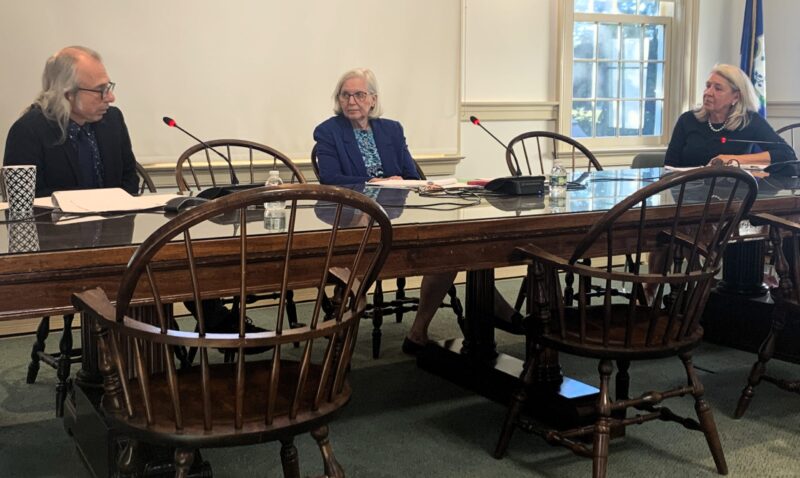
Selectman Jim Lampos, First Selectwoman Martha Shoemaker and Selectwoman Jude Read (from left to right) at their Oct. 6 meeting discussed a possible January referendum vote on the Sound View sewer project.

Editor’s Note: This article was updated with comments from the state Department of Energy and Environmental Protection spokesman.

OLD LYME — Armed with refined cost estimates, the Board of Selectmen is pitching a January referendum vote for a sewer project that has faced resistance for decades as leaders grapple with how to pay for a cleaner Long Island Sound.

Meanwhile, Old Lyme Water Pollution Control Authority (WPCA) Chairman Steve Cinami continues to warn residents a delay could cost millions.

First Selectwoman Martha Shoemaker at Monday’s Board of Selectmen’s meeting told selectmen that state elections timelines and scheduling for the registars of voters will require pushing the referendum date on the Sound View Beach sewer project to Jan. 13, 2026.

She said state election law requires the town’s tabulating machines to be locked for two weeks following the Nov. 4 election. Also crowding the schedule is the Thanksgiving holiday and a state-mandated training for the registrars in December that will limit the availability of the part-time civil servants, according to Shoemaker.  

Sound View is responsible for up to $17.1 million of the $70 million proposal to require residents of four beach communities to install sewers. State and federal funding would bring the amount to be covered by Sound View residents down to $8.5 million.

Selectmen last month said there were too many unanswered questions to get the question on the ballot in time for the municipal election. But increased clarity on the amount Sound View users will have to pay, combined with the impending cost sharing agreement between the town and three private beach communities, have left selectmen ready to prepare another date. 

The Old Lyme WPCA, which oversees the Sound View project, has been pushing for townwide approval before construction bids expire in mid October. The urgency was underscored when the Connecticut Department of Energy and Environmental Protection (CT DEEP) informed local officials that federal funding amounting to about half the project cost is in jeopardy if the town doesn’t get the project approved soon. 

Connecticut DEEP Deputy Commissioner of Environmental Quality Emma Cimino in an Aug. 15 email to Shoemaker said failing to move forward with the referendum by mid October “will significantly impact” the town’s ability to pursue Clean Water Act funding for 25% of the total project cost and a forgivable loan for another 25%.

After Monday’s meeting, Shoemaker said she will send the recommended referendum timeline from the Town’s Registrars of Voters Catherine Carter and Jennifer Datum to the state agency.  

She said the dates were selected in accordance with the state’s election law and calendar. 

“I will tell [the CT DEEP] if they have any other way to get around this, they will have to reach out to the secretary of the state’s office,” she said. 

Cinami, as head of the Old Lyme WPCA, called the proposed delay ridiculous. 

He said a staff attorney with the Connecticut Secretary of the State’s Office told him locking down machine tabulators after the election doesn’t mean the town can’t hold a referendum using paper ballots. 

Secretary of the State Spokesman Roger Senserrich on Tuesday confirmed the referendum could happen while the tabulators are locked. 

Cinami said delaying until mid-January could be an expensive proposition.

“The registrar of voters works for the town, to do town business,” he said in a phone interview Tuesday. “This could cost the town $3 million if we don’t pass a referendum and get the project going prior to the beach associations signing contracts with the state.” 

Cinami said the delay could make the town ineligible for the Clean Water Act funds if they are awarded at the end of December or early January, which is the timeline he’s been given.

“I don’t know what the town doesn’t understand,” he said. “I don’t think I’m a genius. I think the DEEP has been very clear what they plan on doing. And if you don’t listen to them, I think you jeopardize funding.” 

The state going back to the early 1980s has pushed for an end to pollution emanating from local beach communities, leading to a 2018 consent order with Old Colony Beach, Old Lyme Shores, and Miami Beach that resulted in the current shared sewer plan. Sound View was added in 2019 after voters in a townwide referendum agreed to spend $9.5 million on the public portion of the project with the understanding that affected neighborhoods would fund it.

The new referendum vote is necessary because inflation drove up the total cost of the project, though the promise of federal funding means Sound View ratepayers would be paying less than the amount authorized in the first referendum. 

The town is participating voluntarily in the sewer plan at this point. But the state has warned a consent order, like the one forcing the private beach associations to act, could be coming if progress isn’t made.

Cinami said the state set the mid-October deadline because that’s when the rest of the beach communities should be ready to move forward. 

Bids on the Old Lyme Shores portion of the project, the last of the four beach communities to solicit offers, close on Wednesday. 

“After that, my understanding is that the DEEP will allow the beach associations to start work,” he said. “And what I believe will eventually happen is that the town will be ordered to put in sewers.” 

Miami Beach WPCA Chairman Scott Boulanger could not be reached Tuesday for an update on the status of the project in that community after bids came back more than $5 million over budget this summer

By the Numbers

Selectmen on Monday tied up another outstanding issue with the presentation of a third-party report from the accounting firm HRT Advisors analyzing various budget projections

The disparity between estimates from the WPCA, Selectman Jim Lampos, and some residents had raised questions about the true cost to Sound View residents over the 20 year life of the project loan

The WPCA in an August presentation put the cost to construct the system at $1,939 annually over 20 years for a typical user, not including annual fees estimated at $565 by the CT DEEP. 

The HRT analysis, applying a 5% construction contingency for unexpected costs, estimated that construction costs and connection fees to the East Lyme sewer system enroute the New London wastewater treatment plant would amount to $2,241 per year. 

Applying an 8% contingency, the number would rise to $2,292 per year. 

There appeared to be consensus among selectmen to use the HRT figures as the official estimate going forward. 

The HRT report noted Cinami’s estimate included an outdated price tag of $4.1 million for the shared pump station, which is now $4.8 million after the low bidder dropped out. The accountanting firm also included interest on the bond accrued during the construction period.

Cinami on Tuesday agreed the third-party estimate was fair. Taking into account that he’d applied the connection fees to the annual operations and maintenance category rather than construction costs, he said there was only about $70 separating his figures from the accountant’s estimate using the 5% contingency. 

Lampos, who is both a selectman and resident of the Sound View Beach community, said the numbers prove the project is too expensive for the residents, who will have to foot the bill. 

He referenced the state “rule of thumb” articulated last year at a public meeting by agency project engineer Carlos Esguerra. The rule, based on U.S. Environmental Protection Agency guidance from the 1990s, says the cost is affordable to residents if it does not exceed 2% of the town’s median household income (MHI). Esguerra at the time identified Old Lyme’s MHI as $122,000, which equated to $2,440 a year.

Connecticut DEEP Spokesman James Fowler has not provided an updated affordability estimate despite several requests from LymeLine over the past few months. 

Based on the accountant’s lower estimate, the cost per user goes up to around $2,800 per year when annual operations and maintenance costs are included. Lampos described that figure as “well north” of the affordability threshold.  

The CT DEEP did not confirm whether the federal affordability threshold includes annual operations and maintenance costs. Cinami has said it does not. 

Lampos and Shoemaker said they have not been able to get confirmation from the state agency on the affordability calcuation or its implications for this project. 

Shoemaker called for answers from the state. 

On Wednesday, the CT DEEP spokesman in an emailed response to questions from LymeLine said there is no affordability criteria that would allow pollution to continue because the cost was over a certain threshold.  

“Affordability would only be used to determine a suitable compliance schedule,” Fowler said.

He described a financial impact assessment used by sewer service providers – sometimes referred to in shorthand as an “affordability” assessment – when a corrective plan is needed to address a pollution problem. If the assessment indicates a higher impact on residents, communities can break up projects into phases to reduce the financial impact, or seek increased funding.  

“In Old Lyme’s case, DEEP offered $15 million to lessen the impact,” he said. “In bigger communities like Hartford, its sewer utility is under order and has phased projects on a priority basis and is following a specific compliance schedule to work projects to address the pollution.”

Lampos told selectmen that taking a couple weeks to get the accountant’s analysis did not add to the overall project delay. That’s because negotiations on a Cost Sharing Agreement between the four beach communities are still being ironed out and the bids for Old Lyme Shores remain outstanding. 

He maintained that understanding the cost to Sound View residents and ensuring they are represented throughout the project is critical.

During the public comment portion of the meeting, Sound View resident Mary Daley commended the three selectmen for their work on the complex issue. 

Daley, a vocal project opponent, was appointed to the WPCA last year. 

She said Lampos, Shoemaker and Selectwoman Jude Read each kept their campaign promises from two years ago. 

“Because, Jude, you promised to listen, and you certainly have. And, Martha, you promised to do this also, and to ensure that Sound View was represented on the WPCA, and you have accomplished that. And, Jim, you have gone over and beyond all expectations to affect and to ensure that Sound View is treated fairly in the sewer project, and we so appreciate your efforts,” she said. 

TOP STORY: Old Lyme Seeks Clarity on Sound View Sewer Costs as Funding Deadline Nears

The Old Lyme Board of Selectmen this week agreed to bring in a consulting accountant to go over estimates from the WPCA, its engineer Fuss & O’Neill, residents, and state officials to come to a better understanding of the cost to residents. From left to right: Selectman Jim Lampos, First Selectwoman Martha Shoemaker and Selectwoman Jude Read.

OLD LYME–The Old Lyme Board of Selectmen’s plan to hire a third-party accountant to review cost estimates for the Sound View Beach sewer project has raised concerns that delaying a townwide referendum could put millions in state funding at risk.

The selectmen on Monday during its regular meeting reaffirmed a plan to bring in a consulting accountant to analyze various budget projections for Sound View’s portion of a total $70 million sewer installation project to be shared by four beach communities. 

First Selectwoman Martha Shoemaker said she needs more clarity on the financials before asking voters to approve it at a townwide referendum. 

“I know that no one in government will go forward with any type of referendum on a budget application unless they know that these numbers are firm,” Shoemaker said. “I am not putting it to a referendum resolution until it’s taken care of.” 

She said it’s already too late to put the issue on the ballot for the Nov. 4 election based on scheduling deadlines from the Office of the Secretary of the State. 

The Old Lyme Water Pollution Control Authority (WPCA), which oversees the Sound View project, has been pushing for townwide approval before construction bids expire in mid-October. Meanwhile, the state Department of Energy and Environmental Protection (DEEP) is warning that roughly half of the project cost is in jeopardy if the town misses the Oct. 15 deadline.

Shoemaker said the selectmen are also waiting to see how the finances play out for the Miami Beach Association, where bids came in about $5 million higher than expected last month, and for the Old Lyme Shores Beach Association, which is in the process of going out to bid.

Lampos after the meeting said the cost estimates under review came from the Old Lyme WPCA, its engineer Fuss & O’Neill, residents, and state officials. 

On Tuesday evening, Shoemaker said over the phone that she hired an accountant in consultation with the Lower Connecticut River Valley Council of Governments, a regional planning organization. The consultant, whose firm she could not specify while away from her desk, will start on Sept. 16.

The move comes after upwards of 60 people gathered in the Lyme-Old Lyme High School auditorium late last month for a contentious back-and-forth between Old Lyme WPCA Chairman Steve Cinami and residents of the Sound View Beach area. 

A major concern was the uncertainty over how much each Sound View homeowner will have to pay. They also cited a lack of current testing to show a pollution problem exists and questioned why Hawk’s Nest Beach and White Sand Beach were excluded from the project. 

CT DEEP Spokesman James Fowler in a Tuesday email said the town will still be obligated to address “community pollution problems that can arise from areas of substandard septic systems” even if they lose their state and federal funding by failing to act quickly. 

“The Department will be reaching out to the Town this week to set up a meeting to discuss next steps and timing, as we look to continue to assist the Town with resolving this important issue,” he wrote. 

‘With or Without the Town’

Scott Boulanger, chairman of the Miami Beach WPCA, told LymeLine in a Tuesday phone interview that the association is trying to figure out how to proceed “with or without the town.” 

Acknowledging the Miami Beach costs came in higher than expected, he said the project will only become more expensive once the existing bids expire. 

“If this doesn’t go through in October, everything would have to go out to bid again, which basically says the cost is going to be escalated even more,” he said. 

He said he is working with officials from the other beach associations and the CT DEEP on potential ideas to save money, such as eliminating parts of the project for now. 

The state, going back to the early 1980s, has pushed for an end to pollution emanating from local beach communities, leading to a 2018 consent order with the three private beach associations that resulted in the current shared sewer plan. Sound View Beach, which is under Town control, was added in 2019 after taxpayers across the town agreed to spend $9.5 million on the public portion of the project with the understanding that affected neighborhoods would fund it.

The town so far has been participating voluntarily in the sewer plan under the threat of a consent order from the state. 

Now, inflationary costs have triggered the need for another referendum on the Sound View project after the bottom line increased by $7.6 million. But state and federal funding announced last year promised to reduce the price tag by about half, leaving Sound View residents responsible for less than the amount approved in 2019. 

“Eventually, I think what’s going to end up happening, if I had a crystal ball, would be the project might go forth without [the town], which is what was planned like a decade ago,” Boulanger said. 

Then the town, he said, “will just end up paying a lot more whenever they do get put into the system, which they will probably get forced to do one way or the other.”

Old Lyme WPCA Chairman Steve Cinami in a Tuesday phone call predicted that delaying the Sound View referendum will cost the town its 25% forgivable loan from the state. WPCA documents show the loan amounts to about $2.6 million. 

He worried that taking the time to hire an accountant could needlessly jeopardize the funding.

“I’m surprised there’s an accountant out there that knows how to assume costs to run a pump station, but that’s what they seem to be doing,” he said. 

He attributed the delay to resistance from what he described as a small group of people. 

“There’s almost 200 residences in Soundview and only about, from what I can tell, 30 to 40 residences at most were represented at that informational meeting,” he said. “It leads me to believe that 160 people don’t care or don’t care enough to show up.” 

He emphasized the demands from the state won’t go away if the project moves forward without the town. 

The Case for Waiting

Mary Daley, a longstanding opponent of the Sound View project, who was appointed to the Old Lyme WPCA last year, applauded the delay during the public comment portion of Monday’s selectmen’s meeting.  

“I totally support the idea of retaining an independent auditor to do a forensic audit of what has been spent, what is owed, and what will be owed if this project goes forward,” she said as one of the meeting’s remote participants. 

She warned that the combined impact of annual sewer payments and increased taxes could push some older adults out of their long-term homes.

Selectman Jim Lampos, a Sound View resident, acknowledged a lack of verified numbers has been a sticking point among property owners from the beach community, who will be responsible for construction costs as well as annual fees. 

“I think the suggestion of hiring a third party to take a look at it and to vet all the different estimates that are out there, and to render an opinion, could only help breed confidence,” Lampos said. “Having different estimates floating around doesn’t help.” 

Selectwoman Jude Read called on her fellow selectmen to give a clear directive and timeframe to the consulting accountant. 

“Because this can go on for a long time,” she said. 

Lampos, who is currently working with the four beach communities to formalize a cost-sharing agreement, with another meeting set for Sept. 22, agreed. 

“It has to be done quickly,” he said.

TOP STORY: Old Lyme Selectmen Vote to Postpone Setting Referendum on Sound View Sewers Until Key Questions Answered

OLD LYME–The Old Lyme Board of Selectmen on Tuesday, citing a lack of answers to questions they have been asking for months, again decided to hold off on setting a referendum affecting Sound View Beach that could get a stalled sewer project moving again. 

Selectmen at a roughly one hour special meeting voted unanimously to move discussion on the referendum to a future meeting, after their questions have been answered and a cost-sharing agreement has been finalized among the four participating beach communities. 

Selectmen also voted to hire an independent firm to look at annual operating and maintenance costs that would give Sound View residents a better idea how much they can be expected to pay going forward. Numbers provided by the Old Lyme Water Pollution Control Authority (WPCA) and the Connecticut Department of Energy and Environmental Protection (CT DEEP) have been criticized by some residents as artificially low. 

First Selectwoman Martha Shoemaker during the meeting said selectmen have heard cost concerns from Sound View residents “loud and clear.”

She said she will not vote to move forward until she can give residents a clearer idea what those costs will be. 

Meanwhile, the CT DEEP is pressuring the town to act fast on a project years in the making.

“I’m not trying to kick this project down the road, because it’s been kicked down the road for some time,” Shoemaker said. “But I can pretty much assure you that our governor, [or] any other town executive, would not go forward with a project if they didn’t have all the numbers. Solid numbers.” 

Estimates of the long-term cost for a typical resident during a question-and-answer session last week ranged from $40,000 to more than $60,000 over 20 years, depending on who was doing the calculations. 

Construction costs amount to $70 million for the project, which would require residents of Sound View to foot the bill along with homeowners in three private beach associations: Miami Beach, Old Lyme Shores and Old Colony. 

Members of each private beach associations authorized their share of the project in separate referendums. In the case of Sound View, which is a public beach community, it is up to all Old Lyme voters to decide whether residents there should pay for sewers. 

The cost for Sound View comes to approximately $17.1 million. State and federal funding brings the cost down to $8.5 million. 

The CT DEEP last month warned Shoemaker that state and federal funding amounting to roughly half of the project cost is in jeopardy if the town doesn’t act fast to hold a public vote and award construction contracts. 

Failing to complete “one or more of those milestones” by mid-October “will significantly impact” the town’s ability to pursue a Clean Water Fund grant for 25% of the total project cost and a forgivable loan for another 25%, according to CT DEEP Deputy Commissioner of Environmental Quality Emma Cimino. 

Shoemaker in a phone interview after Tuesday’s meeting said selectmen are focused on making sure voters have access to accurate and thorough information when they vote on the sewer question at referendum. 

She was hopeful that a meeting among project officials from the four beach communities on Sunday will yield the  final cost-sharing agreement selectmen have been seeking. She also expressed optimism she could find a third party accountant to evaluate the annual operation and maintenance costs for a more definitive estimate next week. 

She acknowledged the state funding could be in question if the town doesn’t act. 

“If they take away the money, it’s totally unaffordable,” she said. “So we will work with them and explain to them we have been asking for these things to happen over the last year and a half, and we certainly are not dragging our feet.” 

Lampos: ‘Project Stinks’

Selectman Jim Lampos, a resident of the Sound View Beach area, said he vowed when he became a selectman that he would demand fair treatment for the beach residents who would bear the cost of the town project. That means fully understanding how much Sound View residents will owe for operating and maintenance costs every year, while also ensuring all costs are allocated equitably. 

He laid out a timeline going back more than a year to show selectmen have actively been seeking answers and compromises rather than trying to obstruct the process. 

“I think the project stinks, and I always have, for 15 years,” he said. “But I also am a realist.”

He acknowledged about $4 million was spent on project planning across the four beach communities; a referendum was held in 2019; and an agreement was signed with the municipalities through which the sewer lines would run and be treated – all before the current selectmen’s administration. 

“I know the state is banging us over the head to get this done,” he said. “It’s very difficult to stop this moving train. It’s at full speed.” 

But he said cost estimates from the Old Lyme WPCA remain too low to be believed and language that would codify the fair distribution of costs has not been finalized. 

He railed against the state for pressuring the town to install sewers without giving consideration to modern septic alternatives that he said towns west of the Connecticut River have successfully implemented. 

He also pointed to the CT DEEP’s “rule of thumb,” as articulated last year at a public meeting by agency project engineer Carlos Esguerra, that says the cost is affordable to residents if it does not exceed 2% of the town’s median household income (MHI). Esguerra at the time identified Old Ltme’s MHI as $122,000, which equated to $2,440 a year.

The cost to construct the system is slated at $1,939 annually over 20 years for a typical user, not including fees that would likely exceed $500 per year based on state estimates. 

“So, I’m here to say tonight that as we see these numbers, this project is unaffordable,” Lampos said. “And [if] DEEP wants it, instead of threatening us and saying, ‘Oh, we’re going to take your money away’ – as if they’re doing us a favor, as if it’s charity and we should be grateful – DEEP needs to pony up and make up that difference.” 

CT DEEP Spokesman James Fowler last month said that if a project’s costs were estimated to exceed 2% MHI, it would be up to the town or sewer authority to explore additional options, like splitting a project into phases, deferring work not associated with pollution, pursuing additional funding, and requesting a longer project schedule. 

Fowler emphasized that exceeding the 2% threshold “does not mean that communities don’t have to address identified pollution.”

Working Together

Selectwoman Jude Read, the lone Republican on the Democrat-led board, agreed with putting off a vote. She emphasized the sewer project originated with a past town administration and the state, not with current board and commission volunteers. 

She said frustration should be directed at the state rather than local people, who have tried to help. 

“This project’s been going on for well over 10 years. Technology has changed. Population has changed. Science has changed. Climate has changed. What (the state) asked for 10, 12 years ago is not necessarily applicable now,” she said. “But we have to work together to come up with a solution to move forward because I think eventually we are going to have to deal with sewers. We are going to have to deal with groundwater levels rising.”

She said the solution requires channeling local frustrations into a productive conversation with state officials.

“We are willing to work,” she said. “And I think we have a track record of showing that we have been dealing in good faith for 10, 11, 12 years. And we will continue to do so.” 

The CT DEEP going back to the early 1980s has pushed for an end to pollution emanating from local beach communities, leading to a 2018 consent order with the three private beach associations. Sound View was added to the project in 2019 after voters in the first townwide referendum agreed to spend $9.5 million. 

The town, which is participating voluntarily in the sewer plan at this point, is doing so under the threat of a consent order from the state like the one forcing the private beach associations to act. 

The referendum now under consideration would authorize an additional $7.6 million for Sound View’s portion of the project after rampant inflation drove up the cost, though the promise of reimbursement from the state and federal government means Sound View ratepayers will actually be paying less than the amount authorized in the first townwide vote. 

Selectmen also postponed a vote on a draft sewer ordinance that will go to voters along with the spending authorization. The document had been revised with Lampos’ encouragement to ensure residents of the beach communities are not responsible for the cost of installing sewers in any other areas of town going forward. 

The document specifies any future sewer projects must be covered by users in that area. 

Read cautioned selectmen to make sure the provision doesn’t end up exempting residents within the current project boundaries from paying for public improvements like road paving that could end up being covered by the town.

Old Lyme Board of Finance (BOF) Chairman BJ Bernblum confirmed to LymeLine Wednesday morning that the BOF meeting scheduled for Wednesday evening has now been canceled. This meeting would have discussed details of the referendum if the board of selectmen had voted to move the proposal in that direction.

Editor’s Note: This article has been updated with information about Wednesday evening’s Old Lyme Board if Finance meeting.