
TOP STORY: Sound View Residents Urgently Call for Alternatives to Sewer Project as Potential Referendum Looms

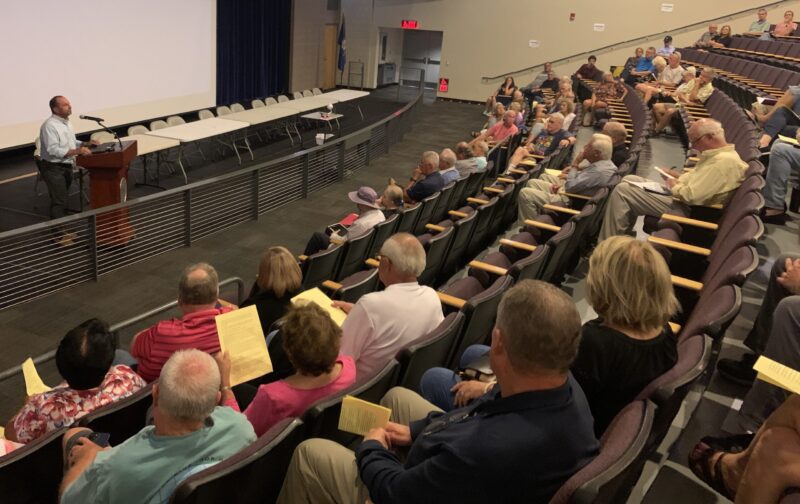
Old Lyme Water Pollution Control Authority Chairman Steve Cinami addresses a tough crowd of Sound View Beach residents at a presentation on the $70 million project to bring sewers to three private beach communities and the town-owned Sound View area.

OLD LYME–As a decades-long effort to clean up Long Island Sound by getting rid of septic systems continues its slow slog in Old Lyme, residents of Sound View Beach are calling for town officials to fight back against state pressure to install sewers or to spread out the cost throughout the town.

Upwards of 60 people gathered in the Lyme-Old Lyme High School auditorium Tuesday evening for a contentious back-and-forth between Old Lyme Water Pollution Control Authority (WPCA) Chairman Steve Cinami and residents of the Sound View Beach area. The subject was Sound View’s portion of a $70 million plan that would require residents of the town owned beach area to foot the bill along with residents of three private beach associations.

Meanwhile, a call from town leaders and Sound View residents for up-to-date pollution statistics and detailed financial information is meeting with pushback from the Connecticut Department of Energy and Environmental Protection. 

Sound View residents on Tuesday decried the lack of solid figures when it comes to how much each homeowner will have to pay. Numbers provided by the WPCA, which drew skepticism from some in the audience as artificially low, added up to about $50,000 for the typical homeowner over the proposed 20-year life of the project loan. The calculation includes construction and annual fees. 

Included in construction costs are Sound View’s share of a pump station and force main for the four beach communities, as well as the internal infrastructure necessary to serve the town’s beach View area. Homeowners additionally are responsible for tying into the system and abandoning their septic systems. 

Sally Woitowitz, a 28-year resident of Sound View, said the annual cost effectively doubles her taxes. She said she will have to move if the project goes through. 

“I have nowhere else to run to,” she said. “A lot of people here, these are cottages for some people. For some of us, it’s our home. It’s all we have.”

She challenged the state’s “rule of thumb,” as articulated last year at a public meeting by DEEP project engineer Carlos Esguerra, that says a project is affordable to residents if it does not exceed 2% of the town’s median household income (MHI) which he identified at the time as $122,000. That equated to $2,440 a year.

The cost to construct the system is slated to amount to $1,939 annually over 20 years for a typical user. 

Cinami has said annual operations and maintenance fees are not factored in when calculating affordability. Those fees will add an additional $565 to Sound View users’ annual payments, based on estimates compiled by the state. 

DEEP Spokesman James Fowler this month would not provide the updated median income for Old Lyme or specify which source the agency uses to determine the figure. But a review of the U.S. Census Bureau’s most recent American Community Survey puts the median at $126,904, which would bring the affordability threshold to $2,538. 

Woitowitz pointed to a unique demographic profile that differentiates Sound View from other parts of town known for affluent and refined beauty. 

“They don’t have $120,000 a year income,” she said of the Sound View residents, many of whom she described as senior citizens.

Woitowitz and other impassioned members of the audience reacted most strongly to what they said is a lack of current scientific evidence that a pollution problem exists. They also called out the perceived unfairness resulting from the exclusion of Hawk’s Nest Beach and White Sand Beach from the project. 

Cinami said White Sand Beach was excluded from the project because the cost was “unaffordable” to the small community. 

Esguerra, the CT DEEP project engineer, has said the state in 2016 authorized additional testing at Hawk’s Nest Beach, with the WPCA at the time agreeing to monitor the area but not to include it in the sewer plan.

Cinami on Tuesday said the WPCA did further testing.  

“And the test results are with the state,” he added. 

Fowler on Wednesday declined to coordinate a phone interview with any DEEP project officials but accepted questions in writing.

“The Department understands that some residents have questions about how the proposed project may impact other areas of Old Lyme, such as Hawk’s Nest and White Sands,” he wrote in an email response to a question from LymeLine. “Those areas are outside of the scope of this project and have different considerations, such as site use and subsurface conditions. It is important to note that the town decided to prioritize and include Sound View/Misc. Area B in the project since there was an opportunity to both address pollution to groundwater and surface water and realize financial benefits through cost-sharing with private associations.”

He did not comment on the status of the data from Hawk’s Nest.

Least Expensive in the Long Term
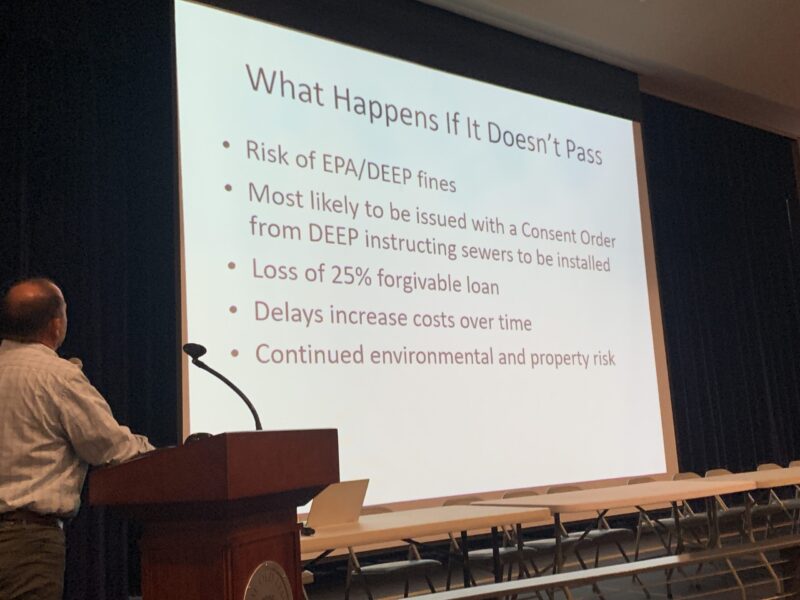
Old Lyme Water Pollution Control Authority Chairman Steve Cinami makes a last minute push for for the latest iteration of a plan to bring sewers to four beach communities in Old Lyme as the Board of Selectmen contemplates a fall referendum.

Cinami, the WPCA chairman, told attendees the Old Lyme WPCA spent funds from its general fund budget to look at alternatives to sewers, including single-septic systems as well as a community leaching field design that would have been located at the abandoned Cherrystones restaurant on Route 156. 

Detailed plans from the Middletown-based Woodward & Curran engineering firm were published in 2017 and 2018 under the leadership of then-First Selectwoman Bonnie Reemsnyder.

In a Frequently Asked Questions document produced for the WPCA, Cinami said the state did not accept any alternative proposals, and indicated that they believed sewers were the only “long-term, least expensive” solution.

“Perhaps the Old Lyme WPCA should have fought back, but at the time, sewers were in favor with Town leadership, and we were requested to investigate installation of sewers,” he said. 

Fowler, the CT DEEP spokesman, reiterated the agency’s longtime stance in his email to LymeLine when he said alternative technologies like code-compliant septic systems and mini-wastewater treatment plant-type systems aren’t feasible due to the need for consistent upkeep, chemical additions, routine maintenance, year-round electricity and regulatory reporting in perpetuity.

“While certain property owners may have or be able to install a code-compliant septic system on their property, it’s not a community level solution and would result in all costs being paid by the homeowner,” he said.

The spokesman described sewers as a “comprehensive, permanent solution for the community” eligible for public infrastructure funds.  

“The sewer project would also remove the uncertainty that a patchwork approach brings, as the patchwork approach could be deemed to be insufficient in the future,” he said.

The data underlying the state’s pollution concerns goes back to a period spanning 1998 to 2013. In the meantime, residents argue many septic systems have been updated or demolished, while a 1997 ordinance requiring systems to be pumped out periodically has reduced the potential for pollution. 

Esguerra, the CT DEEP project engineer, and DEEP water planning and management division Director Nisha Patel at last year’s public meeting at the Old Lyme Town Hall admitted to a room of roughly 100 Sound View residents that the data is old. But they maintained the conditions making septic systems ineffective at stopping sewage from reaching the groundwater – including densely packed homes sitting on unfavorable soil and rock – haven’t changed. 

Shoemaker on Tuesday harked back to that meeting with the DEEP officials. 

“I said that I thought that the data that they were using to determine that (the beaches) were polluted was outdated, and I asked Nisha and Carlos what’s the possibility of getting it re-tested,” she told the audience. “They both pooh-poohed it and said they did not feel that it was necessary to do that.”

Shoemaker last year also told the DEEP officials she thought it was inappropriate for the state to put people in the position of losing their homes. 

Fowler in the CT DEEP email again reiterated the dated data points “remain relevant.”

“The subsurface conditions and uses (soil type, condition of existing septic systems, depth to groundwater and distance to sensitive receptors such as water bodies and drinking water wells) within the project areas have not been addressed, and continue to exist,” he said. “It is also important to consider the modern public health code requirements for on-site septic systems and septic system setbacks from private wells across all properties, not just those with advantageous conditions. The solution must protect our public trust waters (groundwater and surface water) and should eliminate uncertainty for property owners that a wait-and-see or piecemeal approach may not address.”

No Action

The Sound View residents called on town officials to fight back against the state or come up with the money through taxation. 

Shoemaker on Wednesday provided the tax implications for property owners in response to a question about how much it would cost residents across town if the cost was absorbed by all taxpayers rather than the Sound View ratepayers alone. 

She said calculations from the town assessor indicate it would cost $96.63 in taxes per year for each real estate parcel in town. That’s based on the $521,795 expense for the Sound View portion of the project over 20 years.

Cinami during the presentation predicted that further delays will turn the town’s voluntary compliance into a consent order from the state. 

“I’m responsible when I take my oath as a WPCA member to uphold the state laws and town ordinances,” he said. “No one has told me to not continue along this process. And so I’m supposed to continue on this. If an administration told me ‘forget about sewers, we’re gonna fight it,’ that’s their call. It’s not my call, it’s a town call. I don’t have any any dog in the fight.”

Selectman Jim Lampos, a Sound View resident, took the microphone to blast the state for its rigid stance on outdated information. 

“They’re pushing us very hard,” he said. “And they’re not listening to what I think are reasonable arguments.”

Old Lyme resident Martin Merritt brought up situations in towns like Clinton and Old Saybrook, where residents have had some level of success fighting mandated sewer installation in parts of their towns. 

“How come we’re not fighting hard for what these other towns are doing successfully?” he said. 

The CT DEEP spokesman did not comment on the situation in Clinton, where the Water Pollution Control Commission on the town website said “areas of concern are being refined, and through communications with the DEEP, the WPCC and its consultants were able to take a fresh look at the study area, and further investigate which neighborhoods are truly in need of off-site wastewater treatment and which neighborhoods can support continued on-site septic systems with proper management.”

Merritt in his lengthy criticism of the project also pointed to financial figures that he said exceed the affordability threshold, resulting in a project he said will become “the most expensive sewer system that the residents have paid for, ever, in the state of Connecticut.”

“And we are just rolling over and taking it,” he said. “We’re not doing anything. We’re just sitting here and taking it, and saying, ‘charge us whatever you want and we’re not fighting.’”

Dennis Melluzzo, an outspoken Sound View resident appointed to the Old Lyme Water Pollution Control Authority by the current selectmen, put it this way in his comments to the WPCA chairman: “You can charge us. You’re just going to meet us in court – plain and simple, cut and dry.”

Shoemaker said the next steps will be mapped by the Board of Selectmen at a special meeting. 

“You have given the Board of Selectmen a lot to think about,” she said. 

Shoemaker on Wednesday said selectmen will meet early next week to discuss sending the bonding authorization to referendum. The Board of Finance is also required to make a recommendation before the question can go to a public vote.

Editor’s Note: This article was updated to correct the estimated project cost per user over 20 years.
TOP STORY: State Warns Old Lyme to Get Moving on Sewer Project

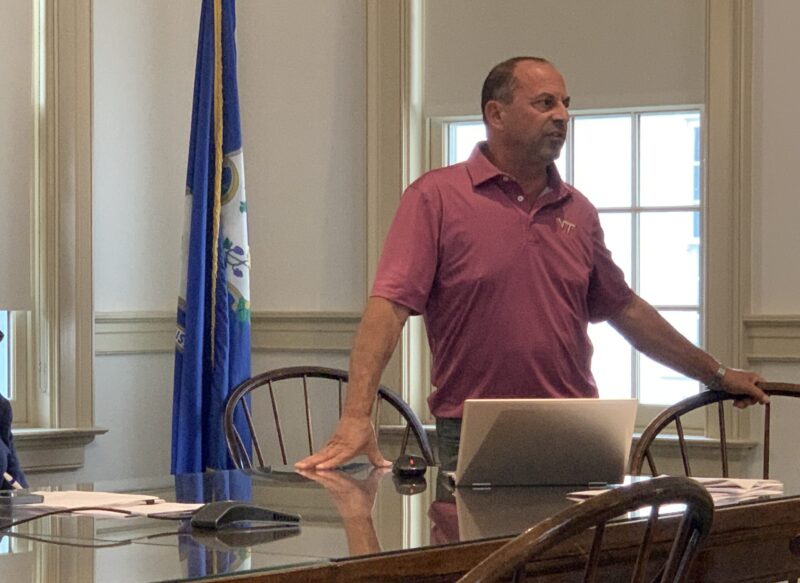
Old Lyme Water Pollution Control Authority Chairman Steve Cinami has spent much of the summer addressing concerns from town officials and the public about a plan to bring sewers to the shoreline in order to garner support for a fall referendum.

OLD LYME–With town officials and residents of Sound View Beach still clamoring for answers about the latest developments in a longstanding push to bring sewers to the Old Lyme shoreline, the state has warned Old Lyme First Selectwoman Martha Shoemaker that time is running out.

Connecticut Department of Energy and Environmental Protecton (CT DEEP) Deputy Commissioner of Environmental Quality Emma Cimino in an Aug. 15 email warned Shoemaker that state and federal funding amounting to roughly half of the project cost is in jeopardy if the town doesn’t move forward with a townwide referendum authorizing the funding necessary to award construction contracts by mid October.

Failing to complete “one or more of those milestones” by mid-October “will significantly impact” the town’s ability to pursue a Clean Water Fund grant for 25% of the total project cost and a forgivable loan for another 25%, according to Cimino. 

Sound View Beach, which is owned by the town, is responsible for up to $17.1 million of the $70 million proposal to require residents of three private beach associations and the town-owned Sound View community to install sewers. The state and federal funding would bring the Sound View contribution to $8.5 million.

The state going back to the early 1980s has pushed for an end to pollution emanating from local beach communities, leading to a 2018 consent order with Old Colony Beach, Old Lyme Shores, and Miami Beach that resulted in the current shared sewer plan. Sound View Beach, which is under town control, was added in 2019 after voters in a townwide referendum agreed to spend $9.5 million on the public portion of the project with the understanding that affected neighborhoods would fund it.

The town, which is participating voluntarily in the sewer plan at this point, is doing so under the threat of a consent order from the state like the one forcing the private beach associations to act. 

Sound View residents have long asked for more specific information about how much they will have to shell out as the municipal bond is repaid over 20 years. They’ve also questioned the data underlying the state’s contention that sewers are necessary to resolve the potential for pollution in the area.

The Board of Selectmen, waiting for answers to those questions, has declined to send to the Board of Finance a resolution that would trigger another town-wide referendum on whether to borrow an additional $7.6 million for Sound View’s portion of the project. The vote is necessary because rampant inflation has driven up the total cost of the project, though the promise of reimbursement from the state and federal government means Sound View ratepayers will actually be paying less than the amount authorized in the first referendum. 

Cimino told Shoemaker the agency was aware the Board of Selectmen had not yet voted on moving the increased bond authorization to referendum because they were waiting for the Old Lyme WPCA to share more information with selectmen and the public. 

“I want to emphasize the need for quick action at each stage to remain aligned with the association timelines,” Cimino said. 

The Old Lyme Water Pollution Control Authority on Tuesday held a contentious project presentation in front of a crowd of mostly Sound View residents. Meanwhile, costs continue to climb as bids last week came back unexpectedly high for the Miami Beach portion of the project, exacerbating selectmen’s concerns about the feasibility and affordability of the project.

Shoemaker on Wednesday in a phone conversation with LymeLine said the referendum would have to occur by Oct. 15 to meet the state’s demands. Logistical requirements involving planning and publicizing the referendum require a decision from both the Old Lyme Board of Selectmen and Board of Finance by Sept. 30, according to Shoemaker. 

The Board of Selectmen is slated to meet in a special meeting early next week, she said.

TOP STORY-UPDATED: Miami Beach Sewer Bids Are Unexpectedly High, Implications Not Yet Fully Understood

This Time Around, Miami Beach is Flush with Sewer Bids … But Costs Aren’t Going Down

Editor’s Note: This article was updated with information from the CT DEEP spokesman.

OLD LYME–Costs continue to climb as bids on Tuesday came back unexpectedly high for the Miami Beach portion of a $70 million project to bring sewers to the shoreline. 

Miami Beach Water Pollution Control Authority (WPCA) Chairman Scott Boulanger in a Wednesday phone interview with LymeLine said bids from four general contracting firms need to be vetted and distilled by project engineers with the Fuss & O’Neill firm before he can fully understand the implications for the already backed-up project. 

A failed bid process earlier this year yielded no responses, according to Boulanger.  

This time around, the bids to oversee the project ranged from the Ludlow, Mass.-based Baltazar Contractors $13.62 million to $21.97 million from C.J. Fucci Construction, Inc. of New Haven. Engineers from Fuss & O’Neill in cost estimates earlier this month predicted the project would amount to about $8.4 million. 

The second lowest bid was from Colonna Concrete and Asphalt Paving of Woodbridge for $17.69 million, followed by Tolland-based Genovesi Construction at $19.9 million. 

“The numbers came in a lot higher than anticipated,” Boulanger said. 

He said officials thought the cost would actually go down from the engineers’ estimates because of a redesign incorporated before the project went out to bid in June. The change involves using a single pipe rather than the more expensive double walled pipe, a move that town documents show was endorsed by the state Department of Health and the Connecticut Department of Energy and Environmental Protection (CT DEEP.)

The project is intended to connect Miami Beach residents to a sewer system spanning multiple beach communities. The association’s internal construction expenses are on top of its $5.03 million portion of a shared pump station and force main serving Old Colony Beach Association, Old Lyme Shores Beach Association and the town-owned Sound View Beach. 

Engineering and legal fees brought the total cost for the Miami Beach project to $21.9 million, based on the early August estimates. Federal and state funding reduced the impact on residents to $12.5 million. 

All four entities are under pressure from the CT DEEP to resolve the pollution issues that state officials say are emanating from local shores. 

The three private beach associations are under a formal consent order from the CT DEEP requiring them to fix the pollution issue, while the town is participating voluntarily under the threat of a similar mandate. 

It is unclear what will happen to the overall project if any of the participating communities drop out because they can’t afford to proceed. That leaves attention now on Miami Beach as officials try to gauge the viability of a project that will cost residents of the affected areas thousands of dollars per year over two decades. 

Members of the Old Lyme Board of Selectmen and Board of Finance are expected later this month to decide if another bonding request for the Sound View portion of the project should go to voters at a public referendum in September. The Old Lyme WPCA is seeking a total of $17.1 million, though federal and state grants cut by half the amount that Sound View users will have to finance to cover the project.

An informational session on the Sound View project is scheduled for 6:30 p.m. on Aug. 26 at Lyme-Old Lyme High School. 

Selectmen have held off on a vote amid concerns about the affordability of the project for the Sound View ratepayers. Residents there have long asked for more specific information about how much they will have to shell out as the municipal bond is repaid over 20 years and have questioned the data underlying the state’s contention that sewers are necessary to resolve the potential for pollution in the area.

Affordability

Over at Miami Beach, the typical resident was already looking at total annual payments of $3,154 before the bids came back higher than expected, according to engineers’ estimates.

Connecticut DEEP Project Engineer Carlos Esguerra last year said the agency sets the amount that residents can reasonably be expected to spend at 2% of the town’s median household income (MHI), which he identified at the time as $122,000. That equated to $2,440 a year.

Cinami has said the state does not consider annual operations and maintenance fees as part of its affordability calculation when it comes to installing a municipal system. 

CT DEEP Spokesman James Fowler on Thursday said there is no federal or state definition of affordability when it comes to preserving and protecting water quality. 

“Similarly, there is no definition of unaffordability that allows a community to maintain a source or potential source of pollution,” he said.  

Fowler attributed the 2% median household income “guidepost” to historic U.S. Environmental Protection Agency guidance, which he said municipalities and water pollution control authorities have used to ensure public sewer infrastructure projects are financially manageable for rate payers.  

“If a project’s costs were estimated to exceed 2% MHI, a town or sewer authority would explore additional options to reduce financial impact like splitting a project into phases, deferring work not associated with pollution, the pursuit of additional funding, and/or requesting a longer project schedule to achieve compliance, based on an enforceable schedule of compliance steps,” he said. 

He emphasized that exceeding the 2% threshold “does not mean that communities don’t have to address identified pollution.”

Viable Solution?

Boulanger said he told members of the Miami Beach Association Board of Governors at a regularly scheduled Tuesday evening meeting that it’s critical to have a full understanding of the bid responses before making any decisions. He said he hopes to speak with the project engineers and obtain a spreadsheet with a breakdown of the results by Labor Day. 

“And then it becomes, you know, whether or not it’s continually a viable solution for the area,” he said. 

Asked if he has a sense which way the board members are leaning when it comes to the viability of the project, he said they’re still relying on him to collect the information that will tell them how much the project will cost all the homeowners in the beach association. 

“They’re listening to me on what I feel,” he said. “And I don’t have a feeling.” 

Ultimately, he said it will come down to the engineering firm’s interpretation of the results and how members of the Miami Beach Association choose to proceed. 

He said the association will also be discussing “viability and options” with state DEEP officials as well.

Boulanger, who has led the Miami Beach WPCA throughout the years-long effort to bring sewers to the area, said he has strived through multiple referenda and presentations to provide members with as much information as he can so they can make an educated decision.

“It doesn’t matter what I want to do personally,” he said. “It’s what does the community want to do?”

Old Lyme Shores has not yet gone out to bid for its portion of the project. Cinami has said the association was ordered by the CT DEEP to award a contract by Oct. 10. 

Part of the Old Lyme WPCA’s urgency to hold a referendum next month stems from contractor quotes for the Sound View project that will expire in October, which could lead to more price increases if officials have to go back out to bid.

Wastewater planning documents that first laid the groundwork for the project go back to at least 2012. The consent order from the state requiring the private beach associations to resolve their pollution issues was issued in 2018.

TOP STORY: Old Lyme Board of Selectmen Need Answers Before Sending Sewer Project to Referendum

Old Lyme Water Pollution Control Authority Chairman Steve Cinami addresses concerns about a plan to bring sewers to several Old Lyme beach communities at Monday’s Board of Selectmen meeting.

OLD LYME–The Old Lyme Board of Selectmen on Monday decided they need more time – and more transparency – before a years-long push to install sewers in the Sound View Beach area comes back up for a townwide vote. 

The three-member board – composed of First Selectwoman Martha Shoemaker and Jim Lampos, both Democrats, and Republican Jude Read – declined to send to the Board of Finance a resolution that could trigger a referendum on whether to add $7.6 million to the $9.5 million approved by voters in 2019.

The costs are part of a broader plan that would require residents of three private beach associations and the public Sound View community to install sewers at a total cost of $70 million, according to estimates from the Fuss & O’Neill engineering firm released Monday.

About half of the new $17.1 million price tag for Sound View will be covered by federal grants and a forgivable loan from the state Department of Energy and Environmental Protection (DEEP). 

Shoemaker at the meeting said selectmen will not move forward until “further information is made available” by the Old Lyme Water Pollution Control Authority (WPCA), which has been working with the other beach communities to address concerns from the state that their septic systems are threatening the health of the Long Island Sound. 

Sound View residents have long asked for more specific information about how much they will have to shell out as the municipal bond is repaid over 20 years. They’ve also questioned the data underlying the state’s contention that sewers are necessary to resolve the potential for pollution in the area.

The WPCA is set to host a public information session at 6:30 p.m. on Monday, Aug. 18, to answer questions including those raised Monday by selectmen and residents. Shoemaker said selectmen and finance board members would have to agree to send the question to a public vote by Aug. 28, in order to stay on track for the tentative Sept. 9 referendum. 

WPCA Chairman Steve Cinami said about $4.05 million has been spent on the total project so far. That includes $1.1 million in shared planning costs for a pump station and force main to be located in the Sound View area, as well as $406,412 in estimated out-of-pocket expenses. The Old Lyme WPCA itself spent $615,200. 

Part of the WPCA’s urgency to hold the referendum stems from contractor quotes for the Sound View project that will expire in October, which could lead to more price increases if officials have to go back out to bid. The project has already been through multiple rounds of bids. 

The bid process for two of the three private beach associations is ongoing. 

The sewer plan stalled following the first referendum due to economic fallout from the pandemic, which had the effect of galvanizing grassroots opposition to the already expensive project.

Taxpayers approved the Sound View plan at referendum six years ago based on the assurance that only residents of the affected beach community would foot the bill. 

Sound View property owner Kathleen Tracy during a public comment portion of the meeting called for leaders to “slow down,” even as she acknowledged the project has been going on for years. 

“It’s very complex, but even in its complexity, it should be transparent,” she said. 

Mary Daley and Dennis Melluzzo, both Sound View residents appointed to the Old Lyme Water Pollution Control Authority by the current selectmen, said the authority’s membership has a history of putting a “rubber stamp” on decisions made by project leadership without public inspection or input. 

“I did not volunteer to be on the WPC board to rubber stamp documents that will change the history of this town,” Daley told selectmen. “This has to change. We need strong leadership that listens and works with the team, not in solitude.”

Sound View resident Frank Teti argued it’s unfair for residents across town to decide whether Sound View residents should be forced to pay for sewers.

“I feel that since the whole town had to vote on this referendum, it should come out of our taxpayer money.” 

Others argued officials have not done enough to explore alternative septic system options. 

Old Lyme WPCA member Andrea Lombard, speaking virtually, reiterated the “very complex” nature of the longstanding project. 

She said the authority started out with the goal to avoid sewers, but state directives narrowed the options. “For many years we explored alternative systems, and they were not accepted by DEEP,” she said.  

She acknowledged the unique position in which the Sound View residents find themselves. “There’s a lot of anger and tension, and that’s being received. We’re trying very hard to work through what we can, but we can’t always give you what you’re requesting,” she said. 

The authority’s goal, according to Lombard, is to be “100% transparent.” 

By the Numbers

The latest estimates from the authority put the project cost at around $1,939 per year over 20 years for a typical user. That’s someone whose house has one bathroom, a kitchen, and four bedrooms or less, which Cinami said applies to about 70% of Sound View households.

He said additional fees to operate and maintain the system are likely to come out to $500 to $600 per year, per household.

Expenses include the town’s portion of capital costs for infrastructure in East Lyme and New London through which Old Lyme’s wastewater will run. Also included is electricity, maintenance, and corrosion and odor control at the planned pump station in Sound View.

DEEP Project Engineer Carlos Esguerra last year said the agency sets the amount that residents can reasonably be expected to spend at 2% of the town’s median income, which he identified at the time as $122,000. That equated to $2,440 a year.

Cinami said the state does not consider annual operations and maintenance fees as part of its affordability calculation when it comes to installing a municipal system. 

Esguerra could not be reached Tuesday for more information on how the agency determines if a project is affordable for residents. 

Cinami also told selectmen the issue will not go away if they don’t act. The current plan for a shared sewer system is the result of formal consent orders from the DEEP requiring the private beach communities to fix the pollution issue, with the town participating voluntarily under the threat of a similar mandate. 

Cinami said voting down the plan at a referendum could result in fines and increased oversight from the state that would force the issue. 

“We will probably lose the 25% forgivable loan. Any delay will probably increase the cost over time. And there’s continued environmental and property risk,” he said. 

Unpopular Decisions in an Election Year

Lampos said he’d be concerned about moving this project forward without knowing the status of the bids for Miami Beach and Old Lyme Shores that will affect whether they can afford to continue with the project. Bids are expected to be opened at Miami Beach later this month, while Cinami said Old Lyme Shores has been ordered by the DEEP to award a contract by Oct. 10.

But Cinami countered that the townwide referendum is separate from what happens in the private beach associations because it is contingent on participation by all four entities. That means the Sound View project has to come back to voters with adjustments if any of the participating beach associations drops out. 

He said he expects all four entities to remain as part of the project. 

“But if one doesn’t, we will not be able to move forward without having another referendum,” he said.

Lampos emphasized the importance of getting all questions answered up front when he likened the sewer situation to another longstanding and as-yet unproductive project on Halls Road. 

Both initiatives, according to Lampos, put unfinished business from previous administrations in front of the current Board of Selectmen. 

The Halls Road Improvements Committee began under then-First Selectwoman Bonnie Reemsnyder, a Democrat, to chart a new course for the commercial strip. The committee’s plan evolved in subsequent years to include a vision for first-floor shops and upper level apartments, but the idea ended up going nowhere while Republican Tim Griswold was in office. 

Opposition to an application to modify zoning regulations to allow for the mixed-use approach on Halls Road reached a fever pitch at a meeting of the Zoning Commission attended by 550 people this spring. The proposal, which was ultimately denied by the commission, had been endorsed by selectmen in a 2-1 party line vote. 

“When Halls Road came to us, the notion was, ‘Well, this has been funded under Griswold. It was all put together before you came in. It’s been voted on in town meetings. You have to move this along,’” Lampos recounted. “And rather than bog it down here, we moved it along to zoning. In the end, we got blamed for it, or at least Martha and I got blamed for it.” 

Lampos emphasized intermunicipal agreements were signed and the previous referendum occurred under Griswold’s leadership. 

“Halls Road is just like sewers. This is going on long before this administration. But it’s in our lap, and we get blamed for it if it goes wrong. So we have to make sure that it goes right,” he said.

He reiterated there are questions selectmen need answered before they can set the referendum. Included are whether Miami Beach will remain involved in the project, whether a cost sharing agreement will be reached to the satisfaction of all parties, and whether language for the sewer ordinance is in place. 

“If we have those three legs of the stool, I would feel more comfortable moving this to a referendum because people will have the information they need to make an informed decision,” he said. 

Editor’s Note: This article was updated to correct the total project cost and clarify the cost per user.

LETTER TO THE EDITOR: So Many Unanwered Questions on Sewers, OLWPCA Member Urges Community to Get Involved

To the Editor:

I recently volunteered to join the OLWPCA [Old Lyme Water Pollution Control Authority] because I wanted to serve my community and the town.

 I was hoping that I could help decipher for my neighbors and friends the ambiguity regarding 10-year-old testing, affordable alternatives and ever-increasing project costs. I wanted to learn all I can, but it seems the more we hear, the less we understand. The issues are huge!

 Sewers have become the hot topic on the beach, at the coffee shops and all over town.

 As a WPCA member and a resident of Old Lyme I would like to provide my neighbors with answers to their questions. I cannot! My neighbors and I read the local news and listen to meetings and do our best to stay informed. But there seems to be so much that we still don’t know.

We know Miami Beach bids will be in early to mid August, but Old Lyme Shores has not even set a date yet to go out to bid. They both are supposedly going to be a part of the project. What if they don’t join in? Who pays for their potentially applicable shares of this project? I understand that the OLWPCA Chair is proposing town meetings and referendums for late August and early September, I wonder why, since significant financial factors to the Town may not be clarified by then.

We hear there is still uncertainty regarding the Cost Sharing Agreement [CSA}. The OLWPCA Chair tells us that the WPCA’s are reviewing and discussing the CSA.

I cannot do what I hoped to do as a member of the OLWPCA. I cannot help my community understand the why, the when or how much this project will cost them. I cannot tell them if it is ‘affordable’. Clearly there is a goal to make this project sound affordable in order to meet the state’s 2% income guideline. My concern is that this ambitious goal will result in many expenses that should beconsidered part of the build and incorporated therefore also in the ‘EDU’ value, will be pushed under the blanket of usage and maintenance. If included as part of the build costs, the entire project could ultimately be construed as UN-affordable! As residents of the beach communities under the gun to get sewers, un-affordability (which many of us already think it is) is very true. We are potentially looking at tens of thousands of dollars in costs! I don’t have that kind of money … do you?

Contractual fees to New London and East Lyme, are not usage. The estimated $700,000 that I think we may owe for bridge work, is not usage. The $100,000 in easements, is not usage. Change orders already identified (before a shovel even goes into the ground), are not usage. Whatever has already been spent in legal fees, consultants, etc., by the OLWPCA and or by Old Colony in regard to the Shared infrastructure, are not usage. Frankly I cannot see how any project expense incurred at this point can be categorized as usage since there has been no usage!  That changes the affordability of the project.

My opinion and that of many is that the Town should take the lead and demand an audit of what the OLWPCA, both past and present and Old Colony with respect to the “Shared group” have spent to date, how much is owed and how much is projected to be owed. My opinion and that of others is that the Town should not move forward without that information.

Come to WPCA and Selectmen’s meetings and speak up, please.

Sincerely,

Brian Cornell,
Old Lyme.