 Who are we?
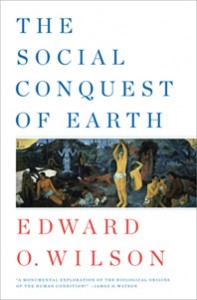
This has been the eternal question of our curious and self-reflective species. Paul Gauguin, in Tahiti in 1897 in his final painting, expanded this question into three: D’ou Venons Nous? Que Sommes Nous? Ou Allons Nous? (Where do we come from? What are we? And where are we going?) As the weather finally begins to cool, it is time for some serious reading …
Edward O. Wilson, the noted Harvard chronicler of ants, has embarked on a trilogy to try and answer all three. The first, The Social Conquest of Earth, addresses the Gauguin threesome in short, pithy chapters, easy for today’s creatures accustomed to electronic social networks. No Proustian rambling for him!
“We have created a Star Wars civilization,” he begins, “with Stone Age emotions, medieval institutions, and god-like technology. We thrash about. We are terribly confused by the mere fact of our existence, and a danger to ourselves and to the rest of life.” His argument, which represents the story of the evolution of social life and its driving forces, is controversial.
It goes like this: “The social conquerors of Earth” dominate today, but they include not only homo sapiens but also ants, bees, wasps, and termites, species that are possibly more than 100 million years older than us (we emerged several 100,000 years ago, only spreading across this globe over the past 60,000 years). It is altogether probable that these other “eusocial species” — less than two percent of the one million known species — will remain long after we disappear.
Our human condition is both selfish and selfless: “the two impulses are conflated … the worst of our nature coexists with the best, and so it will ever be.” Our “hereditary curse” is “our innate pugnacity … our bloody nature (in which) individuals prefer the company of others of the same race, nation, clan, and religion.”
Wilson continues, “The biological human mind is our province. With all its quirks, irrationality, and risky productions, and all its conflict and inefficiency, the biological mind is the essence and the very meaning of the human condition.”
In answering the question, “What are we?” Wilson explores the origins of culture, language, cultural variation, morality, honor, religions and creative art, suggesting “human beings are enmeshed in social networks.” And in these networks, we express our “relentless ambivalence and ambiguity … the fruits of the strange primate inheritance that rules the human mind.”
Wilson submits that religions are logical hallucinations in response to the ever-unanswered question, determining that, “ … religious faith is better interpreted as an unseen trap unavoidable during the biological history of our species. Humankind deserves better … than surrender and enslavement.”
The final chapter of this engrossing and illuminating exploration asks, “Where are we going?” Do we have free will? Wilson answers his question thus: “We are free as independent beings, but our decisions are not free of all the organic processes that created our personal brains and minds. Free will therefore appears to be ultimately biological.” Are we social creatures? Wilson suggests, ” … group selection (is) the driving force of where we have been and where we are going.”
We, a convoluted and introspective species, live in an “extremely complex biosphere” in which we must respect the “equilibrium created by all the other species, plants, animals, and microorganisms around us.” Failure to do so may mean our collapse or even that of the entire system.
But Wilson concludes on an optimistic note, saying, “Earth, by the twenty-second century, can be turned, if we so wish, into a permanent paradise for human beings, or at least the strong beginnings of one.”
This first philosophical exploration of human existence has been followed by the second, The Meaning of Human Existence, published in early 2015, and the third, The End of the Anthropocene will follow shortly.
Together they require serious reflection.
Editor’s Note: The Social Conquest of Earth, by Edward O.Wilson was published by W. W. Norton & Co., New York 2012.
 About the Author: Felix Kloman is a sailor, rower, husband, father, grandfather, retired management consultant and, above all, a curious reader and writer. He’s explored how we as human beings and organizations respond to ever-present uncertainty in two books, ‘Mumpsimus Revisited’ (2005) and ‘The Fantods of Risk’ (2008). A 20-year resident of Lyme, he now writes book reviews, mostly of non-fiction that explores our minds, our behavior, our politics and our history. But he does throw in a novel here and there. For more than 50 years, he’s put together the 17 syllables that comprise haiku, the traditional Japanese poetry, and now serves as the self-appointed “poet laureate” of Ashlawn Farms Coffee, where he may be seen on Friday mornings. His wife, Ann, is also a writer, but of mystery novels, all of which begin in a bubbling village in midcoast Maine, strangely reminiscent of the town she and her husband visit every summer.

 Braiden Sunshine of Lyme sings again this evening on NBC’s ‘The Voice’ at 8 p.m. This sophomore from Lyme-Old Lyme High School (LOLHS) is now in the Top 10 and there will be a viewing party open to all at the school tomorrow evening. Doors open at 7:45 p.m. Admission is free.
 High Hopes Therapeutic Riding, one of the oldest and largest therapeutic riding centers in the United States, recently elected two new members to its Board of Trustees. John Catlett, and Jacqueline Kangley, both of Hadlyme, were voted into office at High Hopes’ 41st Annual Meeting in late October.
 Saint Ann’s Episcopal Church in Old Lyme will celebrate the start of the holiday season by offering the shoreline community a Service of Advent Lessons & Carols sung by the Saint Ann’s Parish Choir on