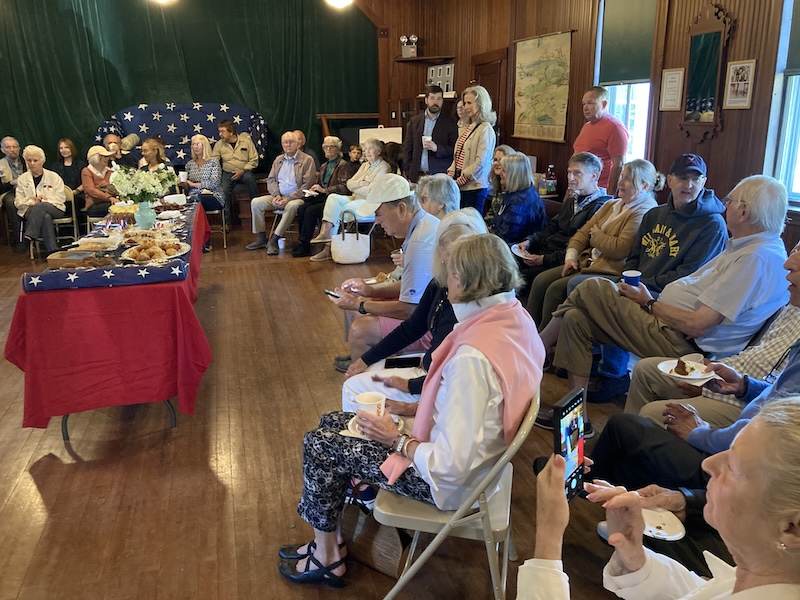
Old Lyme First Selectwoman Martha Shoemaker addresses the audience.at the celebration held to honor General Lafayette’s visit to Old Lyme on Aug. 22, 1824. The event was held in the Old Lyme Historical Society’s building on Lyme Street. All photos by James Meehan except where otherwise indicated.
OLD LYME— On Thursday, Aug. 22, the Old Lyme Historical Society Inc. (OLHSI) celebrated the 200th Anniversary of Major General Marquis de Lafayette’s visit to Old Lyme on Aug. 22, 1824, by serving a continental breakfast attended by Lafayette re-enactor Michael Halbert.
The Old Lyme Historical Society building was appropriately decorated to welcome their esteemed guest.
Around 80 people attended to enjoy breakfast, hear speeches, and take photos of and meet with ‘General Lafayette.’
The.celebratory event drew such a large crowd that there was standing room only for some attendees.
This event was part of a nationwide celebration affiliated with Lafayette200 and took place at the OLHSI building at 55 Lyme Street in Old Lyme.
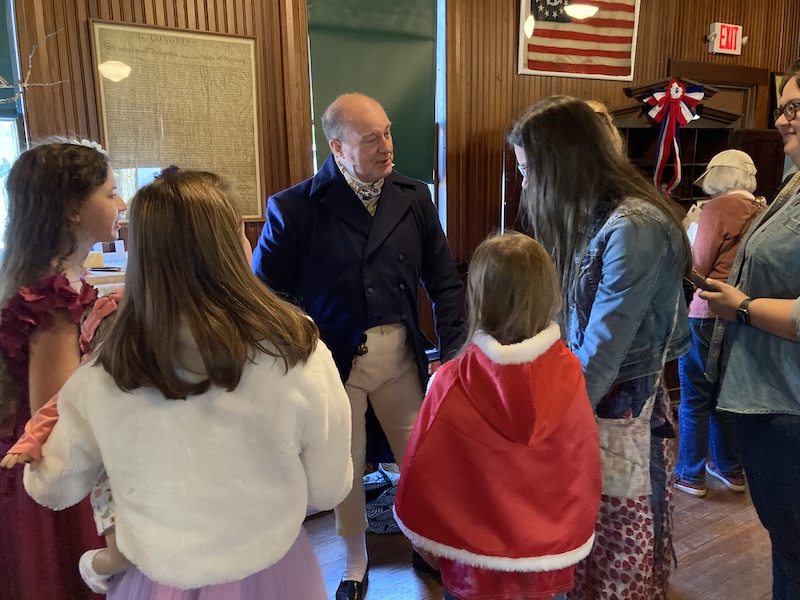
Major General Marquis de Lafayette, played by re-enactor Michael Halbert.(center), drew a constant throng of guests who wished to chat and take photos with him
Lafayette was taking a two-year tour of 24 states to honor the United States’ 50th birthday. On Aug. 22, 1824, he enjoyed breakfast with Richard McCurdy at his home on Lyme Street.
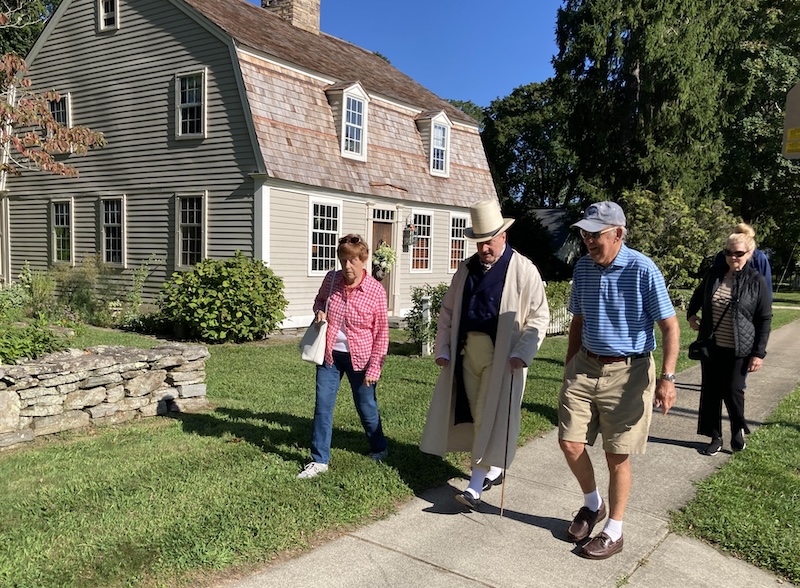
After the breakfast on Aug. 22, 2024 had concluded, ‘General Lafayette’ took a stroll down Lyme Street to the South Green, where revolutionary troops were briefly billeted.
Following the breakfast event, ‘General Lafayette’ walked down Lyme Street to the South Green.
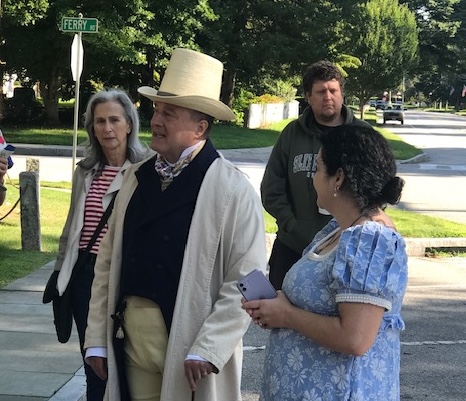
‘General Lafayette’ chatted with a passer-by on Lyme Street. Michaela Pearson (front right) from the OLHSI listened intently. Photo by David Patterson.
Editor’s Note: Read more about Lafayette in these two columns by Tom Gotowka, which were published previously on LymeLine.
Editor’s Notes: i) This op-ed was submitted by Eric Knapp, who is employed as the Town of Old Lyme’s Land Use Coordinator. He is writing here as a private citizen. ii) This is the opinion of Eric Knapp.
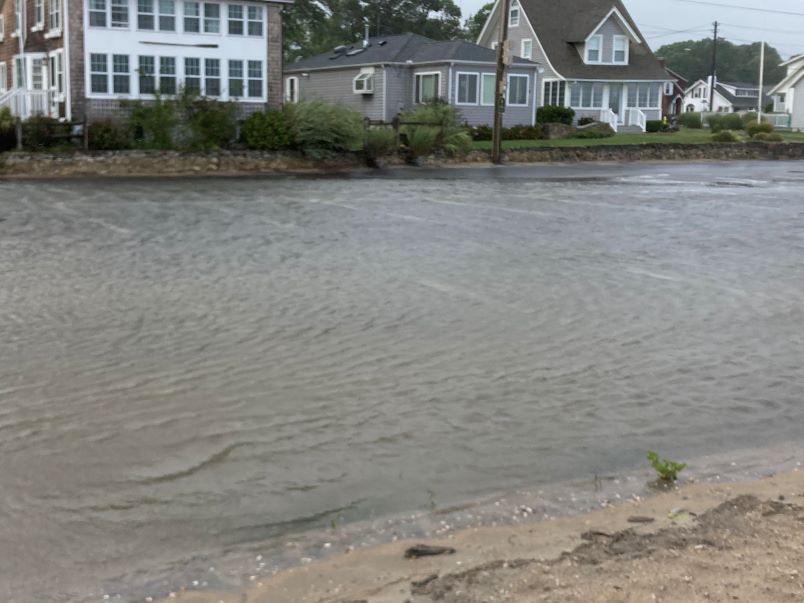
As Long Island Sound rises inexorably, flooding along the Connecticut shoreline is likely to become more frequent. This file photo shows flooding in a prior year at White Sand Beach in Old Lyme.
I have lived in Connecticut my entire life. My career as a lawyer involved representing property owners and land use commissions across the state, but especially along the shoreline, attending countless evening meetings, court hearings and conferences with municipal officials. In my time as a land use officer, I have staffed commissions and served in various positions as a zoning enforcement officer, wetlands enforcement officer, flood plain manager and de facto planner. While I am not a planner by training, my decades of time seeing the Connecticut shoreline in variance capacities has given me time to think about its present and its future.
Connecticut is blessed with abundant water, both fresh and salt. We have a system of rivers that flow through every community, many man-made lakes (almost all of the lakes and ponds in Connecticut are man-made) and a long shoreline with natural harbors. The waters of Connecticut powered our industrialization in the 19th century, and we continue utilizing them for off-shore power and maritime-related centers such as the Coast Guard Academy, Electric Boat and the submarine base. You would be hard-pressed to find anyone who does not have some fond association with the waters of the State.
That makes it particularly difficult to address the sorts of changes that have already arrived and those that are likely to arrive during the course of the 21st century. It does not rain in the same way it did when I was a child. We get many more “rain bombs” — short intense storms that drop an inch, two inches, sometimes more in an hour. It does not snow in the same way that it did when I was a child. December and January are largely snow-less now. Storms during February and March more frequently involve collisions between moisture moving north and a cold front moving south, resulting in huge dumping events, with feet of snow falling at a time.
Infrastructure designed for the 20th century cannot keep up with the 21st century weather. Culverts are now undersized, leading to road-flooding. Some of the pipes draining into Long Island Sound now flow backwards during high tide events. Bulkheads are failing. Streets are flooding. The cooling system for the Millstone nuclear plant has been unable to draw water that is sufficiently cool from a warmer ocean, leaving the biggest source of energy for Connecticut subject to shutdowns. All of this is already here. But more is to come.
The Federal Emergency Management Agency (FEMA) has released a detailed map showing where it anticipates coastal erosion in New London County. It is a scary map to look at, with entire streets anticipated to face serious erosion by 2030.
Nearly all the properties around the mouth of the Connecticut River are serviced by septic systems, most of which are outdated. As Long Island Sound rises, saltwater intrusion will make these systems ineffective. Even now, the nitrogen and phosphorus being added to the Sound due to the over-concentration of septic systems is impairing the water quality, impacting attempts at re-establishing shellfish beds along our shorefront.
As impervious surfaces increase year after year, and the rain bombs occur with greater frequency, storm sewer systems will fail with increasing regularity. Roads will flood and then fail. Methods such as rain gardens and detention basins will lose their effectiveness as the water table rises. There will be, quite literally, no place to put the water.
Elected leaders have not fully embraced this reality. It is not hard to see why. In towns such as Clinton or Westbrook, these low-lying areas provide a large percentage of the real estate taxes. Importantly, since many of the dwellings are seasonally-used, they contribute the same taxes as year-round dwellings, but use a fraction of the services, and do not send any children to the school system. The fact that these neighborhoods are at risk poses potential financial threats to these communities.
Property owners do not want to face this reality either. These are valuable properties. Even when the structures on them are old and dilapidated, the land is worth a great deal. That this investment might lose value, or worse, become valueless, is a hard pill to swallow. Taking steps to address climate-related issues only highlights the problem, putting pressure on resale values. There is frequently an insistence that all that is required is a simple fix: a better drain, or an elevated road, and whatever “temporary” issue there is with water can be resolved.
One of the clearest examples of how the system is not working is the FEMA “substantial improvement” requirement. In theory, the rule is simple: if you perform improvements on your structure, the fair market value of which exceeds 50 percent of the value of the structure, you are obligated to make the structure FEMA-compliant for flood zone purposes. The idea is commendable: over time, as owners perform necessary repairs and improvements, houses will have to be raised, diminishing that owner’s and the community’s flood risk.
The reality is quite different. There are three pathways, and none of them is ideal. First, yes, there are those with the money to elevate their houses. But the truth is that if an owner is going to spend the money to elevate their home, they will also likely want to maximize their investment, making the home as big as zoning will allow, and obtaining variances to go beyond even that. The effluent will still be in the septic system, of course, but the house will be there after the next storm.
Next are the “dodgers”. As any zoning officer will tell you, people will play games to show that they are not exceeding the 50 percent threshold. They can provide their own appraisal of the structure to show it is worth more. They can claim that there is some code-related emergency. They can try and undervalue the work proposed, or simply do more work than their permit sets forth, or maybe not bother to get a permit at all.
The fact that all of this will leave them vulnerable when some future storm arrives is tomorrow’s problem. By then, it may be another owner’s problem. Every seller of a vulnerable shoreline dwelling silently knows that they have dodged a bullet.
Finally, there are those who are simply not in a position to make improvements. Their dwellings will continue to deteriorate, making the problem harder to solve. Each dollar of value that a structure depreciates lowers the threshold of any future improvement that would trigger the “substantial improvement” requirement. These houses are potential death-traps. Inevitably, when these structures collapse and wash away, their debris will harm other properties.
Each year, the amount of impervious coverage grows, the Sound inexorably rises and the odds of a catastrophic storm get worse.
As the saying goes, the first step to recovery is admitting that you have a problem. Shoreline Connecticut has a problem.
So, what happens next?
Realistically, a lot of hard choices. Solutions will take money. There will be winners and losers. Some towns may need to rethink how they see themselves. But it must be done, and we need to start now.
Let’s start with what we can’t do. We cannot simply try and armor the coastline. Not only is this completely disfavored by both FEMA and the Department of Energy and Environmental Protection, but it would also be wildly expensive and would not even work. Armor merely diverts the energy and water from the ocean. The water that is not coming ashore on one site will search for another location to enter.
Water may not overtop a wall, but it will exert pressure on the surface water beneath the wall, pressing the fresh water north and then rising up out of the ground. Likewise, where streams or inlets meet the shore, the tidal wetlands will fill up and freshwater wetland will become brackish. A Maginot Wall along the Sound will work as well as the real one did. Water will find a way around. It always does.
Realistically, we are going to need to create space.
“Creating space” will mean different things in different locations.
For distressed homeowners, who cannot afford to make improvements, a modest buyout program may be possible. Removing houses and creating more pervious area for water to infiltrate will help, if only modestly. Removing potentially hazardous structures from the flood zone will reduce the danger to other structures. Finally, if the structure is removed, there is no chance of anyone being inside during a storm event.
This latter option has two negative financial implications. First, there is the cost of any buyout. Second, each of these dwellings pays taxes, and removing them directly affects the Grand List. But increasing the security of other structures should, in theory, increase their value, somewhat offsetting this loss.
Buffers around tidal wetlands may need to increase. As the Sound rises, these coastal areas will try and move inland. By creating and enforcing realistic buffers, towns can protect the spaces into which these tidal marshes and flats will want to intrude. Property owners will not like seeing these encroachments on their properties. They will feel, rightfully, that they are losing something they own. The abstract idea that healthy tidal areas protect everyone is little comfort to those most affected by these efforts.
Fortunately, there are other creative ways being developed to help mitigate some of these issues. Boston is trying out an “emerald tutu” system, described by the American Society of Mechanical Engineers as, “A linked group of floating spherical mats. Each is roughly a meter in diameter, made of a mix of biomass, seeded with marsh grass, and surrounded by a net to hold it all together.” These serve the dual purpose of assisting the ecosystem while also helping to dissipate wave energy, preventing or mitigating erosion.
In Stratford, they are using concrete reef balls to perform a similar function. Other communities are adding a layer of additional soil to their tidal wetlands to keep them above rising waters.
It will take a lot of trial and error to figure out the best ways to accomplish these goals. Not every project will be successful, and what may work in one place may not work in another.
At the risk of starting a firestorm, there is also the dynamic of reliance on individual septic systems in a large portion of the coast. From Clinton to Old Lyme, the official policy has been “sewer avoidance”. As a result, many older systems, while not officially “failing”, are putting nitrogen and phosphorus into the ecosystem at a rate higher than it can be absorbed. There is also the basic hydrological issue that most of the shore is served by public water, so water arrives from outside of a community and then leaves through the septic system, creating a net increase in water.
The likelihood that new large sewer plants will be constructed is low. They are expensive and unpopular, however necessary they might be. What seems feasible is that smaller community systems can be installed on small lots throughout shoreline communities. Even tying eight or 10 houses into a small system would prove beneficial. Of course, this is not easy to do under the present Health Code, so regulatory changes may be required to allow this to occur.
For larger commercial uses, there may be some benefit to having them build systems that exceed what they require (in exchange for regulatory benefits), which could allow nearby substandard systems to be phased out and those properties to hook into the commercial system (for a cost.)
Inevitably, while making choices, there will be those who will lose property rights, or more clearly, their properties will be reduced in value, sometimes to zero. The reality is that this is going to happen anyway, as the water rises. But if the government does this, it constitutes a taking and compensation will need to be paid. This will cost real money. People will fight to get as much compensation as possible in exchange for giving up some or all of their property, and rightfully so.
The alternative is to wait for a large storm to come and then see who has the resources to rebuild. I am not persuaded that this would be better.
I am not writing this because I have the answers. I am writing this because we all need to come together and start contemplating the answers together. This will take time. It will be hard. People will disagree, quite loudly, about the extent of the problem, before we even get to the question of what answers will look like.
But I would encourage the people of Connecticut to take up this work now, so that my 14-year-old sons will have a future here. We may be the Land of Steady Habits, but we are also a land of inventors and hard workers. We can solve this, but only if we put our minds and our energy, and yes, our dollars towards a solution.
Editor’s Notes: i) We have divided Part One of Thomas Gotowka’s essay into three parts. We will publish Parts 2 and 3 on Monday, Sept. 2 and Tuesday, Sept. 3, respectively. ii) This is the opinion of Thomas D. Gotowka.
Tom Gotowka
We are almost at the final stage of the two dueling campaigns leading to the 2024 presidential election; which initially had all the hallmarks of being just another nasty election featuring two old white guys fighting to demonstrate the other’s incompetence and inferior intellect; but now, it’s gotten awfully weird.
I begin this “View” below at the first debate and review the remarkable events that occurred right afterwards; which led to the emergence of Vice President Kamala Harris as the strong and popular Democratic candidate for President of the United States (POTUS); and then continue through the Democratic National Convention (DNC) in Chicago, where an again-confident President Biden passed the torch to his VP in an enthusiastic keynote address to the delegates.
I will consider a few of Donald J. Trump’s campaign events and his recurring themes to get a sense of what’s on, or in his mind — quoting his often-bombastic rhetoric.
In Part Two of this Epic, “Content of Character,” I review several political and legal events in Trump’s life that illustrate his character — i.e. his moral and ethical principles Note that the title is derived from Martin Luther King Jr’s August 28, 1963, “I have a Dream” speech, which includes the line “I have a dream that my four little children will one day live in a nation where they will not be judged by the color of their skin, but by the content of their character.”
This will be the most consequential presidential election of my lifetime The country is divided and it will be a very tight race.
I do not support Trump’s candidacy. I feel that the repeated insults he has directed at our veterans and military heroes; and the praise he has directed at authoritarian despots like Vladimir Putin and Kim Jong Un make him particularly ill-suited for the President’s concomitant role, — Commander in Chief of America’s Armed Forces. Trump has posted that he trusts Putin more than the U.S. Intelligence ‘lowlifes’; and has bragged that he knows more than the generals.”
The observations and opinions presented in these two, and all my “Views” are mine.
I am not privy to the DNC’s talking points; and assuming it matters to anyone, Christina and I have five children and our family’s pets have always joined us as rescued kittens. No miserable, childless cat ladies in our household, Mr. Vance!
This “View” is long and complicated; but provides a perspective on an evolving period of American history.
Candidate Harris
President Biden announced on Sunday, July 21, that he would not stand for re-election, evidently unwilling to withstand the increasing calls for his withdrawal that were coming from within his own Party; which intensified after a poor performance in the June 27 debate; after which concerns were raised regarding his physical and cognitive health.
Paul Choiniere noted in The Day that Trump “lied from start to finish” in the debate, while Biden did little to counter the lies and little to present his record as President. After he announced his plan to withdraw, the President endorsed his Vice President, Kamala Devi Harris to become the party’s nominee, which was incredibly well-received by the Party and the Nation.
Key Democrats rushed to endorse her; and she raised a record $81 million within the first 24 hours of her campaign launch. The AFL-CIO endorsed Harris’ presidential bid, following endorsements by many individual unions.
Note that I regularly refer to the candidates as “Harris,” or Trump;” and the President as “Biden” in these two essays. I mean no disrespect; it just makes for better flow and easier editing.
Republican Senator Lindsey Graham, risking Trump’s wrath, offered strong praise of Biden: “While we have political differences, I appreciate his lifelong service to our nation, which he dearly loves,” “He has devoted his entire life to public service for the people of Delaware and the United States, and I wish him and his family well as this chapter in his life comes to an end.” Harris then hit the campaign trail with energy, enthusiasm, and an articulate message.
Conspiracy theorists, right-wing commentators, and some Republicans immediately cast Biden’s withdrawal from the campaign as evidence of something sinister. Trump tried to portray Harris’ replacing Biden as the nominee as nefarious, likening it to a “coup;” and in recent days claiming it may somehow be unconstitutional, although he could not specify the Article in the Constitution that was violated.
There is real concern that he could be laying the groundwork to contest his electoral defeat, as he did in 2020.
Trump is now the old man in the race, and after turning 78 last June, became the oldest presidential nominee in U. S. history. Decades older than Harris, he is a convicted felon who has adopted “Hitleresque” themes (see below), and vowed an administration of retribution and televised military tribunals for some of his political opponents.”
Anne Applebaum, Senior Fellow at the Agora Institute at Johns Hopkins University, who co-leads a project on 21st-century disinformation has said, “Now it is the Republicans who are saddled with the elderly candidate, the one who can’t make a clear argument or finish a sentence without veering off into anecdote.”
In reaction, Trump immediately morphed into his “Biff the Bully” persona. As you may recall, Biff Tannen is the bully from the “Back to the Future” movie trilogy; and he had some memorable lines. — perhaps his most quoted and worthy of an appearance at a Trump rally: “Make like a tree and get outta here!”
Trump is again relying on the insults and personal attacks that characterized his earlier campaigns, and has returned to the distasteful rhetoric for which he’s well-known — second rate and seventh grade insults and ridiculous nicknames. My four-year-old granddaughter, Maddie, sums it up nicely, saying, “That’s stupid!”
Trump, who now appears to be “running scared,” called Harris “dumb as a Rock,” “crazy,” “nuts” “low IQ;” and even repurposed an old insult he had aimed at President Biden; labeling her “Lyin’ Kamala.” There’s more, but you get the picture.
However, Harris clearly has his measure. On the day after Biden endorsed her, she reminded her campaign team, “I was a courtroom prosecutor.” I took on perpetrators of all kinds; — predators who abused women, fraudsters who ripped off consumers, cheaters who broke the rules for their own gain. So, hear me when I say: I know Donald Trump’s type.”
Trump’s allies fear that Harris’ momentum has thrown their candidate into a panicked fury, and are urging him to focus on the policy debate. “I know what I’m doing.”
Harris’ VP Selection
On August 6, 2024, Harris announced Minnesota Governor Tim Walz as her running mate. Walz was selected from a pool comprised of state governors, sitting U. S. Senators, and a member of Biden’scabinet.Trump claimed that “He’ll unleash ‘HELL ON EARTH’ and open our borders to the worst criminals imaginable.” (Trump’s caps)
Soon after Harris announced her candidacy, Trump and his running mate began accusing her of antisemitism, calling her, “Totally against the Jewish people.” On Fox News, Trump attempted to present the Harris’ choice of Governor Walz over Pennsylvania Governor Shapiro (and others) as driven by Gov. Shapiro’s Jewish heritage. “I think it’s insulting to Jewish people.”
Vance, expressed similar thoughts at a Philadelphia rally, and said that he, “Felt bad for Shapiro, and that the fact that “the vice-presidential race on the Democratic side became so focused on his ethnicity” is “absolutely disgraceful” and “insulting to Americans.” Vance went even further with “Democrats made Josh Shapiro ‘run from his Jewish heritage.’”
The Trump/Vance duo made no mention of the religious heritage of the other candidates in Harris’ VP pool.
Outrageously Trump has also said, “Jews who vote for the Democratic party “should have their head examined.”
Governor Shapiro released a statement congratulating Walz. “I know that Governor Walz is an exceptionally strong addition to the ticket who will help Kamala move our country forward.” He added, “Lori and I consider Tim and Gwen to be good friends of ours and we are excited for them and for the country to get to know the great people we know them to be.”
Shapiro generated Trump’s wrath with his “freedom speech” at the DNC, where he said that voting for Harris and Walz was not simply a vote of confidence in two candidates, but a vote against “A threat to our freedoms.”
Weirdly, Trump posted, The highly overrated Jewish Governor of the Great Commonwealth of Pennsylvania, Josh Shapiro, made a really bad and poorly delivered speech talking about freedom and fighting for ‘Comrade Kamala Harris’ for President.”
Note that Harris’ husband and stepchildren are Jewish.
About the Author: Tom Gotowka is a resident of Old Lyme, whose entire adult career has been in healthcare. He will sit on the Navy side at the Army/Navy football game. He always sit on the crimson side at any Harvard/Yale contest. He enjoys reading historic speeches and considers himself a scholar of the period from FDR through JFK. A child of AM Radio, he probably knows the lyrics of every rock and roll or folk song published since 1960. He hopes these experiences give readers a sense of what he believes “qualify” him to write this column.
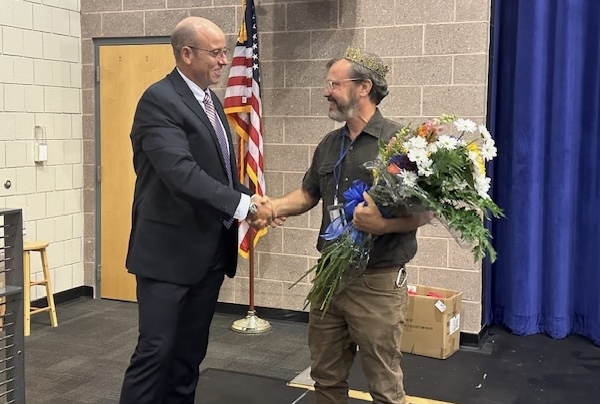
After being announced as Lyme-Old Lyme Schools 2024-25 ‘Teacher of the Year’, Lyme-Old Lyme High School art teacher Will Allik (right) shakes hands with Lyme-Old Lyme Schools Superintendent Ian Neviasier.
OLD LYME—In time-honored tradition, Lyme-Old Lyme Schools Superintendent Ian Neviaser announced the District’s Teacher of the Year and Employee of the Year at the Convocation assembly held Monday in Lyme-Old Lyme High School (LOLHS.)
Longtime LOLHS art teacher William ‘Will’ Allik, who has been working for Lyme-Old Lyme Schools since 2004, was named Teacher of the Year.
Described by Lyme-Old Lyme High School Principal Jim Wygonik as someone, who has, “Gone beyond teaching the curriculum.,” Wygonik continued, “This extraordinary educator [Allik] has ignited a spark in his students, encouraging them to see the world through a creative lens and to think beyond the conventional.
Commenting that Allik’s classroom is, “Not just the subject he teaches, but a powerful tool for expression, innovation, and critical thinking,” Wygonik added that the Teacher of the Year, “Has created an environment where every student feels valued and inspired to explore their unique talents.”
Commenting that Allik, “Challenges his students to push boundaries, to ask questions, and to develop their own creative voice,” Wygonik said, “He [Allik] teaches his students how to see and how to express their vision in creative ways.”
Noting that Allik’s, “Dedication to nurturing young minds is evident in every project he undertakes,” Wygonik stressed that this same dedication is also active in, “Every lesson he teaches, and the hours and hours he dedicates to mentoring our students.”
Finally Wygonik emphasized that Allik, “Understands that his subject is a vital component of a child’s education.”
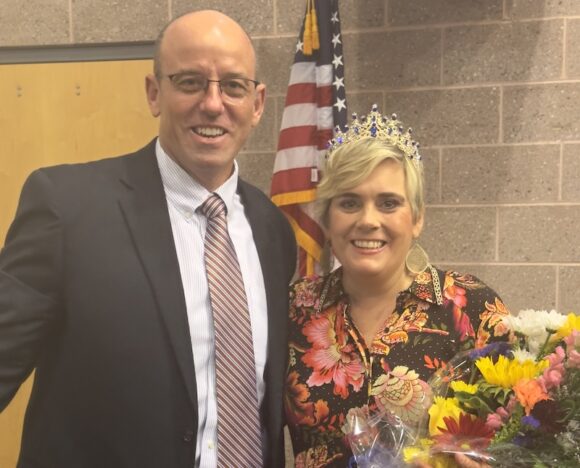
Sarah Karpinski, who is the Library Aide at both Mile Creek and Lyme Schools, is LOL Schools 2024-25 ‘Employee of the Year.’ She stands here with Schools Superintendent Ian Neviasier after receiving her award.
Neviasier named Sarah Karpinski, who is the Library Aide at both Mile Creek and Lyme Schools, as ‘Employee of the Year.’ She has worked for Lyme-Old Lyme Schools since November of 2020 and is also an attorney.
Kelly Enoch, Principal, Mile Creek School, said in support of the announcement of Karpinski’s honor that she [Karpinski], “… is known as “the book whisperer.” The breadth of her knowledge of youth literature allows her to recommend the perfect book to each student who visits the library.”
Allison Hine, Principal of Lyme School, added that Karpinski is known by students and staff alike for, “Her generosity of time, resources, spirit and ready smile.”
Enoch added, “Sarah is a consistent, positive presence, who enhances the joy of learning for all of our students. She brightens the days of so many with her positive presence, friendly demeanor, and “can do” attitude.”
This family walked cheerfully into Lyme Consolidated School on the first day of the new academic year. All photos by LOL Schools.
LYME/OLD LYME–This past Tuesday, Aug. 27, was filled with hugs and smiles—and a few nervous steps and glances—as the first day of a new school year in Lyme-Old Lyme Schools unfolded.
More smiles outside Lyme Consolidated School as friends reconnected.
Asked how the day had gone, Lyme-Old Lyme Schools Superintendent Ian Neviaser told LymeLine exclusively in a text message, “We were happy to welcome our students back to school for what looks to be another exciting year in the Lyme-Old Lyme Schools.”
Teachers at Mile Creek School were all smiles too as they waited for their new students.
He added cheerfully, “We have lots of new faces, and many familiar ones, and look forward to everything this school year will bring.”