
Morning Glory Opens in Old Lyme

After escape from Laos as a child, Sichanh Patana finally fulfills his American Dream
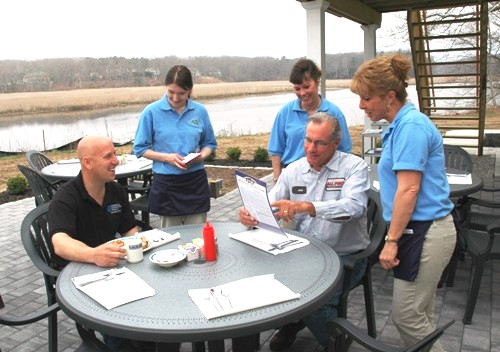
With the Lieutenant River in the background, owner of the property Jim Graybill (right, seated) places his order at the Morning Glory Cafe while Ron Swaney (left) enjoys his breakfast.

With the Lieutenant River in the background, owner of the property Jim Graybill (right, seated) places his order at the Morning Glory Cafe while Ron Swaney (left) enjoys his breakfast.

More than 30 years ago, in a desperate bid to escape the Communist uprising in their homeland of Laos, a two-year-old boy along with his parents and five brothers climbed onto inner tubes on the banks of the Mekong River. They drifted slowly across the dangerous waters finally landing in Thailand.

Yesterday morning, in a classic achievement of the American Dream, Sichanh (pronounced See-Sean) Patana – the two-year-old on the inner tube – proudly opened the Morning Glory Café on the banks of the Lieutenant River in Old Lyme.
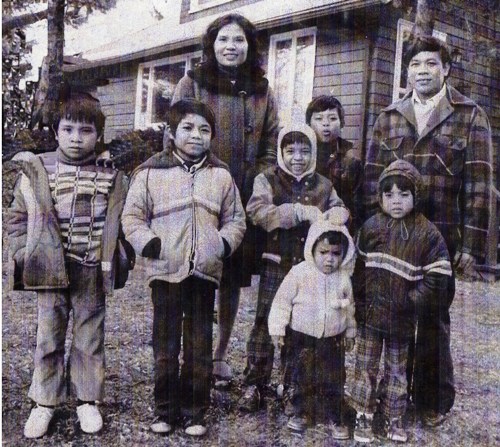
A file photo of the Patana family shortly after their arrival in January 1980.  Sichanh is pictured front row, far right and his father stands behind him.

A file photo of the Patana family shortly after their arrival in January 1980. Sichanh is pictured front row, far right and his father stands behind him.

Patana and his family arrived in Old Lyme in January 1980. He remembers nothing about the escape from Laos nor the long journey that took them first to a crowded refugee camp in Thailand, where they lived for two and half years,  and ultimately to Old Lyme, Conn.

The effort to bring the family from Laos to the US was spearheaded by Old Lyme residents Lou and Cathy Connick with the support of four local churches (the First Congregational Churches of Lyme and Old Lyme, St. Ann’s Episcopal and Christ the King.)

Lou Connick had strong connections with Laos having worked there for many years as the Director of the Asian Foundation for US Aid and Sichanh’s father Peng had been employed by US Aid as a mechanic. This is the first of a series of special bonds that make the story of Sichanh opening Morning Glory a special one.
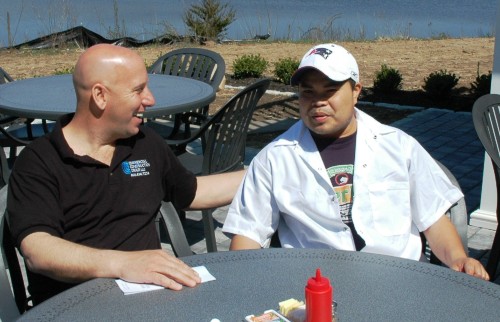
Sichanh catches up with Ron Swaney of Commercial Construction LLC for a relaxing moment after breakfast was over.

Sichanh catches up with Ron Swaney of Commercial Construction LLC for a relaxing moment after breakfast was over.

After the Connicks had successfully worked to bring the Patana family to Old Lyme, they stayed involved with them, assisting with all the day-to-day difficulties that face a family with six children under 13 living in a country where none of them speak the language. Sichanh says he doesn’t recall learning English, “We just grew into it,” he explains.

Peng found work with local garage owner Jim Graybill and stayed employed there for 30 years.  Meanwhile Lou Connick was named Sichanh’s godfather.  Sichanh has one very special memory of his godfather, who passed away some eight years ago, which relates to his current endeavor.  He recalls, “Mr. Connick always encouraged me to open my own business some day.”

All six boys went through Lyme-Old Lyme Public Schools, where Sichanh excelled at soccer.  After college, he took off for Hawaii where he lived for six years working first as a bus boy and then in three different Italian restaurants, where he learned all aspects of the trade.  Returning to Connecticut, Sichanh attended the Center of Culinary Arts at Cromwell and then worked first at the now closed MiaMama’s in Middletown and then became sous-chef at The Hideaway in Old Lyme.
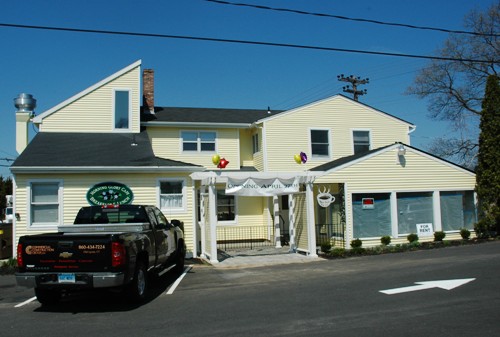
The handsome exterior of the Morning Glory Café.

The handsome exterior of the Morning Glory Café.

Later he joined his brother in his Thai-Basil restaurant in Danielson but finally, deciding his prospects of ever owning his own restaurant were fading first, Sichanh moved into the landscape business .
Three years later he was well settled in his work when a phone call came out of the blue from Jim Graybill asking Sichanh if he was interested in running a restaurant in a property Graybill had recently purchased.  In another fotuitous link, Graybill’s daughter-in-law had worked with Sichanh when they were both employed by The Hideaway and had suggested him.
Sichanh didn’t give Graybill a reply immediately, but then he came and visited the property, admired the view and says, “The river just sold me.”

Inside the café, the color scheme has been carefully chosen.

Inside the café, the color scheme has been carefully chosen.

That was 2007 and now after completely renovating the property the Morning Glory Café is ready to open tomorrow.  Why the name?  The romantic answer is given in the welcome message written in the menu where it says, “Like our travels to the United States, the nights were hard but the glory of the morning always renewed our hopes for a brighter tomorrow.”  In an off the cuff response, Sichanh smiles and says, “It rolls off the tongue nicely!

To Go area_500x345

The restaurant boasts a food and coffee ‘To Go’ section (pictured above), stools at the breakfast bar (pictured below), tables inside and a delightful stone patio outside with a view looking over the river and marshes.  The menu, to which Sicanh says all members of his family gave input, offers familiar favorites as well as some dishes from Laos including “my mom’s famous egg-rolls!”  Speaking of family, one of Sichanh’s brother’s, Pon, is the restaurant manager.

Breakfast bar_500x340

A very successful trial opening for some 50 friends and family was held Saturday morning and at the end of it a clearly pleased and cheerful Jim Graybill told LymeLine, “I thought the idea would be great for the town.  The town deserves a nice relaxing location. There’s no real place to sit and appreciate the water.”

He mentioned his sincere appreciation of all the work done outside by Ron Swaney of Commercial Construction Group LLC and inside by Bob Gianardi of Questa, “that’s made this possible” and said of Sichanh, “I think he’ll do a great job. He has a great menu and I wish him the best success.”
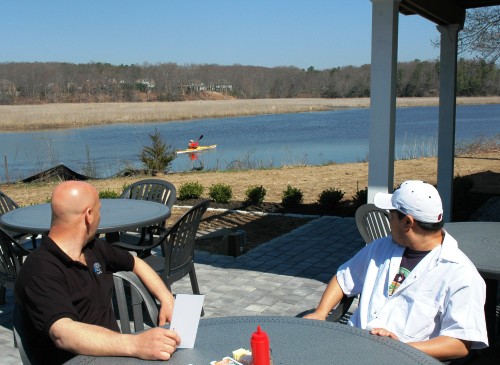
Watching the world (or in this case, a kayaker) go by from Morning Glory's inviting patio.

Watching the world (or in this case, a kayaker) go by from Morning Glory’s inviting patio.

And what are Sichanh’s hopes for the Morning Glory Café?  He answers quickly with a grin, “That we’ll still be here in 10 to15 years!” and then adds, “I hope everyone is happy that comes here. If everyone is happy, then we’ll be happy.”
Taking a more serious tone, Sichanh says, “I want to thank everybody that helped us in the early days, especially the Connicks.”  He notes wistfully that though they may both have passed away now, “We owe our success to them.  Without them we wouldn’t be here.”

Editor’s Note: The Morning Glory Café is open daily from 6 a.m. to 3:30 p.m. and orders can be called in ahead to 434-0480 or faxed to 434-0465.

“Les Jeux Sont Fait” by Jean Paul Sartre

We felt Jen’s book review this week is suited for a Sunday. For those not familiar with Nobel Prize-winning French author Jean-Paul Sartre, his theme is existentialism, which preaches, in Jen’s concise words, “life is a done deal before you started, so what’s the point?”  Sartre is a hard sell, but Jen makes us want to try him one more time.

The Chips Are Down ( Les Jeux Sont Fait) is not as depressing as I remembered.  (Of course, in 10th grade French – everything is moderately depressing unless you get to read Tintin, which you don’t.)

I actually enjoyed it more this time.

It stands as a classic example of the existentialist movement in the last century.  Camus, Sartre, Ionesco and others were presenting the relatively novel opinion that life was a done deal before you started, so what is the point?

“Existentialism is a term that has been applied to the work of a number ofnineteenth and twentieth century philosophers who took the human subject — and his or her conditions of existence — as a starting point for philosophical thought. Existential philosophy is the “explicit conceptual manifestation of an existential attitude” that begins with a sense of disorientation and confusion in the face of an apparently meaningless or absurd world.” *Well, Hell. There’s really no point in even reading my thoughts then, is there?  In Les Jeux Sont Fait, two characters from very different circumstances, die and then fall in love.  As this is a bit backwards, they are given, by the powers above or whomever, another try.  If, in 24 hours they can stay in love then they can return to the living.

Of course, the chips have been played though haven’t they?  What is done is done.  You can no more control the fates than overlook the grammatical anomalies in this sentence.  (Oxymoron doesn’t have the word moron in it for nothing.) See how jumpy existentialism makes me?  My sense of humor is eroding before your very eyes.

Existentialism is a variation on the theme of Ayn Rand’s Objectivism, which states that man should absolutely take charge of his own life.  Reality exists independently of consciousness and your world is what you make of it.  You will succeed if you utilize your powers.  Existentialism holds that your consciousness is your reality and the world is made already so you are not as powerful as you think, but you still have to try.**

Instead of getting control over your own life, your own happiness, you may have no say at all.  Que sera, sera. Whatever will be will be and you’d best just accept it.  Les Jeux Sont Fait, so tough darts.  Or is it?

Sartre seems to agree with me (how vain, it is I with him, of course) that although your freedom may be a fantasy, it is also a necessity.  “Freedom is what you do with what’s been done to you.”  Whatever cards you are dealt are worth playing.  The outcome may or may not be fixed but it’s all in how much you enjoy playing the game.

It is definitely a book you should read at least once (also Beckett’s Waiting For Godot.)  It is not quite as morose as it seems and it is an important door to open.

As Max Tivoli said,” Life is short and full of sorrows, and I loved it”.

* Thank you, Wikipedia.
** I apologize for the gross oversimplification.  There isn’t enough coffee in the world for me to go further down that path of reasoning right now …Editor’s Note to Book Reviewer:  This book breaks all previous records for length of time to locate a photo to run with your review … seems kind of par for the course for Monsieur Sartre …

“The Female Brain” by Dr. Louann Brizendine

She’s done it again!  Our Jen has us rushing down to the bookstore again because her book review choice this week is a must-read.  Can there be anything on earth more fascinating than the female brain?  We think not, but then we’re obviously biased as we’re an exclusively female business.

I wish I had read this book years ago.

I’m not crazy.  Who knew?

What I am – amongst other things – is the proud owner of a female brain.  From the Stone Age on, it has had its own way of ticking that has not really been studied before.  It was always assumed that the male brain was it.  We studied that and just tweaked it ever so slightly to compensate for femaleness.

Wrong!  Wrong!  Wrong!It is utterly different.

This explains a great deal about the Mars and Venus thing.  I was happy to hear that there are chemical reasons for my innate sense of drama.  It isn’t just the wind blowing the wrong way as my husband supposes.  It isn’t some poor sap (him) looking at me the wrong way that sets me off – it’s chemical!  Sadly this is not a season pass to go mental but it is very interesting.

Brizendine is neuropsychiatrist.  She was on the faculty at Harvard Medical School.  She is a graduate of Yale medicine and Berkeley.  We can safely trust her wisdom.
As we knew, women have a greater part of their brain vested in emotional issues.  It was critical to our survival that we learn to pick up on hidden nuances in social gatherings.  We have a heightened sense of awareness with regard to relationships and this enables us to ‘read’ people in a way that the male can not.None of the book is emotely condeming of the male brain.  Its just different.  We need to interpret social reaction to survive.  Men need to protect physically to survive.  Two sides of the same stone.

Brizendine follows the hormonal fluctuations of the female and shows us how varying chemical levels protect and deter us at different stages in our lives.  Young girls learn to read faces.  Toddler girls learn to express themselves emotionally and verbally.  Teen girls are thrown into a maelstrom of fluctuation that makes learning almost impossible.  Mothers learn to sacrfice their own brain power to protect their young instinctually.  Older women get thrown back into the boiling pot of hormones before leaving the reproductive cycles behind and leveling out.
The stages all have their foibles (ever tried to have a rational conversation before the end of your menstrual cycle? … and failed?)  All stages are linked directly to our evolutionary growth.  We still manifest Stone Age instinct.  Men have “fight or flight” while we have “tend and befriend.”  Without it, we wouldn’t have survived.  No one would.”The Female Brain” is fascinating.  Every bit is an unveiling of hidden questions I sometimes did not know I had.

Wonderful book.  You’ll be amazed at what you learn.

“The Story of a Marriage” by Andrew Sean Greer

Our voracious reader Jen Mann dives into, “The Story of a Marriage” by Andrew Sean Greer this week and surfaces to observe insightfully, “While exploring the idea of ‘marriage’, Greer is exploring the idea of self as well.” As always, she has piqued our curiousity and to the library we must go. 

Andrew Sean Greer wrote The Confessions of Max Tivoli.  I was interested to see if he could pull another whopper out of his hat.  He does.  The Story of A Marriage is a very good book.

Set in San Francisco in the early 50s, there are so many levels of interest I don’t know where to begin (echoes of last week – so maybe it’s just Spring Fever.)  A young woman, Pearlie and her husband Holland have a marriage and a young child.

But what is a marriage?  Is it love, safety, self-sacrifice?

Pearlie is confronted by a man from Holland’s past and the unfolding story puts these queries front and center.  Pearlie isn’t sure she knows her husband but she is sure that she loves him and will go to great lengths to make her son and husband happy.

She has a beautiful vine covered house, a quiet dog, a stocked icebox – what pains will she take to keep this dream alive?  Maybe dreams are less than the reality.  Maybe they are more.

What I found especially intriguing is how Greer presents this story.  I take great satisfaction in figuring out stories early on.  I often think I know better (eye-roll please) and actually am thrilled when I am wrong.  I like being out-maneuvered.  Greer is good.  We see some things coming but others are just out of reach.  Instead of feeling frustrated, we are entranced.  Pearlie, Holland and the others are more enigmatic than we initially assume.

There are many kinds of love.  Each of the characters loves in varying degrees and often more than we see.  The story, through Pearlie’s eyes is a wonder as we open our eyes in tandem.

While exploring the idea of ‘marriage’, Greer is exploring the idea of self as well.  As in Max Tivoli, Greer shows us great beauty through pain.  This is not schadenfreude or speculation.  He truly sees the joy inherent in trial, but pure.

The end is unexpected and toothsome because we all struggled to get there.

“Never Let Me Go” by Kazuo Ishiguro

“Never Let Me Go” by Kazuo Ishiguro is one of those books that never lets you forget, to paraphrase the opinion of our wonderful book reviewer Jen Mann. We’ve just read her words and now we’re on our way to the library to request a copy – see if you feel the same way about this extraordinary book.

Occasionally you read a book that resonates within you immediately and you just know that it’s going to do that forever.  Ishiguro’s Remains of The Day was such a book and more so is Never Let Me Go*. 

The power of this book is in its raw, almost surreal, approach to friendships, comfort and love in the broader context of scientific culpability.  How far is too far to save someone?  Which someone is worth saving and how dare anyone decide?

The setting is present day in a slightly skewed version of the world.  An English boarding school called Hailsham is the touchstone for a group of children who grow up there and are sent out too young and vulnerable into a world that will use them.We are initially unsure of why they seem so different but we immediately sense that they are.  A great deal of our information seems intuited, as it is for these children as well.
There are no parents.  There are only guardians and peers.  They grow up to fill a specifically heart-wrenching role that we can only pray will never be reality.  But it their reality, and the grace with which they accept it is crushing.How can their lives be reasonable to them?Because they know nothing else.

The entire book reminded me of a scene in H.G. Well’s Time Machine where the simple innocents are lead happily to their death at the hands of the very people who have lovingly bred them.

As we watch the story at Hailsham unfold, we see the author play boarding-school angst perfectly.  We feel with them.  We watch as these children become adults but never really mature.  They carry their unanswered questions with them and when we see them as adults fulfilling their destiny, we just want them to run away.  They don’t.  It never even occurs to them and we are left despairing for the scientific world that has created and destroyed them.
Ishiguro’s stories evoke many feelings within us.  Loss, despair, hope, trust and mistrust – all simultaneously.  While some feelings are with specific response to his plot, some just float in the air around you.  He reminds you of your own desires.  Your own cravings and fears both as an adult and as a child.  He manifests the intangible and it leaves you feeling winded.
* The title comes from a fictional singer’s album in the book but in our world there are two wonderful versions of Never Let Me Go by respectively Dinah Washington and Tierney Sutton.