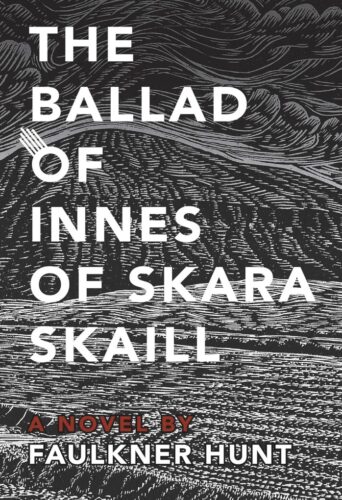
Literature in the Lymes: A Review of ‘The Ballad of Innes of Skara Skaill’ by Faulkner Hunt

He has created a land and characters that instantly feel familiar.

Like Faulkner, I was raised at the knee of a storyteller and read everything in every conceivable accent to my children. Some of us were more often amused (me) than others (them) but, I wouldn’t hesitate to do it again.

Nothing. Absolutely nothing beats a story. A tale. A yarn. A ballad … so I  was, naturally, very excited about this one.

Any storyteller knows a tale about an island is a boon. The islands of northern Great Britain especially are remote and historically, literarily magical; a perfect step into The Ballad of Innes of Skara Skaill.

Skara Skaill is an island, fictional, off the coast of Scotland. It should feel barren and cold and unwelcoming.

It doesn’t.

This is Hunt’s talent, I think. He has created a land and characters that instantly feel familiar. Likable, as maybe vestiges of classic literature or amalgamations of people we relate to; his characters are tangible.

Obviously his work as a screenwriter comes into play (puns away) but not uncomfortably so. It’s more an auditory or visual hint that stands quietly off to the side. It stands just so as a lovely book and we aren’t just flipping through a script waiting for Colin Farrell to step in on screen. 

The setting and the characters are so organic it just flows. The smoke and fog and moss; It’s so quintessentially Scottish island moor yet not brow-beatenly gratuitous. It feels fresh, which is a feat.

It’s also fun.

The four main characters—Hamish, Innes, Rory and Tito—find each other in a plot to unearth and profit from the treasure mentioned in the legend of Skara Skaill. No ordinary ballad this. King Harald mentions a hoard and a hoard there be. It isn’t an ethically ambiguous plot. Each of the four is a good person with well-intentioned desires.

The bad guys are the opposite.

Like any ballad worth its salt; there are solid moral boundaries. 

With a mix of Robert Louis Stevenson meets a tamer Trainspotting (in a good way), the truth outs and I was hooked. The cast of minor characters is also excellent. Hermits, barmaids, conniving mules—Hunt paints a brilliant portrait.

Hunt has taken many familiar parts of literature and made something new. I was so comfortable to be on Skara Skaill. I was so happy to be with these people. It felt so natural and unrestrained that I mention it only because I’m suddenly aware of how rarely, as a reader, I do feel that way. I’d simply never noticed. 

This does not feel like a first novel.

If I had to guess, Faulkner has been writing it in his head for years.

Lucky us that he put pen to paper.
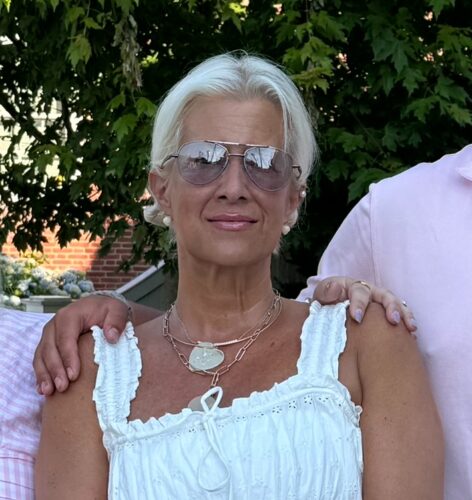
Jennifer Petty Hilger

About the author: Jen Petty Hilger grew up in New York and London, England, but finds herself happily quiet living by the water in Old Lyme.

She and her husband have six children between them and a myriad of rescued animals.
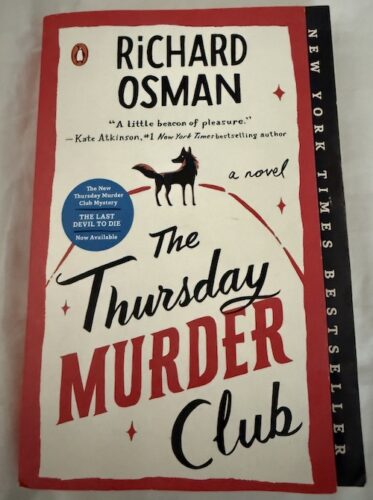
Literature in the Lymes: ‘The Thursday Murder Club’ by Richard Osman

Oh, I wish there were a million more of his books. Instead, this far, there are only four in this series and one in the new series.

More to come, but who can wait when they are this good?

Osman is not only a maestro of the mystery but a comedy man. His characters are spot on cleverly written and usually hilariously so. 

Osman is a writer, who doesn’t assume the reader needs a long drivel of an explanation, so his brevity is flattering. We feel in on the joke when he describes someone.

The Thursday Murder Club is the first of this series and I’d never heard of it when I previewed the upcoming film. 

I immediately ran out for the book and was even more delighted. Each subsequent book was better but I begin here.

Four residents of Coopers Chase retirement community have formed a club. They each bring experience and a certain ‘je ne sais quoi’ to the table when it comes to solving murders. This they do with alarming and hilarious alacrity, much to the consternation of the local constabulary. 

Osman’s gift is hiding the clues so well that you have no idea what’s coming. In the land of predictability you are blindsided every few chapters and it’s marvelous.

At first there is a murder at Coopers Chase. A builder and his henchmen are so busy swindling and bribing, they don’t realize they are being watched.

The Thursday Murder Club is going to get to the bottom of all this. Who is doing this killing? This bribing? Are they going to lose their homes? Oh no they are not!

If anyone thinks these four seemingly sweet, innocent, elderly people are what they seem, then they are in for quite the surprise. 

Watching these four — Elizabeth, Joyce, Ibrahim, Ron and their supporting cast — become friends is so heart-warming.

As cloying as it sounds, it’s such a good time to find a series of books that you can curl up with and just be happy in a world away from the world.

Jennifer Petty Hilger

About the author: Jen Petty Hilger grew up in New York and London, England, but finds herself happily quiet living by the water in Old Lyme.

She and her husband have six children between them and a myriad of rescued animals.
Literature in the Lymes: ‘The Crazies: The Cattleman, the Wind Prospector, and a War Out West’ by Amy Gamerman

Jennifer Petty Hilger

Even if it wasn’t the name of the mountain range in which the story takes place, it would be a great name for the people in this book. It’s a good story and thanks to a good storyteller, it makes a great book. That’s not, as we know, always the case so we’re lucky the right person sunk her  teeth into this.

Investigative prowess doesn’t always transfer from article to book but it does inThe Crazies. Amy Gamerman’s real-life talents as a reporter and writer for the Wall Street Journal helped her gather this information and transform it into a modern, western saga about trying to control the uncontrollable forces of nature with power and money. 

It serves us well as she weaves the stories, the real life sagas, of the past and present dramas of the people involved in one of the largest, craziest lawsuits in recent days. Oil tycoons, cattle farmers, ancient pioneers, regular struggling laymen, Hollywood celebrities, poachers … who isn’t involved? Everyone’s case holds some weight. 

If it’s my land, why the hell can’t I do what I want with it?  Rick Jarrett wants to harvest the ‘million dollar wind’ that blows through Big Timber,  Montana with 500 ft. turbines on his small parcel of land. “The wind that blew alike on the rich and poor had the power to make Rick Jarrett a wealthy man.”

His tycoon neighbors don’t want to look at these eyesore turbines. The hell with the townies and their right to make money off of their own land. 

Just because you have 80 bazillion dollars and don’t want to be staring at something ugly, why do you get to say no to it?  “I like people … I just don’t want to be around them,” said Russell Gordy, the owner of 155,000 acres of land he spent $96 million amassing. 

Many Hollywood celebrities, who have made Big Timber—the nearby town—their hideaway home, feel similarly. Much is at stake for the big-monied hermits, who have no interest in the locals and their poverty.

Additionally The Crazies are held sacred by The Crow, whose ancestors are, perhaps, the original indigenous people in North America. The first burial ground dating back between 12,707 and 12,556 years was found on a cliff west of The Crazies’ Walsall Peak. The remains of a child found with a stunning array of tools and objects were found in 1968. The DNA links the boy to a human, who lived 40,000 years ago near Beijing. He is the most ancient American ever discovered. The Crazies aren’t ill-named.

Nothing about this lawsuit and its participants is cut-and-dried and that’s what makes it a good story.

There is nothing new about the basic human desire for control—and money is rarely outvoted.

About the author: Jen Petty Hilger grew up in New York and London, England, but finds herself happily quiet living by the water in Old Lyme. She and her husband have six children between them and a myriad of rescued animals.
Literature in the Lymes: ‘The Witchstone’ by Henry H. Neff

Lazlo is an 800-year-old demon with a terrible work ethic, a movie star human ‘glamor’ and a wicked sense of humor. He’s selfish, lazy, snarky, maybe secretly kind of nice and in big trouble. His high-ranking, evil father is punishing Lazlo by making him work a thankless job in the devil’s bureaucratic offices. A Hell’s ‘“Hell,” if you will. 

While Lazlo runs up thousands of dollars in expense tabs doing nothing; he is supposed to be supervising the curse of a particular family; the Drakefords. 

The Drakeford Curse has been mutating the family with horrific outcomes since colonial times and Maggie, the current heir, is about to face ruin. Maggie is 19 and entering her darkest hours as a Drakeford. At the family compound in upstate New York, she is slowly transmogrifying. 

The Witchstone is an, as yet, unidentified totem at the center of what will unfold between Lazlo and the younger Drakefords. Lazlo , Maggie and young George, known as Lump, travel from upstate to New York City and then Europe. Lazlo takes the Drakefords in search of a way to break the curse. Or does he? Since he also tells his boss he specifically isn’t doing that. Then he tells someone else he might be thinking about, maybe not thinking of, not doing that. Smarmy to the last, we should definitely not trust a demon but we sorta do.

Demons from many sides intervene to stop the trio as they travel from fancy Italian hotel to cursed demon empress’s castle to holy church and every hell hole in between. Neff’s cast of demonic characters is unrivaled. I don’t usually root immediately for a movie to erupt from a book but this would be so great visually. Some of these creepy crawlers on the subway or tunneling underneath Central Park just scream for an agent. 

Best of all, the very end made me want a sequel—like a Bond flick with a forked tail.

About the author: Jen Petty Hilger grew up in New York and London, England, but finds herself happily quiet living by the water in Old Lyme. She and her husband have six children between them and a myriad of rescued animals.
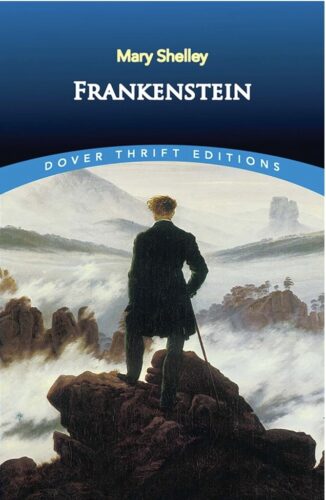
A Special Halloween ‘Literature in the Lymes’: ‘Frankenstein’ by Mary Shelley

Editor’s Note:We are delighted to welcome a guest author to our ‘Literature in the Lymes’ column today and it is none other than the talented daughter of Jennifer Petty Hilger, our regular book reviewer. Campbell Mann is a writer from Lyme, Conn. After training as an operatic mezzo-soprano at The Boston Conservatory, she has since worked as a poet and mixed-media artist. She currently lives in Brooklyn, N.Y., with her partner and a variety of indoor philodendrons.

Campbell Mann

It is difficult, perhaps impossible, to find a 21st century reader unfamiliar with Frankenstein.

Mary Shelley’s seminal novel, first published in 1818 when its author was 20, has since towered over Gothic and post-Gothic literature for more than two centuries. It is rivaled in magnitude of popular absorption perhaps only by Stoker’s Dracula (a work, which is heavy-laden in its own right with Shelley’s influence, along with that of her husband Percy and the couple’s notorious, occasional friend, the poet Lord Byron).

It has inspired endless and near-constant adaptation—practically every decade of the past century has seen its own half-dozen film and television versions. And while some of these are faithful to the novel, most are wildly extrapolated—the green-skinned, bolt-necked icon of American Halloween bears little resemblance to Shelley’s wretch.

I say this not to argue for literary purism—it is entirely to be expected for a 206-year-old story to be vastly altered in so much time—but merely to highlight our vast distance from the source. Most, while they know Frankenstein, do not know Frankenstein

Admittedly, Frankenstein can be a difficult text. It possesses many of the qualities that often deter readers from Georgian literature at large; it is verbose, dense, confusing at times in structure and syntax. But in spite of this, it glistens with a modernity that is striking even now. It is gripping, tense, emotionally radiant, and immensely readable. It is haunting and stunningly profound.

As in many 19th century novels, Shelley places us first within the exterior of a frame narrative. We are loosely in the 18th century, as an Arctic-bound research ship finds itself trapped in the ice floes. The expedition’s leader, Captain Robert Walton, begins a series of letters to his sister, Margaret, detailing the strange occurrences of the recent days. First, an enormous figure has been seen driving a pack of sled-dogs in the distance, unnerving the captain and crew. A starving, freezing man is then pulled from the ice, who introduces himself as Victor Frankenstein. In Walton’s eyes, Victor sees a glimpse of something—passion, or obsession—and begins to warn him of its consequences with his own tale. 

Born into a wealthy family from Geneva, Switzerland, Victor Frankenstein spends his youth enraptured by the potential power of alchemy and science. Shortly before he leaves to pursue his interests formally at the University of Ingolstadt, his mother dies, pushing his obsession deeper into the mysterious forces of life and death.

At Ingolstadt he excels and soon longs to further his own secret theories, body-snatching corpses and vivisecting feral animals until he has created an eight-foot-tall humanoid creature, whom Shelley calls the wretch. But naturally, Victor has not thought this through. As the wretch gurgles painfully to unnatural life, his creator abandons him and flees in terror. 

The narrative’s long remainder details the ways in which Victor and the wretch relate to the world and one another. Of course, it is far more complicated than that, but that is the most broad stroke of it. There is violence, loss, and pain on all fronts.

Shelley tells us, over and over in endless ways, that these two beings are inextricably bound to one another. What do we owe to our children? What do we owe to each other, and to ourselves? What if our actions are not the whim of a moment but profound and material choices, with consequences borne not by us alone?

Mary Shelley wants to know as well.