
Op-Ed: Follow NEC Future’s Own Findings, Abandon Alternative #1, Statement from Old Lyme Selectwoman MaryJo Nosal to the FRA:

Today we welcome representatives from the U.S. Department of Transportation Federal Railroad Administration (FRA) at Lyme-Old Lyme High School, 4:30PM. The following is a statement I planned on reading if the meeting format had allowed for public comment:

Congress established the Northeast Corridor Commission in 2008 and it was “chartered to facilitate collaborative planning and unified action” for the NEC Future process. The Commission’s report, NEC FUTURE and Investing in the Northeast Corridor: Advancing the American Economy (02/19/2016) (http://www.nec-commission.com), estimates the annual economic loss to our nation’s economy due to frequent Northeast Corridor (NEC) service disruptions at $500M. Equally important, the report clearly and strongly supports the needed investment in a NEC which includes the mid-size cities to advance the potential of the railroad as an engine for the American economy. “The potential for more transformative economic gain may lie in mid-sized cities such as Baltimore, Hartford, Newark, New Haven, Providence, and Wilmington. Their economies, with anchors such as research universities and corporate headquarters, stand to benefit from more reliable and frequent service, providing faster access to the financial and human capital resources of major hubs. Such investment in infrastructure would support recent economic and demographic trends and align with local economic development plans already in place. Additional capacity, improved travel time, and new origin-destination pairs could ensure the viability of projected growth in major markets, spark growth in mid-sized markets, and put the U.S. on par with peer regions around the world when competing for economic growth. Other cities, such as Hartford, not on the NEC mainline, have the potential to benefit with higher levels of investment. Today, infrequent service and lengthy travel times place limits on the potential growth mid-size cities might realize in terms population and jobs. Service improvements in consideration through the NEC FUTURE process would dramatically decrease the travel time from mid-sized cities such as Wilmington, Providence, and Hartford to the larger strong markets in New York, Boston, and Washington.

The FRA should support the Commission’s findings by selecting the alternative, or modifications of the alternative, which provides increased mainline access to the NEC for customers and businesses, and significant improvement in travel time to hub cities by expanding NEC service to the underserved mid-size markets including New Haven and Hartford, CT. Eliminate the Old Saybrook-Kenyon Rhode, Island bypass option as it certainly does not meet the stated goals of the NEC Future and in fact, is in opposition to the Commission’s findings as it threatens an established economy of a small historical town and does not provide significant access or significant time savings to hub cities.
Opinion: Let Your Presence Make a Difference (Since Your Voice Can’t be Heard) — Go to the FRA Meeting

Back in February of this year, we wrote an opinion piece titled, “The Menace in our Midst.”  about the proposed high speed rail route through Old Lyme, about which we as a community had just heard. Surprisingly, not a whole lot has changed since then with the exception that the Federal Railroad Administration (FRA) has finally decided to pay Old Lyme a call. That meeting is this afternoon at 4:30 p.m. in the Lyme-Old Lyme High School auditorium.

We’re re-publishing most of our editorial from February, but changing the message.  Back then, we urged readers to write to the FRA and say what you thought about Alternative 1 during the official Comment Period.  Today, our message is simply, “Go to this afternoon’s meeting.” You will not be able to speak — at this point it seems public comment is not being allowed, but our numbers will tell a story … so let’s pack that hall!

The saddest thing about all of this is that we all (or most of us) support high speed rail — please read the open letter to the FRA from Alex Twining that we received last night, which discusses some different solutions to Amtrak’s challenges in the northeast.

Here’s our editorial from February:

In the space of just a few short weeks, the residents of Old Lyme have become aware of a menace in their midst. Most unusually for these same residents, their response has been to a man (or woman) identical.  When that happens in this town — unquestionably, a rare event — you can be sure that, ‘Something is rotten (to misquote Hamlet) in the state of Old Lyme.’

The ‘menace’ in this case is Alternative 1 of the four high-speed railtrack routes proposed by the Federal Railroad Authority (FRA) in their Northeast Corridor (NEC) Future plan.

But let’s backtrack for a second — why is the FRA proposing these new routes? Their objective is, “to improve the reliability, capacity, connectivity, performance, and resiliency of future passenger rail service … while promoting environmental sustainability and continued economic growth.”  Let’s say right away that we are fully supportive of this objective — we are huge fans of rail-travel — you cannot grow up in Europe without taking rail travel for granted.  The trains there are fast, clean and efficient … they are a way of life.  We absolutely wish it were the same in the US.

So what is the difference here?  Why has the reaction to Alternative 1 been so strong, so united, so passionate?  In case you are unaware, Alternative 1 calls for the high speed rail track to cross the Connecticut River over a new bridge a little higher up the river than at present and then travel to the center of Old Lyme bisecting Lyme Street by eliminating both the western and eastern campuses of Lyme Academy College of Fine Arts before turning north and crossing I-95.  [Note: This has now become a tunnel under the Connecticut River according to the latest information from the FRA.]  The 1817 John Sill House, currently owned by the Academy and situated on its campus, would likely be acquired by the FRA by eminent domain and then demolished.

The impact of a high-speed railtrack through that sector of town would be totally devastating for our community, effectively destroying its very heart.

This editorial could now run for pages to explain the full spectrum of impact to Old Lyme of this proposal.

We could discuss the horrific effects on our incredible local environment — one which has inspired artists for generations including some of the greatest impressionist painters in American history and one officially designated as a “Last Great Place.”

We could talk about the untold damage to the storied structures on Lyme Street and list the irreplaceable buildings that will either be completely destroyed or permanently scarred by this new train track construction, many of which are either National Historic Landmarks or on the National Historic Register.

We could mention that Lyme Street is the joyful, bustling hub of our little town — it has a unique personality and touches every aspect of our community life.  It is home to our town hall, our public schools, our daycare, our youth services, our library, our churches, our village shops, our art college, our art association (the oldest in the country), and the Florence Griswold Museum (a national institution.)  Can you even begin to imagine Lyme Street with a high speed railroad running across it?

And let’s just consider for a minute what this proposal, if implemented, would achieve?  Bearing in mind that you can already travel from London to Paris (286 miles) in 2 hours and 15 minutes, would we be able to hop on a train in Old Saybrook and be in Washington DC (334 miles) roughly two hours and 45 minutes later?  No, the current travel time of six hours would be reduced by a grand total of 30 minutes to 5 hours and 30 minutes.  Unbelievable.

As we said, we could go on for pages but others have kindly taken care of that for us.  There was a splendid press conference yesterday, which spelled out the craziness of Alternative 1 from every angle — coldly, clinically and objectively.  The Old Lyme-Phoebe Griffin Noyes Library has a full print copy of the NEC Future tome if you care to read it in its entirety.  There are links galore on the Old Lyme Town website to the statement and attachments submitted yesterday (Feb. 10) on behalf of some 20 local organizations to the FRA.

So please read and educate yourself on Alternative 1, but most importantly, please, please write to the FRA with your thoughts.  There are many questions as to why and how this proposal was able to be presented without a single public hearing being held closer than 30 miles away from a town on which it was having such a major impact.  But that is history now …

Back to today — the FRA is coming this afternoon … will you be there?

FRA to Host Public Meeting in Old Lyme on Proposed Rail Route; Submit Questions, Comments in Advance

NECFUTURE_logoUPDATE:  New information has been added regarding where to send your questions in advance of the meeting, the format of the meeting and attendees — see text in red below. We have now received an official announcement regarding the public meeting with the Federal Railroad Administration (FRA) in Old Lyme from Old Lyme First Selectwoman Bonnie Reemsnyder.
The meeting will be held next Wednesday, Aug. 31, at 4:30 p.m. in the Lyme-Old Lyme High School auditorium, 69 Lyme St., Old Lyme, CT. This meeting will last about 1.5 to 2 hours, and the FRA will give a very short presentation to clarify the process and address misstatements.  Then the FRA representatives will have a roundtable discussion about the NEC Futures Draft EIS with local and state leaders.

The meeting will be open to the public in an effort to allow residents and businesses to hear the discussion.  Questions will not be permitted from the floor.

Senator Richard Blumenthal, along with local selectmen and elected officials, have been invited to the meeting.  Congressman Joe Courtney is able to attend until 5 p.m. and CT Department of Transportation Commissioner James Redeker will be there for the entire meeting.  We now understand Senator Blumenthal will be there for the entire meeting also.

The Town of Old Lyme requests that comments and questions be submitted to selectmansoffice@oldlyme-ct.gov prior to the meeting so that they may be addressed at the roundtable discussion.  It will also be possible to submit questions at the meeting for discussion by the participants.

SECoast, the non-profit organizing and educating the public to protect Southeastern Connecticut and the Lower Connecticut River Valley that is constructively opposing the proposed rail route through Old Lyme, has requested that any questions readers submit to the town are also submitted to them at info@secoast.org.  This will enable the organization to keep track of the questions asked since they will obviously not all be answered at the public meeting.  SECoast is not a participant at the roundtable discussion.

Reemsnyder recommends arriving early since the meeting will begin promptly at 4:30 p.m.


Letter to the Editor: New Trains Not New Tracks

An Open Letter to the Members of the FRA:

I support high speed rail service. This country needs to find the most efficient transportation system possible to make us the most sustainable country on earth. The world is urbanizing at a rapid rate which makes mass transit a critical part of the solution. That means making both local and long distant rail so attractive that people drive and fly much less. This lowers our carbon footprint, increases our productivity and makes our lives easier. When you travel to China you realize we are living 50 years in the past!

I have reviewed the Northeast Corridor EIS and specifically the FRA preferred Alternate 1 and would like to make a counter proposal. I recommend a two part plan that provides a near term solution for improved local and regional Northeast Corridor Rail Service (STEP ONE) and long term solution for dramatically reduced high speed rail travel (STEP TWO).

STEP ONE : NEW TRAINS NOT NEW TRACKS!

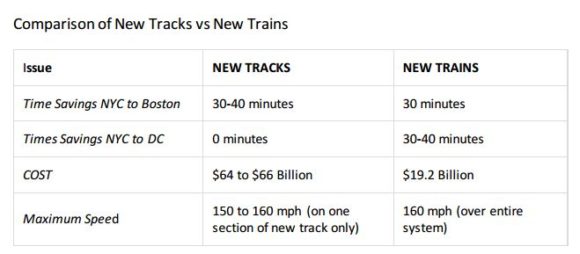
Use existing tracks with new trains for improved high speed rail and better commuter rail. This part of the plan is quite simple. To save 30 minutes off the current Acela travel time from NYC to Boston we can spend $65 billion on a major new rail project from Old Saybrook, CT to Kenyon RI, OR we can spend less than $20 billion on completely new high speed trains running from DC to NYC to Boston. We can spend $20 billion or $65 billion to save 30 minutes of time. It seems like an easy decision. Buy new trains for $19.2 billion.

In fact with all new trains we can save a total of 70 minutes from DC to Boston, up to 40 minutes on DC to NYC and 30 minutes from NYC to Boston. By spending $65 billion we also bypass lots of rail dependent towns and destroy numerous historic towns along the way. For $20 billion we make NO changes to the landscape, we just get lighter more fuel efficient trains that are designed to run at higher speeds on curvy tracks. We adopt the same type of trains used in Europe and Asia but precluded for almost a century in the US based on a 1920’s Federal Law. When the Acela’s were built we took efficient lighter weight trains from Europe and overbuilt them which made them too fat and heavy to bank on the curves. And they use more energy to move all that weight.

For more information on the recommended new trains read this article from 2013 titled, “High Speed ‘Trains of the Future’ May Finally be Coming to the Northeast“and recent articles in the NY Times from this past Sunday.

comparison_of_costs_Twining


STEP TWO : BUILD A REAL HIGH SPEED TRAIN TO SAVE 90 MINS!

Build a really fast route as the crow flies through NY-CT-MA to allow even the Maglev trains like in Shanghai. This would take a decade and cost a lot but long term it would reduce massive carbon emissions from air travel and car travel. This would be an investment in our future. This is the approach that France took to build the TGV.

We would now have a real high speed line and a very fast intercity rail line along the shoreline.

Please consider my recommended plan.

Sincerely,

Alex Twining,
Old Lyme

Editor’s Notes: i) Alex Twining is President & CEO of [ t ] TwiningProperties of New York, NY, and Cambridge, Mass. www.twiningproperties.com.

ii) This letter has been submitted to the FRA in reference to the public meeting being held Aug. 31, in the Lyme-Old Lyme High School auditorium.


CT Early Childhood Alliance Names Sen. Linares a 2016 “Children’s Champion”

Sen. Art Linares high fives students during a school visit in Clinton.

Sen. Art Linares high fives students during a school visit in Clinton.

AREAWIDE — Sen. Art Linares has been named a 2016 “Children’s Champion” by the Connecticut Early Childhood Alliance for his leadership on issues related to Connecticut’s young children.

Connecticut Early Childhood Alliance (www.earlychildhoodalliance.com) is committed to improving outcomes in the areas of learning, health, safety and economic security for children ages birth to eight.

“I’m honored to be named a Children’s Champion,” Sen. Linares said.  “My focus at the State Capitol is on improving the quality of life for people of all ages in Connecticut.  That includes working with my colleagues in Hartford to shape legislation that impacts the well-being of Connecticut’s young children in the areas of healthy development, early care and education, nutrition and safety.”

He continued, ” I remain committed to passing effective state policies which help all of Connecticut’s children succeed.  I thank the Connecticut Early Childhood Alliance for this recognition.”

An Assistant Minority Leader, Sen. Linares, 27, is the lead Republican senator on the state legislature’s Planning and Development Committee. He also serves on the Education Committee, the Internship Committee and the Judiciary Committee. Sen. Linares has previously served on the Children’s Committee, the Commerce Committee and the Banks Committee.

Sen. Linares represents the Town of Lyme as well as Chester, Clinton, Colchester, Deep River, East Haddam, East Hampton, Essex, Haddam, Old Saybrook, Portland, and Westbrook.  He can be reached at Art.Linares@cga.ct.gov or at 800 842-1421 or visit his website at www.SenatorLinares.com .