Old Lyme Historical Soc., Duck River Garden Club Present Zoom Program on ‘Salt Marsh Haying’ Tonight

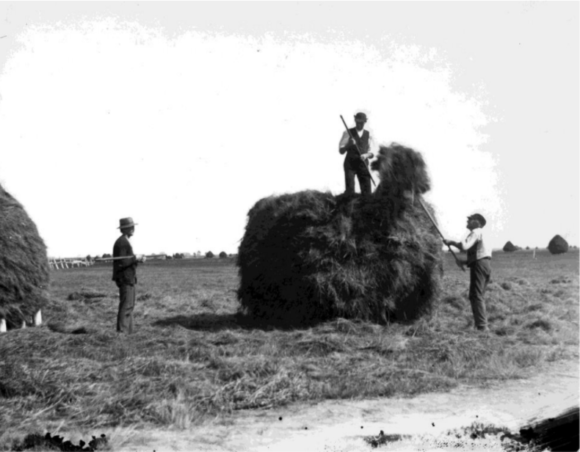
Salt Marsh haying in progress. Photo courtesy of the Lane Memorial Library, Hampton, N.H.

OLD LYME — What is Salt Marsh and why was this grass so prized in Colonial times?

The Old Lyme Historical Society and Duck River Garden Club will provide the answers in a Zoom presentation titled, ‘Salt Marsh Haying,’ which they are co-sponsoring this evening, Wednesday, Sept. 30, at 7 p.m.

Shaun Roche, Visitor Service Manager with the United States Fish & Wildlife Service, will speak to the historic uses and  the eco-value of our salt marshes. 

All are welcome. Email info@oldlymehistorical.org to obtain a link to  this event.

from the Stewart B. McKinney National Wildlife Refuge

SECWAC Presents George Packer from ‘The Atlantic’ Discussing His New Book on Richard Holbrooke, Tonight

George Packer

AREAWIDE — The Southeast Connecticut World Affairs Council (SECWAC) hosts George Packer in a Zoom presentation this evening, Wednesday, Sept. 30, at 6 p.m. titled, ‘Our Man: Richard Holbrooke and the End of the American Century.’

All are welcome. This presentation is free for members, guests $20, registration is required.

In his book “Our Man: Richard Holbrooke and the End of the American Century”, Packer tells the story of Richard Holbrooke, the diplomat who was the force behind the Dayton Accords that ended the Balkan War, but who failed to achieve the post of Secretary of State which he coveted.

The story, told against the backdrop of US foreign policy from the Vietnam War to the Afghanistan War, is a nonfiction narrative both intimate and epic in its revelatory portrait of this extraordinary and flawed man, and the elite spheres of government and society he inhabited.

George Packer is a staff writer at The Atlantic and a former staff writer at The New Yorker.  He is the author of The Unwinding: An Inner History of the United States (winner of the 2013 National Book Award), The Assassin’s Gate: America in Iraq (a finalist for the 2006 Pulitzer Prize), and Blood of the Liberals (winner of the 2001 Robert F Kennedy Book Award).

Our Man: Richard Holbrooke and the End of the American Century was a finalist for the Pulitzer Prize and winner of the Los Angeles Book Award for Biography.  He is also the author of 2 novels and a play, “Betrayed,” which won the Lucille Lortel Award.  Packer has been a Guggenheim fellow and twice a Fellow at the American Academy in Berlin.

Copies of the book may be purchased from Bank Square Books in Mystic, CT, here.

Letter to the Editor: Rubino Will Not Be Restricted by Party Lines in His Quest For Solutions That Benefit Local Community

To the Editor:

I am writing to encourage your readers to support and vote for Dave Rubino, the democratic candidate for the 23rd House District to represent Lyme, Old Lyme, Old Saybrook and Westbrook. I have had the opportunity to meet Dave, and talk with him about the issues that drive him as a person and a professional. Dave is a lawyer, with both business and human rights experience. His work on international voting rights demonstrated a shift in him professionally, putting his money where his mouth is, and fighting for what he valued.

While the national election for President captures the most attention, it is our local representatives that have the biggest impact on our lives on a day-to-day basis. David’s international legal work was bi-partisan in nature, working under both republican and democratic presidents. We need that willingness to work towards solutions – regardless of party – that bring progress to our community.

Dave has stepped up in recent years to volunteer and work in his community as a member of the Old Lyme Economic Development Commission. As our state and community work our way towards recovery and navigating the COVID crisis, we will need leaders willing to listen and represent the interests of our small businesses and navigating what is best for our community from a public health standpoint. As a member of the Old Saybrook Board of Selectman and chair of the
Economic Development Commission, I am confident in David’s ability to provide that for our community.

Sincerely,

Matt Pugliese,
Old Saybrook.

Editor’s Note: The writer is an Old Saybrook Selectman and Chair of Old Saybrook Economic Development Commission.

Diebolt Clarifies His Plans for 220 (Approx.) Apartments on Hatchetts Hill (Includes 70 Affordable Housing Units); Says “It’s 100% Good for the Town”

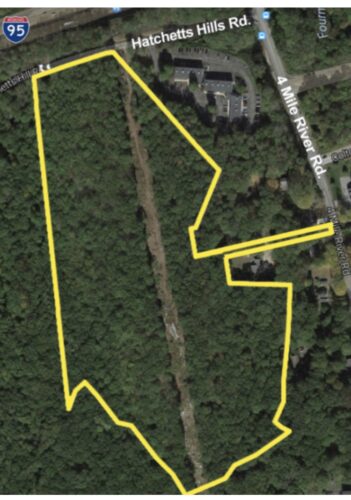
The boundary marked on this map indicates the perimeter of the 20.6 acres owned by Mark Diebolt, which is the proposed site of a housing development. The site is already zoned for multi-family housing.

OLD LYME — Describing his proposed housing development off Hatchetts Hill Rd. in Old Lyme as, “A one hundred percent good thing for the town,” Mark Diebolt went on to give an detailed outline of the ambitious proposal during a phone conversation with LymeLine last Monday (Sept. 22.)

The plan, which is still in draft form and has not yet been released, calls for construction of 11 buildings, which will offer a total of between 216 and 224 one- and two-bedroom apartments. The precise number is not yet finalized but Diebolt anticipates it will be around 220.

The intention is for roughly a third of the apartments — between 70 and 75 — to be made available as ‘Affordable Housing,’ which means the plans can be submitted under the state’s 8-30g regulations that facilitate the process of obtaining approvals.

Diebolt described his vision for the development, which, apart from the apartments, is also slated to include a pool, gym. movie theater and clubhouse, as being, “Somewhere people want to live” and “Having the feel of its own little community.” He believes, “A diverse group of residents” will be attracted to the community, which will be both attractive and “completely safe.” and emphasized, “There will be ways for people to interact and socialize, if they wish.”

Drawing a comparison with the recent Saybrook Station development in Old Saybrook, he said he similarly envisaged, “New England-style building … and making it like a small village.” He emphasized, however, a significant difference between the Saybrook project and this one in Old Lyme in terms of the building density. Diebolt pointed out, “They have a lot less land,” noting that the former has 186 units in nine buildings on 1o acres whereas in Old Lyme, he is looking at 220 units in 11 buildings on just over 20 acres.

Noting it is a “unique location,” and “all rural around that area,” Diebolt explained that the uneven topography, which includes “lots of rock,” allows opportunities “to use the natural contours of the property” both for underground parking and also, in some cases, to offer views of Long Island Sound from the apartments. The parcel of land comprising 20.6 acres, which he has owned for many years and is already zoned for multi-family use, lies at the eastern end of Hatchetts Hill and is bordered to the north by Hatchetts Hill Rd. and to the east by Four Mile River Rd.

Diebolt stressed several times during the conversation, “This is not low-income housing,” adding, “There is a real misconception about it [Affordable Housing.]” He noted that the developers would be following the state rules for the number of units that would be offered at different percentages of the median income for the town. Significantly, the apartments designated as affordable housing will be intermingled with all the other units in this development and built to exactly the same standard.

Pointing out that the investors in the project will likely become, “One of the largest taxpayers in town,” Diebolt noted that, at the same time, he does not expect, “Too many kids,” to be entering Lyme-Old Lyme Schools as a result of the development due to the size of the individual apartments being offered.

Diebolt also notes another positive for Old Lyme is that the development will roughly double the amount of affordable housing in the town. Currently Old Lyme has around 1.5 percent of affordable housing and this project will take that percentage to around 3 percent. The town is under a long-term, statewide mandate to achieve a goal of having 10 percent of its total housing as affordable housing.

Asked the names of his fellow investors, Diebolt, who acknowledges he is, “The face of the project,” said they did not wish to be named at this point, but commented they are, “Connecticut residents and professionals,” adding, “I’m not a land developer.”

Questioned as to the intended name of the development, Diebolt chuckled and said that, as with the investor names, it was still under wraps. But he then shared that he is an amateur ornithologist and said that might possibly impact their choices as they, “Play around with names.”

In terms of location, Diebolt notes the site is extremely conveniently situated for on- and off-ramps going in both direction at Exit 71 of I-95. He also remarks that the single exit from the project will be onto Hatchetts Hill Rd. and will only allow a right-turn — there will be no exit onto the much busier Four Mile River Rd.

Regarding next steps, the plan has already been presented in a preliminary fashion to the Old Lyme Water Pollution Control Authority (WPCA). This was, in Diebolt’s words, to let them know that, “Basically our [Diebolt’s] professional engineers are in discussion with East Lyme WPCA engineers about connecting to water and sewer lines on Colton Rd. in East Lyme.” The property being proposed for development is only approximately 100 meters from those East Lyme  water and sewer lines and the possibility of connecting to them seems likely to be critical to the project moving forward.

Following that, Diebolt expects to submit a formal plan to Old Lyme’s Inland Wetlands Commission in December or January, which will kick off the official approval process with the Town.

Last Monday, Diebolt discussed the project with the Old Lyme Affordable Housing Committee (OLAHC), again for information purposes. After giving a brief overview of the project, Diebolt answered questions from the committee ranging from how many stories would the buildings have (Diebolt said a maximum of three) and would all the units be rented (yes – there will be no opportunity to purchase apartments) to whether pets will be allowed (yes, definitely – Diebolt again stressed the developers wanted these to be, “Homes people are proud to have” adding, “Pets are part of our culture.

Committee member Karen Winters spoke positively about the fact that, “The work force is intermingled,” so, as Diebolt clarified, “No one will know who’s who,” meaning those renting under Affordable Housing policies will not be identifiable from those who are not. Winters said, “I think that’s a win.”

Tom Ortoleva, another committee member, asked how many acres of the total were buildable. Diebolt responded, “It’s a tough site. One of the more expensive items [in the project] is site work.” He emphasized, “We have it all laid out. We could have put 274 units on the site … but we didn’t want it crowded.”

Committee member Tammy Tinnerello and Ortoleva questioned why Diebolt was not planning any three-bedroom units to which Diebolt replied, “Our market research indicates there is no demand for them,” or only minimal demand, but he also noted the developers would be willing to look into the matter further.

Overall, in Diebolt’s opinion, “The project was well received,” [by the committee] and, “The members seemed encouraging,” but prior to entertaining questions OLAHC Chairman Michael Fogliano had emphasized to committee members that they were there, “To listen and learn,” and not to consider a formal application nor take a vote.

Diebolt ended his session with the committee saying optimistically, “A thing of this magnitude is going to take a while to get going … but hopefully it will come to fruition.”

A la Carte: Hold on to Summer, Make Your Own Luscious Ice Cream, Sorbets

Lee White

Last week I missed getting the last peaches available at Whittle’s. This made me sad because, even though it is late September, I guess I am not ready for fall.

In any case, I did find delicious peaches at Big Y and made two crisps (like cobblers but made with nuts, oat, butter, flour and sugar). Of course, I gave the desserts away because, once I have a portion at home, the rest of it disappears … into my tummy.

Instead of making a dessert for myself, I ate two Lindy’s ices, which I keep in my kitchen freezer. The ones I have now are orange and taste like a popsicle, At 110 calories, they keep my cravings at bay.

But I realized I can make my own ices, sorbet and ice cream and used to do so. My late husband loved to have an ice cream sundae after dinner—any flavor, chocolate syrup, whipped cream and a shower of salted peanuts.

I am not likely to make ice cream too often, but if you want to make ice cream, I have included a wicked recipe from Al Forno, too.

I will, however, make sorbet and ices soon. I just ordered an inexpensive ice cream maker from Amazon and it may be here this week. Both these recipes are splendid.

Berry Sorbet

(From Jack Bishop: Secrets of Creamy Fruit Sorbets, “Cook’s Illustrated,” August, 1995, pp. 24-25)

If you do not want to add the vodka, the sorbet will be a bit icy, like a granita,

2 cups fruit puree or juice
1 cup sugar
1 tablespoon lemon juice (for blueberry sorbet, use two tablespoons of lemon juice)
1 tablespoon vodka 

Combine all ingredients in large bowl. Stir on and off for several minutes until sugar has dissolved. If mixture is not cold, pour into small container, seal and refrigerate until mixture is no more than 40 degrees. Pour chilled mixture into container of ice cream machine (following manufacturer’s directions) and churn until frozen. Scoop frozen sorbet into a container, seal, and freeze for at least several hours. (Sorbet can be kept frozen for up to three days.)

Buttermilk Sorbet

(From Martha Stewart Living, February 2000, page 193)

Yield: 1 1/2 quarts

This is one of the most luscious sorbets I have ever tasted.

1 3/4 cups sugar
2 cups water
2 cups buttermilk
1 1/2 teaspoons pure vanilla extract

Combine sugar in a medium saucepan with 2 cups water. Stir over medium heat until sugar dissolves completely, about 10 minutes. Increase heat, and bring just to a boil. Remove from heat and let cool.

In a large bowl, combine sugar syrup with buttermilk and vanilla. Transfer mixture to an ice cream maker and follow manufacturer’s instructions to freeze. When freezing is complete, transfer sorbet to an airtight container and place in freezer for at least 1 hour. Sorbet will keep, frozen, for up to 2 weeks.

Photo by Malicki M. Beser on Unsplash.

Al Forno’s Cinnamon Ice Cream

from Cucina Simpatica by George Germon and Johanne Killeen (HarperCollins Publishers, New York, 1991)

2 cups heavy cream
1 cup milk
2/3 cup sugar
4 cinnamon sticks
8 espresso or French-roast coffee beans

Combine all ingredients in a saucepan. Scald over medium-high heat, stirring often, until sugar dissolves. Set aside, uncovered, for 1 hour to steep.

Strain, chill, and freeze in an ice-cream maker according to the manufacturers’ instructions.

About the author: Lee White has been writing about restaurants and cooking since 1976 and has been extensively published in the Worcester (Mass.) Magazine, The Day, Norwich Bulletin, and Hartford Courant. She currently writes Nibbles and a cooking column called A La Carte for LymeLine.com and the Shore Publishing and the Times newspapers, both of which are owned by The Day.