OLD LYME—The Ruth Ann Heller Music Foundation Board of Trustees has announced it has awarded private study music scholarships for the 2024-2025 academic year to students from both Lyme-Old Lyme (LOL) Middle School and LOL High School.
Award recipients from the LOL Middle School are: Natalie Gibbons, Conor Buckeridge, Estelle Filardi, Isla Morrissette (winner of the Dr. Stephen Crites Scholarship for Low Brass), Olivia Rozanski-Rose, Mary Kane, Max Mooney, and Anna Paris William.
Award recipients from the LOL High School are: Avery Zbierski, Ceciley Buckley, Caterina Wilson, Morgan Buerger, Emelia Munster, and Oliver Wyman.
As a supporting organization for LOL Schools, the Ruth Ann Heller Music Foundation awards scholarships that are to be used for private music instruction to students participating in the LOL Schools Band Programs.
The 501(c)(3) non-profit foundation was formed in 1999 after the retirement of Ruth Ann (King) Heller from LOL High School, with a mission to strengthen and improve the instrumental music program in LOL Schools.
Donations to the Foundation in any amount are gratefully accepted. The mailing address is the Ruth Ann Heller Music Foundation, PO Box 298, Old Lyme, CT 06371.
While I personally do not consider Robert Eggers’ horror films to be my cup of tea (mainly due to his non-traditional narrative style), I cannot deny his artistic merit and accomplishments with every film he has released (including The Witch and The Lighthouse).
His most recent film, Nosferatu, a remake of F. W. Murnau’s iconic 1922 silent movie of the same name (also an adaptation of Bram Stroker’s 1897 Dracula novel), is cut from the same cloth. I emphasize this simply because of my opinion, but the critic within me is obliged to promote and share his accomplishments with others who seek new movies worth checking out.
I first discovered Murnau’s original “Symphony of Horror” through pop culture references as a child (one that comes to mind is the title character flicking the lights in the SpongeBob episode that depicts the first 24-hour shift at the Krusty Krab). Even at a young age I could appreciate the creepy factor in this silent movie, particularly the famous shot of Orlok rising from his coffin.
The appearance of Count Orlok, alone, is enough to chill you to the bone. When I learned Eggers planned to direct a new adaptation of this classic, I knew that, despite my opinions, he was the one contemporary filmmaker who should be trusted with this task.
Again, I am not a fan of Eggers’ non-traditional style of directing but can acknowledge his talent. His unusual choices for cinematography leave you scratching your head, but you are captivated and eagerly anticipate what will happen next.
It reminds me of The Green Knight, another movie I reviewed years ago. I noticed that Eggers also makes use of sound to further unsettle his audience (to great effect), as well as emphasizing silence to set the viewer on the edge of their seat.
I was also impressed by the cinematography, particularly the depiction of scenes lit by only candle or fireplace, or even just the moon. His non-traditional methods also apply to his depiction of the vampire tropes we have come to understand throughout the history of movies.
But above all, we cannot overlook the acting. Every performer delivers, especially Lily Rose-Depp (daughter of Johnny Depp) as Ellen Hutter, whose performance shall certainly be hailed as an iconic Scream Queen in the years to come.
And a special round of applause must be given to Bill Skarsgård as Count Orlok, particularly his voice. After his success as Pennywise the Clown in the It movies, Skarsgård has proved he is not a one-hit-wonder, and with this performance has cemented his legacy in Hollywood and will certainly add more iconic performances to his resume for the rest of his career.
Because this is a horror movie, many readers will automatically rule out seeing it simply due to personal preferences. Make no mistake, there are plenty of horror movies whose merits go beyond the confines of the genre and are worth checking out (think of The Shining and The Silence of the Lambs).
However, I do not think I will go to great lengths to persuade somebody to subject themselves to discomfort and disgust to experience this accomplishment. I will certainly attempt to sway people into getting out of their comfort zone and give it a shot, despite knowing my efforts will be futile.
But for those of us who are fans of horror movies, it is absolutely worth the price of the ticket (or streaming subscription.)
About the Author: Having lived in Old Lyme and Lyme since the age of three, Kevin has always had a passion for movies that is beyond simply watching, but understanding the craft of cinema and and experiencing films as if they were a musical album. Kevin also has his own website devoted to movie analysis, CityOfCinema.com, and also co-hosts a podcast, Moviehouse Mystics, with Koda Uhl (available on Apple Podcasts, Spotify, and YouTube).
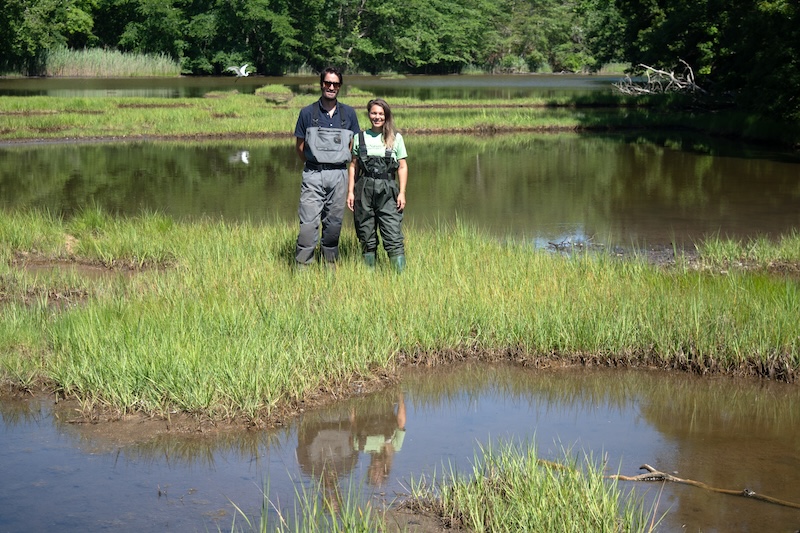
Employees of The Nature Conservancy in Connecticut stand on the Bride Brook Estuary marshland at Rocky Neck State Park. The area has just been awarded a $4 million grant to undertake transformative work to restore the estuary and coastal marsh. Photo courtesy of The Nature Conservancy in Connecticut.
NEW HAVEN/EAST LYME—A $4 million grant secured by The Nature Conservancy in Connecticut (TNC in CT) will set in motion a planning process for transformative work to restore the Bride Brook estuary and coast marsh at Rocky Neck State Park.
Funding has been awarded by the National Oceanic and Atmospheric Administration’s (NOAA) Transformational Habitat Restoration and Coastal Resilience Grant Program.
The Nature Conservancy in Connecticut will manage the “Bride Brook Estuary Transformation Project” in collaboration with the Connecticut Department of Energy and Environmental Protection (DEEP), which manages Rocky Neck State Park. The project will be in partnership with NOAA, the Connecticut National Estuarine Research Reserve, Ducks Unlimited, Save the Sound, and Restore America’s Estuaries. The initiative will build upon previously completed projects at Rocky Neck State Park to ensure a healthy marsh, as well as ecosystem restoration and resilience, and improved visitor access to the park’s natural resources.
“We are incredibly excited to have secured these federal funds to restore an important ecosystem in Connecticut, and for the benefits that will extend to everyone who loves and lives near Rocky Neck State Park,” says Jessica Cañizares, director of coastal ecosystem projects for TNC in CT. “The funding needed for comprehensive, transformational restoration of the entire system has only become available recently under the Bipartisan Infrastructure Law and Inflation Reduction Act, and this was an ideal time to come together with the state and local partners.”
“The Connecticut Department of Energy and Environmental Protection is thrilled to be working with The Nature Conservancy in Connecticut and other partners on this important effort to improve marsh health and coastal access at Rocky Neck State Park,” says Katie Dykes, DEEP Commissioner for Environmental Conservation.
She continues, “DEEP has been working to enhance coastal marsh habitat for species such as alewife, saltmarsh sparrow, and a variety of waterfowl. With increased sea level rise and frequency and duration of storm events, there remains a need to look at the marsh ecosystem as a whole—beyond the boundaries of the State Park—and we are excited to collaborate with partners on expanding this essential process.
Dykes concludes, “DEEP is committed to providing high quality coastal access opportunities for the residents of our state and ensuring coastal habitats will be resilient to the effects of climate change, and this project addresses both priorities.”
Rocky Neck State Park is home to the Bride Brook tidal creek which flows into Long Island Sound, a tidal marsh, the largest alewife population in the state, a popular beach and boardwalk, a campground, wooded trails, a pavilion, and an extremely popular fishing site. It is also known for its position alongside an Amtrak route, to the delight of many children who enjoy seeing trains pass during beach visits. The railway bridge was constructed in 1851, and Rocky Neck was established as a state park in 1931.
But the 82 acres of marsh at Rocky Neck have long faced challenges and are, in a sense, drowning, says Cañizares. The marsh is a critical component of the ecosystem, as it hosts unique biodiversity and provides protective benefits to coastal and inland communities.
“The marsh might seem healthy if you aren’t sure what to look for—it’s green, there are osprey feeding, there are ducklings, we see fish, and there are crabs. But this isn’t a healthy marsh. We see a lot of expanding open pools of water and mud, and there is a loss of vegetation. What we should see is the main creek channel of Bride Brook, bordered by a solid marsh platform, looking like a grassy meadow,” Cañizares explained.
The restoration of the Bride Brook estuary and the marsh at Rocky Neck has consistently been among the highest priorities in the state, attracting the involvement of numerous groups for decades, says Tim Clark, southeastern Connecticut project director for TNC in CT. “Their work has resulted in important conservation successes, specifically the culvert upgrade in 2009 that significantly improved fish passage for alewife, and beach enhancements.”
“However, bridges and other infrastructure along Bride Brook are likely contributing to a lack of full connectivity between the marsh and Long Island Sound. It’s believed these modifications altered the natural flow of water and disrupted how sediment moves through the system, leading to marsh degradation. This project will further study the issue, as well as determine and design solutions,” Clark explained.
Improving marsh conditions and restoring connections between Bride Brook and Long Island Sound would allow for large-scale, climate-resilient marsh restoration, strengthen the ecosystem, and support fish passage. This work will benefit local communities as well. A restored marsh will act as a natural shield for the coastline, buffer effects of climate change, manage floodwaters, store “blue carbon,” and reduce ambient air and water temperatures. Alterations to existing infrastructure could also improve public access to and from the beach, while enhancing recreational and educational opportunities.
“We look forward to engaging with multiple communities in Connecticut to learn about how this project might improve the visitor experience at Rocky Neck, especially for all people of all abilities,” Clark added.
There are also economic impacts to consider: Re-establishing tidal connectivity at Bride Brook and restoring the marsh will enhance flood resilience at Rocky Neck and for surrounding communities by absorbing and dissipating floodwaters during storms. The Federal Emergency Management Agency (FEMA) estimates that tidal marsh habitats provide nearly $10,510 per acre per year in “ecosystem services,” including protective benefits. A fully functioning system at the state park would provide around $860,000 per year in benefits to wildlife, visitors and neighboring communities.
“Connecticut’s shoreline is enjoyed by countless people year-round and is a critical habitat for many species. We must continue to preserve and protect it. I am proud to see Bipartisan Infrastructure Law and Inflation Reduction Act dollars supporting this work in Connecticut, and I will continue to fight for these federal investments for our natural treasures,” says Senator Richard Blumenthal.
As co-chair of the bipartisan congressional Long Island Sound Caucus, Representative Joe Courtney said he was thrilled about the funding award and its role toward maintaining the area’s “vibrant natural heritage.”
“The grant awarded to the Conservancy will support restoration of Rocky Neck State Park’s ecosystem, a habitat off of the Long Island Sound, and preserve the biodiversity of a unique coastal gem for years to come. This award is yet another example of the good work coming out of the federal Infrastructure Law and Inflation Reduction Act, which I helped enact. Congratulations to the coalition of conservationists throughout the state and district for obtaining this critical funding source,” Courtney added.
“NOAA is excited to be supporting The Nature Conservancy in Connecticut and partners as they work toward restoring healthy marsh habitat for the many species and communities that rely on this important coastal ecosystem,” said Carrie Selberg Robinson, director of the NOAA Fisheries Office of Habitat Conservation.
Early work through the grant will focus on design, engagement with the local community, and regulatory permits, setting the stage for restoration within and surrounding the marsh and Bride Brook. TNC in CT will coordinate with DEEP to plan to conduct a robust public outreach effort to gather input from Connecticut residents and Rocky Neck visitors on desired outcomes from this restoration project.
This project will also have lasting impacts beyond this state park. The Nature Conservancy in Connecticut hopes to use this project as a vehicle to develop a roadmap for similar sites across Connecticut and New England, particularly sites facing concerns with tidal restrictions caused by transportation infrastructure, and with a need for resilient and equitable access to a public resource.
Editor’s Notes: i) This article is based on a press release issued Dec. 4, 2024 by The Nature Conservancy in Connecticut.
ii) The Nature Conservancy is a global conservation organization dedicated to conserving the lands and waters on which all life depends. Guided by science, TNC creates innovative, on-the-ground solutions to our world’s toughest challenges so that nature and people can thrive together. Working in more than 70 countries and territories, TNC uses a collaborative approach that engages local communities, governments, the private sector, and other partners. The Connecticut chapter has protected more than 53,000 acres of land and is engaging with communities throughout the state to help build and conserve a more resilient, livable world. To learn more, visit: www.nature.org/CT
OLD LYME—Fran (Belknap) Lo, 73, left us Dec. 23, 2024. She leaves her husband of 40 years, Julian; children Emma (with husband Rahul and their daughter Ezme), and Phoebe; brother David (with wife Sara); and sisters-in-law, Eve and Joan.
Fran was a proud and loving stay-at-home mom when her children were young, and an English and Social Studies teacher at St. Bernard School for many years. … She was an active school volunteer when her children were small and edited the Region 18 newsletter Education Currents in the 1990s. …
She graduated from Oberlin College (BA), New York University Sloan School of Business (MBA), and Connecticut College (MAT). …
In lieu of flowers, please consider making a donation to Cure PSP at https://www.psp.org/ .
To plant trees in memory, please visit the Sympathy Store.
OLD LYME—James M. Fox, 72, husband of Kathleen (Fallon) Fox, of Old Lyme, passed away Saturday December 21, 2024, peacefully at home. He was one of ten children born in Hartford on May 11, 1952, son of the late Thomas A. and Loretta (Fagan) Fox. Jim recently retired after working many years in the HVAC industry. His favorite place was White Sands Beach in Old Lyme where he loved spending time with his family.
Besides his wife, Jim leaves his son Sean, daughter Heather Olson and her husband Alex, and son Seamus. His grandchildren, Cooper, Madeleine, Jack, and Elin. He will also be remembered by his siblings, Peggy Harding and her husband Chuck, Brian Fox and his wife Jane, Marty Fox and his wife Annie as well as many nieces and nephews. Jim was predeceased by his infant son James M. Fox, Jr. and his beloved sister MaryEllen Fox.
A Mass of Christian Burial celebrating Jim’s life will be held on Monday December 30, 2024 at 11:00 am in St. John Church of St. Padre Pio Parish, 161 Main St., Old Saybrook, CT 06475. Burial will be private. In lieu of flowers, memorial donations in Jim’s name may be made to SoundWaters at soundwaters.org. To extend condolences, please visit Farleysullivan.com.