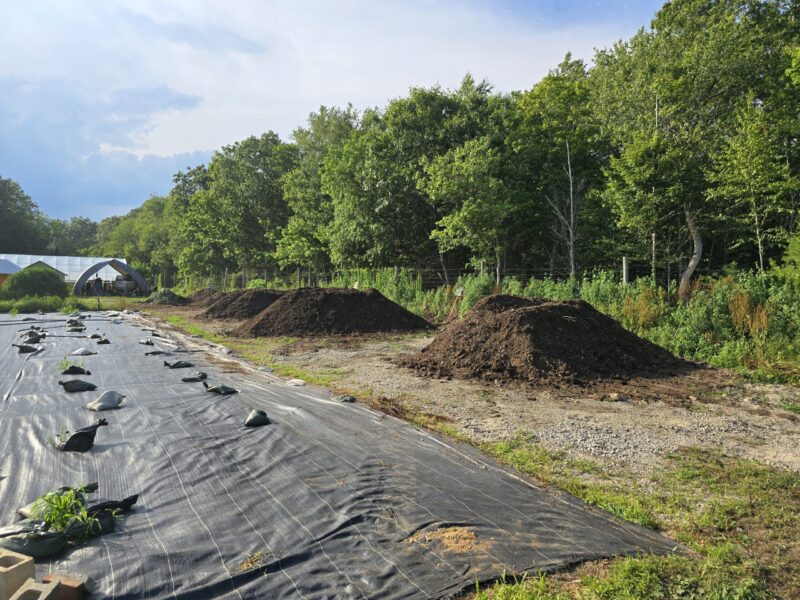
Baylee Drown, co-owner of Long Table Farm, gives a tour of the farm’s composting operation to students from Lyme Consolidated School. Photos and video courtesy of Long Table Farm.
LYME/OLD LYME–For three years, a local farmer has been teaching elementary school students in Lyme how to transform lunch leftovers into plant food.
This year, she’ll be expanding her composting program across the Region 18 school district.
Baylee Drown, co-owner of Long Table Farm in Lyme, doesn’t want the kids from Lyme Consolidated School to have to return to throwing their uneaten food in the trash when they make the transition to grade six at Lyme-Old Lyme Middle School in Old Lyme.
“Going to the middle school should not be a step back for sustainability,” she said in a phone interview this week.
Superintendent of Schools Ian Neviaser, from his office in Center School before Wednesday’s start of school, said Lyme-Old Lyme Schools are committing to growing the composting program. The district includes four schools in Old Lyme and the single elementary school in Lyme.
“We have very little food waste from the cafeteria itself, but from student lunches we have quite a bit of food waste,” he said. “So if a student doesn’t finish their lunch, instead of throwing it out, we’re now going to be composting that.”
Lyme Consolidated School Principal Alison Hine said students have become accustomed to ending each lunch wave by disposing their garbage in the appropriate receptacles.
“They put their trash into the trash can, they put their food waste into the composting bucket that we have there, and they recycle their milk cartons,” she said.
Staff members from Lyme Consolidated School have traditionally dropped off 5-gallon buckets of scraps – typically two per school day – at the farm. That’s where Drown and her partner in life and farming, Ryan Quinn, undertake the process of turning the unwanted food into compost that helps nourish a wide array of crops.
Vegetables from the farm are sold in seasonal shares to subscribers and at farmers markets.
Drown said food scraps from Lyme Consolidated typically fill one 55-gallon drum per week. Each drum holds around 500 pounds.
Hine credited members of the Lyme Consolidated Green Team, a club of third through fifth grade students committed to preserving the environment, with overseeing daily disposal activities in the cafeteria. They’ve also visited the farm to learn about composting firsthand.
The school received a grant so the students could design new recycling containers and signage to make the process more efficient, she said.
“I think that we have a unique opportunity in schools to help students to understand how effective waste management really contributes to a healthier and much more resilient community,” Hine said. “And, you know, while these kids are young and excited about it, I think that to harness that and to help them be a contributing part of the society is important.”
Neviaser, the superintendent, said there are no costs to the district associated with the school composting program at this time.
Drown said she hopes to roll out the program by October as she continues to make contact with leaders in each of the district’s five schools. She said there are tentative arrangements for her to pick up five-gallon barrels filled with scraps from the high school and drop off empty ones, though she has not yet negotiated a fee.
Long Table Farm also works with leaders in Lyme to give residents a place to drop off their food scraps. The town last year began selling green-lidded, brightly labeled buckets at cost to residents interested in hauling their organic refuse to the farm.
Previous plans to apply for a $350,000 to $375,000 grant from the state Department of Energy and Environmental Protection to grow the municipal composting program failed to materialize after she was not able to secure a partnership with the town of Lyme or the Lower River Valley Council of Governments by the June deadline.
Composting piles are churned periodically at Long Table Farm in order to reach an optimal, sustained temperature that keeps away weeds, germs and offensive odors.
Drown said she hopes to host more field trips for Lyme-Old Lyme students as part of the expanded program. Key to the students’ education is the difference between composting and decomposition.
High quality compost is a mix of decayed organic matter that doesn’t just break down on its own, according to Drown. The process takes time and attention. She has to churn each compost pile periodically so that ideal temperatures – from 113 to 165 degrees – can be sustained for two weeks.
“I have temperature probes and they’ll be able to see how hot, and feel how hot, it is in the compost,” she said.
When food scraps go to the landfill, they break down from the lack of oxygen. That leads to the release of methane, a key contributor to global warming.
Drown said composting is different because it relies on oxygenation to fuel optimal decomposition without unpleasant odors.
She emphasized her compost doesn’t stink.
“We want to keep it that way because odors are indicative of nitrogen leaving the farm, and we want to keep all the nitrogen on the farm because nitrogen is our fertilizer,” she said. “And we also don’t want to draw in things that might want to eat food scraps, like wildlife.”
According to the U.S. Composting Council, composting fights climate change by diverting food scraps from landfills and replacing synthetic fertilizers. It can also improve soil health, reduce erosion and help conserve water.
Another benefit touted by the national organization is one Drown touts locally: the ability to help build community through sustainability.
“I’d really like to see us be successful here in Lyme and Old Lyme, and then have other farmers and municipalities develop this type of a relationship,” she said.
Drown’s composting philosophy acknowledges that towns and school districts have food waste they need to get rid off, whether it’s hauled away on a municipal contract or processed barrel-by-barrel at the local farm.
“Farmers already have the infrastructure, farmers already have a tractor, they already have land where they can handle this material and they have a vested interest in using compost,” she said. “And I think it’s a synergistic arrangement.”
OLD LYME–A resurfacing project on Interstate 95 will result in several months of intermittent nighttime lane and ramp closures between Exit 70 and 72 starting Tuesday.
The work begins in Old Lyme just after the Baldwin Bridge and extends to the Rocky Neck Connector overpass in East Lyme, according to the state Department of Transportation (CT DOT).
CT DOT Spokesman Joe Cooper in a Saturday email said specific closures can only be confirmed a few days in advance because paving depends on the weather. Portable message boards will be placed on the highway at least two days in advance to let drivers know a closure is coming.
“Any lane or ramp closures will be temporary, scheduled at night, and limited in duration,” he said.
Detour routes will be posted.
The agency in a press release said work will last from 7 p.m. to 5 a.m. through Nov. 23 in both the northbound and southbound directions.
The $11.6 million project, which also includes resurfacing on Interstate 91 in Rocky Hill and Wethersfield, is being carried out by Griswold-based American Industries.
Crews will fix storm drains, patch and seal damaged sections of pavement, put down a thin new asphalt surface with a protective coating, and replace unsafe guardrails.
The DOT encouraged motorists to allow extra travel time, remain alert, and follow all signage in the work zone. The agency said Connecticut State Police will guide motorists through the work zone.
Rounding out our summer rerun series, here’s a column from 2023 about a most determined hiker …
Five years ago now, Diana Jackson was walking 2,192 miles.
The Darien native is one of over 3,300 people each year who try to walk the entire length of the Appalachian Trail (the AT) from Georgia to Maine. But she’s one of the 25% of them that actually completed the task.
She learned to hike with her parents in the White Mountains of New Hampshire and at age seven announced her goal of making the entire trek. Her parents humored her, but on graduation from Wellesley College she got serious and spent six months in preparation. “I thought of this as my gap year,” she said.
“I have a tendency of psyching myself out,” she says, so she didn’t read too many books about the dangers of the adventure. But she did drop a lot of money on a tent, sleeping bag and the first of four pairs of hiking boots … each replaced as they wore out en route.
Starting in late March south of Springer Mountain in Georgia, on her first night it rained and she got soaked. Crude shelters are maintained by volunteers along the trail, but they are first come, first served and the early spring nights were as cold in Georgia as the October nights when she finished in Maine.
When Diana was lucky, she’d find a hostel just off the trail where for $25 a night she could get a bunk. But most nights her dehydrated dinners heated over her camp stove were her cuisine of choice. Over the seven months of her trek, she lost 40 pounds.
Though her backpack weighed 45 pounds, she was able to average about 20 miles of walking each day.
In most places the AT is described as “the green tunnel” but in others there are serious mountains to climb and rivers to cross (some without bridges). She relied on an app called FarOut, using GPS to keep on the trail and lead her to drinkable water, shelters and hostels. At least once a day she could find a cell signal to let her family know where she was and how she was doing.
Twice she suffered injuries, falling face first and hurting her knee. She was all alone and without her usual first aid kit, so she just kept going, “pushing through the pain” until she could find help.
After seven months she could see her goal in sight, 5,269-ft.-tall Mount Katahdin in northern Maine, the official end of the AT. But it took her a couple of days to reach the summit, alternately crying, laughing and filled with joy. Her parents joined her for the final climb, though she put them on a slightly easier trail.
After the victory came the inevitable letdown but also some important life lessons. “I had always doubted myself,” she says. “But now I know I can do anything.”
These days Diana works at L.L. Bean in Maine.
“One of the things I love about the company is that their motto is ‘inspiring others to experience the restorative power of the outdoors’ and I found the AT to be healing and restorative in that way,” she says. “The trail will always be my happiest place and my most special life experience.”
Editor’s Notes:i) Jim Cameron is the founder of the Commuter Action Group and advocates for Connecticut rail riders. He writes a weekly column called ‘Talking Transportation,’ which is published by a number of publications in the state. ii) ”Talking Transportation” recently won first place in the general column/commentary category in the Connecticut Society of Professional Journalists Excellence in Journalism Contest.
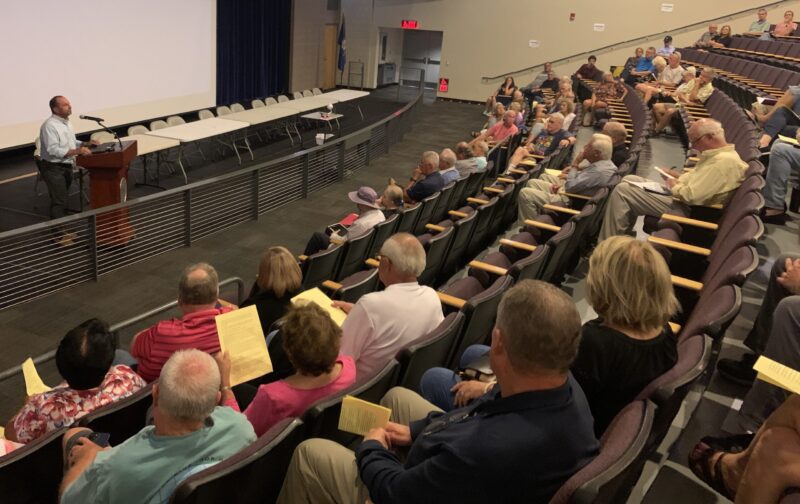
Old Lyme Water Pollution Control Authority Chairman Steve Cinami addresses a tough crowd of Sound View Beach residents at a presentation on the $70 million project to bring sewers to three private beach communities and the town-owned Sound View area.
OLD LYME–As a decades-long effort to clean up Long Island Sound by getting rid of septic systems continues its slow slog in Old Lyme, residents of Sound View Beach are calling for town officials to fight back against state pressure to install sewers or to spread out the cost throughout the town.
Upwards of 60 people gathered in the Lyme-Old Lyme High School auditorium Tuesday evening for a contentious back-and-forth between Old Lyme Water Pollution Control Authority (WPCA) Chairman Steve Cinami and residents of the Sound View Beach area. The subject was Sound View’s portion of a $70 million plan that would require residents of the town owned beach area to foot the bill along with residents of three private beach associations.
Sound View residents on Tuesday decried the lack of solid figures when it comes to how much each homeowner will have to pay. Numbers provided by the WPCA, which drew skepticism from some in the audience as artificially low, added up to about $50,000 for the typical homeowner over the proposed 20-year life of the project loan. The calculation includes construction and annual fees.
Included in construction costs are Sound View’s share of a pump station and force main for the four beach communities, as well as the internal infrastructure necessary to serve the town’s beach View area. Homeowners additionally are responsible for tying into the system and abandoning their septic systems.
Sally Woitowitz, a 28-year resident of Sound View, said the annual cost effectively doubles her taxes. She said she will have to move if the project goes through.
“I have nowhere else to run to,” she said. “A lot of people here, these are cottages for some people. For some of us, it’s our home. It’s all we have.”
She challenged the state’s “rule of thumb,” as articulated last year at a public meeting by DEEP project engineer Carlos Esguerra, that says a project is affordable to residents if it does not exceed 2% of the town’s median household income (MHI) which he identified at the time as $122,000. That equated to $2,440 a year.
The cost to construct the system is slated to amount to $1,939 annually over 20 years for a typical user.
Cinami has said annual operations and maintenance fees are not factored in when calculating affordability. Those fees will add an additional $565 to Sound View users’ annual payments, based on estimates compiled by the state.
DEEP Spokesman James Fowler this month would not provide the updated median income for Old Lyme or specify which source the agency uses to determine the figure. But a review of the U.S. Census Bureau’s most recent American Community Survey puts the median at $126,904, which would bring the affordability threshold to $2,538.
Woitowitz pointed to a unique demographic profile that differentiates Sound View from other parts of town known for affluent and refined beauty.
“They don’t have $120,000 a year income,” she said of the Sound View residents, many of whom she described as senior citizens.
Woitowitz and other impassioned members of the audience reacted most strongly to what they said is a lack of current scientific evidence that a pollution problem exists. They also called out the perceived unfairness resulting from the exclusion of Hawk’s Nest Beach and White Sand Beach from the project.
Cinami said White Sand Beach was excluded from the project because the cost was “unaffordable” to the small community.
Esguerra, the CT DEEP project engineer, has said the state in 2016 authorized additional testing at Hawk’s Nest Beach, with the WPCA at the time agreeing to monitor the area but not to include it in the sewer plan.
Cinami on Tuesday said the WPCA did further testing.
“And the test results are with the state,” he added.
Fowler on Wednesday declined to coordinate a phone interview with any DEEP project officials but accepted questions in writing.
“The Department understands that some residents have questions about how the proposed project may impact other areas of Old Lyme, such as Hawk’s Nest and White Sands,” he wrote in an email response to a question from LymeLine. “Those areas are outside of the scope of this project and have different considerations, such as site use and subsurface conditions. It is important to note that the town decided to prioritize and include Sound View/Misc. Area B in the project since there was an opportunity to both address pollution to groundwater and surface water and realize financial benefits through cost-sharing with private associations.”
He did not comment on the status of the data from Hawk’s Nest.
Least Expensive in the Long Term
Old Lyme Water Pollution Control Authority Chairman Steve Cinami makes a last minute push for for the latest iteration of a plan to bring sewers to four beach communities in Old Lyme as the Board of Selectmen contemplates a fall referendum.
Cinami, the WPCA chairman, told attendees the Old Lyme WPCA spent funds from its general fund budget to look at alternatives to sewers, including single-septic systems as well as a community leaching field design that would have been located at the abandoned Cherrystones restaurant on Route 156.
Detailed plans from the Middletown-based Woodward & Curran engineering firm were published in 2017 and 2018 under the leadership of then-First Selectwoman Bonnie Reemsnyder.
In a Frequently Asked Questions document produced for the WPCA, Cinami said the state did not accept any alternative proposals, and indicated that they believed sewers were the only “long-term, least expensive” solution.
“Perhaps the Old Lyme WPCA should have fought back, but at the time, sewers were in favor with Town leadership, and we were requested to investigate installation of sewers,” he said.
Fowler, the CT DEEP spokesman, reiterated the agency’s longtime stance in his email to LymeLine when he said alternative technologies like code-compliant septic systems and mini-wastewater treatment plant-type systems aren’t feasible due to the need for consistent upkeep, chemical additions, routine maintenance, year-round electricity and regulatory reporting in perpetuity.
“While certain property owners may have or be able to install a code-compliant septic system on their property, it’s not a community level solution and would result in all costs being paid by the homeowner,” he said.
The spokesman described sewers as a “comprehensive, permanent solution for the community” eligible for public infrastructure funds.
“The sewer project would also remove the uncertainty that a patchwork approach brings, as the patchwork approach could be deemed to be insufficient in the future,” he said.
The data underlying the state’s pollution concerns goes back to a period spanning 1998 to 2013. In the meantime, residents argue many septic systems have been updated or demolished, while a 1997 ordinance requiring systems to be pumped out periodically has reduced the potential for pollution.
Esguerra, the CT DEEP project engineer, and DEEP water planning and management division Director Nisha Patel at last year’s public meeting at the Old Lyme Town Hall admitted to a room of roughly 100 Sound View residents that the data is old. But they maintained the conditions making septic systems ineffective at stopping sewage from reaching the groundwater – including densely packed homes sitting on unfavorable soil and rock – haven’t changed.
Shoemaker on Tuesday harked back to that meeting with the DEEP officials.
“I said that I thought that the data that they were using to determine that (the beaches) were polluted was outdated, and I asked Nisha and Carlos what’s the possibility of getting it re-tested,” she told the audience. “They both pooh-poohed it and said they did not feel that it was necessary to do that.”
Shoemaker last year also told the DEEP officials she thought it was inappropriate for the state to put people in the position of losing their homes.
Fowler in the CT DEEP email again reiterated the dated data points “remain relevant.”
“The subsurface conditions and uses (soil type, condition of existing septic systems, depth to groundwater and distance to sensitive receptors such as water bodies and drinking water wells) within the project areas have not been addressed, and continue to exist,” he said. “It is also important to consider the modern public health code requirements for on-site septic systems and septic system setbacks from private wells across all properties, not just those with advantageous conditions. The solution must protect our public trust waters (groundwater and surface water) and should eliminate uncertainty for property owners that a wait-and-see or piecemeal approach may not address.”
No Action
The Sound View residents called on town officials to fight back against the state or come up with the money through taxation.
Shoemaker on Wednesday provided the tax implications for property owners in response to a question about how much it would cost residents across town if the cost was absorbed by all taxpayers rather than the Sound View ratepayers alone.
She said calculations from the town assessor indicate it would cost $96.63 in taxes per year for each real estate parcel in town. That’s based on the $521,795 expense for the Sound View portion of the project over 20 years.
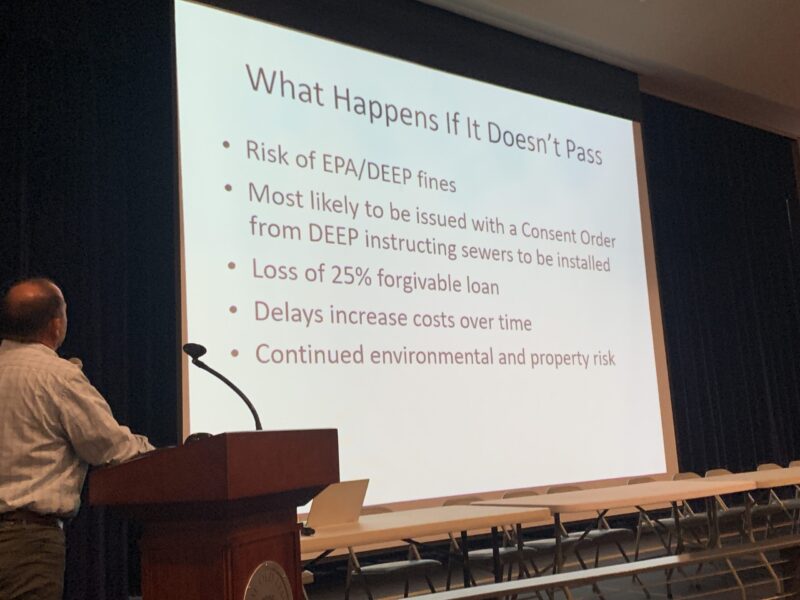
Cinami during the presentation predicted that further delays will turn the town’s voluntary compliance into a consent order from the state.
“I’m responsible when I take my oath as a WPCA member to uphold the state laws and town ordinances,” he said. “No one has told me to not continue along this process. And so I’m supposed to continue on this. If an administration told me ‘forget about sewers, we’re gonna fight it,’ that’s their call. It’s not my call, it’s a town call. I don’t have any any dog in the fight.”
Selectman Jim Lampos, a Sound View resident, took the microphone to blast the state for its rigid stance on outdated information.
“They’re pushing us very hard,” he said. “And they’re not listening to what I think are reasonable arguments.”
Old Lyme resident Martin Merritt brought up situations in towns like Clinton and Old Saybrook, where residents have had some level of success fighting mandated sewer installation in parts of their towns.
“How come we’re not fighting hard for what these other towns are doing successfully?” he said.
The CT DEEP spokesman did not comment on the situation in Clinton, where the Water Pollution Control Commission on the town website said “areas of concern are being refined, and through communications with the DEEP, the WPCC and its consultants were able to take a fresh look at the study area, and further investigate which neighborhoods are truly in need of off-site wastewater treatment and which neighborhoods can support continued on-site septic systems with proper management.”
Merritt in his lengthy criticism of the project also pointed to financial figures that he said exceed the affordability threshold, resulting in a project he said will become “the most expensive sewer system that the residents have paid for, ever, in the state of Connecticut.”
“And we are just rolling over and taking it,” he said. “We’re not doing anything. We’re just sitting here and taking it, and saying, ‘charge us whatever you want and we’re not fighting.’”
Dennis Melluzzo, an outspoken Sound View resident appointed to the Old Lyme Water Pollution Control Authority by the current selectmen, put it this way in his comments to the WPCA chairman: “You can charge us. You’re just going to meet us in court – plain and simple, cut and dry.”
Shoemaker said the next steps will be mapped by the Board of Selectmen at a special meeting.
“You have given the Board of Selectmen a lot to think about,” she said.
Shoemaker on Wednesday said selectmen will meet early next week to discuss sending the bonding authorization to referendum. The Board of Finance is also required to make a recommendation before the question can go to a public vote.
Editor’s Note: This article was updated to correct the estimated project cost per user over 20 years.
Old Lyme Water Pollution Control Authority Chairman Steve Cinami has spent much of the summer addressing concerns from town officials and the public about a plan to bring sewers to the shoreline in order to garner support for a fall referendum.
Connecticut Department of Energy and Environmental Protecton (CT DEEP) Deputy Commissioner of Environmental Quality Emma Cimino in an Aug. 15 email warned Shoemaker that state and federal funding amounting to roughly half of the project cost is in jeopardy if the town doesn’t move forward with a townwide referendum authorizing the funding necessary to award construction contracts by mid October.
Failing to complete “one or more of those milestones” by mid-October “will significantly impact” the town’s ability to pursue a Clean Water Fund grant for 25% of the total project cost and a forgivable loan for another 25%, according to Cimino.
Sound View Beach, which is owned by the town, is responsible for up to $17.1 million of the $70 million proposal to require residents of three private beach associations and the town-owned Sound View community to install sewers. The state and federal funding would bring the Sound View contribution to $8.5 million.
The state going back to the early 1980s has pushed for an end to pollution emanating from local beach communities, leading to a 2018 consent order with Old Colony Beach, Old Lyme Shores, and Miami Beach that resulted in the current shared sewer plan. Sound View Beach, which is under town control, was added in 2019 after voters in a townwide referendum agreed to spend $9.5 million on the public portion of the project with the understanding that affected neighborhoods would fund it.
The town, which is participating voluntarily in the sewer plan at this point, is doing so under the threat of a consent order from the state like the one forcing the private beach associations to act.
Sound View residents have long asked for more specific information about how much they will have to shell out as the municipal bond is repaid over 20 years. They’ve also questioned the data underlying the state’s contention that sewers are necessary to resolve the potential for pollution in the area.
The Board of Selectmen, waiting for answers to those questions, has declined to send to the Board of Finance a resolution that would trigger another town-wide referendum on whether to borrow an additional $7.6 million for Sound View’s portion of the project. The vote is necessary because rampant inflation has driven up the total cost of the project, though the promise of reimbursement from the state and federal government means Sound View ratepayers will actually be paying less than the amount authorized in the first referendum.
Cimino told Shoemaker the agency was aware the Board of Selectmen had not yet voted on moving the increased bond authorization to referendum because they were waiting for the Old Lyme WPCA to share more information with selectmen and the public.
“I want to emphasize the need for quick action at each stage to remain aligned with the association timelines,” Cimino said.
The Old Lyme Water Pollution Control Authority on Tuesday held a contentious project presentation in front of a crowd of mostly Sound View residents. Meanwhile, costs continue to climb as bids last week came back unexpectedly high for the Miami Beach portion of the project, exacerbating selectmen’s concerns about the feasibility and affordability of the project.
Shoemaker on Wednesday in a phone conversation with LymeLine said the referendum would have to occur by Oct. 15 to meet the state’s demands. Logistical requirements involving planning and publicizing the referendum require a decision from both the Old Lyme Board of Selectmen and Board of Finance by Sept. 30, according to Shoemaker.
The Board of Selectmen is slated to meet in a special meeting early next week, she said.