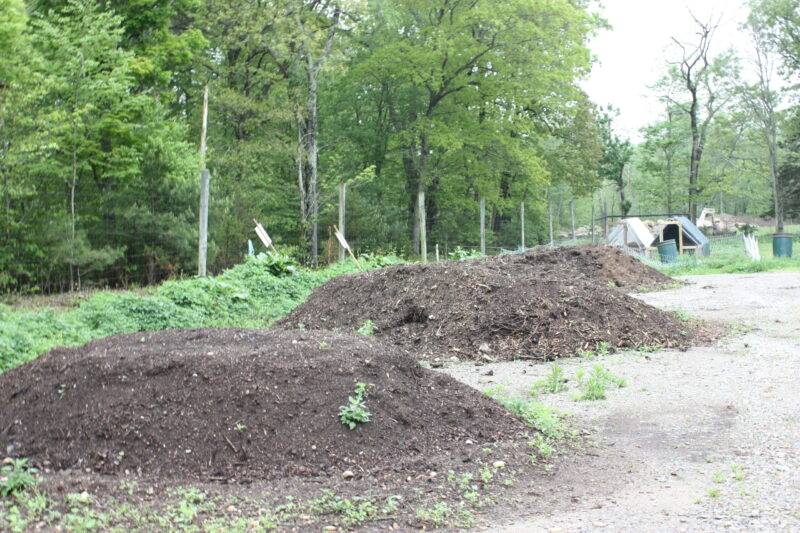
A pumpkin was catapulted into the Lyme Old Lyme Food Share Garden (LOLFSG) compost pile at last year’s inaugural event. Photo courtesy of LOLFSG.
OLD LYME–On Saturday, Nov. 8, big orange gourds will be flying at the second annual Lyme Old Lyme Food Share Garden (LOLFSG) Pumpkin Toss.
The event will run from 9 to 11 a.m. at Town Woods Park, 30 Town Woods Road.
The event offers families a fun venue to recycle their Halloween pumpkins for a good cause, according to an LOLFSG press release.
Building on the popular pumpkin chunkin’ phenomenon, garden volunteers will deploy a trebuchet to toss the pumpkins into the compost pile.
The group said pumpkins from last year’s toss broke down through the composting process into nutrient-rich soil, which helped the Foodshare garden grow over three tons of produce for donation to the Gemma Moran United Way food distribution program and the Shoreline Soup Kitchen and Pantries.
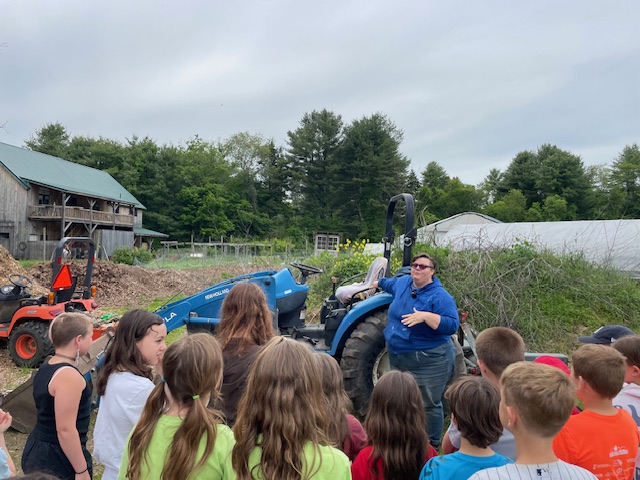
Baylee Drown, co-owner of Long Table Farm, gives a tour of the farm’s composting operation to students from Lyme Consolidated School. Photos and video courtesy of Long Table Farm.
LYME/OLD LYME–For three years, a local farmer has been teaching elementary school students in Lyme how to transform lunch leftovers into plant food.
This year, she’ll be expanding her composting program across the Region 18 school district.
Baylee Drown, co-owner of Long Table Farm in Lyme, doesn’t want the kids from Lyme Consolidated School to have to return to throwing their uneaten food in the trash when they make the transition to grade six at Lyme-Old Lyme Middle School in Old Lyme.
“Going to the middle school should not be a step back for sustainability,” she said in a phone interview this week.
Superintendent of Schools Ian Neviaser, from his office in Center School before Wednesday’s start of school, said Lyme-Old Lyme Schools are committing to growing the composting program. The district includes four schools in Old Lyme and the single elementary school in Lyme.
“We have very little food waste from the cafeteria itself, but from student lunches we have quite a bit of food waste,” he said. “So if a student doesn’t finish their lunch, instead of throwing it out, we’re now going to be composting that.”
Lyme Consolidated School Principal Alison Hine said students have become accustomed to ending each lunch wave by disposing their garbage in the appropriate receptacles.
“They put their trash into the trash can, they put their food waste into the composting bucket that we have there, and they recycle their milk cartons,” she said.
Staff members from Lyme Consolidated School have traditionally dropped off 5-gallon buckets of scraps – typically two per school day – at the farm. That’s where Drown and her partner in life and farming, Ryan Quinn, undertake the process of turning the unwanted food into compost that helps nourish a wide array of crops.
Vegetables from the farm are sold in seasonal shares to subscribers and at farmers markets.
Drown said food scraps from Lyme Consolidated typically fill one 55-gallon drum per week. Each drum holds around 500 pounds.
Hine credited members of the Lyme Consolidated Green Team, a club of third through fifth grade students committed to preserving the environment, with overseeing daily disposal activities in the cafeteria. They’ve also visited the farm to learn about composting firsthand.
The school received a grant so the students could design new recycling containers and signage to make the process more efficient, she said.
“I think that we have a unique opportunity in schools to help students to understand how effective waste management really contributes to a healthier and much more resilient community,” Hine said. “And, you know, while these kids are young and excited about it, I think that to harness that and to help them be a contributing part of the society is important.”
Neviaser, the superintendent, said there are no costs to the district associated with the school composting program at this time.
Drown said she hopes to roll out the program by October as she continues to make contact with leaders in each of the district’s five schools. She said there are tentative arrangements for her to pick up five-gallon barrels filled with scraps from the high school and drop off empty ones, though she has not yet negotiated a fee.
Long Table Farm also works with leaders in Lyme to give residents a place to drop off their food scraps. The town last year began selling green-lidded, brightly labeled buckets at cost to residents interested in hauling their organic refuse to the farm.
Previous plans to apply for a $350,000 to $375,000 grant from the state Department of Energy and Environmental Protection to grow the municipal composting program failed to materialize after she was not able to secure a partnership with the town of Lyme or the Lower River Valley Council of Governments by the June deadline.
Composting piles are churned periodically at Long Table Farm in order to reach an optimal, sustained temperature that keeps away weeds, germs and offensive odors.
Drown said she hopes to host more field trips for Lyme-Old Lyme students as part of the expanded program. Key to the students’ education is the difference between composting and decomposition.
High quality compost is a mix of decayed organic matter that doesn’t just break down on its own, according to Drown. The process takes time and attention. She has to churn each compost pile periodically so that ideal temperatures – from 113 to 165 degrees – can be sustained for two weeks.
“I have temperature probes and they’ll be able to see how hot, and feel how hot, it is in the compost,” she said.
When food scraps go to the landfill, they break down from the lack of oxygen. That leads to the release of methane, a key contributor to global warming.
Drown said composting is different because it relies on oxygenation to fuel optimal decomposition without unpleasant odors.
She emphasized her compost doesn’t stink.
“We want to keep it that way because odors are indicative of nitrogen leaving the farm, and we want to keep all the nitrogen on the farm because nitrogen is our fertilizer,” she said. “And we also don’t want to draw in things that might want to eat food scraps, like wildlife.”
According to the U.S. Composting Council, composting fights climate change by diverting food scraps from landfills and replacing synthetic fertilizers. It can also improve soil health, reduce erosion and help conserve water.
Another benefit touted by the national organization is one Drown touts locally: the ability to help build community through sustainability.
“I’d really like to see us be successful here in Lyme and Old Lyme, and then have other farmers and municipalities develop this type of a relationship,” she said.
Drown’s composting philosophy acknowledges that towns and school districts have food waste they need to get rid off, whether it’s hauled away on a municipal contract or processed barrel-by-barrel at the local farm.
“Farmers already have the infrastructure, farmers already have a tractor, they already have land where they can handle this material and they have a vested interest in using compost,” she said. “And I think it’s a synergistic arrangement.”
Compost Benefits Farm, Lyme Residents, Town’s Bottom Line … and Doesn’t Stink!
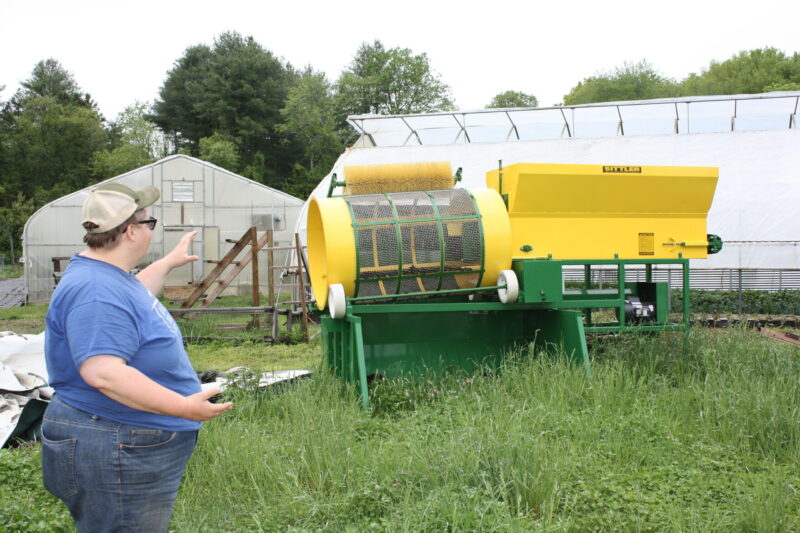
Long Table Farm’s Baylee Drown points out the importance of the trommel screener in sifting through compost to ensure the purest product. All photos by E. Regan.
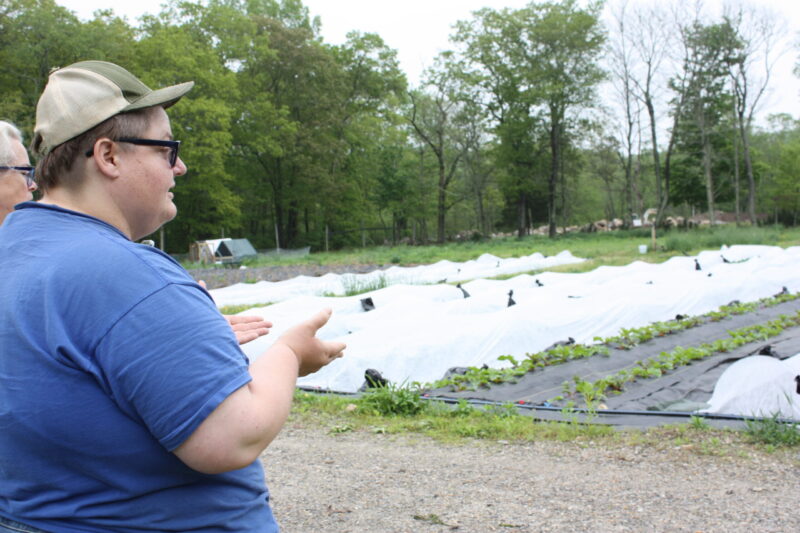
LYME, CT—Long Table Farm owner Baylee Drown last week stood alongside several carefully-tended compost piles adjacent to the vegetable fields as food scraps carried in from all over town cooked down in a natural process that she hopes will bring the community-supported agriculture operation into a new era of sustainability.
Common fears about the stench of rotting food and the rodents it attracts were unfounded on that damp Thursday morning as Drown and Lyme Selectwoman Kristina White looked out from the crushed stone pad separating the compost piles from the earth below. Drown said wood chips spread over the piles is a simple and effective way to manage odors.
“My farm does not stink,” she said. “And I don’t want it to stink. I live here. I have a vested interest in it not stinking.”
Drown, who speaks passionately about carbon sequestration and has been known to refer to farm animals as “manure production,” said it’s her goal to be able to turn one million pounds of food scraps and other organic material into 2,000 cubic yards of compost annually.
She currently produces 200 cubic yards per year of compost, which returns to the farm as fertilizer for a wide array of vegetables that have become more abundant because of it.
Drown and her partner, Ryan Quinn, established Long Table Farm 11 years ago. They initially leased the site before purchasing it in 2018. She credited an agricultural conservation easement, which permanently prohibits the land from being developed and thus reduces the appraised value, with keeping the farm affordable to small business owners like them.
Drown said staff members from Lyme Consolidated School have been dropping off two five-gallon buckets of food scraps per day since 2022. The Town of Lyme last year began selling green-lidded, brightly labeled buckets at cost to residents interested in hauling their organic refuse to the farm.
White said the program benefits the farm, the residents of Lyme, and the town’s bottom line.
She noted 20-25% of the weight of solid waste comes from food.
“So if we can reduce the amount of food waste in the solid waste stream, then our costs for the town go down. And it’s probably going to be mandated eventually by the state,” she said.
She counted 40 of the specially-produced buckets that have been sold so far by the town. Drown added that about 140 people drop off scraps in their own buckets.
White said bringing food scraps to the farm is a good option even for those who do their own composting at home. That’s because items like bones, fats, oils and other organics that don’t break down as well in a backyard compost pile are welcome at the farm.
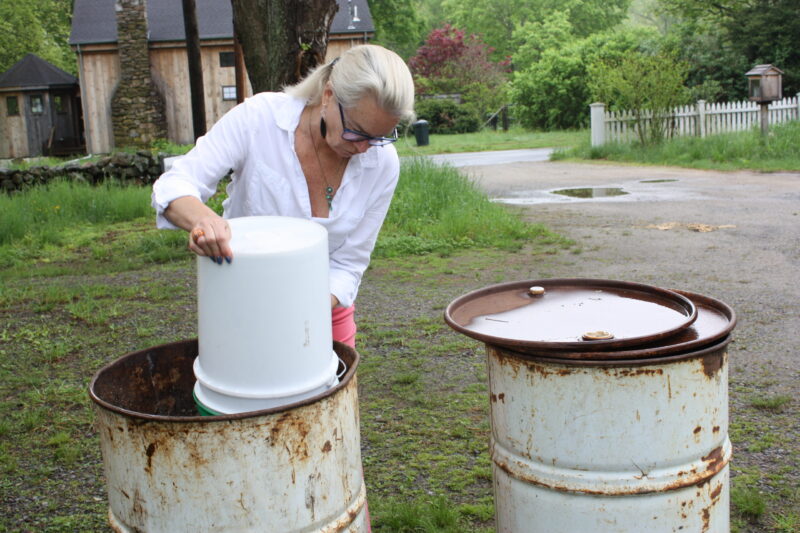
Selectwoman Kristina White dumps a bucket of food scraps from her home into a barrel at Long Table Farm to be turned into compost.
“What we’re trying to say is, ‘Yeah, please compost. Continue to compost in your backyard. But all that other stuff that you’re throwing in the garbage, put it in this bucket,’” she said.
Drown hopes to expand the program through a grant from the state Department of Energy and Environmental Protection as she looks to include Old Lyme in the mix. She said some new farm equipment and expansion of the crushed stone pad would allow the farm to meet the organic recycling needs of both towns, assuming 50% of residents brought in their food scraps.
She also hopes to install collection barrels at places like the transfer station and recycling center.
Drown is asking for $350,000 to $375,000 in funding from the state, combined with in-kind help from the two towns in marketing the composting program and providing educational opportunities.
She told the Lyme Board of Selectpeople at a meeting this week that the grant application has to come from a municipality or the regional Council of Governments since private entities alone are not authorized to apply.
First Selectman David Lahm encouraged Drown to explore a partnership that includes both Lyme and Old Lyme.
“The state government is pushing regionalization,” he said. “So if you can show it’s more than one town, it’s easier to get money.”
Drown said she will be meeting with Lyme-Old Lyme Schools Superintendent Ian Neviaser next week and is lining up a meeting with Old Lyme First Selectwoman Martha Shoemaker.
An Expanded ‘Beta Test’
Long Table Farm owner Baylee Drown points to abundant Swiss chard that grows with the help of compost produced at the farm.
Back at the farm, Drown described the program as a “beta test” as the farmers work to scale up production to meet demands coming down the pike now that the state is mandating more businesses and organizations recycle their food scraps.
“I think it’s a good system to have a starter program that’s optional. And then get people kind of used to the idea before the mandate comes out,” Drown said.
It’s also a beta test for the public.
Anyone in the area is invited to drop off their scraps Wednesday through Sunday from dawn to dusk in two barrels at the farm entrance.
In addition to the scraps, compost at Long Table Farm comprises leaves, wood chips, animal bedding and manure. Drown and Quinn use their blue farm tractor to haul the collection barrels from the parking area to the piles arranged atop the stone pad.
She said she’s hopeful grant money can cover a grabbing mechanism to tip the barrels from the tractor into the pile so the farmers don’t have to do it by hand.
“Right now, it’s messy and gross,” she said. “But we’re tough.”
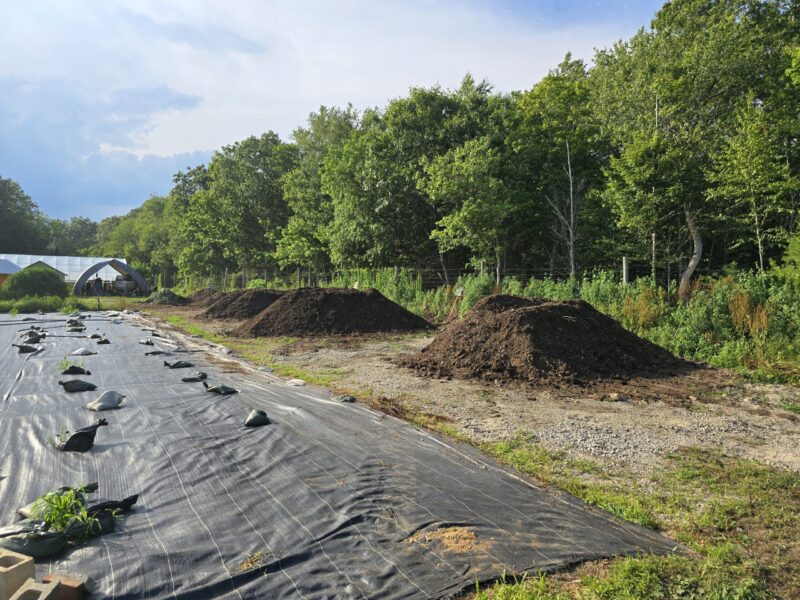
Drown said the composting happens as the large piles “cook,” with bacteria and fungi breaking down the material so that heat is released as a byproduct.
The magic number is 131 degrees, according to Drown. That’s the temperature at which pathogens are killed and weed seeds become sterile.
After a trip through the farm’s rotating screener, properly cooked compost emerges as a clean, high quality fertilizer that she said her friends in the farming community are “champing at the bit” to purchase.
She said Connecticut and Rhode Island don’t have a reliable supplier of high-grade compost and potting soil to supply small scale vegetable farmers in the region.
“I’ve made two batches that were totally weed seed free, but not all my batches are that way yet,” she said. “I’m making good compost, but it’s not perfect yet for vegetable farms.”
Drown was optimistic that will change.
“And that’s another part of why this beta testing process is really helpful,” she said. “Because I’m learning by doing.”
She also sees the pilot program as a way to work toward a sustainable model that will eventually include tipping fees like those the town currently pays the Materials Innovation and Recycling Authority to haul solid waste out of town.
Piles of compost “cook” at Long Table Farm.
In the meantime, Drown said she’s happy to donate the labor and materials she estimated at $3,000 per year to handle food scraps for the town. Her grant application to the state commits to another $50,000 in labor to develop the infrastructure to grow the program.
“And I’m learning how to be a good composter. I took a certificate course so I can operate a compost facility legally that’s recognized in multiple states,” she said. “At some point, the money that’s being given to waste companies needs to be given to farmers.”
White, who also serves as Executive Director of the Lyme Land Trust, was confident the town would start looking into reimbursing farmers for their work when recycling organic material becomes the law.
“Because we’re going to have to pay someone to do it,” she said.
She described the initiative as one that fits into Lyme’s unique, deeply-rooted and pervasive commitment to open space.
“Part of our mission is supporting local farmers and keeping farmland, versus that farmland turning into more development,” she said. “In Lyme, everything is intertwined.”