TOP STORY: Old Lyme Seeks Clarity on Sound View Sewer Costs as Funding Deadline Nears

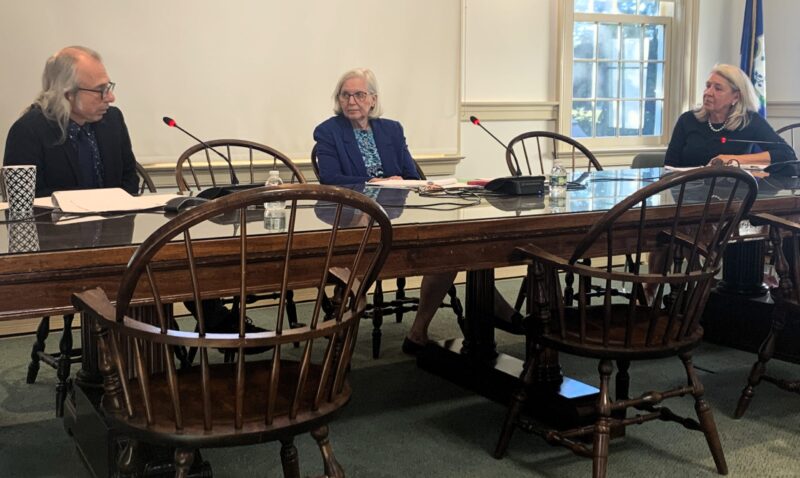
The Old Lyme Board of Selectmen this week agreed to bring in a consulting accountant to go over estimates from the WPCA, its engineer Fuss & O’Neill, residents, and state officials to come to a better understanding of the cost to residents. From left to right: Selectman Jim Lampos, First Selectwoman Martha Shoemaker and Selectwoman Jude Read.

OLD LYME–The Old Lyme Board of Selectmen’s plan to hire a third-party accountant to review cost estimates for the Sound View Beach sewer project has raised concerns that delaying a townwide referendum could put millions in state funding at risk.

The selectmen on Monday during its regular meeting reaffirmed a plan to bring in a consulting accountant to analyze various budget projections for Sound View’s portion of a total $70 million sewer installation project to be shared by four beach communities. 

First Selectwoman Martha Shoemaker said she needs more clarity on the financials before asking voters to approve it at a townwide referendum. 

“I know that no one in government will go forward with any type of referendum on a budget application unless they know that these numbers are firm,” Shoemaker said. “I am not putting it to a referendum resolution until it’s taken care of.” 

She said it’s already too late to put the issue on the ballot for the Nov. 4 election based on scheduling deadlines from the Office of the Secretary of the State. 

The Old Lyme Water Pollution Control Authority (WPCA), which oversees the Sound View project, has been pushing for townwide approval before construction bids expire in mid-October. Meanwhile, the state Department of Energy and Environmental Protection (DEEP) is warning that roughly half of the project cost is in jeopardy if the town misses the Oct. 15 deadline.

Shoemaker said the selectmen are also waiting to see how the finances play out for the Miami Beach Association, where bids came in about $5 million higher than expected last month, and for the Old Lyme Shores Beach Association, which is in the process of going out to bid.

Lampos after the meeting said the cost estimates under review came from the Old Lyme WPCA, its engineer Fuss & O’Neill, residents, and state officials. 

On Tuesday evening, Shoemaker said over the phone that she hired an accountant in consultation with the Lower Connecticut River Valley Council of Governments, a regional planning organization. The consultant, whose firm she could not specify while away from her desk, will start on Sept. 16.

The move comes after upwards of 60 people gathered in the Lyme-Old Lyme High School auditorium late last month for a contentious back-and-forth between Old Lyme WPCA Chairman Steve Cinami and residents of the Sound View Beach area. 

A major concern was the uncertainty over how much each Sound View homeowner will have to pay. They also cited a lack of current testing to show a pollution problem exists and questioned why Hawk’s Nest Beach and White Sand Beach were excluded from the project. 

CT DEEP Spokesman James Fowler in a Tuesday email said the town will still be obligated to address “community pollution problems that can arise from areas of substandard septic systems” even if they lose their state and federal funding by failing to act quickly. 

“The Department will be reaching out to the Town this week to set up a meeting to discuss next steps and timing, as we look to continue to assist the Town with resolving this important issue,” he wrote. 

‘With or Without the Town’

Scott Boulanger, chairman of the Miami Beach WPCA, told LymeLine in a Tuesday phone interview that the association is trying to figure out how to proceed “with or without the town.” 

Acknowledging the Miami Beach costs came in higher than expected, he said the project will only become more expensive once the existing bids expire. 

“If this doesn’t go through in October, everything would have to go out to bid again, which basically says the cost is going to be escalated even more,” he said. 

He said he is working with officials from the other beach associations and the CT DEEP on potential ideas to save money, such as eliminating parts of the project for now. 

The state, going back to the early 1980s, has pushed for an end to pollution emanating from local beach communities, leading to a 2018 consent order with the three private beach associations that resulted in the current shared sewer plan. Sound View Beach, which is under Town control, was added in 2019 after taxpayers across the town agreed to spend $9.5 million on the public portion of the project with the understanding that affected neighborhoods would fund it.

The town so far has been participating voluntarily in the sewer plan under the threat of a consent order from the state. 

Now, inflationary costs have triggered the need for another referendum on the Sound View project after the bottom line increased by $7.6 million. But state and federal funding announced last year promised to reduce the price tag by about half, leaving Sound View residents responsible for less than the amount approved in 2019. 

“Eventually, I think what’s going to end up happening, if I had a crystal ball, would be the project might go forth without [the town], which is what was planned like a decade ago,” Boulanger said. 

Then the town, he said, “will just end up paying a lot more whenever they do get put into the system, which they will probably get forced to do one way or the other.”

Old Lyme WPCA Chairman Steve Cinami in a Tuesday phone call predicted that delaying the Sound View referendum will cost the town its 25% forgivable loan from the state. WPCA documents show the loan amounts to about $2.6 million. 

He worried that taking the time to hire an accountant could needlessly jeopardize the funding.

“I’m surprised there’s an accountant out there that knows how to assume costs to run a pump station, but that’s what they seem to be doing,” he said. 

He attributed the delay to resistance from what he described as a small group of people. 

“There’s almost 200 residences in Soundview and only about, from what I can tell, 30 to 40 residences at most were represented at that informational meeting,” he said. “It leads me to believe that 160 people don’t care or don’t care enough to show up.” 

He emphasized the demands from the state won’t go away if the project moves forward without the town. 

The Case for Waiting

Mary Daley, a longstanding opponent of the Sound View project, who was appointed to the Old Lyme WPCA last year, applauded the delay during the public comment portion of Monday’s selectmen’s meeting.  

“I totally support the idea of retaining an independent auditor to do a forensic audit of what has been spent, what is owed, and what will be owed if this project goes forward,” she said as one of the meeting’s remote participants. 

She warned that the combined impact of annual sewer payments and increased taxes could push some older adults out of their long-term homes.

Selectman Jim Lampos, a Sound View resident, acknowledged a lack of verified numbers has been a sticking point among property owners from the beach community, who will be responsible for construction costs as well as annual fees. 

“I think the suggestion of hiring a third party to take a look at it and to vet all the different estimates that are out there, and to render an opinion, could only help breed confidence,” Lampos said. “Having different estimates floating around doesn’t help.” 

Selectwoman Jude Read called on her fellow selectmen to give a clear directive and timeframe to the consulting accountant. 

“Because this can go on for a long time,” she said. 

Lampos, who is currently working with the four beach communities to formalize a cost-sharing agreement, with another meeting set for Sept. 22, agreed. 

“It has to be done quickly,” he said.
Old Lyme Property Transactions, 9/10/25

9/8: 30 New Britain Road, Matthew J. Bub and Elizabeth Bub of Avon to David F. Gentile, $765,000. 

9/4: 4 Hillside Road, Jodi L. Lott of Lyme to Sarah Hardy, $545,000. 

9/2: 33 Boston Post Road, Elizabeth A. Tichacek, Trustee, of New Mexico, to William Burhans, $595,000. 

8/28: 14 Victoria Lane, Matthew J. Conroy, Trustee, of Chester, to Shannon M. Perry and Benjamin P. Perry of Waterford, $325,000. 

8/26: 30A Hartford Ave., Susan K. Way, Trustee, of Old Lyme, to James E. Casey and Karen Casey, $305,000. 

8/22: 4 Johnny Cake Hill Road, Robert M. Gorman Trust of Mystic to Maureen Kuehler and David Kuehler, $800,000. 

8/18: 41 Connecticut Road, Mark Stankiewicz of Madison and Lynn G. Killoy of East Lyme to Sara H. Peterson of Glastonbury, $715,000. 

All Welcome to Celebrate Lyme-Old Lyme Food Share Garden Volunteers, Saturday

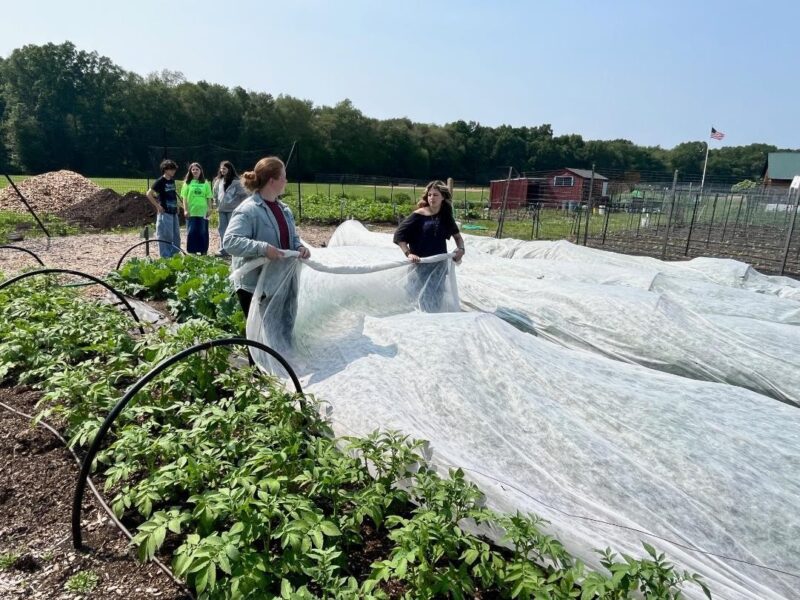
Volunteers of all ages have helped the Lyme-Old Lyme Food Share Garden grow. Earlier this year, Eco Warriors from Lyme-Old Lyme Middle School uncovered cabbage in the garden at Town Woods Park.

OLD LYME–On Saturday, Sept. 13 at 10:30 a.m., the Lyme-Old Lyme Food Share Garden (LOLFSG) will celebrate its volunteers in an end-of-season gathering at Town Woods Park. 

All are welcome to the free event, which includes sandwiches and drinks. Salads and desserts are welcome but not essential.  

LOLFSG in a press release said the nonprofit group this year donated more than 3,700 pounds of produce to the United Way and the Shoreline Soup Kitchens & Pantries. The bounty adds up to more than 12,000 pounds delivered since 2022. 

“Garden volunteers come in many varieties,” the group said. “On-site gardeners show up on cold and damp March days, hot and humid July days and on glorious weather days in any month. They plant, weed, harvest, manage pests, fertilize, innovate, problem-solve and so much more.”

Other volunteers publicize the work of the garden, foster community relationships, fundraise, donate money, inspire new volunteers and perform many other tasks, according to the group.  

“As a fully volunteer nonprofit organization, it all matters and it is all appreciated,” organizers said. “Please help us celebrate!”

The Lyme Old Lyme Food Share Garden is located at 26 Town Woods Rd behind the field house and playground.

TOP STORY: Old Lyme Selectmen Vote to Postpone Setting Referendum on Sound View Sewers Until Key Questions Answered

OLD LYME–The Old Lyme Board of Selectmen on Tuesday, citing a lack of answers to questions they have been asking for months, again decided to hold off on setting a referendum affecting Sound View Beach that could get a stalled sewer project moving again. 

Selectmen at a roughly one hour special meeting voted unanimously to move discussion on the referendum to a future meeting, after their questions have been answered and a cost-sharing agreement has been finalized among the four participating beach communities. 

Selectmen also voted to hire an independent firm to look at annual operating and maintenance costs that would give Sound View residents a better idea how much they can be expected to pay going forward. Numbers provided by the Old Lyme Water Pollution Control Authority (WPCA) and the Connecticut Department of Energy and Environmental Protection (CT DEEP) have been criticized by some residents as artificially low. 

First Selectwoman Martha Shoemaker during the meeting said selectmen have heard cost concerns from Sound View residents “loud and clear.”

She said she will not vote to move forward until she can give residents a clearer idea what those costs will be. 

Meanwhile, the CT DEEP is pressuring the town to act fast on a project years in the making.

“I’m not trying to kick this project down the road, because it’s been kicked down the road for some time,” Shoemaker said. “But I can pretty much assure you that our governor, [or] any other town executive, would not go forward with a project if they didn’t have all the numbers. Solid numbers.” 

Estimates of the long-term cost for a typical resident during a question-and-answer session last week ranged from $40,000 to more than $60,000 over 20 years, depending on who was doing the calculations. 

Construction costs amount to $70 million for the project, which would require residents of Sound View to foot the bill along with homeowners in three private beach associations: Miami Beach, Old Lyme Shores and Old Colony. 

Members of each private beach associations authorized their share of the project in separate referendums. In the case of Sound View, which is a public beach community, it is up to all Old Lyme voters to decide whether residents there should pay for sewers. 

The cost for Sound View comes to approximately $17.1 million. State and federal funding brings the cost down to $8.5 million. 

The CT DEEP last month warned Shoemaker that state and federal funding amounting to roughly half of the project cost is in jeopardy if the town doesn’t act fast to hold a public vote and award construction contracts. 

Failing to complete “one or more of those milestones” by mid-October “will significantly impact” the town’s ability to pursue a Clean Water Fund grant for 25% of the total project cost and a forgivable loan for another 25%, according to CT DEEP Deputy Commissioner of Environmental Quality Emma Cimino. 

Shoemaker in a phone interview after Tuesday’s meeting said selectmen are focused on making sure voters have access to accurate and thorough information when they vote on the sewer question at referendum. 

She was hopeful that a meeting among project officials from the four beach communities on Sunday will yield the  final cost-sharing agreement selectmen have been seeking. She also expressed optimism she could find a third party accountant to evaluate the annual operation and maintenance costs for a more definitive estimate next week. 

She acknowledged the state funding could be in question if the town doesn’t act. 

“If they take away the money, it’s totally unaffordable,” she said. “So we will work with them and explain to them we have been asking for these things to happen over the last year and a half, and we certainly are not dragging our feet.” 

Lampos: ‘Project Stinks’

Selectman Jim Lampos, a resident of the Sound View Beach area, said he vowed when he became a selectman that he would demand fair treatment for the beach residents who would bear the cost of the town project. That means fully understanding how much Sound View residents will owe for operating and maintenance costs every year, while also ensuring all costs are allocated equitably. 

He laid out a timeline going back more than a year to show selectmen have actively been seeking answers and compromises rather than trying to obstruct the process. 

“I think the project stinks, and I always have, for 15 years,” he said. “But I also am a realist.”

He acknowledged about $4 million was spent on project planning across the four beach communities; a referendum was held in 2019; and an agreement was signed with the municipalities through which the sewer lines would run and be treated – all before the current selectmen’s administration. 

“I know the state is banging us over the head to get this done,” he said. “It’s very difficult to stop this moving train. It’s at full speed.” 

But he said cost estimates from the Old Lyme WPCA remain too low to be believed and language that would codify the fair distribution of costs has not been finalized. 

He railed against the state for pressuring the town to install sewers without giving consideration to modern septic alternatives that he said towns west of the Connecticut River have successfully implemented. 

He also pointed to the CT DEEP’s “rule of thumb,” as articulated last year at a public meeting by agency project engineer Carlos Esguerra, that says the cost is affordable to residents if it does not exceed 2% of the town’s median household income (MHI). Esguerra at the time identified Old Ltme’s MHI as $122,000, which equated to $2,440 a year.

The cost to construct the system is slated at $1,939 annually over 20 years for a typical user, not including fees that would likely exceed $500 per year based on state estimates. 

“So, I’m here to say tonight that as we see these numbers, this project is unaffordable,” Lampos said. “And [if] DEEP wants it, instead of threatening us and saying, ‘Oh, we’re going to take your money away’ – as if they’re doing us a favor, as if it’s charity and we should be grateful – DEEP needs to pony up and make up that difference.” 

CT DEEP Spokesman James Fowler last month said that if a project’s costs were estimated to exceed 2% MHI, it would be up to the town or sewer authority to explore additional options, like splitting a project into phases, deferring work not associated with pollution, pursuing additional funding, and requesting a longer project schedule. 

Fowler emphasized that exceeding the 2% threshold “does not mean that communities don’t have to address identified pollution.”

Working Together

Selectwoman Jude Read, the lone Republican on the Democrat-led board, agreed with putting off a vote. She emphasized the sewer project originated with a past town administration and the state, not with current board and commission volunteers. 

She said frustration should be directed at the state rather than local people, who have tried to help. 

“This project’s been going on for well over 10 years. Technology has changed. Population has changed. Science has changed. Climate has changed. What (the state) asked for 10, 12 years ago is not necessarily applicable now,” she said. “But we have to work together to come up with a solution to move forward because I think eventually we are going to have to deal with sewers. We are going to have to deal with groundwater levels rising.”

She said the solution requires channeling local frustrations into a productive conversation with state officials.

“We are willing to work,” she said. “And I think we have a track record of showing that we have been dealing in good faith for 10, 11, 12 years. And we will continue to do so.” 

The CT DEEP going back to the early 1980s has pushed for an end to pollution emanating from local beach communities, leading to a 2018 consent order with the three private beach associations. Sound View was added to the project in 2019 after voters in the first townwide referendum agreed to spend $9.5 million. 

The town, which is participating voluntarily in the sewer plan at this point, is doing so under the threat of a consent order from the state like the one forcing the private beach associations to act. 

The referendum now under consideration would authorize an additional $7.6 million for Sound View’s portion of the project after rampant inflation drove up the cost, though the promise of reimbursement from the state and federal government means Sound View ratepayers will actually be paying less than the amount authorized in the first townwide vote. 

Selectmen also postponed a vote on a draft sewer ordinance that will go to voters along with the spending authorization. The document had been revised with Lampos’ encouragement to ensure residents of the beach communities are not responsible for the cost of installing sewers in any other areas of town going forward. 

The document specifies any future sewer projects must be covered by users in that area. 

Read cautioned selectmen to make sure the provision doesn’t end up exempting residents within the current project boundaries from paying for public improvements like road paving that could end up being covered by the town.

Old Lyme Board of Finance (BOF) Chairman BJ Bernblum confirmed to LymeLine Wednesday morning that the BOF meeting scheduled for Wednesday evening has now been canceled. This meeting would have discussed details of the referendum if the board of selectmen had voted to move the proposal in that direction.

Editor’s Note: This article has been updated with information about Wednesday evening’s Old Lyme Board if Finance meeting.

TOP STORY: From Lunch Table to Farm: Lyme-Old Lyme Schools Get Behind Expanded Food Recycling Effort

Baylee Drown, co-owner of Long Table Farm, gives a tour of the farm’s composting operation to students from Lyme Consolidated School. Photos and video courtesy of Long Table Farm.

LYME/OLD LYME–For three years, a local farmer has been teaching elementary school students in Lyme how to transform lunch leftovers into plant food.

This year, she’ll be expanding her composting program across the Region 18 school district.

Baylee Drown, co-owner of Long Table Farm in Lyme, doesn’t want the kids from Lyme Consolidated School to have to return to throwing their uneaten food in the trash when they make the transition to grade six at Lyme-Old Lyme Middle School in Old Lyme. 

“Going to the middle school should not be a step back for sustainability,” she said in a phone interview this week.  

Superintendent of Schools Ian Neviaser, from his office in Center School before Wednesday’s start of school, said Lyme-Old Lyme Schools are committing to growing the composting program. The district includes four schools in Old Lyme and the single elementary school in Lyme.

“We have very little food waste from the cafeteria itself, but from student lunches we have quite a bit of food waste,” he said. “So if a student doesn’t finish their lunch, instead of throwing it out, we’re now going to be composting that.”

Lyme Consolidated School Principal Alison Hine said students have become accustomed to ending each lunch wave by disposing their garbage in the appropriate receptacles.  

“They put their trash into the trash can, they put their food waste into the composting bucket that we have there, and they recycle their milk cartons,” she said. 

Staff members from Lyme Consolidated School have traditionally dropped off 5-gallon buckets of scraps – typically two per school day – at the farm. That’s where Drown and her partner in life and farming, Ryan Quinn, undertake the process of turning the unwanted food into compost that helps nourish a wide array of crops. 

Vegetables from the farm are sold in seasonal shares to subscribers and at farmers markets. 

Drown said food scraps from Lyme Consolidated typically fill one 55-gallon drum per week. Each drum holds around 500 pounds. 

Hine credited members of the Lyme Consolidated Green Team, a club of third through fifth grade students committed to preserving the environment, with overseeing daily disposal activities in the cafeteria. They’ve also visited the farm to learn about composting firsthand. 

The school received a grant so the students could design new recycling containers and signage to make the process more efficient, she said. 

“I think that we have a unique opportunity in schools to help students to understand how effective waste management really contributes to a healthier and much more resilient community,” Hine said. “And, you know, while these kids are young and excited about it, I think that to harness that and to help them be a contributing part of the society is important.” 

Neviaser, the superintendent, said there are no costs to the district associated with the school composting program at this time. 

Drown said she hopes to roll out the program by October as she continues to make contact with leaders in each of the district’s five schools. She said there are tentative arrangements for her to pick up five-gallon barrels filled with scraps from the high school and drop off empty ones, though she has not yet negotiated a fee.  

Long Table Farm also works with leaders in Lyme to give residents a place to drop off their food scraps. The town last year began selling green-lidded, brightly labeled buckets at cost to residents interested in hauling their organic refuse to the farm.  

Previous plans to apply for a $350,000 to $375,000 grant from the state Department of Energy and Environmental Protection to grow the municipal composting program failed to materialize after she was not able to secure a partnership with the town of Lyme or the Lower River Valley Council of Governments by the June deadline. 

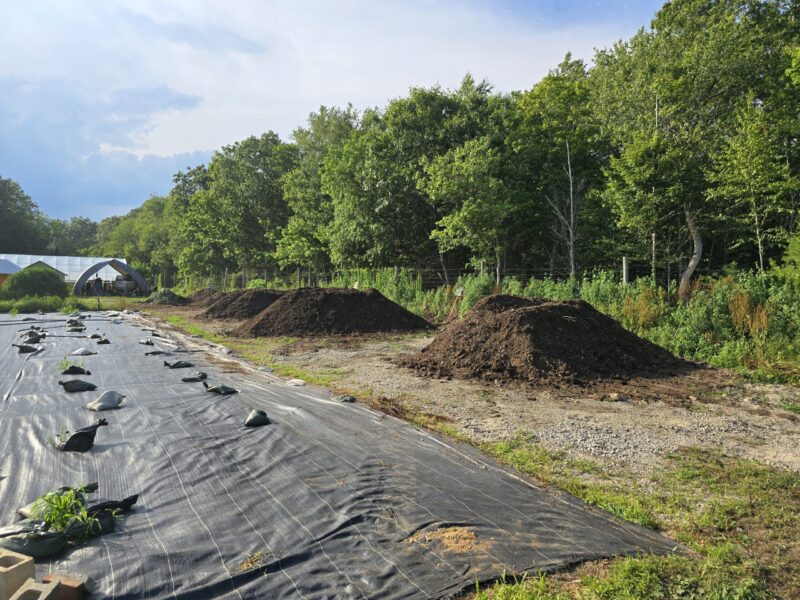
Composting piles are churned periodically at Long Table Farm in order to reach an optimal, sustained temperature that keeps away weeds, germs and offensive odors.

Drown said she hopes to host more field trips for Lyme-Old Lyme students as part of the expanded program. Key to the students’ education is the difference between composting and decomposition.

High quality compost is a mix of decayed organic matter that doesn’t just break down on its own, according to Drown. The process takes time and attention. She has to churn each compost pile periodically so that ideal temperatures – from 113 to 165 degrees – can be sustained for two weeks. 

“I have temperature probes and they’ll be able to see how hot, and feel how hot, it is in the compost,” she said. 

When food scraps go to the landfill, they break down from the lack of oxygen. That leads to the release of methane, a key contributor to global warming. 

Drown said composting is different because it relies on oxygenation to fuel optimal decomposition without unpleasant odors. 

She emphasized her compost doesn’t stink. 

“We want to keep it that way because odors are indicative of nitrogen leaving the farm, and we want to keep all the nitrogen on the farm because nitrogen is our fertilizer,” she said. “And we also don’t want to draw in things that might want to eat food scraps, like wildlife.”

According to the U.S. Composting Council, composting fights climate change by diverting food scraps from landfills and replacing synthetic fertilizers. It can also improve soil health, reduce erosion and help conserve water.

 Another benefit touted by the national organization is one Drown touts locally: the ability to help build community through sustainability. 

“I’d really like to see us be successful here in Lyme and Old Lyme, and then have other farmers and municipalities develop this type of a relationship,” she said. 

Drown’s composting philosophy acknowledges that towns and school districts have food waste they need to get rid off, whether it’s hauled away on a municipal contract or processed barrel-by-barrel at the local farm. 

“Farmers already have the infrastructure, farmers already have a tractor, they already have land where they can handle this material and they have a vested interest in using compost,” she said. “And I think it’s a synergistic arrangement.”