
Lyme-Old Lyme High School’s Presidential Scholar Pan Goes to the Capitol

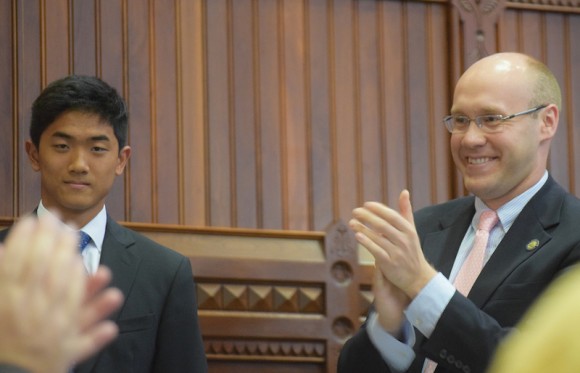
Eric Pan, left, reacts to the applause from politicians in the State Capitol.

Eric Pan, left, savors the applause from politicians in the State Capitol.

On May 30, Lyme-Old Lyme High School senior Eric Pan was introduced on the House Floor of the State Capitol by Rep. Devin Carney (R-23rd). Pan was recognized for being named a 2015 U.S. Presidential Scholar, a highly prestigious honor given to only to a maximum of 141 students nationally.

The White House Commission on Presidential Scholars, appointed by President Obama, selects honored scholars annually based on their academic success, artistic excellence, essays, school evaluations and transcripts, as well as evidence of community service, leadership, and demonstrated commitment to high ideals.

Of the three million students expected to graduate from high school this year, more than 4,300 candidates qualified for the 2015 awards determined by outstanding performance on the College Board SAT and ACT exams, and through nominations made by Chief State School Officers or the National YoungArts Foundation’s nationwideYoungArts™ competition.

The 2015 Scholars are comprised of one young man and one young woman from each state, the District of Columbia and Puerto Rico, and from U.S. families living abroad, as well as 15 chosen at-large and 20 U.S. Presidential Scholars in the Arts.

Created in 1964, the U.S. Presidential Scholars Program has honored almost 7,000 of the nation’s top-performing students with the prestigious award given to honorees during the annual ceremony in D.C. The program was expanded in 1979 to recognize students who demonstrate exceptional talent in the visual, literary and performing arts.

The 2015 ceremony will be held June 21, when each honoree will receive a Presidential Scholar Medallion.

Pan plans to attend the University of Connecticut in the fall, where he will study biomedicine and medicine.
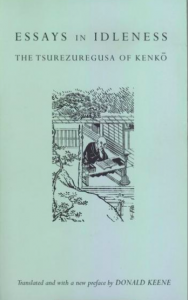
Reading Uncertainly? Kenko, “Essays in Idleness,” from The Tsurezuregusa of Kenko, (1332?)

KenkoOccasionally, I find myself compelled to drift into the past, seeking older words of wisdom. I was therefore drawn to Kenko, a Japanese Buddhist priest who wrote these words some 700 years ago: “The pleasantest of all diversions is to sit alone under the lamp, a book spread out before you . . . “ How true!
In these Essays, he leads with repeated cautionary admonitions: “The most promising thing in life is its uncertainty,” following that later with “A man is more likely to seem a true master of his art if he says, ‘I cannot tell for certain.’ “  And he concludes: “The one thing you can be certain of is the truth that all is uncertainty.” Yet today how often do we hear politicians, commentators, and ourselves state “absolutely,” “exactly,” “emphatically,” “certainly,” and unequivocally.” So much for uncertainty …

Here are a few more delicious Buddhist quotations:

  • “People tend to exaggerate even when relating things they have actually witnessed, but when months or years have intervened, and the place is remote, they are all the more prone to invent whatever tales suit their fancies, and, when these have been written down, fictions are accepted as fact.”
  • “What a foolish thing it is to be governed by a desire for fame and profit and to fret away one’s whole life without a moment of peace. Great wealth is no guarantee of security. Wealth, in fact, tends to attract calamities and disaster. Even if, after you leave enough gold to prop up the North Star, it will only prove a nuisance to your heirs . . . . The intelligent man, when he dies, leaves no possessions.”
  • “If you trust neither in yourself nor in others, you will rejoice when things go well, but bear no resentment when they go badly. You will then have room on either side to expand, and not be constrained.”
  • “In everything, no matter what it may be, uniformity is undesirable. Leaving something incomplete makes it interesting, and gives one the feeling that there is room for growth.”

So this brief comment is deliberately left incomplete, to encourage you to try Kenko!

Editor’s Note: Kenko, “Essays in Idleness,” from The Tsurezuregusa of Kenko, (1332?), as edited and translated by Donald Keene, is published by Columbia University Press, New York, 2nd edition, 1998.

Felix Kloman_headshot_2005_284x331-150x150About the author: Felix Kloman is a sailor, rower, husband, father, grandfather, retired management consultant and, above all, a curious reader and writer. He’s explored how we as human beings and organizations respond to ever-present uncertainty in two books, ‘Mumpsimus Revisited’ (2005) and ‘The Fantods of Risk’ (2008). A 20-year resident of Lyme, he now writes book reviews, mostly of non-fiction that explores our minds, our behavior, our politics and our history. But he does throw in a novel here and there. For more than 50 years, he’s put together the 17 syllables that comprise haiku, the traditional Japanese poetry, and now serves as the self-appointed “poet laureate” of Ashlawn Farms Coffee, where he may be seen on Friday mornings. His wife, Ann, is also a writer, but of mystery novels, all of which begin in a bubbling village in midcoast Maine, strangely reminiscent of the town she and her husband visit every summer.
Old Lyme Church Continues 350th Celebrations with Concert This Afternoon Featuring Vivaldi’s ‘Gloria’

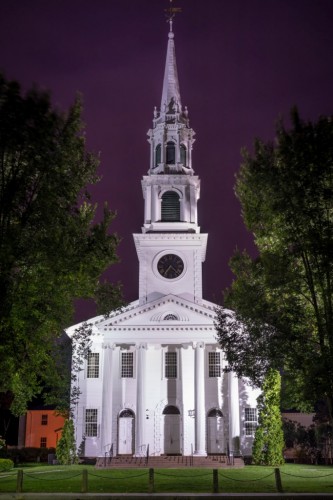
FCCOL_exterior_Photo_by_Nigel_Logan_122KB

Throughout 2015, the First Congregational Church of Old Lyme is celebrating 350 years of history. A series of concerts and a talk on the historic landscape of Lyme Street have been scheduled to commemorate the rich legacy of the past and ongoing connections that link the church and the larger community.

The next event is a concert to be held at the church this afternoon at 4 p.m. when the Senior Choir from the Congregational Church will be joined by choristers from Saint Ann’s Episcopal Church and Christ the King Church, both in Old Lyme, to perform Vivaldi’s ‘Gloria.’

Vivaldi composed the ‘Gloria’ in Venice, probably in 1715, for the choir of the Ospedale della Pietà, an orphanage for girls (or more probably a home, generously endowed by the girls’ “anonymous” fathers, for the illegitimate daughters of Venetian noblemen and their mistresses). The Ospedale prided itself on the quality of its musical education and the excellence of its choir and orchestra.

A priest, music teacher and virtuoso violinist, Vivaldi composed many sacred works for the Ospedale, where he spent most of his career, as well as hundreds of instrumental concertos to be played by the girls’ orchestra. This, his most famous choral piece, presents the traditional Gloria from the Latin Mass in 12 varied cantata-like sections.

The wonderfully sunny nature of the ‘Gloria’ with its distinctive melodies and rhythms is characteristic of all of Vivaldi’s music, giving it an immediate and universal appeal. It is written for female soloists, chorus and small orchestra.

All are welcome to attend this concert and join the continuing celebrations of this important year in the life of the Church.  Admission is $10 per person or $20 per family.

Public worship on the east side of the Connecticut River can be traced back to 1664 when the Court acknowledged that there were “thymes and seasons” when inhabitants could not attend Sabbath meetings in Saybrook and ordered them to agree on a house where they would gather on the Lord’s Day. A year later, Articles of Agreement defined a “loving parting” that created a separate “plantation” on the river’s east side, which would soon be named Lyme.

The first three meetinghouses stood on a hill overlooking Long Island Sound. After a lightning strike destroyed the third of those structures in 1815, the church was relocated to its present site closer to the village. Master builder Samuel Belcher from Ellington was hired to design a fourth meetinghouse beside the town green and the cornerstone was laid on June 10, 1816. That stately white church with its graceful steeple and columned façade, painted repeatedly by the country’s most prominent landscape artists, burned to the ground on July 5, 1907, in what was almost certainly an act of arson.

Rebuilt to replicate Belcher’s design after a community-wide, fundraising campaign, the fifth meetinghouse, which was dedicated in 1910, remains today as both a vibrant center of faith and fellowship and Old Lyme’s most important historic landmark.

For more information on the concert of church life and events, visit www.fccol.org or call the church office at (860)-434-8686.

The First Congregational Church of Old Lyme is located at the intersection of Ferry Rd. and Lyme St.in Old Lyme, CT.

Wildcats Play for Shoreline Baseball Championship Tonight

The Wildcat boy’s varsity baseball team, seeded fourth and coached by Randy St. Germain, meet seventh seeded Coginchaug High School tonight in the Shoreline Championship final to be held at Dodd Stadium starting at 7 p.m.

Against the odds for both teams, the Old Lyme boys defeated top-seeded Morgan of Clinton in Thursday’s semi-final while Coginchaug eliminated number three seed Portland.

GO WILDCATS!

Architect’s Fee for Second Round of Boathouse Designs Approved, Drawings Expected Within Four Weeks

The Hains Park Boathouse Improvement Committee (HPBIC) met Thursday evening in Old Lyme’s Memorial Town Hall with a single agenda item to review the architect’s fee for designing Options 2A and 3A.  Six committee members were present along with Selectman Arthur ‘Skip’ Sibley, who is an ex-officio member.

Option 2A involves use of the existing foundation combined with construction of a new building while Option 3A also uses the existing foundation, but retains the existing building with a new addition. Both options call for improvements to toilets and consideration of new pavilion.

Architect Nina Cuccio Peck’s proposed fee was a discounted rate (for this phase only) not to exceed $7,000 to create drawings for both options in sufficient detail that they could then be handed to a professional estimator to develop two firm quotes.  The plans would not be a “full bid set,” but Fuchs noted, “Nina will be creating the same level of detail for both options so an estimator will be able to create an apples to apples comparison of the costs.”

The expectation is that Peck will have these plans ready within four weeks, at which point the committee will select an estimator and send out the plans for estimation.  The motion (to approve Peck to proceed with the work) passed unanimously with the only significant discussion being about how accurately it would be possible to estimate costs given that the plans would fall short of the “full bid set” standard. Paul Gianquinto, HPBIC Co-Chairman, estimated that the margin of error would be around 15 percent but also pointed out that the variance should be roughly the same for both options.

Editor’s Note: Click to read an article covering the previous May 14 meeting of the HPBIC titled Boathouse Proposal Draws Sharply Differing Opinions, Slowly Advances