Letter from Paris: New European Union Commission Leadership Faces Rocky Road

Nicole Prévost Logan

Nicole Prévost Logan

On Nov. 1, following the mandate of Manual Barroso (2009-2014) from Portugal, the 12th Commission of the European Union (EU) moved into its headquarters at the Berlaymont  in Brussels.

The selection process of the Commission – the key institution of the EU and a formidable machine employing 25,000 persons – has greatly changed since its beginnings in 1951.  The mandate was shortened from nine years to five ;  whereas the president of the Commission used to be designated by the Council of Ministers (equivalent to the present European Council), he (or she) )  is now elected by the Parliament.  A major turn in the composition of the Commission took place in 2004 with the addition of 10 new members from Central and Eastern Europe.  The present rule assigning one commissioner per country creates an odd situation: Malta, with a population of 400,000, has the same representation as Germany with a population of 82 millions.

Jean-Claude Juncker from Luxemburg, a member of the European People’s Party, was elected by the Parliament with 422 votes out of 751 as the new president of the Commission.  Angela Merkel strongly supported him.  Linguistically and culturally he stands half way between France and Germany – a real asset for the most important official of the EU.

Upon his return from the G20 summit meeting in Brisbane, Australia, in mid November, Juncker had to face the “Luxleaks” crisis exposed by the press.  Forty international newspapers, including Le Monde, the Guardian and the Suddentsche Zeitung, investigated the tax breaks granted by Luxemburg to 340 multinationals, like Google, Apple or Amazon.  Yuncker’s critics said that, while he was serving as prime minister and minister of finances, Luxemburg became the leading tax haven of Europe.  To put an end to these practices, the “rulings” – holding companies and other devices used for tax “optimization” – were suspended.  As the new president of the Commission, Yuncker reaffirmed his commitment to fight tax evasion.

The post of commissioner of economy and budget was given to Pierre Moscovici, the former French minister of economy. The choice seems ironic since France almost flunked the rule imposed by the Pact of Stability and Growth requiring a deficit of 3 percent of the GDP (France’s deficit has reached 4.4 percent)

The new High Representative of the European Union for Foreign Affairs is Federica Mogherini , 41,  a diplomat with an impressive record.  Her intention to improve relations with Russia was not appreciated by some of the Eastern European countries.

Tibor Navracsics, a former minister with the ultra conservative Hungarian government was to become commissioner of culture, but his nomination was voted down by the Parliament.

It is a tumultuous time for the new team of the EU.  In the guidelines he presented to the plenary session of the Parliament in July 2014, Jean-Claude Yuncker set his priorities as follows: a plan of public and private investment of 300 billion over three years to stimulate the economy, harmonizing budgetary policies of the member states and coping with the explosive surge of refugees.

Nicole Prévost Logan

Nicole Prévost Logan

About the author: Nicole Prévost Logan divides her time between Essex and Paris, spending summers in the former and winters in the latter.  She writes a regular column for us from her Paris home where her topics will include politics, economy, social unrest — mostly in France — but also in other European countries.  She also covers a variety of art exhibits and the performing arts in Europe.  Logan is the author of ‘Forever on the Road: A Franco-American Family’s Thirty Years in the Foreign Service,’ an autobiography of her life as the wife of an overseas diplomat, who lived in 10 foreign countries on three continents.  Her experiences during her foreign service life included being in Lebanon when civil war erupted, excavating a medieval city in Moscow and spending a week under house arrest in Guinea.
A Historical Perspective on ‘Giving Thanks’

We are pleased to celebrate this Thanksgiving season by republishing an article written for LymeLine.com by Linda Ahnert to honor Thanksgiving 2007.

Who doesn’t love Thanksgiving?

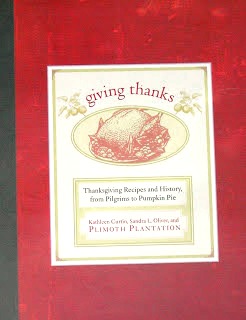
Giving thanks_bookA few years ago, a book entitled “Giving Thanks: Thanksgiving Recipes and History, from Pilgrims to Pumpkin Pie” was published.  The co-authors are Kathleen Curtin, food historian at the Plimoth Plantation, Mass., and Sandra L. Oliver, food historian and publisher of the newsletter “Food History News.”
The book is a fascinating look at how an autumnal feast evolved into a “quintessential American holiday.”

Most Americans, introduced to the story of the Pilgrims and Indians during childhood, assume there is a direct link between the traditional holiday menu and the first Thanksgiving.  But we learn from the book that many of those food items—such as mashed potatoes and apple pie—were simply impossible in Plymouth, Massachusetts, in 1621.  Potatoes were not introduced to New England until much later and those first settlers did not yet have ovens to bake pies.

What we do know about the bill of fare at the first celebration in 1621 comes from a letter written by colonist Edward Winslow to a friend in England:  “Our harvest being gotten in, our governor sent four men on fowling, that so we might after a special manner rejoice together after we had gathered the fruit of our labors.”

Later 90 Indians joined the party with “their great king Massasoit whom for three days we entertained and feasted.”  Then the Indians “went out and killed five deer which they brought to the plantation.”

So venison was a principal food on the menu.  It also seems safe to assume that mussels, clams, and lobsters (all in plentiful supply) were served as well.   According to other journals of the colonists, the “fowl” that Winslow described were probably ducks and geese.  But wild turkeys were also bountiful in 1621, and so it is very likely that they were on the Pilgrims’ table.  Thank goodness for that.

Throughout the New England colonies, it became common to proclaim a day of thanksgiving sometime in the autumn.  In period diaries, there are many descriptions of food preparation—such as butchering and pie baking—followed by the notation that “today was the general thanksgiving.”

By the 19th century, Americans were taking the idea of a “thanksgiving” to a whole new level.  The religious connotations were dropping away in favor of a holiday celebrating family and food.  Roast turkey had become the centerpiece of these fall celebrations.

Turkeys, of course, were native to North America.  (Benjamin Franklin, in a letter, had even proposed the turkey as the official U.S. bird!)  And turkey was considered to be a fashionable food back in the mother country.  Just think of the significance of turkey in Charles’ Dickens’ “A Christmas Carol.”  When Scrooge wakes up in a joyful mood on Christmas morning, he calls to a boy in the street to deliver the prize turkey in the poulterer’s shop to the Cratchit family.  (Earlier in the story, the poor Cratchits were dining on goose.)

It is thanks to a New England woman that Thanksgiving became an American holiday.  Sarah Hale was a native of New Hampshire and the editor of “Godey’s Lady’s  Book,”  a popular women’s magazine.  She lobbied for years for a national observance of Thanksgiving.  She wrote editorials and sent letters to the president, all state governors, and members of Congress.

Finally, in 1863, she convinced Abraham Lincoln that a national Thanksgiving Day might help to unite the Civil War-stricken country.   The fourth Thursday in November was now officially on the American calendar.

Connecticut’s own Harriet Beecher Stowe wrote this description of a New England Thanksgiving in one of her novels—“But who shall . . .describe the turkey, and chickens, and chicken pies, with all that endless variety of vegetables which the American soil and climate have contributed to the table . . . After the meat came the plum-puddings, and then the endless array of pies. . .”

The autumnal feast became a national holiday, but each region of the country put its own spin on the menu.   Not to mention that immigrants have also added diversity.  The result is a true “melting pot” of America.  The second half of “Giving Thanks” contains recipes that reflect what Americans eat for Thanksgiving in the 21st century.

In the South, for instance, the turkey might be stuffed with cornbread and there would be pecan and sweet potato pies on the table.  In New Mexico, chiles and Southwestern flavors may be added to the stuffing.

There’s the “time-honored traditional bread stuffing” recipe.  There’s also one for a Chinese American rice dressing and directions for a Cuban turkey stuffed with black beans and rice.  Desserts run the gamut from an (authentic) Indian pudding to an (exotic) coconut rice pudding.  Old-fashioned pumpkin pie is included as well as the newfangled pumpkin cheesecake.

But no matter what food items grace our Thanksgiving tables, it seems that we all end up stuffing ourselves silly.  Perhaps overeating started at that very first harvest celebration in 1621.  In Edward Winslow’s letter describing the feast with the Indians, he noted that food was not always this plentiful. But he wrote his friend in England “ … yet by the goodness of God, we are so far from want that we often wish you partakers of our plenty.”

Letter to the Editor: A Thanksgiving Thank You to Townspeople for Help Finding Lost Dog

To the Editor:

I wanted to post a thank you to all the residents in your town for their help finding my lost dog Lily.  Moreover, I want to let everyone know she has been found and is doing well.

I saw so many people, but didn’t know their name, or where they live.  There were police officers, town highway workers etc.

I want to let them know how much they touched our hearts.

Sincerely,

Cathleen Andrew,
Clinton.

Artisan Fair This Saturday at Florence Griswold Museum Celebrates ‘Small Business Saturday’

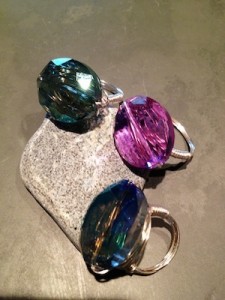
Absinthine jewelry by Michaelle Pearson will be on sale in the Museum Shop on Saturday.

Absinthine jewelry by Michaelle Pearson will be on sale in the Museum Shop on Saturday.

It’s ‘Small Business Saturday’ this coming Saturday, Nov. 29, and the Florence Griswold Museum is celebrating by hosting an Artisan Fair from 11 a.m. to 3 p.m. i the Museum Shop.  All the items for sale are “Crafted in Connecticut.”  

Click here to see information on some of the vendors.