Septic Truck Catches Fire on Halls Rd. in Old Lyme

Flames pour from a septic pumper truck parked in the Old Lyme Shopping Center Wednesday afternoon. Photo by K. Monson.

OLD LYME–The local fire marshal said a blaze that ignited in the engine compartment of a septic pumper truck was contained to the cab by firefighters in a Halls Road parking lot Wednesday afternoon. 

Old Lyme crews were called to the Old Lyme Shopping Center at 1:16 p.m., according to Old Lyme Fire Marshal David Roberge. Lyme and Old Saybrook fire departments also responded. 

Roberge said the driver of the Finkeldey Septic Service truck went in to get lunch at Papi’s Taqueria, then came out to find the truck on fire. 

No other property was damaged, the fire marshal said. 

Representatives of the state Department of Energy and Environmental Protection and a private contractor were still at the scene as of 4:30 p.m. cleaning up oil and firefighting foam, according to Roberge.  

He said the tank of the septic truck, which was empty, did not catch fire. 

“No poop was lost,” he said. 

Also Wednesday afternoon, fire departments from Old Lyme and Lyme were fighting a 100 ft. by 200 ft. brush fire on Burr Road in Old Lyme resulting from a lawnmower that caught fire. 

The call came in at 3:31 p.m., Roberge said. 

Hurtle’s ‘Lyme Home Watch’ Earns Accreditation From National Organization for Third Year

Bill Hurtle and his wife, Jennifer.

LYME, CT — Lyme Home Watch has earned accreditation from the National Home Watch Association (NWHA) for the third year.

Home Watch uses visual inspections to check for obvious issues at vacation or primary homes while the owners are away, according to a press release from the association. NWHA has been around since 2009, ensuring that all principals of NHWA-accredited member companies are background checked, insured and bonded.

Owner Bill Hurtle said the need for his services became evident as he saw friends and family head south for the winter, leaving their home unoccupied or having a non-professional “home watcher” monitor their property.

Hurtle is a resident of Lyme since 2013. For about two decades, he worked as a microbiologist for the Department of Homeland Security. Prior to that, he was employed by the Department of the Army and at the United States Army Medical Research Institute of Infectious Diseases in Frederick, Maryland.

Lyme Home Watch’s primary mission is to provide house checks for the exterior and interior of a home. They also provide pre- and post-storm checks, facilitate contractor and vendor meetings, and offer keyholder services to their clients.

Hurtle is a graduate of the NHWA’s Home Watch Boot Camp and has earned the designation of Certified Home Watch Professional, which places him among the élite Home Watch providers in the industry.  

Lyme Home Watch serves Lyme, Old Lyme, Niantic, Old Saybrook, Essex, and Westbrook.

Three New Spring Exhibitions on View at Lyme Art Association Through May 29

“Sunflowers for Ukraine,” an oil painting by Blanche Serban, will run as part of the “Sunflower’s Bloom” exhibition at the Lyme Art Association, April 18 through May 29.

OLD LYME – The spring season brings three exhibitions to the Lyme Art Association (LAA) beginning April 18. An Opening Reception will be held Friday, April 25, from 5 to 7 p.m.

Sunflower’s Bloom; Ship to Shore: A Marine Show; and Stillness: A Still Life, run through May 29 at the LAA gallery, 90 Lyme Street. 

The association in a press release said Sunflower’s Bloom is a juried exhibition dedicated to supporting Ukraine and its people. With the sunflower—Ukraine’s national flower—as its guiding symbol, the show highlights themes of resilience, hope, and beauty that flourishes even in adversity. All entry fees will be donated to UNICEF to aid Ukrainian children and families, and a portion of sales commissions from the exhibition will also contribute to this effort. 

The show is juried by Jenny Parsons, curator at the Florence Griswold Museum.

Ship to Shore: A Marine Show, will be juried by acclaimed marine artist Sergio Roffo. It features a range of subjects from tranquil harbors to turbulent seas.

Stillness: A Still Life is a juried show overseen by artist Justin Wiest. Inspired by the introspective nature of still life painting, the exhibition invites artists to capture the quiet beauty of everyday objects, offering viewers a moment of reflection amid life’s fast pace.

LAA Executive Director Elsbeth Dowd said the three exhibitions showcase artistic excellence and serves a greater purpose.

“With Sunflower’s Bloom, we are using art as a means to provide tangible support for those in need, while Ship to Shore and Stillness highlight the artistic traditions that LAA has long celebrated,” Dowd said. 

The gallery is open to the public Tuesday through Sunday, 10 a.m. to 5 p.m. Admission is free.

For more information on upcoming shows, educational programs, and special events, visit LymeArtAssociation.org or contact Elsbeth Dowd at elsbeth@lymeartassociation.org.

Founded in 1914 by the American Impressionists, the LAA continues the tradition of exhibiting and selling representational artwork by its members and invited artists, as well as offering art instruction, lectures, and other public programs to the community.

Old Lyme Town Budget Hearing Uncontentious Despite Proposed 7.8% Increase Over Current Spending

OLD LYME – Board of Finance Chairman Bennett J. Bernblum on Monday presented the proposed $45.39 million budget along with its potential implications on taxes in this and coming years. 

The proposed $45.39 million 2025-26 budget – which includes town operations and capital expenses as well as the town’s share of the regional Lyme-Old Lyme school district – represents an increase of $3.28 million, or 7.8%, over current spending. It is heavily influenced by large-scale renovation projects affecting the schools and the Lymes’ Senior Center. 

The public hearing on the budget lasted just over a half hour in front of roughly two dozen people in the Town Hall meeting room. Bernblum opened with the acknowledgement that it was not the kind of “sell out crowd” that drew more than 550 people to the Lyme-Old Lyme High School earlier this month to discuss for more than three hours a controversial proposal to allow apartments on the commercial strip of Halls Road. 

Amid the apparent lack of controversy Monday night, Bernblum laid out the budget proposal he said would likely raise tax bills for the average property owner by around 4.7% based on the recent townwide property revaluation. But residents whose home values increased more than the average will see a heftier hike in their tax bills. 

He said the projected tax rate, which won’t be set until immediately after the proposed budget is approved by voters, will be 16.2 mills.

A mill represents $1 in tax per $1,000 of assessed property value.  

Bernblum has said the tax rate would be going up 6.8% if the finance board didn’t offset the increase by taking $800,000 out of the undesignated fund balance, or Rainy Day Fund.

The current tax rate is 24.4 mills. After taking the revaluation into account – and if spending did not change at all in the coming year – the tax rate would be 15.5 mills. 

The town’s grand list of taxable property grew by 57.4% as a result of the revaluation, according to final assessor’s data that takes into account adjustments by the Board of Assessment Appeals. The board finished its final hearings earlier this month. 

That means a house appraised at $400,000 with a valuation mirroring the average 57.4% increase to the grand list is now worth $629,600, according to Bernblum’s presentation. The tax bill for that homeowner based on the proposed budget would be $7,153 – an increase of $321, or 4.7%, over the current tax bill. 

Illustrating the complexity of a revaluation year, Bernblum said a house valued at $600,000 that went up 65% in value due to the revaluation is now worth $990,000. The owner of such a home can expect a $11,247 tax bill if the proposed budget goes through. That’s an increase of $999, or 9.8%, over the current tax bill. 

Old Lyme’s government operations expenses come in at $11.39 million, an increase of $835,260 million, or 7.9%, over the current budget. That includes debt service amounting to $702,350, which is up $271,168, or 62.9%, over current payments. The increase is driven largely by debt payments on the Lymes’ Senior Center renovation project.

The proposal includes an additional $107,000 increase in health insurance expenses over the current year.

The budget proposal, along with new language related to several town ordinances, will go to voters at a town meeting on May 19. 

The Impact of Education

The proposed budget in Old Lyme includes education costs of $31.52 million, which is up $1.99 million, or 6.72%, from the town’s current share of the regional school district budget. The increase is driven by debt payments on a multi-building renovation project approved by voters at a cost of $57.5 million. 

A referendum on the $39.7 million Region 18 budget proposal – which represents an increase of $2.7 million, or 7.39%, over the current spending plan for the district – is scheduled for May 6 in Lyme and Old Lyme.

The Region 18 Board of Education earlier this month voted unanimously to send the budget proposal to referendum.

Earlier objections to a decision to cut an elementary music teacher from the proposed budget were muted after the school board agreed to put the position back into the spending plan. The district will find savings elsewhere in the proposed budget to cover the cost, according to Superintendent of Schools Ian Neviaser. 

Neviaser in a Tuesday email said the regional school board has opted not to use any of its $3.1 million undesignated fund balance to offset the spending increase despite calls to explore the option.

“The board has not chosen to make any changes to the current proposed budget and plans to go to referendum with what we believe is a fiscally responsible and reasonable request of a 2.69% increase in the operating budget coupled with a 4.7% increase in debt service, which is the main driver for the overall 7.39% increase,” he said. 

School board Chairman Jason Kemp, who said he was speaking for himself rather than the full board, wrote in an email Tuesday that the undesignated fund is generally used for projects that might be too large for an annual budget, but too small to go to referendum and bonding. 

“While nothing is planned at the moment, an example of such a project would be to replace the track which we are told can’t really be resurfaced again. It would be fiscally irresponsible to spend that down significantly to cover a year of debt service on the PK-8 school project,” he said. 

He noted the proposed budget is less than the projected 10% increase for the coming year that had been presented to the towns prior to the referendum vote on that project. He cited lower than expected interest rates and grant funding that helped defray costs.

Rainy Days in Old Lyme 

On the town side, the finance board on April 15 voted to use $800,000 from its own undesignated fund balance to soften the impact of the proposed budget increase on taxpayers. 

Budget figures from Finance Director Anita Mancini show the allocation will bring the predicted $14.2 million Rainy Day Fund from 35.15% of the total operating budget at the end of this budget year to an estimated 29.6% in the coming budget year.

Bernblum said maintaining a healthy undesignated fund balance will help the town mitigate the effect of increasing budgets on taxpayers going forward. 

“And that will still leave (a) surplus of a significant amount to hedge against future needs,” he said. 

He emphasized that debt payments from the schools’ renovation project will continue to increase through the 2028-29 budget year. 

“So debt service for Region 18 is going to continue to go up significantly, but not astronomically, over the next several years, and then finally it will begin to come down,” he said. 

A philosophical schism between the two major parties on the finance board has pitted Democrats against Republicans. The decision to dip into the Rainy Day Fund for $800,000 represented a compromise among the three Democrats, who wanted to use more of the surplus to mitigate tax increases, and the three Republicans, who would have preferred to use less in order to save for the future. 

Some finance board members at the time said the town could be facing costs in coming years related to a years-long effort to bring sewers to several beach communities under pressure from the state Department of Energy and Environmental Protection. 

While town officials have long said the expense would be covered by property owners in the affected beach areas, Bernblum on Monday acknowledged there could be costs to residents at large. 

State law specifies towns cannot assess property owners for any amount higher than the percent increase in the property value attributed to the sewers.

“It is possible that something could go wrong in the formula and that…the (Old Lyme Water Pollution Control Authority) won’t be able to bill the homeowners all of the costs necessary to recover 100%, in which case then the town could have some liability,” he said. 

Shoemaker said costs related to connecting town-owned properties to the sewer system, including the Old Lyme Police Department on Shore Road and a planned bathroom facility at Sound View Beach, would also be covered by the town. 

She said the town’s proposed capital plan includes $20,000 for initial engineering designs related to the Sound View bathrooms and contemplates spending an additional $20,000 on designs the following year. 

Uncertain Expenses

Proposed capital costs come in at $2.49 million in the proposed budget. That’s up $456,792, or 22.5%, from the current budget.

The capital spending plan includes $443,500 to save for the purchase of three fire department apparatuses over the next several years. Also included in the budget is an additional $200,000 for road-paving projects, bringing the total line item to $1 million.

The plan earmarks $70,200 toward architectural designs sought by the Halls Road Improvements Committee (HRIC) for a plan to add a pedestrian bridge, sidewalks and other amenities, according to Bernblum. 

But the Board of Selectmen last week agreed to put the work of the HRIC on hold in the wake of a groundswell of opposition to a separate proposal to amend the town’s zoning regulations and the subsequent resignation of HRIC Chairwoman Edie Twining. 

“What is going to happen with Halls Road is in the hands of the Board of Selectmen primarily at this point,” Bernblum said. “So what they decide to do, or we decide to do, with respect to Halls Road at the moment has not been decided.” 

Proposed capital expenses also include $80,000 to supplement $95,000 approved last year at a town meeting for the design and construction of a replacement gazebo at White Sands Beach. 

First Selectwoman Martha Shoemaker said the town engineer’s original estimates were upended when it was discovered the town would have to follow state and federal flood zone requirements in updating the structure. 

Subsequent estimates came in at $173,000 for the project, according to Feb. 24 Board of Selectmen meeting minutes. 

Shoemaker attributed the steep increase to more stringent guidelines for installing the footings and holding the gazebo in place. 

Shoemaker said the plan is to complete the engineering designs using last year’s allocation so the project can go out to bid. 

Bernblum put it this way: “We’ll go out to bid when the designs are completed and cross our fingers that there’s enough money. And if not, we’re going to have to come back to you guys and beg for more.” 

Bernblum said the finance board remains open to public feedback on the proposed budget through the May 19 town meeting. 

“Historically, we haven’t gotten negative feedback in regards to it, but we certainly invite that,” he said.

Editor’s Notes: i) Bennett Bernblum is a financial supporter of LymeLine.com, but has no input to the editorial process, which remains completely independent.
ii) A reminder of Our Policy on Comments.

Gardening Tips for Late Spring from ‘The English Lady’

Though April showers may come your way, They bring the flowers that bloom in May,
So if it’s raining have no regrets, Because it isn’t raining rain you know, it’s raining violets.

– Al Jolson

Azaleas in full bloom are a welcome sign of the approaching summer.

April was a month of activity in the garden, and our old nemesis, weeds are beginning to rear their heads, so we need to extract the little devils before they take hold and are difficult to remove.  

Maureen Haseley-Jones

Having said that, I must point out the benefits of many weeds. Nettles are food for butterflies, clover extracts nitrogen from the air, which is then absorbed into the soil and the oil from jewel weed soothes poison ivy rash. The young foliage of Dandelions is great in salads and when lightly cooked it tastes like spinach with the added advantage of containing many healthy nutrients. 

In this group, I do not want to forget our songbirds and other wildlife who depend on weed seeds as a food source. 

WEED REMOVAL

Weeds must be pulled gently so that the weeds and roots do not break apart, because if this happens, thousands of weed seeds will reseed and you will find yourself with an endless cycle of unnecessary weeding. When careful weeding has been accomplished, apply an organic weed pre-emergent, with a corn gluten base by Bradfield Organics; this natural product will keep weeds at bay for about six weeks. 

ROSES, RHODODENDRONS & MORE

Day lilies bring a splash of color to spring gardens.

Plant bare root roses at the end of April or beginning of May and plant container roses in mid- May.  In the middle of May when the soil temperature has reached 55 degrees, add manure and on top of the manure add a fine bark mulch about one foot from the base of the roses. Check my Early Spring tips to remind yourself on pruning roses. 

Be careful clearing winter debris from around rhododendrons, mountain laurel and azaleas; these evergreens have shallow roots and do not appreciate having their roots exposed. If winter weather did erode soil around some roots, add soil to cover the exposed roots and at the same time resettle the plant in place. In the middle of May apply manure and fine bark mulch as well as some peat, which adds much needed acidity for evergreens.

Plant Gladioli corms at two-week intervals in late April. Planting in two- week intervals ensure you will get a succession of bloom.  Plant the corms eight inches below the surface; this extra depth helps to keep the heavy blooms erect.

The Red Lily beetle will soon appear, and I suggest applying organic Neem oil on the Lilies when they are about four inches above ground, the oil helps to halt this beetle problem.

SOIL SOLARIZATION & MULCHING

This is an effective way to control many soil-borne problems, specifically the tomato blight that causes fruit rot. Covering the soil with clear plastic in the area where tomatoes are to be planted at the end of April, for one to two months can generate high enough temperatures in the top six to 12 inches of soil to kill pests, nematodes, weed seeds and many disease organisms like the tomato blight.  This process has proved invaluable for home gardeners and the beneficial effects last for several seasons.  

To solarize, dig a trench several inches deep around the soil bed, and spread a thin, clear plastic film (1-4mils) over the bed.  Press the plastic into close contact with the soil and seal the edges by filling the trench with soil.  Leave the plastic on the soil until you are ready to plant tomatoes or other vegetables in about six weeks.  

With a soil thermometer checking to see when the soil temperature has reached 55 degrees, then manure all the borders with composted manure in bags from the garden center or aged manure from the bottom of the farmer’s pile, then mulch with a fine brown hardwood mulch. It is important to wait until the soil temperature has reached 55 degrees so that the valuable bacteria in the manure can work its magic in the soil. 

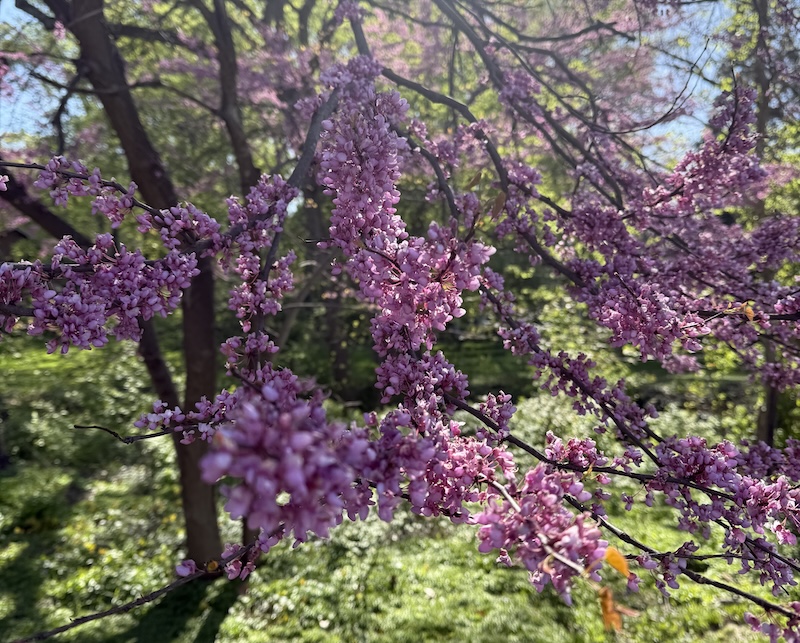
As spring temperatures rise, blossom begins to appear on trees.

In the vegetable garden, following soil preparation and planting, it is time to mulch. Mulch with composted manure that will not ‘cap,’ which means it does not form a crust like other mulches and air and water can penetrate through to the roots of the plants where it is needed for vegetable and fruit production.      

If you did not apply an organic grub control on the grass in March, apply now to reduce the grubs, which is the food source for Moles; the grub control will help to  cut down on the mole population.    

Soil is the most important component of production in the garden; with compost, organic manure and peat to amend soil and rebuild its structure. The ratio to use is one part compost to three parts manure and apply peat to the planting mix in the ratio of one part peat to three parts manure when planting evergreens. And as mentioned above, peat adds the acidity which evergreens require.

Good soil structure assists with drainage, prevents compaction, and the rich nutrients with the amendments break down and encourage the soil animals beneath the surface to work at full capacity. In a sandy soil, humus is needed to produce   micronutrients for this soil, which is the combination of manure, mulch and carbon from the atmosphere that binds the sand particles together which will produce a healthy workable soil. In heavy soil such as clay, the humus separates the clay particles which allow for air and drainage.  

GROWING CONDITIONS IN LATE APRIL/EARLY MAY

These are very favorable for new plant-root development. This month is the best time to transplant evergreen shrubs and plant new evergreens. Apply composted manure and peat together with the topsoil in the planting hole. Then give the roots a workout with your hands before planting. Separating the roots in this way gives them the freedom to reach into the surrounding soil for nutrients and water remaining moist in the heat of summer.    

Many years ago, when I moved into my farmhouse on the shoreline, I discovered that my soil was sandy, which is good for drainage but sadly lacking in nutrients.  I began adding a few inches of manure to all planted borders in April, July and October. The result today is when I put a spade in the ground to check the color of the soil in spring it’s ‘black gold’.  

Gloves should be worn when handling manure, as manure contains bacteria; the bacteria is great for the plants and the soil but not good for your health.  These natural soil amendments tend to be slow acting; gradually making the nutrients available to the plants throughout the season with infinite rewards.. Composted manure is applied in spring around mid May when the soil temperature has reached 55 degrees and when the plants show about six inches of growth. This method allows the nutrients and soil animals to become active at the time when plant growth is occurring at a rapid pace. 

DAFFODILS, FROSTS & ANNUALS

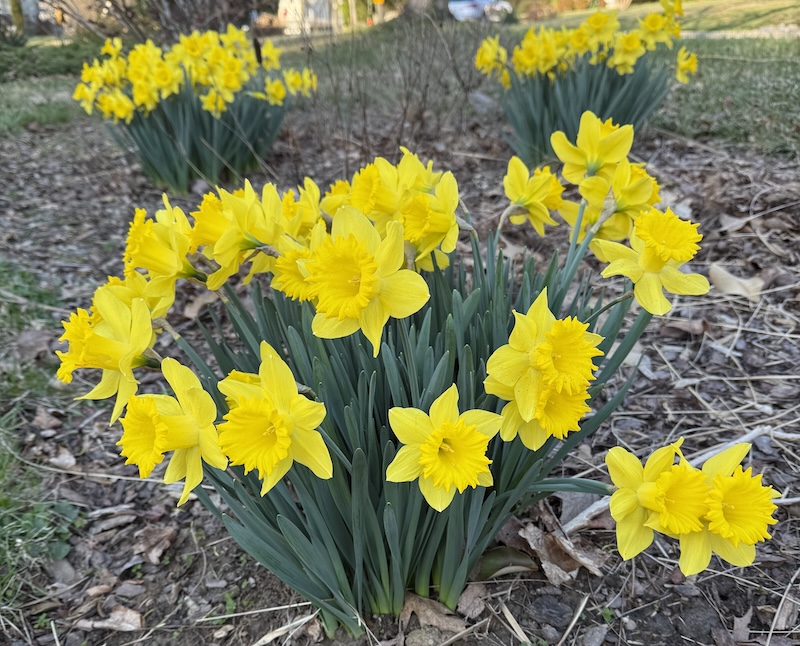
Daffodils are a sure sign of spring.

Daffodils, which are my favorite flower, are appearing in gardens and on roadways making a lovely spring time sight. When the Daffodil bloom has past, do not cut the leaves from the Daffodils or any of your spring flowering bulbs, the leaves send down energy in the form of food into the bulbs to store for next season’s growth. 

This is the time to tackle a new lawn or patch seed, use only good quality grass seed, organic fertilizers and lime, which provide the alkaline, need for healthy grass growth.   

Even after several consecutive warm days, frost can still occur. Having said that I suggest that you do not plant annuals until Memorial weekend.  If you purchase annuals at the Mother’s Day sales, place the annual plants in a protected spot in the garden, like a wall, until planting.  Do not cultivate around the perennials in the borders until mid May. 

Do not panic if you are not able to get the April tasks done until May, your garden will wait for you and the constancy that is Mother Nature will continue to keep your patch of earth flourishing. 

Enjoy the pleasure of being outdoors in warmer temperatures, inhaling the pungency of awakening soil and your connection with Mother Nature. Do not overdo it; warm up the body before the garden labor and stay well hydrated with lots of water. 

We are inexorably entwined with the earth and know that even the smallest gesture of a garden has positive rewards; the effects are not only on you but on our planet.  

It is important to have a well-thought-out plan before creating a new garden or landscape. Yo may wish to call my son Ian, who has followed in my footsteps as a landscape designer, and arrange a landscape consultation at LandscapesByIan.com

I will see you in your garden with more gardening tips later in May and if you have any gardening questions, please email MaureenHaseleyJones@gmail.com

About the author: Maureen Haseley-Jones is a member of a family of renowned horticultural artisans, whose landscaping heritage dates back to the 17th century. She is one of the founders, together with her son Ian, of, The English Lady Landscape and Home Company. Maureen and Ian are landscape designers and garden experts, who believe that everyone deserves to live in an eco-conscious environment and enjoy the pleasure that it brings. Maureen learned her design skills from both her mother and grandmother, and honed her horticultural and construction skills while working in the family nursery and landscape business in the U.K. Her formal horticultural training was undertaken at the Royal Botanic Gardens at Kew in Surrey.