I have lived in Old Lyme for 19 years and am deeply committed to its welfare, including its economic vitality. To that end I have served on the town’s Economic Development Commission and continue to serve on the Board of Selectmen’s Halls Road Improvements Committee. I am now running for election to the Old Lyme Planning Commission. Decisions made by the Planning Commission and the Zoning Commission are of the utmost importance to our town. They determine how we may use our property and how those uses may change. I want to participate in these decisions and assure that they open-minded, thoughtful, made in the best interests of our residents, respect the rights of property owners, and comply with the law.
In thinking about our land-use approval process, I am aware of concerns expressed by property owners and others that the bifurcated process can be cumbersome, time-consuming, and expensive. I therefore looked into how land-use decisions are made in other towns and found that combining planning and zoning into one commission may produce a better outcome. Most Connecticut towns, especially the smaller ones, do this. Joining them creates efficiencies, better coordination, and quicker decision- making.
Here are [stet] some of what I found:
> Norwalk decided that combining the commissions: “will save considerable time and costs without the need to present requests to both commissions … The union of the planning and zoning commissions also creates a more consistent planning relationship. It gives the commission increased jurisdiction. That broadened authority results in greater consistency in the planning process.” (Norwalk Tomorrow 3/28/22.)
> Essex’s First Selectman, Norm Needleman, stated that, “there had been friction between the two commissions because the Zoning Commission isn’t obligated to implement the Plan of Conservation and Development drawn up by the Planning Commission (CT Examiner 9/18/20)
> Land use attorney Larry Shipman said, “Planning and zoning make sense together because at least you have people on the commission focused on planning issues, so they can become advocates for the plans they develop. . . . I find it easier as an applicant, that a joint commission allows you to accomplish more in less time.” Shipman also thought that a combined commission would make the Plan of Conservation and Development more effective and functional; because the same people who write it are responsible for implementing it. (CT Examiner 9/18/20)
Some towns like Essex are contemplating going one step further by appointing commissioners rather than electing them. Commissioners will be required to have expertise and experience in land use. We, too, might want to explore this approach.
I am aware of a few arguments against combining the two commissions, principally that the workload will be too great. However, this concern can be addressed by increasing the number of commissioners and delegating appropriate matters to the Land Use Coordinator.
I hope you will support my effort to participate in Old Lyme’s land use decisions; this is just one idea about how we might improve the process.
James R. Taylor, 76, of Parker, Colo.—husband of Ruth; father of Laura Cantillo of Scottsdale, AZ, Susan Mayne of Old Lyme, CT, and Paul Taylor of Houston, TX; grandfather of Zachary, Taylor, Alex, Daniel, Sarah, and David.
Born in Phoenixville, Pa., passed away September 26, 2-23 in Parker, Colo.
Lieutenant, U.S. Marine Corps, Korea, President of Mountain States Exploration …
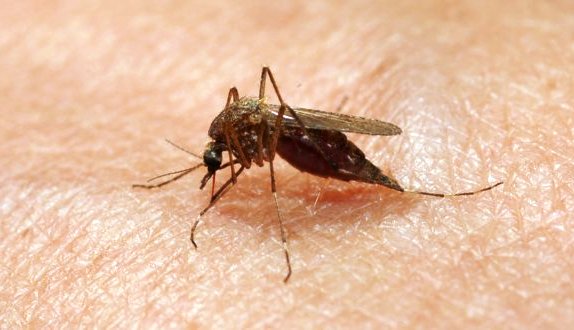
EAST LYME, CT — On Sept. 27, Ledge Light Health District (LLHD) announced that mosquitoes collected in East Lyme and from a collection station on the Waterford/New London line on Sept.14 have tested positive for West Nile Virus (WNV), and that mosquitoes collected in Ledyard on Sept. 20 have tested positive for Eastern Equine Encephalitis (EEE).
Previously LLHD announced that mosquitoes collected in Stonington on Sept. 11 tested positive for Eastern Equine Encephalitis (EEE) and West Nile Virus (WNV), and that mosquitoes collected in Ledyard on Sept. 13 tested positive for West Nile Virus.
In all these Stonington and Ledyard cases, the positive mosquito was culiseta melanura, which is known to primarily bite birds but has been known to bite mammals.
Also, LLHD announced that mosquitoes collected in Lyme, Conn. on Sept. 6 tested positive for West Nile Virus (WNV). The positive mosquito was culex restuans, which is known to bite birds and mammals.
Previously this summer, mosquitoes from North Stonington (8/21) and Waterford (8/23) tested positive for WNV.
Positive EEE and WNV mosquitoes are normally expected during the summer months, and their presence serves as a reminder for residents to take standard precautions to avoid being bitten by mosquitoes. Precautions to avoid mosquito bites:
Minimize time outdoors at dusk and dawn.
Be sure door and window screens are tight fitting and in good repair.
While outdoors, wear shoes, socks, long pants, and long-sleeved shirts. Clothing material should be tightly woven.
Use mosquito netting when sleeping outdoors.
Consider using mosquito repellent when it is necessary to be outdoors and always use it according to label instructions. The most effective repellents contain DEET or Picaridin. Oil of lemon eucalyptus is also effective for brief periods of exposure.
When using DEET, use the lowest concentration effective for the time spent outdoors (for example, 6% lasts approximately 2 hours and 20% for 4 hours) and wash treated skin when returning indoors. Do not apply under clothing, to wounds or irritated skin, the hands of children, or to infants less than 2 months.
Measures to reduce mosquitoes around the home:
Dispose of water-holding containers, such as ceramic pots, used tires, and tire swings.
Drill holes in the bottom of containers such as those used for recycling.
Clean clogged roof gutters.
Turn over objects that may trap water when not in use such as wading pools and wheelbarrows.
Change water in bird baths on a weekly basis.
Clean and chlorinate swimming pools, and cover pools when not in use.
Use landscaping to eliminate areas where water can collect on your property.
Additional resources for information on West Nile virus and mosquito management can be found at this link.
If you need assistance or advice treating standing water on your property, a member of LLHD’s Environmental Health staff can help. An Environmental Technician will visit your property and provide education on how to prevent and eliminate mosquitoes. Contact Patti Myers at (860) 434-1605 ext. 214 for more information.
Editor’s Note: This article is based on press releases issued by Ledge Light Health District on various dates in September.
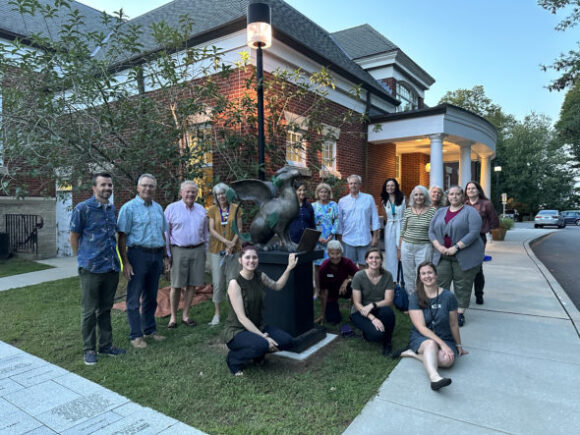
The Old Lyme Phoebe Griffin Noyes Library Board of Trustees and staff gathered to celebrate the Library’s 125th Anniversary with the unveiling of a bronze sculpture of a book-reading griffin on the library’s front lawn.
OLD LYME — On Sept. 12, the Old Lyme Phoebe Griffin (PGN) Noyes Library Board of Trustees and staff gathered to celebrate the Library’s 125th Anniversary with the unveiling of a bronze statue of a griffin, a mythical half-eagle, half-lion creature. The almost 200-pound bronze statue, created by sculptor Michael McLaughlin, stands by the library’s entrance with an open book at its paws.
“While it is great fun to have such a wonderful sculpture right by our door,” explains Library Director Katie Huffman, continuing, “We are most excited by how it will help our library better connect with children, and further advance the library’s mission.”
According to Julie Bartley, the PGN’s Children’s Librarian, the library has long recognized that to inspire lifelong learning, it has to reach children at an early age … which is basically the same intent as the library’s many youth programs. The Library’s griffin is intended to contribute to that effort.
“While the griffin has often been portrayed as a fierce, magical creature,” Huffman notes, she adds, “We hope our griffin is slightly softer and more accessible than most.”
She points out, “It is still a griffin, with a nod to the merits of its determined, insatiable curiosity, but we hope visitors will find her friendly and inviting, and that even the youngest visitor will be inspired to give her a pat.”
Sculptor McLaughlin resides in northwestern Connecticut. He received his foundation in classical art while studying at the Lyme Academy of Fine Arts. Upon completing his studies at the Academy, Michael went on to participate in an “old school” style apprenticeship in the studio of sculptor, Juan Andreu.
Andreu later inspired McLaughlin to travel to Thailand, Korea and Japan to continue his course of study further.
McLaughlin is the recipient of numerous awards and has won commissions from municipalities, galleries and private collectors from across the country.
Established in 1897, the Phoebe Griffin Noyes Library exists to inspire lifelong learning and discovery in a welcoming place with exceptional resources programs and services. As a 501(c)3 association library, it receives support from town and state funding, and also relies on private donations.
The Library’s griffin was made possible thanks to private financial support from the Library’s Board of Trustees and others.
Saint-Émilion is a small village perched on the hills overlooking the Dordogne river about 28 miles east of Bordeaux It is surrounded by some of the most prestigious vineyards in the world and in 1999, the “cultural village”of St. Emilion was added to the list of UNESCO World Heritage sites.
In winter, the population of Saint-Émilion is not more than 200 but in summer the place turns into one of the tourist hot spots of France. Crowds start showing up early in the morning and people fill the café terraces, climb the steep and narrow streets, and look at the small shops selling cannelets and macarons. Unwelcome cars, bumper to bumper, search desperately for a parking place.
The town has over 1.3. million visitors a year.
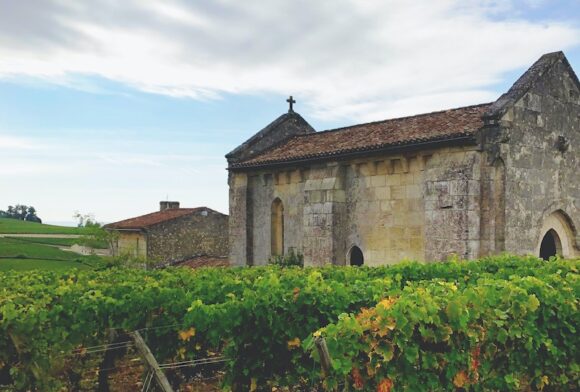
A view of Saint-Émilion. Photo by Sigmund on Unsplash.
A family friend, now an enthusiastic guide, led us through the long history of the village with a series of colorful anecdotes. The first traces of human occupation in Saint-Émilion date back 35,000 years. We plunged into the past with our guide, who showed us the catacombs and some of the 200-km long tunnels, which turn the hill into something resembling a Gruyère cheese .
Saint-Émilion acquired its name from brother Aemilianus or Emilion — a monk who arrived from Brittany in the 8th century AD. He was a master in the art of making bread. In doing so he earned money, which was stolen by other monks, according to our guide. He then became a hermit and lived in a cave. He is remembered for accomplishing several miracles.
Word of these miracles attracted other monks and pilgrims on their way to Santiago de Compostela in Spain. Vestiges from the 8th to the 12th century are still visible underground, including wall paintings, wall carvings, altars and medieval chapels. The most striking is the “Monolith church” built in the early 12th century. Its gigantic 12-meter-high arch is made of a single block of stone. The best residences of Bordeaux are built out of the limestone found in the Saint-Émilion quarry.
In 1152 Eleanor of Aquitaine married Henri II Plantagenet. Two years later Henry became king of England and the region fell under British rule, where it remained for three centuries.This perhaps explains why the British still feel very much at home in this area.
The “One Hundred Year War” ended when the English army was defeated by the French at battle of Castillion in 1453.
In 1199, the youngest son of Eleanor, John Lackland, sealed the “Charter of Falaise” (Falaise is a town in Normandy) conferring rights to the Jurade – an association that is unique in the world. The Jurats of Saint-Émilion controlled all civic, legal and administrative affairs of the city. In the 15th century, the French kings reaffirmed those rights. The association was dissolved during the French Revolution.
Today the Jurade association exists again. Its 140 Jurats members wear the medieval scarlet robes during their annual celebration the third week in June. Quite a spectacle to watch on the top of the ruin of the Tour du Roy – the only intact Roman donjon (the great tower or innermost keep of a castle) remaining in the GirondeDépartement.
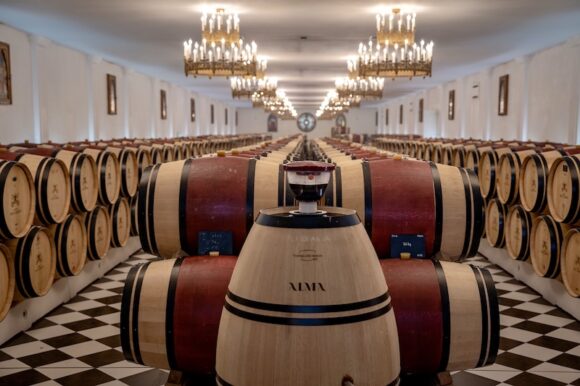
Barrels of Saint-Émilion wine are left to age in cool cellars. Photo by Brian Ashley Harris, www.brian-ashley.com.
The art of wine-making started as far back as 6,000 BC. In the Saint-Émilion area, the first wine amphora date from 56BC. The culture of wine intensified after the spread of Christianity in the 5th century AD. Archaeological excavations are ongoing in the Gallo-Roman villa du Pilat. Beautiful mosaics reveal the great wealth of that villa, which is probably related to the production of wine.
Wine-growing is a multimillion industry. It is highly regulated and fiercely competitive. It is also a vulnerable industry.
In the 1870s, a pest insect called phylloxera devastated French vineyards. It took them 30 years to recover by grafting resistant American rootstocks. Today close to up one third of the Bordeaux wine is again threatened by a double crisis, over-production and the vagaries of climate changes. A “sanitary plan” consisting of pulling vines, started in June 2023.
I obtained lots of information about Saint-Émilion while talking to a young student pursuing her university studies in Bordeaux in tourism, culinary art and oenology.
How are the Saint-Émilion wines ranked? At the 1855 Exposition Universelle held in Paris, Napoleon III, appointed a commission to rank the Bordeaux wines. That ranking has remained frozen since then for the Bordeaux wines, but only on the left bank of the Garonne River (Medoc and Graves.)
But since 1955 the ranking of the Saint-Émilion wines can be revised every 10 years. In 2022, the latest selection retained only two Premiers Grands Crus classés A:Chateau Pavie and Chateau Figeac, 12 “Premiers Grands Crus Classés B, and 72 “Grands Crus Classés. The expression “grand cru” can. be translated “first growth” in English.
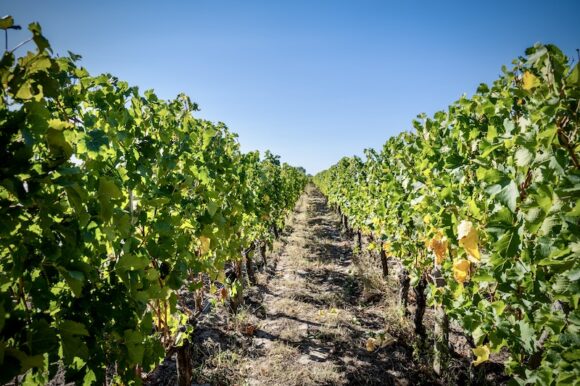
Looking down the neat rows of vines in a Saint-Émilion vineyard. Photo by Brian Ashley Harris, www.brian-ashley.com.
Saint-Émilion vineyards cover 5,400 hectares (out of 115,000 for the entire Bordelais region.) One hectare (or Ha) is the equivalent of three acres. Most of the plots in Saint-Émilion are small at 20 Ha or less.
In fact, keeping down the size helps make the wine rare and therefore more expensive.
The gaps between rows of vines are one meter or less to force the work to be done manually and not by machine.
To keep production as low as possible, the workers may even trim bunch of grapes if they are not in exact alignment. The lifespan of a wine can reach 65 years, but on our country road, I saw plots planted with brand new vines.
We approached Saint-Émilion from the main Bergerac–Libourne road in the lower plain on the right bank of the Dordogne river. A 68-meter high church steeple dominates a skyline of houses nestled among ruins of cloisters and medieval fortifications. It felt as if the winding road was taking us to the Holy Grail. On each side, we could see manicured rows of vines. Here land is worth gold and one hectare (about three acres) can be worth seven million Euros.
On top of the ridge, we notice an elegant house with a turret. Unfolding down the hill are impeccable rows of vines and low sustaining walls. This if the Chateau Belair-Monange, the residence of the Moueix family. They have been wine growers for three generations, as well as “négociants” (wine merchants) doing business in France and also the Napa valley. Their wine is “only” Premier Grand Cru Classé.”
What makes the Moueix family different from other producers is that they keep buying plots and now own 10 vineyards. In the 1960s, Jean Pierre, the head of the dynasty, made the brilliant move of buying Chateau Petrus located in Pomerol, an area adjacent to Saint-Émilion in the west.
To the surprise of everybody, the family sold 20 percent of the Petrus vineyard to a Colombian-American businessman in 2018.
Edouard Moueix, born in 1977, heads wine production today. His wife, Kelley, is American and runs a store in the village that sells bags and other luxury items.
Chateau Angelus is big in Saint-Émilion. In fact, very big.
Its offices, chais (local term for storerooms), shops and showrooms are quite conspicuous in the area. On the hill, the imposing main building where clients come to taste the wines has a beautiful roof. When foreign guests enter the building, the bells in the belfry above the entrance door will play the music of their country. The 85-Ha. vineyard is situated in a natural amphitheater near the center of town — a priceless location.
Until last year it ranked in the highest category of St Emilion wines but was excluded in 2022 and lost its “A”. The owner – Hubert Boüard de la Foresti – is the last of eight generations since 1785.
The reason for this earth-shaking development is that M. Bouard de la Foresti violated his responsibilities as head of the Confrérie du Grand Conseil du vin de Bordeaux where he served three years. He was convicted of fraud.
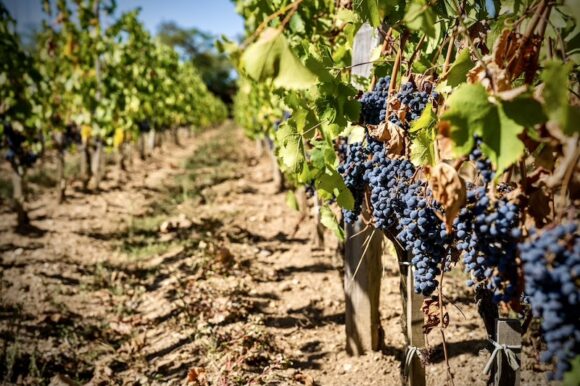
The vines are loaded with grapes prior to the ‘vendage’ when the grapes are harvested. Photo by Brian Ashley Harris, www.brian-ashley.com.
Although located not in Saint-Émilion proper but nearby in the west in the Pomerol region, Chateau Petrus is well worth mentioning. Its path to celebrity is different from the others since it received remarkable publicity through some really high-profile events.
Queen Elizabeth II chose Chateau Petrus to be served at her marriage in 1947.
John F. Kennedy offered Chateau Petrus as a gift to Jackie.
James Bond was served the Chateau Petrus in one of his films.
The acreage is quite small:- only 11 Ha.but a bottle can reach 2,300 to 5,000 Euros — and as much as 10,000 Euros — at auction.
Bernard Arnault, the richest man in France (LVMH), until 2022 owned a small plot in Saint-Émilion producing Cheval Blanc, Grand Cru Classé Catégorie A, until 2022. A 1947 bottle sells for $770.
The culture of wine in Saint-Émilion is strictly regulated. Fertilizers are not permitted, composts are but not more than every three to four years, since the earth does not need many nutrients. Watering is only allowed at times of drought.
Besides the wine growers must abide by the European Union blueprint to generate a sustainable production by respecting the environment. The label “AOC” or Appelation d’ Origine Controlée is granted to protect the production of a defined area – the terroir – using traditional know-how specific to the geographical area.
Do not miss a chance, next time you are in Saint-Émilion to do some wine-tasting by tilting the glass to see the color, twirl the glass to bring out the flavor and/or smell the wine to detect its alcohol content, aroma or acidity. You can taste the wine in one of the many wine caves àvins (wine cellars) in the village.
One can also visit estates such as the elegant Chateau Soutard — their wine-tasting package costs $800 for a group of four. A votre santé!
Editor’s Note:This is the opinion of Nicole Prévost Logan.
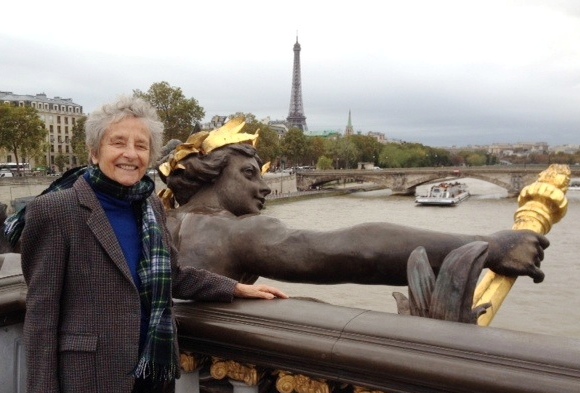
Nicole Prévost Logan
About the author: Nicole Prévost Logan divides her time between Essex and Paris, spending summers in the former and winters in the latter. She writes an occasional column for us from her Paris home where her topics will include politics, economy, social unrest — mostly in France — but also in other European countries. She also covers a variety of art exhibits and the performing arts in Europe. Logan is the author of ‘Forever on the Road: A Franco-American Family’s Thirty Years in the Foreign Service,’ an autobiography of her life as the wife of an overseas diplomat, who lived in 10 foreign countries on three continents. Her experiences during her foreign service life included being in Lebanon when civil war erupted, excavating a medieval city in Moscow and spending a week under house arrest in Guinea.