A View From My Porch: The Beach Boys Redux — Surfing with Gen. Alpha

Tom Gotowka

I hypothesized in a “View” published in early August that “The Beach Boys,” whose music regularly celebrated muscle cars, the power of the internal combustion engine, and California car culture had an influence on Americans’ early reluctance to buy electric vehicles.

I did not expect to ever consider their music in another essay, or in this case, a little bit of their musical homage to the beach and surfing; but we are approaching the fall of the year and my grandson, “H”, who turned seven earlier this summer, graduated last summer with a few of his New Jersey cousins from surfing camp and returned home, schooled in, “The practices and values of the surf and ocean lifestyle.” 

My impression of his surf camp experience is that this coaching focused on technique and safety rather than the physics and science of the sport; and did not even acknowledge the robust body of music that contributed to “surfer-cool.” 

Consequently, as duty called, I present some of the science of the sport in this essay, and like the essay on electric vehicles, refer, but only briefly, to the surfing song list published by “The Beach Boys.” 

This essay is also presented as something light as we enter Old Lyme’s campaign season 2023.

Generation Alpha:

“Gen. Alpha,” is the cohort born between the early-2010s and the mid-2020s.They are the most globally-connected generation of children ever and could also end up being the most formally educated. They are the children of millennials and the immediate successors of the “Zoomers” of “Gen. Z,” and are the first generation to be born entirely within the 21st century. 

COVID-19 had a substantial impact on their childhood and acclaimed social demographer and futurist, Mark McCrindle, who coined the term Generation Alpha, defines and analyzes the generations in this article. He notes, “Generation Alpha will be the largest generation than ever before. Each week there are over 2.7 million Gen Alphas born. They will live for longer and are more culturally diverse compared to their older counterparts.”

All of Christina’s and my grandchildren are Alphas. “H” was born in mid-2016, a remarkable year; which I illustrate below:

  • The Denver Broncos defeated the Carolina Panthers, 24 to 10 in Super Bowl 50 on Feb.7; and a month later, Denver QB, Peyton Manning retired after 18 seasons in the NFL.
  • “Spotlight”, a very troubling “docudrama” that dramatized the “Boston Globe’s year-long Pulitzer Prize-winning investigation of the Catholic Archdiocese of Boston, won two Academy Awards on Feb. 28:– “Best Picture” and “Best Original Screenplay”.
  • That same evening, Leonardo DiCaprio won his first Academy Award, “Best Actor”, for his role as a frontiersman mauled by a bear in “The Revenant.”
  • President Obama and his family visited Cuba in March — the first visit by a sitting POTUS since Calvin Coolidge in 1928. His visit included talks with Cuba’s leader, Raul Castro, the Cuban people, some dissidents; and served as a symbolic capstone on more than a year’s effort to normalize economic and diplomatic relations between the United States and Cuba, after more than 50 years of Cold War hostility. Notably, the Obamas and the Castros attended a baseball game together at Havana’s 55,000 seat “Estadio Latinoamericano” between the Cuban National Team and the Tampa Bay Rays, marking the first visit to the island by a Major League Baseball team since 1999. Note, Rays, 4 to1.
  • The Atlantic hurricane season, which began on June 1, was the deadliest hurricane season since 2008, and the first above-average hurricane season since 2012.
  • On June 19, the Cleveland Cavaliers won the NBA Championship by defeating the Golden State Warriors — their city’s first professional sports championship in more than 50 years. 
  • Unlike the Academy Awards, a fantasy-based drama, “Game of Thrones,” won 12 Emmys on Sept. 18, the year’s top winner. 
  • On Nov. 2, the Chicago Cubs won their first World Series since 1908, snapping the “Billy Goat Curse,” one of the more infamous curses in sports, and baseball’s longest World Series title drought; surpassing Boston’s own “Curse of the Bambino” by almost a quarter-century. 
  • On Dec 10, Army finally beat Navy 21 to17 in double overtime; after blocking a Navy field goal with essentially no time left in the game — the first win over Navy since 2001. Army’s 14-game losing streak was the longest by either academy in a series that began in 1890.

Clearly, I have no idea whether surfing will be a long-term interest for “H,” and if so, whether his family will support his quest for the perfect wave. Nevertheless, here is some of the science that impacts the sport.

He is, however, an early and eager reader, and also a fan of the “View; and so, this essay might provide the basis for some, “What I did on my summer vacation” presentations, or a paragraph or two as he moves beyond first grade. 

Making Waves:
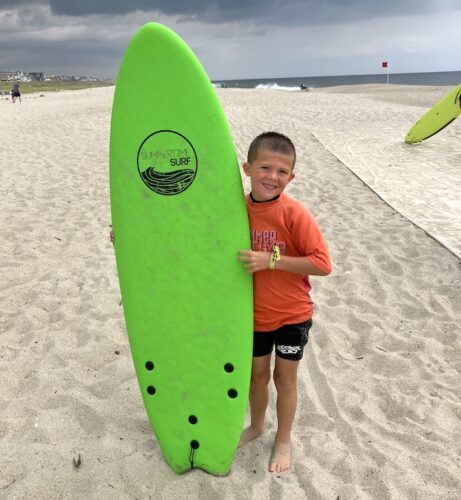
The author’s grandson, ‘H’, holds his board after another successful day at Surf Camp.

Waves form when the wind blows across the surface of the ocean, transferring energy through friction. Several factors affect the size and shape of waves. These include wind speed, wind duration, fetch (i.e., the distance over which the wind blows), water depth, and shoreline shape.

Generally, waves on the West Coast of the United States are bigger than those on the East Coast. The prevailing winds on the West Coast are behind the waves, which increases the waves’ energy; while on the East Coast, the prevailing winds usually blow against the incoming waves, decreasing the waves’ energy.

Further, the Pacific Ocean has a greater expanse than the Atlantic Ocean, which means that the fetch is greater on the West Coast.

Applied Physics:

Surfing is a good example of how several forces act together to enable a ride on the waves. I am going to discuss a few: gravity, buoyancy, and inertia; and consider the “center of gravity” (COG).

The forces of gravity and buoyancy work against each other. Gravity pulls the surfboard down, while buoyancy pushes it up. “H” will eventually understand that the latter force is referred to as “Archimedes’ Principle,” which states, in simple terms, that, “A body at rest that is completely or partially submerged in a fluid is acted upon by an upward, or buoyant, force.”

Because the materials used in contemporary surfboards are much lighter and less dense than the materials used in the past, the boards are more buoyant.

The early surfboards on the California beaches were essentially long redwood planks, sanded smooth; which absorbed water and became very heavy, even with the best protective finishes available at the time. These boards ranged from 10 to 20 ft. long and were not maneuverable, versus the modern boards that are much shorter and “steerable”.

An understanding of the COG is also important. Conceptually, the COG is the point around which the body’s weight is evenly distributed or balanced in all directions. The COG affects the stability of objects. The lower the COG, the more stable the object. The higher it is, the more likely the object is to topple over if it is pushed. 

Beyond surfing, the COG is also important in designing buildings and bridges; aircraft, race cars, and Humvees. (Note to “H”: It is also why you do not stand up in your dinghy and why you keep low when mountain biking.)

In practice, managing the COG is one of the most important skills a surfer can master. For example, to remain balanced, surfers crouch, keeping their center of gravity low. Surfers can also change their position on the board. If a surfer stands in the middle of the board where buoyancy and weight are balanced, the board will be flat. If the surfer moves back, the nose of the board will go up, making it much easier to turn in the water compared to the long wooden boards described above.  

This difference is due to the physical principle known as inertia, which describes how difficult it is to change something’s motion once it has started moving. Of course, “H” will eventually know it as “Newton’s First Law,” which states that an object at rest remains at rest, and an object in motion remains in motion at constant speed and in a straight line unless acted on by an external force.

Although long boards may not be as nimble as short boards, they reach higher speeds, mainly because their larger surface provides more area for water to push the surfer along. 

Connecticut Surf:

According to the “experts”, Long Island Sound has only modest fetch, so epic waves are hard to come by, but the following beaches are worth checking out:

  • The prime surfing season in Connecticut is typically from late summer through fall when hurricanes and tropical storms can generate larger swells.
  • Rocky Neck State Park has a sandy beach with a mix of sandbars and rocky sections that can create some challenging waves. 
  • Hammonasset Beach is good for longboarding and beginner surfers.
  • Fairfield Beach offers a consistent break with hollow waves that can be quite powerful during the right conditions. 

However, if you want an ocean experience that is close by, there are a few places in Rhode Island worth considering: 

  • Misquamicut Beach has reliable,  consistent, and beginner-friendly” surf. Like Connecticut, the best time of year to surf Misquamicut is Spring and often, the month of September; when you’ll get rideable swells and light offshore winds.
  • East Beach in Charlestown also has consistent waves, and can be challenging.

If a surfer’s search takes him or her beyond New England, The Beach Boys also chronicled a possible surfers’ travel program, identifying sites with “cooking” surf on three continents, Hawaii, and the Caribbean in two songs from the early-1960s, whose abridged lyrics follow below:

Let’s go surfing now, everybody’s learning how;
Come on a safari with me.
At Huntington and Malibu they’re shooting the pier;

At Rincon they’re walking the nose.
We’re going on safari to the islands this year, so if you’re coming, get ready to go.

They’re angling in Laguna in Cerro Azul;
they’re kicking out in Doheny, too.
Surfing’s mighty wild, getting bigger every day,
from Hawaii to the shores of Peru

And further:

You’ll catch them surfing’ at Del Mar,
Ventura county line,
Santa Cruz and Trestle,
Australia’s Narrabeen.
All over Manhattan
And down Doheny way,  

Haggerties and Swamies
Pacific Palisades.
San Onofre and Sunset,
Redondo Beach, L.A.
All over La Jolla; 
At Waimea Bay.

The Perils of Surfing:

In 1866, Mark Twain spent a few months in the Sandwich Islands (i.e., Hawaii) as a correspondent for “The Sacramento Union” newspaper. He reported on his own attempts at surfing: “I got the board placed right, and at the right moment, too; but missed the connection myself. The board struck the shore in three-quarters of a second… and I struck the bottom about the same time, with a couple of barrels of water in me.”
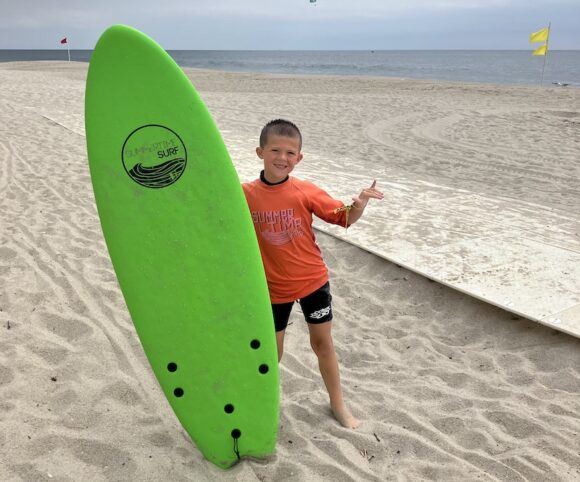
‘H’ gives the Shaka sign with his left hand. It is a friendly hand gesture usually associated with the surfing culture.

Author’s Thoughts:

Should you meet “H” on the beach, he may greet you with the Shaka sign, which is a friendly hand gesture usually associated with the surfing culture.  He’ll extend the thumb and pinky finger of his hand while holding the three middle fingers curled, Depending on the context, the gesture can mean ”hang loose”, “chill out,” or just hello. ” You might also warrant a “Cowabunga, Dude!”, which is an expression of amazement or enthusiasm. Remember, he turned seven a few months ago.

I anticipate that my next “View” will be about children’s books.

Editor’s Note: This is the opinion of Thomas D. Gotowka.

About the Author: Tom Gotowka is a resident of Old Lyme, whose entire adult career has been in healthcare. He will sit on the Navy side at the Army/Navy football game. He always sit on the crimson side at any Harvard/Yale contest. He enjoys reading historic speeches and considers himself a scholar of the period from FDR through JFK. A child of AM Radio, he probably knows the lyrics of every rock and roll or folk song published since 1960. He hopes these experiences give readers a sense of what he believes “qualify” him to write this column.

Author’s Sources:

Carter, Christine M. “The Complete Guide To Generation Alpha, The Children Of Millennials”. Forbes.08/18/2019.
Francis, J.F. “The Ultimate Guide to Surfing in Connecticut.” Surf Atlas. 12/04/2021.
Hall, D. “Currents, Waves, and Tides”. Smithsonian Ocean. 08/2020.
Kesten, P. “The Physics of Surfing.” Santa Clara University. Illuminate.08/19/2019.
Klein, C. “What Was the Curse of the Bambino—and How Was Baseball’s Greatest Hex Broken”? History. 09/30/2021.
Larson, S. “Spotlight and its Revelations.” The New Yorker. 12/08/2015. 
McCrindle, M. and Fell, A. (2023). ”Generation Alpha”. Sydney: Hachette Book Group. 2021. 
Sanchez, R. “What is the Chicago Cubs’ billy goat curse”? CNN. 10/28/2016
Spotlight Team. “Church Allowed Abuse by Priest for Years. The Boston Globe. 01/06/2002.
Trinastic, J. “Waves of Physics: The Science of surfing”. Science Connected. 05/11/2021
Twain, M. “Roughing it”. The American Publishing Company. 1872.

Song List:

Surfing Safari (The Beach Boys, 1962)
Surfing U.S.A. (The Beach Boys, 1963)

Old Lyme Rowing/Blood Street Sculls Members Qualify for 2024 Paris Olympics at World Rowing Championships

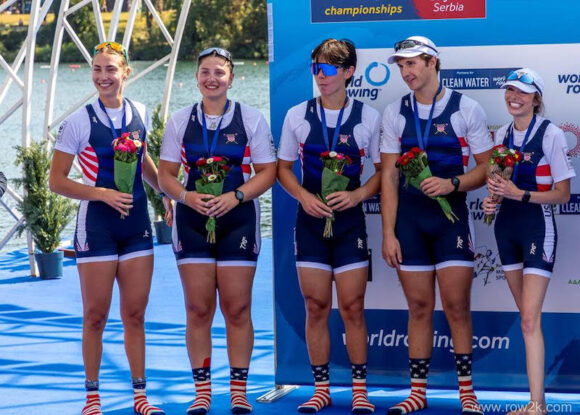
Liam Corrigan (second from right), who was a member of the Lyme-Old Lyme High School Class of 2015, stroked the Men’s Four to a silver medal in the recent 2023 World Rowing Championships in Serbia.That position qualifies the boat for the 2024 Paris Olympics. Blood Streets Sculls Masters Rower Nobuhisa Ishizuka, right in photo, is President of US Rowing and was head of the US delegation at the Championships. All photos are by www.row2K.com and published with their permission.

BELGRADE, SERBIA — Numerous Old Lyme Rowing Association / Blood Street Sculls members represented the United States in the 2023 World Rowing Championships held Sept. 3-10 in Belgrade, Serbia.

Liam Corrigan, who graduated from Lyme-Old Lyme High School (LOLHS) in 2015, stroked the Men’s Four to a silver medal, qualifying the boat for the Paris Olympics in 2024.

After graduating from LOLHS, Corrigan attended Harvard University, where he was ultimately captain of the rowing team. He subsequently moved to California, where he continues his rowing career with the California Rowing Club. Corrigan’s parents, Brian Corrigan and Joan Rivington, live in Lyme having moved there in 2020 from Old Lyme, where they had lived for many years.

The 2021 Tokyo Olympics saw Corrigan along with Old Lyme native and 2010 LOLHS graduate Austin Hack row in the US Men’s Eight boat, which ultimately just missed out on a medal coming in a photo-finish fourth in the final.

This year’s World Championships also acted as the first qualifying event for countries for the 2024 Paris Olympics. In total, the U.S. won seven medals and qualified 10 boats for Paris (eight Olympic and two Paralympic) over the eight-day regatta.

The U.S. finished fourth in total medals.

The U.S. won silver in the women’s eight, PR3 mixed double sculls, PR3 mixed four with coxswain, lightweight women’s double sculls, and men’s four, as well as bronze in the women’s double sculls and lightweight women’s single sculls. PR3 is a one of three classes of para-rowing in which the athletes have physical impairments, visual impairment and/or intellectual disabilities. The PR3 sport class is for rowers, who have the use of their legs, trunk and arms and can use the sliding seat. 

The U.S. qualified the women’s single sculls, women’s double sculls, lightweight women’s double sculls, women’s pair, men’s pair, men’s four, women’s four, and women’s eight for the Paris 2024 Olympic Games, as well as the PR3 mixed double sculls and the PR3 mixed four with coxswain for the Paris 2024 Paralympic Games.

Former Blood Street Sculls member Ben Washburne of Madison, CT (second from right in photo) won silver in the PR3 Mixed Coxed Four , thus qualifying for the 2024 Paris Olympics.

Ben Washburne of Madison, Conn., and former Blood Street Sculls member (second from right in photo) also won silver in the PR3 Mixed Coxed Four qualifying for Paris.

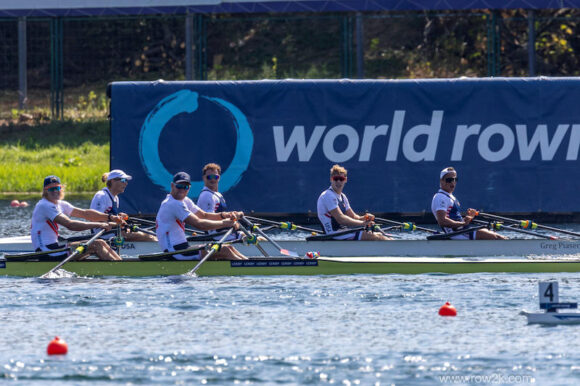
Another former Blood Street Sculls rower Dominique Williams, also of Madison, Conn., and his crew finished 9th in the Men’s Quadruple Sculls and will have a chance to qualify next spring at the final Olympic qualification regatta in Lucerne, Switzerland. Williams’s US boat is pictured at right in photo below.

Another former Blood Street Sculls member, Dominique Williams of Madison, Conn., and his crew finished 9th in the Men’s Quadruple Sculls. They will have a chance to qualify next spring in Lucerne, Switzerland, for the 2024 Paris Olympics.

Blood Street Sculls was also represented in the 2023 World Rowing Championships by Nobuhisa Ishizuka, who lives in Madison, Conn., and is a Blood Streets Sculls Masters Rower.

Ishizuka joined the US Rowing Board of Directors in 2018 and serves as President of US Rowing. He was in attendance at the 2023 World Rowing Championships as the head of the US delegation.

Death Announced of Jeannine T. (St. George) LaMothe, 92, Mother of Charles Lamothe Jr. of Old Lyme

GROTON — Jeannine T. (St. George) LaMothe, 92, of Poquonnock Road passed peacefully at Lawrence + Memorial Hospital Saturday, Sept. 2, 2023, surrounded by her loving family …

Jeannine was a dedicated and proud mother, grandmother and great-grandmother who is survived by four children: Charlene Lassinger (Gary) of Groton, George Lamothe (Andi) of Summerfield, Fla., Charles Lamothe Jr. (Trish) of Old Lyme, and Robert Lamothe (Amy) of East Lyme; nine grandchildren: … and 11 great-grandchildren, …

Jeannine was best known for her incredible talent as a powerful singer and gifted organist, having followed her passion for performing since childhood …

Her family invites you to Celebrate a Life well lived in a Mass of Christian burial at 10 a.m. Saturday, Sept. 23, in Sacred Heart Church, 56 Sacred Heart Dr., Groton. Burial will be private …

Visit this link to read the full obituary published by The Day on Sep. 17, 2023.

Lyme-Old Lyme’s Food Share Garden is One of Three Locally to Receive United Way Award for Innovation 

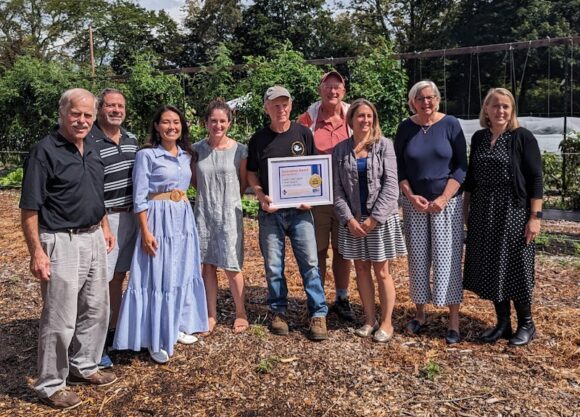
Lyme-Old Lyme Food Share Garden (LOLFSG) founder Jim Ward holds the Innovation Award certificate in the center of this group of LOLFSG volunteers and United Way representatives. From left to right are Old Lyme First Selectman Tim Griswold, LOLFSG Board Members Jack Larocca, Mylan Sarner, Amy Mastrangelo, Ward, and Peter Hunt; continuing left to right, SECT United Way Vice President Gemma Moran United Way stands next to Old Lyme Selectwoman Martha Shoemaker, who is alongside Jill Rusk, also of United Way. Photo submitted by LOLFSG.

LYME/OLD LYME — As part of United Way of Southeastern Connecticut’s annual Engagement Awards program, the Lyme-Old Lyme Food Share Garden is one of three giving gardens in New London County, which have been honored for innovation. 

The other two gardens honored are the Craig Floyd Giving Garden at Coogan Farm, Denison Pequotsepos Nature Center, and the East Lyme Giving Garden.

An awards presentation was made on Sept. 13, at the East Lyme Giving Garden, 4 Church Ln., East Lyme for the partners to coincide with Hunger Action Month, occurring annually in September. 

After receiving the award, LOLFSG founder and board chair Jim Ward commented exclusively to LymeLine.com, “The Innovation Award from United Way of New London reflects the dedication of the residents and businesses of Lyme and Old Lyme.” He added, “The success of the garden is a testament to our dedicated volunteers and the generous financial support from the communities.”

Last year, the giving gardens provided more than 37,000 pounds of fresh produce to the Gemma E. Moran United Way/Labor Food Center (Food Center), marking a 65 per cent increase over the previous growing season. The Innovation Award is being presented to them for this increase, in addition to tailoring their produce based on a guest survey regarding which food items are most requested and needed. 

September is Hunger Action Month to help increase awareness of hunger and hunger-related issues. Currently the food insecurity rate in New London County is nearly 11 percent overall and 12.3 percent in children. 

It is often difficult and expensive for families struggling to make ends meet to afford fresh food items. They may also have limited access to food. The giving gardens provide nutritious, healthy items for families to which they may not otherwise have access. 

Volunteers at all three gardens are actively involved in planting, weeding, harvesting, and washing the vegetables prior to being picked up for delivery to the Food Center. 

Volunteers at the Food Center’s warehouse in New London package the produce, whence it is then either distributed to member agencies or through the Mobile Food Pantry program. 

Representatives from each garden meet regularly to discuss best practices and techniques, and to give feedback to United Way. They also work to vary the items each one grows for a more diverse selection and based on survey results. 

Editor’s Note: This article is based on a press release issued by the Lyme-Old Lyme Food Share Garden.

Letter From Paris: Let the Games Begin … in Paris … in 2024!

Nicole Prévost Logan

The countdown has started for the Summer Olympic Games 2024 (or J.O. [Jeux Olympiques] 2024 as the French say) and the excitement is growing. The dates are July 26 through Aug. 11, and Aug. 28 through Sept. 8 for the Special Olympics . Paris will be the host of the events.

The interface of an historical city like Paris with venues for sporting events should be magical while also being a challenge.  Imagine watching beach volley ball under the Tour Eiffel or breakdancing on the Place de la Concorde !

Photo by Luca Dugaro on Unsplash.

The J.O. 2024 mark the centenary of 1924 inauguration of the first modern Olympic games. It will be the sixth time for France to host the event, and also represents the  largest event ever organized in the country. There will be total parity between men and women athletes – a first in the history of the games.   

On Aug.  26, 2023, a disappointing announcement was made: because of a series of spring downpours, the sewers overflowed and ran into the Seine, which was declared too polluted to serve as a venue for water sports. The preparatory work for the competition on the Alexander III bridge had to be dismantled. 

In order to prevent the recurrent surge of polluting water into the Seine after storms, a gigantic project has been undertaken.  Between the Gare d’Austerlitz and the Hopital Salpêtrière east of the city, several blocks of apartment buildings were razed to make room for a “bassin de rétention”  50 meters in diameter. At the bottom of a 30 meter-deep well a massive “tunnnelier” machine will dig a tunnel under the Seine for huge pipes to be laid.   Other bassins will be constructed upstream east of Paris.

In a way the scheduling of the games in 2024 is helping to speed up this huge project of assainissement (sanitation).  Some day soon, maybe one will be able to swim in the Seine!

Logistics will be a major headache for the games officials, mostly to organize transport. Flying taxis will turn the skies of summer 2024 into a science-fiction scene of the future. A 10-minute flight from Charles DeGaulle airport can certainly beat a two-hour long ride by public transport.

Additional buses and trams will compensate for the closure of many metro and bus stops in central Paris and on the Périph (Beltway), a special lane will be reserved for athletes and games officials. 

The fully automated subway ligne 14 will be extended to include Orly airport and a new métro station will open near the Stade de France.

In order to assist in welcoming at least 13 million visitors, 40,000 volunteers positions were offered and filled up immediately.   

Security will be a top priority , particularly during the opening ceremony which will be watched by 600,000 spectators. All of them are obliged to have a ticket, including the 400,000, holding free tickets. 

Photo by Sebastien Gabriel on Unsplash.

Order will be maintained by 35,000 police. According to Gerald Darmanin, Minister of the Interior, the scope of the security plan is unprecedented, since it will cover six kilometers along the banks of the Seine when a parade of 115 boats will end up at the Trocadéro and the foot of the Tour Eiffel

A security perimeter will be installed around the city against any possible acts of terrorism. More than 4,000 video-surveillance cameras will function with “smart” AI algorithms to protect private data.

Anti-drones will be there also. During the Tokyo games, 400 million cyberattacks were detected. In Paris, the organizers will be ready for such a possibility. 

How expensive will the tickets be?  It is hard to give the exact prices since they depend on the competition. Just to give an idea, the most expensive seat at the opening ceremony will cost 2,700 Euros and the cheapest 90. 

At the closing ceremony, the respective prices are 1,600 and 45 Euros. 

Two of the most expensive competitions to watch will be Athletics at 900 Euros and swimming at 690 Euros. At the other end of the price range, tickets to watch the marathon or the urban games on Place de la Concorde will be either quite low or even free. In spite of the fact that many tickets have been made available for free,  people complain that prices are much too high. 

Given the politically-poisoned environment existing at present in France, it is hoped that the social unrest in the streets will not flare up again and add to the huge logistics problems of managing millions of spectators. As expected, criticisms of Paris 2024 abound centered primarily on protests against the entrance tickets being so expensive that the average person cannot afford them.

In fact, most Parisians will probably want to flee the capital during the games. Hotel rooms and AirBnB apartments will be offered at exorbitant prices. 

Most of the infrastructure to accommodate the Olympic sporting events already exists. The Aquatics Center for swimming and diving competitions is an exception. 

Close to 95 percent of the financing comes from the private sector. Private investors will bear the cost – estimated at 1.3 billion Euros – of the Olympic village. This is where the 10,500 athletes will stay in the Saint Dénis area, north-west of Paris. Architects have designed the temporary lodgings to be easily transformed into permanent apartments for low-income French residents. 

Except for the surfing competitions, which will be held in Tahiti, 9,800  miles away from Paris  (certainly not next door!), all the sporting events will take place in 30 sites equally divided between Olympic and Special Olympics throughout France but mostly in and around Paris. 

If you enjoy sightseeing in the old city, you might be interested in knowing that some key historical sites will be turned into “Sport Arenas” for various disciplines. Examples are:-

Place de la Concorde : skateboard (first time in J.O.) ; breakdancing; BMX bicycle free style,  basketball

Les Invalides: Archery

Eiffel Tower stadium and Champ de Mars: Judo and Wrestling;  Special Olympics (wheelchair rugby) 

Rolland Garros: Tennis

Chateau de Versailles:  Equestrian events, Dressage, Horse-jumping

Hotel de Ville to Les Invalides:  a 42km-long marathon touching on many historical monuments of Paris. On the first day, 80 men will run.  On the second day, 80 women .

Pont d’Iena: a beautiful location for spectator stands

Grand Palais: Fencing, Taekwondo  (Korean martial art)

Trocadero: Start of the road cycling races, 273 km

Parc de la Villette (north of Paris) largest cultural park in Europe.

Celebration Centers during the Games to meet athletes are:

Parc des Princes: Football

Vaires sur Marne Nautical Stadium: Rowing, Canoeing/Kayaking

Marseille: Sailing

La Défense Arena, Aquatics Center: Swimming and diving

Stade de France (also called Stade Olympique):  Athletics. This is the oldest discipline, going back to 776 BC in Greece

St Quentin-en-Yvelines: cycling track

A view of Notre Dame before the devastating fire.

To top it all, President Emmanuel Macron has a vision of Notre Cathedral opening for the public with a celebration of mass to coincide with J.O. 2024.  That would indeed make these ‘The Games of the Century’!

Editor’s Note:This is the opinion of Nicole Prévost Logan.

Nicole Prévost Logan

About the author: Nicole Prévost Logan divides her time between Essex and Paris, spending summers in the former and winters in the latter. She writes an occasional column for us from her Paris home where her topics will include politics, economy, social unrest — mostly in France — but also in other European countries. She also covers a variety of art exhibits and the performing arts in Europe. Logan is the author of ‘Forever on the Road: A Franco-American Family’s Thirty Years in the Foreign Service,’ an autobiography of her life as the wife of an overseas diplomat, who lived in 10 foreign countries on three continents. Her experiences during her foreign service life included being in Lebanon when civil war erupted, excavating a medieval city in Moscow and spending a week under house arrest in Guinea.