Editor’s Notes: i) This op-ed was submitted by Eric Knapp, who is employed as the Town of Old Lyme’s Land Use Coordinator. He is writing here as a private citizen. ii) This is the opinion of Eric Knapp.
Many years ago, in my former life as an attorney, I attended a hearing before a land use agency in Canterbury. Ahead of my matter on the agenda was a proposal for a single-family house. A neighbor was strongly opposed. Her argument was stated as follows: I moved to Canterbury so that when I looked out my window, I would not have to see another house. And for years, I have not. If this is approved, I will see this house every day.
This did not turn out to be a winning argument, but it did point to something deeper. The suburban lifestyle is extraordinarily popular. A good number of people want to live on a cul-de-sac, with their own land and few neighbors.
The problem with this is that there are fixed costs, for land, utilities, driveways, drainage, not to mention basic building materials, and the incentives all point towards maximizing the return on each lot. That means that most of the new subdivisions being built out in this part of the state tend to cater to the top of the market.
As I noted in my last piece, while everyone seems to agree that the market needs more moderately priced homes, the market conditions do not favor this result. The Affordable Housing Statute, C.G.S. §8-30g, was supposed to address this, by offering greater density in exchange for “affordable” units. But this tradeoff has not been the boon it was supposed to be, and most developers in this part of the state use it as a last resort.
Along the shore, a similar dynamic plays out. The Federal Emergency Management Agency (FEMA) pressures homeowners to elevate their homes to be higher than the “flood elevation.” While many of the existing homes are modest ones on small lots, the cost of elevating them is quite high. The result is that if a property owner is willing (or financially able) to elevate a dwelling, they will usually want to maximize the size of the newly-elevated structure. It makes little financial sense to spend $100,000 to elevate a $200,000 house.
Flood-prone areas are increasingly a patchwork of expensive homes that have been elevated, and their “left behind” smaller homes that have not.
At some point, and I have no idea when, we will be hit with a Category 3 storm. When that happens, the demographics of the shore will change. FEMA will require damaged houses to be upgraded, and only those with the means to do so will be able to return.
The state government in Hartford is pushing—with increasing force—for towns to embrace “transit-oriented development.” But the residents of this part of the state stay here precisely because it does not look like the more densely populated communities. Quite literally, you could not pay a resident of Essex or Old Lyme to live in Stamford or Norwalk, or even New London. They like living in their suburbs/exurbs and are loathe to give up the comforts of their shoreline home.
A local Stew Leonard’s would be convenient but few here pine to live in Newington or Danbury. People may visit Trader Joe’s in Orange, but Rte. 1 there versus here is no comparison.
That brings us back to the “suburban dilemma” mentioned in the title. We are trying to square the lifestyle we love with the housing market we don’t. So far, the lifestyle is winning. It remains to be seen whether this will hold true going forward.
Editor’s Notes: i) This op-ed was submitted by Eric Knapp, who is employed as the Town of Old Lyme’s Land Use Coordinator. He is writing here as a private citizen. ii) This is the opinion of Eric Knapp.
The Connecticut General Assembly has determined that creating more affordable housing in the State is a priority. It is hard to argue that we have sufficient housing in a price range that a family of moderate means can afford. As a goal, housing that residents can afford is worthy.
It is also apparent that Connecticut’s attempts to promote that goal have not been a success. The original legislation to promote “affordable housing” was adopted in 1988. In the intervening 36 years, a variety of carrots and sticks have been put forward, but the problem has not gone away. I am not even sure we can say it has gotten measurably better.
And yet the Legislature is looking at even more heavy-handed solutions to address the problem. To quote a popular gif, “the beatings will continue until the morale improves.”
It is worth exploring why these methods have failed in this part of the State. Whatever your political leanings, we all have an interest in not perpetually continuing failed methods.
For starters, much of the “easy” land to develop has already been divided up. This part of Connecticut has been carved up since colonial times, and there are few remaining farms or other large tracts to work with. While shifting “affordable” housing to marginal land has been a historical pattern, it is not a very successful, or equitable solution. Additionally, as we have discovered, filling wetlands does not solve the underlying hydrological reason the land was wet to begin with. Many lands that were filled back in the 1950s, 1960s or 1970s are returning to their original state. Climate change is accelerating that process.
Lack of sewers is an inherently limiting factor. If sewage for each parcel must be treated on the parcel itself, then larger uses require larger areas for septic treatment. Creating any type of increased density requires good (original) soils, and area used for septic systems displaces other possible uses.
For all of the talk and legislative push for “transit-oriented development”, this part of the State is notably poor in transit options. Yes, Clinton, Westbrook and Old Saybrook have train stations, constructed at great expense, but no one really uses these to get around locally. Old Lyme, East Lyme and Waterford lack even the station, although we have the tracks. Going up the Connecticut River Valley, there is no rail at all. Yes, there is River Valley Transit (formerly Nine Town Transit), but service is sparse and still requires either living near the pick-up locations or using the “XtraMile” ridesharing app on your phone. In short, having a car is more or less obligatory in this part of the State, and that becomes expensive.
The State can keep upping the ante. It can assign a “mandated” number of units. It can even prohibit single family zoning. Honestly, I do not believe even abolishing zoning entirely would have much of an impact on housing affordability for this part of the State. It is fun to complain about the hurdles zoning regulations place on development, but, while there are affordable housing projects that are violently opposed, it is usually not at the zoning commission where they are blocked effectively.
If the State of Connecticut is serious about rebalancing the housing market, here is what works: infrastructure and public services. If there was both public water and municipal septic disposal, there could be additional density. The State has largely dumped “Complete Streets” into the towns’ laps, but if it wants this done, it will have to do it itself. A more vibrant bus network will take state money and coordination. Upgrading drainage infrastructure will prevent flooding. None of this comes cheap. And historically, this part of the State has been underserviced compared to Hartford, New Haven and Fairfield Counties. By way of example, Route 11 sits unfinished.
The Southeastern Connecticut Council of Governments (SCCOG) produced a study in 2019, entitled the “Regional Wastewater Management Plan”. Five years ago, it noted that, “the sewer system in East Lyme has essentially exhausted its capacity allocation negotiated with New London and Waterford.” It also notes that, “sewers in portions of Groton, Jewett City, New London, and Norwich predate the federal Clean Water Act in 1972”. But the official policy of most towns is still “sewer avoidance,” which is an effective way to discourage further density.
The truth is that the towns of this area probably have about the population density that they want. And that is fine. But if you want to address the affordability crisis, you will need more housing units. More units require greater density. Greater density requires upgraded infrastructure. Short of that, it is like the old joke about the weather, “everyone talks about it, but no one does anything.”
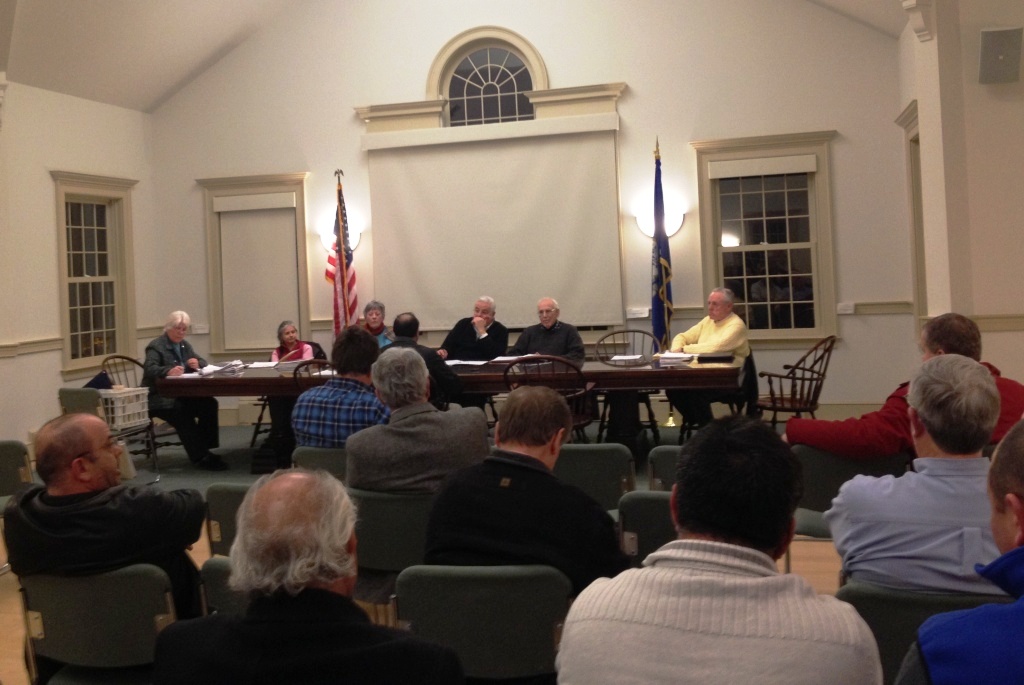
What is the future of zoning? File photo above shows a historical photo of a former Old Lyme Zoning Commission during a meeting.
Editor’s Notes: i) This op-ed was submitted by Eric Knapp, who is employed as the Town of Old Lyme’s Land Use Coordinator. He is writing here as a private citizen. ii) This is the opinion of Eric Knapp.
Zoning in Connecticut is 100-years-old this year. West Hartford was the first town in the State to adopt zoning regulations in 1924. The practice did not make its way to this part of the shoreline until the post-war (World War II) period, when the federal government undertook a concerted effort to promote home ownership for white families. For most of the towns in this area, the adoption of zoning came well after the development of the immediate shoreline areas. How this was addressed—or not addressed—is something I will explore later in the essay.
It seems apparent, at least to me, that the concept of zoning is starting to show its age, and increasingly, it is a poor fit to address issues such as the Americans with Disabilities Act or flood zone requirements. What is not so clear is where to go from here.
From the very beginning, zoning was always a suburban conceit. The idea that residences should be separated from businesses, and both should be separated from industrial uses stems from the very idea that suburban residents want quiet, well-tended neighborhoods, and less desirable uses should be concentrated elsewhere.
This never really made sense in rural areas, where people lived on properties, which doubled as their place of work, and frequently where they sold their products. The fact that the work was odiferous and made noises at early hours hardly bothered the neighbors. Since they were probably engaged in the same activities and were sufficiently far away, it hardly mattered.
In urban areas, there was a long tradition of living over storefronts. Many of Connecticut’s cities developed as “company towns”, where workers lived close enough to arrive on foot and shopped at the company store. Trying to separate out uses made little sense. To get a sense of what this looks like in practice, look at the New Haven Zoning Map, where there are individual “planned development districts” by the dozen, in sizes that would be considered “spot zoning”, if that were a real thing these days.
In the suburbs, though, people still want to limit their neighbors’ activities. [Zoning is always about what your neighbor can do. You should be able to do whatever you want, of course. (Please note, that this is meant tongue in cheek — zoning applies to everyone equally. I am not suggesting that anyone should be able to act with impunity.)]
The relatively late arrival of zoning meant that other tools served that purpose for decades. There are a profusion of associations, some granted powers by special act of the General Assembly. Each one comes with its own rules and rights, all of which must be enforced, but not by the local zoning enforcement officer, much to the confusion and dismay of some residents. (See “hammer laws” for details.) There are boroughs, and fire districts, a “city” and historic districts.
The diffusion of responsibilities and roles gives lie to the idea that we have only 169 municipalities.
A problem that has existed since the adoption of zoning locally is that the shoreline areas were divided into very small lots. The smallest “standard” zoning lot size for most towns in the area is 10,000 sq. ft., just under a quarter acre. But a casual glance, the shore area is made up of plenty of 50’ x 100’ lots, and some even as small as 3,600 sq. ft.
I have argued with local commissions for years that if every lot in a zone is nonconforming, that probably means that there is an inherent defect in the regulations. No local commission wants to take this issue head on.
Instead, the reality is that land use decisions in these areas are largely made by zoning boards of appeals. By statute, of course, these boards are supposed to grant variances only in cases of “exceptional difficulty or unusual hardship”. When every lot is nonconforming, though, the hardships are hardly “unusual”. “My house/lot predates zoning.” “I need to go higher in the setbacks to meet FEMA requirements.” “My septic system takes up my backyard.” “The house is riddled with code violations.” All of these statements can be true, but they are hardly “unusual”.
The truth is, though, that zoning boards of appeals do grant variances. And according to Joe Capossela, who taught the Zoning Board of Appeals (ZBA) piece of the Bar Association’s Land Use Law and Practice for many years, that is exactly what they are supposed to do. They are, in Joe’s words, the “lollipop board”.
If you are liked by your neighbors and do not get greedy, the ZBA will give you a lollipop. But this is exactly the opposite of the “uniformity of zone” that is promised by Connecticut General Statutes Section 8-2. And it delegates the power statutorily given to zoning commissions to zoning boards of appeals.
There are ZBAs that impose gates on variance applications, but these are frequently arbitrary and unfair. One method I have seen, and do not recommend, is to require every variance application to have a complete A-2 survey, architectural plans and not-infrequently, a lawyer’s discussion of the claimed hardship.
This poses as a strict test of the worthiness of an application, but what it really amounts to is a means test. If you can afford to pay to produce an application, your application will almost certainly be granted. If you do not have the resources to provide these materials, at a cost easily exceeding $10,000, then you are not worthy of the ZBA’s time.
As land use law is theoretically tied to the inherent location and characteristics of the property, not its owners, this debases the value of zoning itself.
This is not the only tension between “land-based rules” and “owner-based rules”. The Americans with Disabilities Act requires that governmental bodies provide “reasonable accommodations” for people with disabilities. In zoning terms, this may require handicapped ramps in setback areas or elevators that may exceed height or coverage allowances.
There are workarounds.
Many cities and some towns have systems in place that allow zoning regulations to be “temporarily” modified to allow these improvements to be placed, on the theory that once they are no longer needed, for instance when the individual with those needs moves away, the improvements will be removed. In practice, the improvements never go away, if for no other reason than the administrative headache of trying to police such things is beyond the resources of most land use offices.
Flood zones present a different challenge. The zone lines drawn by FEMA do not respect the zone lines drawn by the zoning commission. The rules of uniformity within a zone do not align well with the requirements that houses be elevated out of the flood zone. Some houses get to have basements. Others cannot. And people really like their basements.
For most towns, additional vertical expansion, if done too close to property lines, is considered an improper expansion of a nonconformity. As most houses on their tiny lots along the shore violate one or more setback, trying to elevate a house will violate this principle. A variance will be required, and many zoning boards of appeals are sympathetic to the need to meet FEMA requirements. Zoning bends to address this, but these goals should be more compatible.
So far, I have spent this article addressing the failings of standard “Euclidean” zoning, but the title suggests that there must be a future for zoning out there. I suspect that there is.
The suburban desire to have bad things over there, not over here is a powerful one and will likely continue to drive the need for zoning. There have been trends, or fads, in the past few decades. Form-based zoning does not really help most suburban areas. Transit-oriented development has its uses, but there is a big gap between Old Saybrook and New London with no service and very limited bus or other transit options.
The State of Connecticut has been increasing its pressure on affordable housing, but without solutions that involve remedying the septic situation, no mandate can force the densities needed. I fully expect that zoning limits of “one house per lot” and/or “single-family zoning” will be curtailed or eliminated. I have no expectation that will make things better.
This cannot just be a paper about pessimism. What can be done? For starters, let’s meet people where they are. If you want to limit new lots to 10,000 sq. ft., okay. But let’s just admit that most lots along the shore do not meet that. Zoning regulations should say that any valid lot in existence today is conforming. All the other limits, setback, coverage, floor area ratio, can still effectively control density.
Having hundreds of nonconforming lots is a useless relic and should be addressed.
In flood zones, maximum height should be measured from the point above flood elevation needed to meet the local freeboard requirement. Again, for most of these small lots, there are other tools to address bulk issues. But we want houses to be elevated out of the flood zone.
Requiring variances to elevate when that is the only issue is a waste of resources and counterproductive.
We need to be more creative on what a “mixed use” looks like. The idea of “store downstairs, apartment upstairs” is less useful now, in the age of Amazon and Zoom. The use of space is more fluid and less defined than it was. People are running businesses from their phones, which is not “land use” at all. Kitchen tables might double as crafting tables. Ovens can cook dinner or make cookies for sale. A garage might hold tools, but some of those tools might be “dual purpose”.
Zoning does not address this well. We have “home occupations”, but not everything neatly qualifies for that designation. Some better definitions and understandings on this are probably required.
The technology is not quite where it needs to be for seamless hybrid meetings. Sure, people can watch from anywhere. And they can even speak. But trying to have exhibits available to everyone watching, and then to allow people watching to submit exhibits in real time that every other participant can see—both in the room and on a device—requires an expertise that is just beyond what most small towns have available.
We will get there, but perhaps not quite yet.
Legal notices are a relic as well. The idea of a “newspaper of general circulation” is not especially meaningful when no one gets a physical “newspaper” anymore. Sure, getting notices up on a town webpage is a good step, but, again, this relies on expertise that varies from town to town.
I would propose having the Connecticut Secretary of the State handle every legal notice. There would be one page at the State’s website that would be a clearinghouse for legal notices. The State could charge for the privilege. It would still be cheaper than what the local papers charge. And everyone, no matter where they are, would know where to look. No guessing which paper. No searching for some tiny print on page 38.
I know that there is a hesitancy to create new state bureaucracy, but in this case, a central monopoly would actually make sense.
I would love to see towns be much more proactive in getting their land use information into an electronic format visible to everyone, anywhere, at any time. In a 21st century world, you should be able to click on a parcel on the GIS map and be able to access its history before municipal land use boards; its outstanding and historical permits; and its zoning, building and health department files.
This is all public information. It should be widely available to the public.
I would love to see a “flood zone improvement calculator” tool. Owners of dwellings in a flood zone should be able to calculate how much work they can do before needing to elevate their house. This would need to include the value of permits within the “lookback period” and be keyed to the assessor’s valuation of the structure.
As I noted in my last piece published Aug. 30, 2024 on LymeLine.com, I have no monopoly of wisdom here. I cannot claim that I, alone, have answers. But we should be searching for these answers, and right now, I just do not see a lot of that happening.
Editor’s Notes: i) This op-ed was submitted by Eric Knapp, who is employed as the Town of Old Lyme’s Land Use Coordinator. He is writing here as a private citizen. ii) This is the opinion of Eric Knapp.
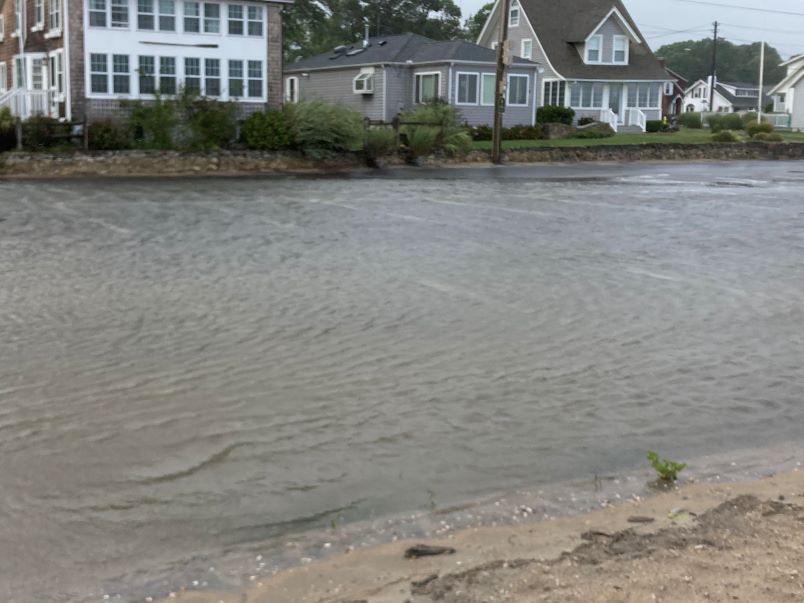
As Long Island Sound rises inexorably, flooding along the Connecticut shoreline is likely to become more frequent. This file photo shows flooding in a prior year at White Sand Beach in Old Lyme.
I have lived in Connecticut my entire life. My career as a lawyer involved representing property owners and land use commissions across the state, but especially along the shoreline, attending countless evening meetings, court hearings and conferences with municipal officials. In my time as a land use officer, I have staffed commissions and served in various positions as a zoning enforcement officer, wetlands enforcement officer, flood plain manager and de facto planner. While I am not a planner by training, my decades of time seeing the Connecticut shoreline in variance capacities has given me time to think about its present and its future.
Connecticut is blessed with abundant water, both fresh and salt. We have a system of rivers that flow through every community, many man-made lakes (almost all of the lakes and ponds in Connecticut are man-made) and a long shoreline with natural harbors. The waters of Connecticut powered our industrialization in the 19th century, and we continue utilizing them for off-shore power and maritime-related centers such as the Coast Guard Academy, Electric Boat and the submarine base. You would be hard-pressed to find anyone who does not have some fond association with the waters of the State.
That makes it particularly difficult to address the sorts of changes that have already arrived and those that are likely to arrive during the course of the 21st century. It does not rain in the same way it did when I was a child. We get many more “rain bombs” — short intense storms that drop an inch, two inches, sometimes more in an hour. It does not snow in the same way that it did when I was a child. December and January are largely snow-less now. Storms during February and March more frequently involve collisions between moisture moving north and a cold front moving south, resulting in huge dumping events, with feet of snow falling at a time.
Infrastructure designed for the 20th century cannot keep up with the 21st century weather. Culverts are now undersized, leading to road-flooding. Some of the pipes draining into Long Island Sound now flow backwards during high tide events. Bulkheads are failing. Streets are flooding. The cooling system for the Millstone nuclear plant has been unable to draw water that is sufficiently cool from a warmer ocean, leaving the biggest source of energy for Connecticut subject to shutdowns. All of this is already here. But more is to come.
The Federal Emergency Management Agency (FEMA) has released a detailed map showing where it anticipates coastal erosion in New London County. It is a scary map to look at, with entire streets anticipated to face serious erosion by 2030.
Nearly all the properties around the mouth of the Connecticut River are serviced by septic systems, most of which are outdated. As Long Island Sound rises, saltwater intrusion will make these systems ineffective. Even now, the nitrogen and phosphorus being added to the Sound due to the over-concentration of septic systems is impairing the water quality, impacting attempts at re-establishing shellfish beds along our shorefront.
As impervious surfaces increase year after year, and the rain bombs occur with greater frequency, storm sewer systems will fail with increasing regularity. Roads will flood and then fail. Methods such as rain gardens and detention basins will lose their effectiveness as the water table rises. There will be, quite literally, no place to put the water.
Elected leaders have not fully embraced this reality. It is not hard to see why. In towns such as Clinton or Westbrook, these low-lying areas provide a large percentage of the real estate taxes. Importantly, since many of the dwellings are seasonally-used, they contribute the same taxes as year-round dwellings, but use a fraction of the services, and do not send any children to the school system. The fact that these neighborhoods are at risk poses potential financial threats to these communities.
Property owners do not want to face this reality either. These are valuable properties. Even when the structures on them are old and dilapidated, the land is worth a great deal. That this investment might lose value, or worse, become valueless, is a hard pill to swallow. Taking steps to address climate-related issues only highlights the problem, putting pressure on resale values. There is frequently an insistence that all that is required is a simple fix: a better drain, or an elevated road, and whatever “temporary” issue there is with water can be resolved.
One of the clearest examples of how the system is not working is the FEMA “substantial improvement” requirement. In theory, the rule is simple: if you perform improvements on your structure, the fair market value of which exceeds 50 percent of the value of the structure, you are obligated to make the structure FEMA-compliant for flood zone purposes. The idea is commendable: over time, as owners perform necessary repairs and improvements, houses will have to be raised, diminishing that owner’s and the community’s flood risk.
The reality is quite different. There are three pathways, and none of them is ideal. First, yes, there are those with the money to elevate their houses. But the truth is that if an owner is going to spend the money to elevate their home, they will also likely want to maximize their investment, making the home as big as zoning will allow, and obtaining variances to go beyond even that. The effluent will still be in the septic system, of course, but the house will be there after the next storm.
Next are the “dodgers”. As any zoning officer will tell you, people will play games to show that they are not exceeding the 50 percent threshold. They can provide their own appraisal of the structure to show it is worth more. They can claim that there is some code-related emergency. They can try and undervalue the work proposed, or simply do more work than their permit sets forth, or maybe not bother to get a permit at all.
The fact that all of this will leave them vulnerable when some future storm arrives is tomorrow’s problem. By then, it may be another owner’s problem. Every seller of a vulnerable shoreline dwelling silently knows that they have dodged a bullet.
Finally, there are those who are simply not in a position to make improvements. Their dwellings will continue to deteriorate, making the problem harder to solve. Each dollar of value that a structure depreciates lowers the threshold of any future improvement that would trigger the “substantial improvement” requirement. These houses are potential death-traps. Inevitably, when these structures collapse and wash away, their debris will harm other properties.
Each year, the amount of impervious coverage grows, the Sound inexorably rises and the odds of a catastrophic storm get worse.
As the saying goes, the first step to recovery is admitting that you have a problem. Shoreline Connecticut has a problem.
So, what happens next?
Realistically, a lot of hard choices. Solutions will take money. There will be winners and losers. Some towns may need to rethink how they see themselves. But it must be done, and we need to start now.
Let’s start with what we can’t do. We cannot simply try and armor the coastline. Not only is this completely disfavored by both FEMA and the Department of Energy and Environmental Protection, but it would also be wildly expensive and would not even work. Armor merely diverts the energy and water from the ocean. The water that is not coming ashore on one site will search for another location to enter.
Water may not overtop a wall, but it will exert pressure on the surface water beneath the wall, pressing the fresh water north and then rising up out of the ground. Likewise, where streams or inlets meet the shore, the tidal wetlands will fill up and freshwater wetland will become brackish. A Maginot Wall along the Sound will work as well as the real one did. Water will find a way around. It always does.
Realistically, we are going to need to create space.
“Creating space” will mean different things in different locations.
For distressed homeowners, who cannot afford to make improvements, a modest buyout program may be possible. Removing houses and creating more pervious area for water to infiltrate will help, if only modestly. Removing potentially hazardous structures from the flood zone will reduce the danger to other structures. Finally, if the structure is removed, there is no chance of anyone being inside during a storm event.
This latter option has two negative financial implications. First, there is the cost of any buyout. Second, each of these dwellings pays taxes, and removing them directly affects the Grand List. But increasing the security of other structures should, in theory, increase their value, somewhat offsetting this loss.
Buffers around tidal wetlands may need to increase. As the Sound rises, these coastal areas will try and move inland. By creating and enforcing realistic buffers, towns can protect the spaces into which these tidal marshes and flats will want to intrude. Property owners will not like seeing these encroachments on their properties. They will feel, rightfully, that they are losing something they own. The abstract idea that healthy tidal areas protect everyone is little comfort to those most affected by these efforts.
Fortunately, there are other creative ways being developed to help mitigate some of these issues. Boston is trying out an “emerald tutu” system, described by the American Society of Mechanical Engineers as, “A linked group of floating spherical mats. Each is roughly a meter in diameter, made of a mix of biomass, seeded with marsh grass, and surrounded by a net to hold it all together.” These serve the dual purpose of assisting the ecosystem while also helping to dissipate wave energy, preventing or mitigating erosion.
In Stratford, they are using concrete reef balls to perform a similar function. Other communities are adding a layer of additional soil to their tidal wetlands to keep them above rising waters.
It will take a lot of trial and error to figure out the best ways to accomplish these goals. Not every project will be successful, and what may work in one place may not work in another.
At the risk of starting a firestorm, there is also the dynamic of reliance on individual septic systems in a large portion of the coast. From Clinton to Old Lyme, the official policy has been “sewer avoidance”. As a result, many older systems, while not officially “failing”, are putting nitrogen and phosphorus into the ecosystem at a rate higher than it can be absorbed. There is also the basic hydrological issue that most of the shore is served by public water, so water arrives from outside of a community and then leaves through the septic system, creating a net increase in water.
The likelihood that new large sewer plants will be constructed is low. They are expensive and unpopular, however necessary they might be. What seems feasible is that smaller community systems can be installed on small lots throughout shoreline communities. Even tying eight or 10 houses into a small system would prove beneficial. Of course, this is not easy to do under the present Health Code, so regulatory changes may be required to allow this to occur.
For larger commercial uses, there may be some benefit to having them build systems that exceed what they require (in exchange for regulatory benefits), which could allow nearby substandard systems to be phased out and those properties to hook into the commercial system (for a cost.)
Inevitably, while making choices, there will be those who will lose property rights, or more clearly, their properties will be reduced in value, sometimes to zero. The reality is that this is going to happen anyway, as the water rises. But if the government does this, it constitutes a taking and compensation will need to be paid. This will cost real money. People will fight to get as much compensation as possible in exchange for giving up some or all of their property, and rightfully so.
The alternative is to wait for a large storm to come and then see who has the resources to rebuild. I am not persuaded that this would be better.
I am not writing this because I have the answers. I am writing this because we all need to come together and start contemplating the answers together. This will take time. It will be hard. People will disagree, quite loudly, about the extent of the problem, before we even get to the question of what answers will look like.
But I would encourage the people of Connecticut to take up this work now, so that my 14-year-old sons will have a future here. We may be the Land of Steady Habits, but we are also a land of inventors and hard workers. We can solve this, but only if we put our minds and our energy, and yes, our dollars towards a solution.