
TOP STORY: Old Lyme Selectwoman’s Call to Disband Halls Road Improvement Committee Rejected by Shoemaker, Lampos

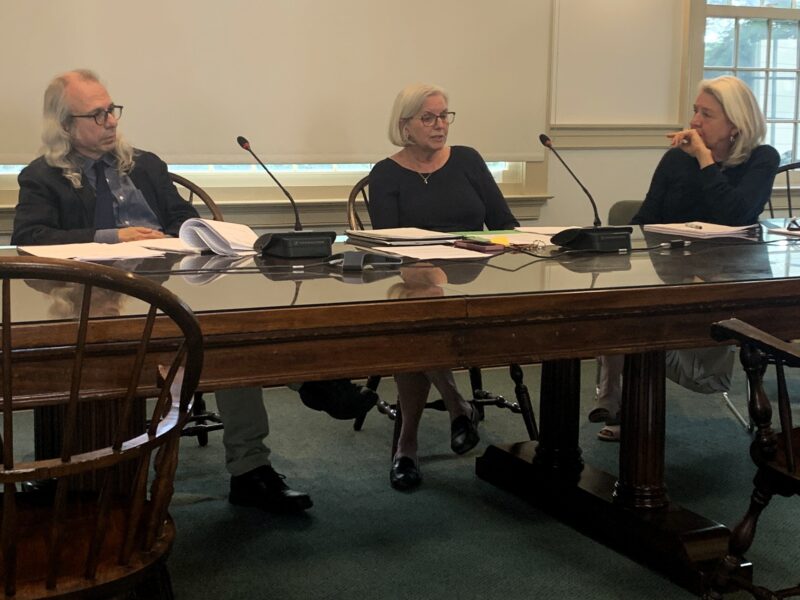
Old Lyme First Selectwoman Martha Shoemaker, center, with Selectman Jim Lampos, left, and Selectwoman Jude Read, right.

OLD LYME–Selectwoman Jude Read is calling for the dissolution of the Halls Road Improvements Committee (HRIC) as the Old Lyme Board of Selectmen continues to back away from big picture changes to the road that have evolved over the past decade. 

On the selectmen’s table now is a scaled-back plan that includes new sidewalks, but no other substantial upgrades like the bow bridge and trail system envisioned by the HRIC. First Selectwoman Martha Shoemaker in May signed off on a grant application to the Connecticut Department of Transportation (DOT) for $800,000 to install sidewalks on the north half of Halls Road. 

Josh Morgan, DOT Communications Director, said in a Tuesday email that he expects the award announcements to go out in the next several weeks. 

During their Monday evening regular meeting, the selectmen considered creating a new committee to guide the process if a grant is awarded. But Read emphasized the existing Halls Road committee should be disbanded before forming a new one. 

“The other thing I think would be helpful – these are my thoughts – is, if and when we start a new committee, we’re careful about the charge, what the goal is, (and) how many people are on that committee.” 

Read also suggested requiring a unanimous vote when appointing members to a new committee. She is the lone Republican on the board with Shoemaker and Selectman Jim Lampos, both Democrats. 

Lampos and Shoemaker declined to disband the committee right now because they need more information on the status of projects that were pending when selectmen voted to put the group on a hiatus in April.

The HRIC has been controversial since it started in 2015 under Democratic then-First Selectwoman Bonnie Reemsnyder with a charge to consider a master plan for the commercial span. The result – honed over the course of dozens of public meetings, information sessions, and workshops – evoked images of village-like storefronts and apartments, a pedestrian bridge, more greenspace and sidewalks. 

Reemsnyder successor Tim Griswold, a Republican, a few years later called the vision too grandiose. He said at the time that he preferred to focus on building sidewalks one segment at a time before considering such broad plans. 

But opposition came to a head earlier this year when more than 550 people filled the Lyme-Old Lyme High School auditorium for a public hearing on changes to the town’s zoning regulations that the committee hoped would turn their vision into reality. 

The proposal to create an overlay district in the commercial zone would have allowed as many as 40 housing units per acre to be built above, or behind, ground-floor businesses. 

The plan was rejected by the Zoning Commission, HRIC Chairwoman Edie Twining subsequently resigned, and the board of selectmen put the committee on hiatus while attempting to manage the fallout. 

Crossing That Bridge

Before making any decisions on whether to disband the HRIC, Shoemaker and Lampos on Monday said they wanted to get a better understanding of how much has been spent on Halls Road projects to date and which contracts remain outstanding. 

At the behest of the HRIC, selectmen in 2023 hired AI Engineers of Middletown to come up with plans for a pedestrian bridge over the Lieutenant River and a trail system between Lyme Street and Halls Road. The company’s work was funded with $135,000 in federal American Rescue Plan money and a $28,500 grant through the Connecticut Recreational Trails program.

Old Lyme Finance Director Anita Mancini said the committee spent $13,500 of the trails grant so far. 

The committee in an FAQ document said AI Engineers was tasked with taking charge of conceptual designs, formal designs, permitting and the construction bid process. No funding for construction has been secured. 

The decision to accept or reject the designs would be up to the public, according to the committee. Old Lyme’s form of government calls for the public to vote on major decisions at town meetings, with options to send the biggest issues to referendum. 

Shoemaker said the town could be responsible for returning $13,500 to the state if the town doesn’t complete the design project. 

Read argued it might be prudent in some cases “to take a loss.”

“Is it better to lose $13,500 or spend another $15,000, have it designed, and not be sure if the town’s going to approve it or not?” she said. 

Shoemaker and Lampos reiterated they need a better idea of the financial picture first. 

They said it’s been difficult to pinpoint how much has been spent, and in which line items, in a decade of budgets overseen by multiple administrations. 

Lampos credited the current selectmen with making the budget process and town procedures more transparent. 

“I think there’s a lot of clarity, but there’s just so much that we can answer for what happened before us,” Lampos said. 

LymeLine in April requested documents related to the amount expended so far on HRIC projects. Shoemaker on Monday said the information will be available next week. 

Lampos, who wrote the grant with Shoemaker’s executive assistant Katie Balocca, emphasized there is nothing in the grant to cover the HRIC’s bow bridge proposal. 

“It is currently on hiatus. We’re not addressing it,” he said. 

Building the bow bridge would require the state Department of Energy and Environmental Protection to transfer ownership of its property on the east bank of the Lieutenant River to Old Lyme, which the agency has agreed to do as long as the town agrees to put a fishing pier, a dock for portable boats and parking spaces there. 

Lampos acknowledged the idea, like other elements of the HRIC plan, is controversial. That’s why the grant application focuses solely on sidewalks. 

“Almost everybody was saying, ‘forget the overlay,’ half the people were saying, ‘forget the bridge,’ and just about everyone was saying, ‘but we want the sidewalks,’” he recounted. 

Read wondered if a new committee should be limited to overseeing only what’s in the grant or if they should be empowered to look at other improvements and funding sources. 

“We have requests for sidewalks, lighting, signage, beautification,” she said. 

Lampos put it this way: “If we don’t get the grant, I think we cross that bridge at that time.”

Letter to the Editor: Moving Forward with a Plan to Improve Halls Road

To the Editor:

Even with the suspension of the broader Halls Road Improvement effort (the Zoning Overlay proposal), town officials have expressed support for pursuing sidewalks along with better lighting, crosswalks, bike paths and beautification.

Reassessing how to move forward must include involvement by all members of the [Old Lyme] Board of Selectmen and a clear definition of the expectations from a reconstituted Halls Road improvement Committee.

While town residents have previously stated their support for Halls Road improvements, property owners, business owners, and town agencies must have a greater role/voice in any plan.

Please note the following points/proposals:

  • Timeline: The overall Halls Road plan is anticipated to be a multi-year process with various phases.
  • Funding: Securing grants and other funding sources is a key aspect of implementing.
  • Consensus: Any appointment to a reconstituted Halls Road Committee must receive the approval of all the select-people.

Sincerely,

William Folland,
Old Lyme.

Old Lyme Selectmen Place Halls Road Improvements Committee on Hold

OLD LYME – The Old Lyme Board of Selectmen on Monday pressed pause on the Halls Road Improvements Committee (HRIC).

Selectmen at their regular meeting agreed to the move in the wake of months of controversy involving the future of a short span of road lined with outdated strip malls set between two highway interchanges. At the center of the dispute was a proposal from the Halls Road committee calling for the creation of an overlay district in the commercial zone that would allow apartments and condominiums to be built above, or behind, ground-floor businesses set close to the street. 

Months of vocal opposition to the group’s work culminated on April 14 when the committee’s vision for Halls Road was rejected in a 4-1 vote by the Zoning Commission. HRIC chairwoman Edie Twining resigned a few days later after six years at the helm. 

Many residents – more than 1,200 in an online petition and more than 500 packed into an April public hearing – did not see eye to eye with the committee.

First Selectwoman Martha Shoemaker in a phone interview Tuesday said the town’s three selectmen agreed to put the Halls Road committee on a “hiatus.”

There are currently four vacancies on the nine-member committee, according to the town website. 

“All three of us so much appreciate all the work the Halls Road Improvements Committee has done over the years, and we just want to plan for the best way forward,” she said. 

Shoemaker and HRIC member Paul Gianquinto will meet with the state Department of Energy and Environmental Protection (DEEP) on May 5 to discuss unfinished business involving a plan for physical improvements to Halls Road. Representatives of the DEEP have been in talks with town officials about the possibility of transferring ownership of the state’s property on the east bank of the Lieutenant River to Old Lyme, as long as the town agrees to build a fishing pier and parking spaces there. 

Shoemaker said she will bring the topic back to the Board of Selectmen for discussion after she and Gianquinto meet with the state. 

As part of the HRIC plan to make the road safer and more passable for walkers and bikers, selectmen in 2023 hired AI Engineers of Middletown to come up with plans for a pedestrian bridge over the Lieutenant River and a trail system between Lyme Street and Halls Road. The designs were funded with $135,000 in federal American Rescue Plan money and a $28,500 grant through the Connecticut Recreational Trails program.

Shoemaker said selectmen on Monday concurred with a longstanding call among residents to put sidewalks on the road. 

She said she’s had preliminary talks with the town engineer about what those sidewalks might look like but did not yet have specific details. She was also exploring grant options through the state to cover construction. 

The Halls Road Improvements Committee was introduced by Democrat Bonnie Reemsnyder in 2015 with the goal of advising the Board of Selectmen on how best to develop a master plan for the area. The result evoked images of village-like storefronts and apartments, a pedestrian bridge, more greenspace and sidewalks. 

But Reemsnyder successor Tim Griswold, a Republican, called the vision too grandiose. He said at the time that he preferred to focus on building sidewalks one segment at a time before considering such broad plans. He withdrew a previous zoning proposal to create a Halls Road Village District before it could go to public hearing. 

The recently rejected overlay district application was signed by Shoemaker in November. The proposal was represented at the public hearing by William Sweeney, the attorney for the Halls Road Improvements Committee since 2022.

Shoemaker emphasized HRIC members serve at the request of the Board of Selectmen. 

“We’re going to put them on pause for a little while,” she said.

Op-Ed: After HROD Defeat, Some Thoughts on Improving Old Lyme’s Approach to Managing Major Projects Going Forward

Editor’s Note: We originally published this op-ed submitted by Howard Margules of Old Lyme on July 12, 2024. After the 4-1 defeat of the Halls Road Overlay District proposal by Old Lyme’s Zoning Commission last Monday (April 14), several members of the Halls Road Improvement Committee, including its former chair Edie Twining—who resigned yesterday—suggested republishing it as a constructive contribution to the discussion regarding how to move forward from this point.

Is a Town Planner the Answer?

Our town’s major projects—Halls Road, sewers, Shoreline Gateway, and Affordable Housing—are all vital to our town’s future economic viability. 

They also share something else in common: they have been “works in process” for quite a while, and all remain unfinished. It is important to point out that these projects have been ongoing across multiple administrations, regardless of which political party is in power; so this is not a partisan issue but one that crosses party lines. 

Why do these projects take so long to complete, and what can be done to expedite them?

Over the last ten years I have been involved, one way or another, in most of these projects. 

I am a current member of both the Halls Road Improvement Committee and the Planning Commission and the former Chair of the Economic Development Commission. Thinking back on my front-row experiences has led me to some observations on those questions and suggestions for improving timely project completion.

Relying on Volunteers

Our town is very fortunate to have a motivated, engaged volunteer corps staffing our town Boards, Committees and Commissions. I have worked with good people from both parties, and I have been generally impressed with the competence, knowledge and commitment they bring to the job. And, they are doing this work for “free.” 

But, there are issues with relying on volunteers. 

First, there is a town requirement that the Boards and Commissions be balanced politically. This occasionally leads to appointments made simply to fulfill the political balance requirement rather than appointing the most qualified individual.

Additionally, there have been instances where the Committee or Board Chair has had no input in the selection, or, objected to the appointment, but was overruled, even though the person appointed was not the best candidate. 

Second, our town relies almost solely on volunteers to address some very complex projects which often require specific expertise and knowledge that may be absent in our volunteers. 

Additionally, most Boards and Commissions only meet once per month, which is acceptable for routine issues but inadequate for addressing major complex projects. 

Finally, it is also difficult to put too much pressure or expectations on volunteers since they can always elect to just bow out. Relying almost totally on volunteers makes it hard for the town to complete major projects successfully in a timely fashion.

Low Accountability

Many municipalities, especially larger ones, employ a full- or part-time professional planner, to lead major projects. They are professionals with the expertise required to address the complex issues major projects raise. Most importantly, they are held accountable as professionals for completing projects. 

Currently, we don’t have the structure or ability to hold any one person accountable. Accountability gets more complicated given the number of Boards and Commissions involved, various interests that have to be satisfied, and political agendas that occasionally get in the way.

Lack of Collaboration

All of these major projects require approvals from multiple Boards and Commissions Typically, this is done sequentially. One Board or Commission generates proposals that then require approval from another body. Of course, it is natural then for everyone to want to add their two cents. 

The sequential review and approval process frequently leads to varied opinions, occasionally to conflicts, and thus delays. Each set of potential conflicts must be resolved in sequence, drawing out the process and the projects unnecessarily. 

In my view, it would be more beneficial to provide a mechanism for the Boards and Commissions to collaborate initially, perhaps reaching broad consensus and some level of buy-in before the official approval process. 

The Board of Selectman should form a specific project committee for each major effort. We do have some such now, but they do not include representatives of the bodies that will have to provide approval later on. 

The relevant Boards and Commissions or representatives of those bodies need to be involved early in the project, if not from its inception. 

Relevant Expertise

Expert advice (engineering, law, environmental science, design, etc.) is required for these major projects. We are very fortunate in Old Lyme to have a wide range of skills represented in our citizenry and we have benefitted from their help over many years. 

Unfortunately, those with the most relevant skills are often still working, raising children, etc. and have little time to volunteer. We can take advantage of these local skills where they are available, but major projects need consistent and constant expert input, even if it means we must hire professionals to assist.  

Even to manage the work of hired experts can require Board or Commission members to climb a steep learning curve.This is another area in which a professional planner could be very helpful.

Leadership

Finally, these complex projects require engaged leadership from the Board of Selectmen. The Board of Selectmen needs to assist with coordination, monitoring, oversight, timetables, expense control, lobbying public officials for funding, and commit to completing projects on time and on budget.

Our town will face more challenges going forward. If we are to successfully face these challenges and secure our economic future, we need to enhance our approach to supporting and managing major projects.

BREAKING NEWS: Halls Road Improvements Committee Chair Edie Twining Resigns

OLD LYME — This afternoon, Halls Road Improvements Committee Chairwoman Edie Twining submitted her resignation in a letter to Old Lyme First Selectwoman Martha Shoemaker. Twining’s resignation from the volunteer position is with immediate effect.

The text of Twining’s letter is as follows:

“Dear Martha,  

It is with a heavy heart that I resign as a member and Chair of the Halls Road Improvements Committee (HRIC). My family has been part of Old Lyme for three generations. When I returned to Old Lyme after living in Boston for 40 years, I followed in my father’s footsteps volunteering for the town. My  commitment to this committee has spanned over 8 years and many thousands of unpaid hours of work. In that time, the committee held dozens of public outreach sessions, responded to feedback and created  a Vision Proposal that informed the Halls Road Master Plan. All of my efforts have been done as a volunteer and, contrary to false accusations on social media, I have never had or sought any monetary gain, direct or indirect, from my involvement on the committee.  

The committee has received multitudes of letters of support for both the Master Plan and the Halls Road Overlay District (HROD) proposals, Planning Board Approval, detailed Zoning Commission review and dozens of public outreach sessions. To those supporters; I am deeply grateful for your attention to this  committee’s work and for your ongoing support. You understood the HRIC was never a partisan project,  but sought the benefit of the whole town, regardless of political affiliation!  

Despite seven years of very public effort, well publicized by friends and foes, many people claim never to  have been aware of the HRIC and its efforts to improve pedestrian safety, add new crossings, and update our 1960’s commercial-only zoning with a mixed-use option. Those who have followed the HRIC process have seen the multiple layers of work we have done and provided constructive suggestions that have altered the plan. Many who opposed it and chose to never attend a meeting, never visit the town website (where all details were publicly available), claim, instead that all of this was proceeding covertly with no community outreach. The fact that they chose not to attend any public meetings, not to read the detail on the town website or get involved does not give them the excuse to say the public was not informed.  

Critics have relentlessly misrepresented and misunderstood the plan, its aims, the challenges faced by the town, and the nature of the solutions proposed. This pervasive disregard for facts culminated in the latest campaign of wild exaggerations meant to mislead our community about the goals and details of the HROD proposal. The social media avalanche of invented nightmares and half-truths is indicative of the poisonous, adversarial politics that is tearing our country – and now our town – to pieces. None of those opposing the proposal ever directly asked the committee to explain how the regulation works, nor did they ever suggest any concrete alternative proposals.  

They were not interested in squarely facing our Town’s future in a changing world. Instead, they created a monstrous fantasy version of the HROD proposal that no one could support, used it to whip up a storm of protest, and set out to bully the town’s officers into submitting to their fantasy. 

The Zoning Commission’s refusal to deliberate, and abandonment of their efforts to modify the HROD  proposal in any way, was, in my view, an abdication of the Commission’s rights and responsibilities. The most important statement about the whole process was made by Zoning Commission member Denise  Savageau. She blamed the dysfunctional Old Lyme bureaucracy for failing after 10 years to work together constructively to create a unified plan and new zoning for Halls Road. It was, is, and should have been treated from the beginning as a TOWN effort. Instead, an appointed committee of the Board of Selectmen was treated by other Boards and Commissions the same way they treat a private person applying for permission to make modifications to their house. That approach doomed the effort from the start, because it foreclosed the possibility of collaboration and working together to frame what was  needed. The separate silos of Planning, Zoning, and HRIC; the fiction that the town itself could not demand that the three cooperate with one another—all of these, in retrospect, were fatal errors.  

This “us vs. them” madness is such a sad and destructive trend both locally and nationally. There seems no way to fight back against waves of falsehoods. So, I am leaving all the work we have accomplished to those who come after. If they do nothing, outside forces will dictate our town’s future. Meanwhile I look forward to contributing my time to more productive pursuits in my board positions with the Old Lyme Land Trust, Old Lyme Historical Society and my design work for the New London Homeless Hospitality  Center.  

Respectfully,  

Edie Twining”

Editor’s Notes: i)Twining also provided a list of the committee’s accomplishments.
ii) A reminder of Our Policy on Comments.