Even with the suspension of the broader Halls Road Improvement effort (the Zoning Overlay proposal), town officials have expressed support for pursuing sidewalks along with better lighting, crosswalks, bike paths and beautification.
Reassessing how to move forward must include involvement by all members of the [Old Lyme] Board of Selectmen and a clear definition of the expectations from a reconstituted Halls Road improvement Committee.
While town residents have previously stated their support for Halls Road improvements, property owners, business owners, and town agencies must have a greater role/voice in any plan.
Please note the following points/proposals:
Timeline: The overall Halls Road plan is anticipated to be a multi-year process with various phases.
Funding: Securing grants and other funding sources is a key aspect of implementing.
Consensus: Any appointment to a reconstituted Halls Road Committee must receive the approval of all the select-people.
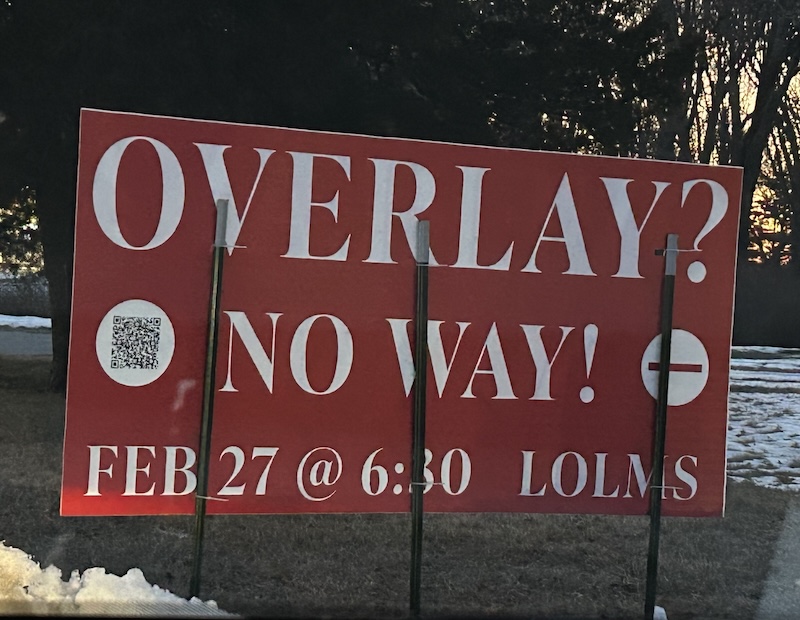
This is an example of one of the signs to which this letter-writer refers. The photo was taken before the Feb. 27 date was postponed to April 9. Photo submitted.
To the Editor:
We now know that Old Lyme’s First Select-Person, Martha Shoemaker, directed the town’s Public Works Director to remove NOWAY OVERLAY (stet) signs from various locations around town. Prior to the removal of the signs there was no attempt, by any town official, to work with either the property owner or the group responsible for installing the signs to work out the matter.
What is further concerning is that Martha Shoemaker is a member (ex officio) of the Hall’s Road Improvement Committee that has put forth the Zoning Regulation proposal that the NOWAY OVERLAY signs are in opposItion to. Is this a conflict of interest or at least the appearance of a conflict?
When wire political signs are posted during election season, neither the town’s Zoning Enforcement Officer nor the Historic District Commission, which disfavors wire signs, remove them. With respect to the Hall’s Road Overlay proposal – also a matter of great public and local political concern – why should signs taking a position on that issue be treated differently? And why are some wire signs along roadways, on a variety of topics, left intact and only signs in opposition to the Overlay removed?
At a meeting that I attended on March 19 at the town hall that included the First Select-Person, the town’s Public Works Director and the Zoning Enforcement Office, I attempted to offer a less confrontational approach with enforcement of our town’s zoning regulation involving signs.
I suggested an approach that a member of the town’s Historic District Commission (HDC) and I discussed in a recent phone conversation. The first attempt of the HDC to regulate structures concern in the District is to contact the property owner, and then invite the property owner to meet, discuss, and try to work out the matter.
The conflicting views of the issues surrounding the Overlay Zoning proposal and the rights of free expression have resulted in the erosion of public trust of many of our public officials. So where do we go from here? The following is my recommendation.
The Town of Old Lyme’s Code of Ethics ( Section 43-8 (8) includes a provision whereas the Ethics Commission can initiate a complaint and investigate such complaint.. It does not require the filing of a complaint specifically from a town resident.
I believe the Ethics Commission is the proper forum ( town agency) to address the issues stated above.
With reference to Howard Margules recent Op-Ed published in LymeLine.com, ineffective leadership by Old Lyme’s First Selectperson has been the root cause for ongoing issues with the Lymes’ Senior Center renovation and the going-nowhere Halls Road Improvement Project. The failure to appoint competent individuals to manage these projects is a major factor in their ongoing issues.
Only in Old Lyme is a renovation project, (the Lymes’ Senior Center) that is 9 months behind schedule and $900,000 over budget before construction begins, called a successful and well run project.
Only in OId Lyme are town residents told the Halls Road Improvements are coming when all major funding requests from the state and federal agencies have been denied due to failures at the local level to submit a proper application.
Old Lyme’s Board of Selectmen make the appointments to the committees that are responsible for the projects mentioned above yet major decisions affecting these projects are made primarily by the First Selectperson thus eliminating an honest discussion by the full board. This is an ongoing problem.
Having attended [Monday] night’s [Old Lyme] Selectmen’s debate, this unaffiliated voter sums up the outcome as follows:
The candidates for Select-person Reed and Lampos were impressive, their responses to all questions were well stated leaving no doubt as to their position on the subject. One could almost feel their passion for wanting to serve the town and willingness to hear all sides of the matter at hand. The candidates for First Select-person Mesham and Shoemaker were, to say it kindly, less impressive with typical canned wishy-washy responses to the questions.
The issue where there was a definite divide between the R’s and D’s was the issue of Halls Road. The D’s like the grand plan that would remake Halls Road into a dense mixed-use neighborhood that would forever change the character of Old Lyme. The R’s position is that the Halls Road Improvement Committee have gone way beyond the original mandate of sidewalks and lighting improvements and are against the grand plan.
Whichever party wins the majority of Select-person positions in this upcoming election will most likely decide which direction Halls Road will take. Voters have a clear choice here, grand plan or sidewalks and lighting. Hopefully voters will not let party affiliation blind them into making the wrong choice.
I took this photo (above) of the mixed use development to the Main Street in South Portland, Maine. This could be a blueprint for Halls Road if the Halls Road Improvements Committee (HRIC) zoning changes are adopted.
Halls Road is and will always be a service road not an area for residential development. Any development should be limited to service oriented business, examples being health care facilities, urgent care facility as well as businesses that support the highways.
We all agree that Halls Road in its current configuration is an eyesore but overreacting and approving the HRIC proposed changes to zoning regulations may make a bad situation worse.