Op-Ed: Tuesday, November 4th & the HROD

Editor’s Note: F.B. (Rick) Drake of Old Lyme submitted this op-ed to us. He is a career architect with national and international design experience in the creation of small towns.

Some candidates in the coming election are taking credit for the defeat of the HROD [Halls Road Overlay District], an easy claim to stake. After all, the most controversial debates and the final vote on the proposal took place during the current Administration’s tenure in Town Hall. Whatever was wrong with the Overlay must by association at least, if not by direct action, have been their fault, right?  Maybe, but the subject’s worth at least a slightly closer look.

The Halls Road Improvement Committee (HRIC) was created in 2015 and labored for 10 years through changing memberships and five different town administrations, three Democratic and two Republican, to produce the proposal that was defeated earlier this year.  Each of those administrations no doubt influenced the committee, but none made it law. The ultimate authority to accept or deny the proposal resided with the Zoning Commission.  That’s certainly how events unfolded in 2024 and ’25.  The HRIC was allowed to complete its work without undue interference from the current administration. Ditto the Zoning Commission, which was allowed to consider and vote on the proposal also without interference. In fact, contrary to the claims of some, the current administration acted appropriately in January not by voting to approve the Overlay per se but by voting to approve its submittal to the Zoning Commission for its consideration and conclusion. Absent that vote, the decade long process would still be ongoing and a structured opportunity to stop, reassess and reconfigure it would have been postponed yet again. Forwarding the Overlay to the Zoning Commission for a vote was the opposite of controlling the process. It was allowing that process to operate as it was meant to.  

That said, the importance of an administration’s influence can’t be entirely discounted, and  there are good examples that reinforce that point.  

  • While the current administration refrained, as it should have, from directing the HRIC’s work, it used its influence in a positive way to arrange meetings between HRIC leadership and some of its most vocal critics. This author knows this to be true because he participated in some of those meetings as a critic. But even then, at the end of the day, the administration allowed the system to function and the HRIC to incorporate – or to set aside – its critics’ concerns as it, the HRIC, not the Selectmen, was charged to do.
  • An earlier administration’s influence, however, actually had a more direct and profound effect. One analysis of the HROD attributes many of its shortcomings to the hiring of a lead consultant put forward by that earlier administration, a consultant that was arguably unqualified to do the work. Whether the earlier administration failed to grasp the technical challenges of the HROD and/or the lack of qualifications of the consultant it put forward or not, a case could reasonably be made today that the shortcomings of the HROD were ultimately more the result of that consultant’s hiring than of many of the decisions rendered by the HRIC’s lay members, themselves.

Credit for defeat of the HROD, however, is, itself, worth a closer look. Without a town-wide vote, the party affiliations of the HROD’s opponents are unknown. Claims of credit for its defeat, therefore, or inferences to that effect by any group other than “the Citizens of Old Lyme” are unfounded and, more to the point, misleading. Opposition to the HROD, or support for that matter, crossed party lines. This author is just one of many who criticized the Overlay on technical grounds, not political (Drake letter to the ZC 2/18/25).  Furthermore, an examination of the vote taken by the Zoning Commission reinforces the fact that the Overlay faced multilateral opposition. Of the four negative votes cast, two were in fact Democrat or Democrat endorsed and two were Republican. Any single group’s claims of unilateral credit for defeating the measure, therefore, or inferences of same are at best unsubstantiated if not disingenuous during an election cycle.

In time, the community may come to realize that the greatest shortcoming of the HROD experience was not the number of its housing units or the length of its buildings but rather the unwarranted politicization of the effort, an unfortunate outcome for which neither the HRIC nor the current administration is responsible. The Administration shepherded the HROD to a majority vote decision by the Zoning Commission after HRIC members had contributed incalculable numbers of hours of time and myriad personal sacrifices in an effort to improve our town. Critics might agree that some of those efforts were imperfect, but claiming they were politically motivated requires proof not innuendo. The town and the committee members in particular deserve better.  

F. B. Drake

Editor’s Note: This op-ed was updated with a revised headline.
TOP STORY: Failed Halls Road Overlay Makes Way for Election Day in Old Lyme

OLD LYME–When Democratic First Selectman candidate Martha Shoemaker beat Republican challenger John Mesham by 123 votes two years ago, plans to transform Halls Road into a livable, pedestrian-friendly village center were still being hashed out in committee meetings and consultants reports.

Now, following the defeat earlier this year of a Zoning Commission application for the Halls Road Overlay District (HROD) that would have allowed developers to build apartments in the commercial zone, the issue has become a flashpoint in the rematch between Shoemaker and Republican challenger John Mesham. 

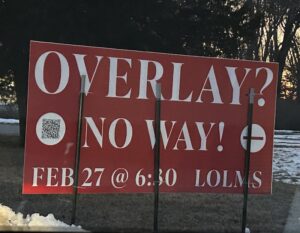
The “Overlay? No Way!” crowd was evident over the winter in signs across town and at a Zoning Commission public hearing that filled the high school auditorium to maximum capacity. A vast majority of the 550 attendees came out in opposition. 

According to Mesham, it never should have gotten to that point. 

“If I was on the Board of Selectmen, I would definitely not have ever voted to present that project to Planning and Zoning,” he said last week in an interview at the Republican headquarters on Halls Road. 

Mesham, who spent 29 years in law enforcement before retiring from the Connecticut State Police in 2020, said experience as an executive officer in the Bridgeport and Montville barracks has prepared him to run a public agency like the Town Hall. His current term on the Inland Wetlands and Watercourses Commission has taught him about the regulatory process. 

Shoemaker is a retired 35-year teacher, 12-year union president, and two-term member of the Region 18 Board of Education. She was selectwoman from 2021-23 before being elected first selectwoman.

The overlay proposal drafted by the Halls Road Improvements Committee (HRIC) was submitted to the Zoning Commission late last year by Shoemaker after a 2-1 vote of the selectmen. Shoemaker and fellow Democrat Jim Lampos were in support; Republican Jude Read cast the lone nay vote. 

Lampos and Read are both running for reelection as selectmen. 

Part of the Process

Shoemaker at the Town Hall last week said she followed statutory guidelines and local precedent for submitting the proposal to the Zoning Commission. 

The first proposal in 2021 was submitted, and then pulled, by then-First Selectman Tim Griswold after critics described it as an overreach, and a revised 2023 version that first floated the overlay zone was later rejected by the Zoning Commission. Members cited concerns about its effectiveness and the lack of water and sewer infrastructure.

The commission is empowered to approve, deny or modify applications. Shoemaker said she put the proposal in their hands so they could do their job. 

“And I know that the zoning board would have moved and pulled things out of it, or tweaked it to something that they could have been more comfortable with, because they weren’t going to put Old Lyme in jeopardy,” Shoemaker said. 

Asked if she would have done anything differently in retrospect, the first selectwoman said she said she would not have delayed the continuation of the public hearing for as long as she did. 

The hearing, which began in January, was initially continued to the end of February. But the meeting was postponed to April at the request of Shoemaker and the HRIC, who informed residents the move was prompted by “strong interest” in the topic that required a larger venue and more time for the commission to review communications from residents. 

“I think there were a group of people who sort of defined it as something that it wasn’t, and placed fear into the minds of some of the people in this town,” she said. 

Critics said the plan had the potential to create more than 1,000 apartments on 40 acres if it went through. Proponents argued topography and regulatory realities would effectively limit development to under 400 apartments at the most. 

Shoemaker said she should have educated the public more about the project instead of letting misinformation spread. 

“I think the most important thing is providing the facts,” she said. 

Mesham during his interview disputed the idea that forwarding the project to the Zoning Commission was largely a procedural issue bound by statute and the other applications that have come before it. 

“So, you know, you can say it’s part of the process, but really, part of the process is the Board of Selectmen reading the room and saying ‘we’re not gonna move ahead with this,’” he said. 

Sidewalk Consensus

He said his first order of business if elected will be to call for a “shovel-ready” plan for sidewalks, lighting and “probably some greenery” to improve Halls Road.

“I think people move to Old Lyme because they like Old Lyme,” he said. “And we don’t need to drastically change Old Lyme.” 

Sidewalks, too, are at the top of Shoemaker’s priority list for a second term. In May, she signed off on a grant application to the Connecticut Department of Transportation (DOT) for $800,000 to install sidewalks on the north half of Halls Road. 

“I think there’s total consensus on sidewalks,” she said. 

Less clear is the future of a pedestrian bridge – sometimes referred to as the bow bridge – proposed by the HRIC, according to Shoemaker. 

“It’s something that’s nice to have, but is it a need or a want? And we have to weigh that out,” she said. 

The state Department of Energy and Environmental Protection this year transferred ownership of the state’s property on the east bank of the Lieutenant River to Old Lyme, as long as the town puts a fishing pier and parking spaces there. The land swap is a necessary component of designs for the walking bridge and trail system funded with $135,000 in federal American Rescue Plan money and a $28,500 state grant. 

“If we want the walking bridge, we have to do the fishing pier,” she said. “So do we want the fishing pier? What do we do to the environment if we start to build a fishing pier? There’s a lot of questions that still need to be answered.”

Mesham reiterated it’s time to get back to basics on Halls Road. 

He said what started as a call for greenery, signage, and lighting “spun out of control” with efforts to attract developers and add large-scale improvements like the bridge. 

“It clearly got too big for what people want, so I think we need to get back to the original intent of the Halls Road Improvement Committee,” he said. 

TOP STORY: Old Lyme Selectwoman’s Call to Disband Halls Road Improvement Committee Rejected by Shoemaker, Lampos

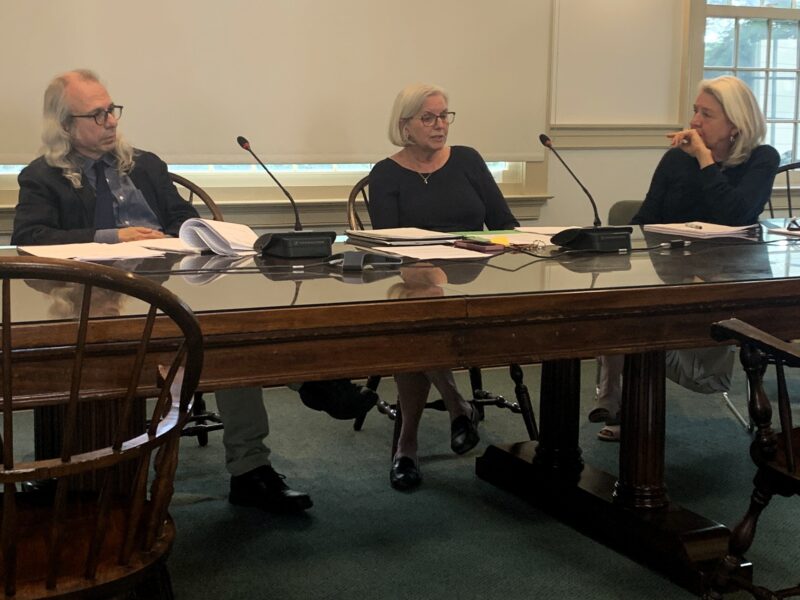
Old Lyme First Selectwoman Martha Shoemaker, center, with Selectman Jim Lampos, left, and Selectwoman Jude Read, right.

OLD LYME–Selectwoman Jude Read is calling for the dissolution of the Halls Road Improvements Committee (HRIC) as the Old Lyme Board of Selectmen continues to back away from big picture changes to the road that have evolved over the past decade. 

On the selectmen’s table now is a scaled-back plan that includes new sidewalks, but no other substantial upgrades like the bow bridge and trail system envisioned by the HRIC. First Selectwoman Martha Shoemaker in May signed off on a grant application to the Connecticut Department of Transportation (DOT) for $800,000 to install sidewalks on the north half of Halls Road. 

Josh Morgan, DOT Communications Director, said in a Tuesday email that he expects the award announcements to go out in the next several weeks. 

During their Monday evening regular meeting, the selectmen considered creating a new committee to guide the process if a grant is awarded. But Read emphasized the existing Halls Road committee should be disbanded before forming a new one. 

“The other thing I think would be helpful – these are my thoughts – is, if and when we start a new committee, we’re careful about the charge, what the goal is, (and) how many people are on that committee.” 

Read also suggested requiring a unanimous vote when appointing members to a new committee. She is the lone Republican on the board with Shoemaker and Selectman Jim Lampos, both Democrats. 

Lampos and Shoemaker declined to disband the committee right now because they need more information on the status of projects that were pending when selectmen voted to put the group on a hiatus in April.

The HRIC has been controversial since it started in 2015 under Democratic then-First Selectwoman Bonnie Reemsnyder with a charge to consider a master plan for the commercial span. The result – honed over the course of dozens of public meetings, information sessions, and workshops – evoked images of village-like storefronts and apartments, a pedestrian bridge, more greenspace and sidewalks. 

Reemsnyder successor Tim Griswold, a Republican, a few years later called the vision too grandiose. He said at the time that he preferred to focus on building sidewalks one segment at a time before considering such broad plans. 

But opposition came to a head earlier this year when more than 550 people filled the Lyme-Old Lyme High School auditorium for a public hearing on changes to the town’s zoning regulations that the committee hoped would turn their vision into reality. 

The proposal to create an overlay district in the commercial zone would have allowed as many as 40 housing units per acre to be built above, or behind, ground-floor businesses. 

The plan was rejected by the Zoning Commission, HRIC Chairwoman Edie Twining subsequently resigned, and the board of selectmen put the committee on hiatus while attempting to manage the fallout. 

Crossing That Bridge

Before making any decisions on whether to disband the HRIC, Shoemaker and Lampos on Monday said they wanted to get a better understanding of how much has been spent on Halls Road projects to date and which contracts remain outstanding. 

At the behest of the HRIC, selectmen in 2023 hired AI Engineers of Middletown to come up with plans for a pedestrian bridge over the Lieutenant River and a trail system between Lyme Street and Halls Road. The company’s work was funded with $135,000 in federal American Rescue Plan money and a $28,500 grant through the Connecticut Recreational Trails program.

Old Lyme Finance Director Anita Mancini said the committee spent $13,500 of the trails grant so far. 

The committee in an FAQ document said AI Engineers was tasked with taking charge of conceptual designs, formal designs, permitting and the construction bid process. No funding for construction has been secured. 

The decision to accept or reject the designs would be up to the public, according to the committee. Old Lyme’s form of government calls for the public to vote on major decisions at town meetings, with options to send the biggest issues to referendum. 

Shoemaker said the town could be responsible for returning $13,500 to the state if the town doesn’t complete the design project. 

Read argued it might be prudent in some cases “to take a loss.”

“Is it better to lose $13,500 or spend another $15,000, have it designed, and not be sure if the town’s going to approve it or not?” she said. 

Shoemaker and Lampos reiterated they need a better idea of the financial picture first. 

They said it’s been difficult to pinpoint how much has been spent, and in which line items, in a decade of budgets overseen by multiple administrations. 

Lampos credited the current selectmen with making the budget process and town procedures more transparent. 

“I think there’s a lot of clarity, but there’s just so much that we can answer for what happened before us,” Lampos said. 

LymeLine in April requested documents related to the amount expended so far on HRIC projects. Shoemaker on Monday said the information will be available next week. 

Lampos, who wrote the grant with Shoemaker’s executive assistant Katie Balocca, emphasized there is nothing in the grant to cover the HRIC’s bow bridge proposal. 

“It is currently on hiatus. We’re not addressing it,” he said. 

Building the bow bridge would require the state Department of Energy and Environmental Protection to transfer ownership of its property on the east bank of the Lieutenant River to Old Lyme, which the agency has agreed to do as long as the town agrees to put a fishing pier, a dock for portable boats and parking spaces there. 

Lampos acknowledged the idea, like other elements of the HRIC plan, is controversial. That’s why the grant application focuses solely on sidewalks. 

“Almost everybody was saying, ‘forget the overlay,’ half the people were saying, ‘forget the bridge,’ and just about everyone was saying, ‘but we want the sidewalks,’” he recounted. 

Read wondered if a new committee should be limited to overseeing only what’s in the grant or if they should be empowered to look at other improvements and funding sources. 

“We have requests for sidewalks, lighting, signage, beautification,” she said. 

Lampos put it this way: “If we don’t get the grant, I think we cross that bridge at that time.”

Letter to the Editor: Moving Forward with a Plan to Improve Halls Road

To the Editor:

Even with the suspension of the broader Halls Road Improvement effort (the Zoning Overlay proposal), town officials have expressed support for pursuing sidewalks along with better lighting, crosswalks, bike paths and beautification.

Reassessing how to move forward must include involvement by all members of the [Old Lyme] Board of Selectmen and a clear definition of the expectations from a reconstituted Halls Road improvement Committee.

While town residents have previously stated their support for Halls Road improvements, property owners, business owners, and town agencies must have a greater role/voice in any plan.

Please note the following points/proposals:

  • Timeline: The overall Halls Road plan is anticipated to be a multi-year process with various phases.
  • Funding: Securing grants and other funding sources is a key aspect of implementing.
  • Consensus: Any appointment to a reconstituted Halls Road Committee must receive the approval of all the select-people.

Sincerely,

William Folland,
Old Lyme.

Old Lyme Selectmen Place Halls Road Improvements Committee on Hold

OLD LYME – The Old Lyme Board of Selectmen on Monday pressed pause on the Halls Road Improvements Committee (HRIC).

Selectmen at their regular meeting agreed to the move in the wake of months of controversy involving the future of a short span of road lined with outdated strip malls set between two highway interchanges. At the center of the dispute was a proposal from the Halls Road committee calling for the creation of an overlay district in the commercial zone that would allow apartments and condominiums to be built above, or behind, ground-floor businesses set close to the street. 

Months of vocal opposition to the group’s work culminated on April 14 when the committee’s vision for Halls Road was rejected in a 4-1 vote by the Zoning Commission. HRIC chairwoman Edie Twining resigned a few days later after six years at the helm. 

Many residents – more than 1,200 in an online petition and more than 500 packed into an April public hearing – did not see eye to eye with the committee.

First Selectwoman Martha Shoemaker in a phone interview Tuesday said the town’s three selectmen agreed to put the Halls Road committee on a “hiatus.”

There are currently four vacancies on the nine-member committee, according to the town website. 

“All three of us so much appreciate all the work the Halls Road Improvements Committee has done over the years, and we just want to plan for the best way forward,” she said. 

Shoemaker and HRIC member Paul Gianquinto will meet with the state Department of Energy and Environmental Protection (DEEP) on May 5 to discuss unfinished business involving a plan for physical improvements to Halls Road. Representatives of the DEEP have been in talks with town officials about the possibility of transferring ownership of the state’s property on the east bank of the Lieutenant River to Old Lyme, as long as the town agrees to build a fishing pier and parking spaces there. 

Shoemaker said she will bring the topic back to the Board of Selectmen for discussion after she and Gianquinto meet with the state. 

As part of the HRIC plan to make the road safer and more passable for walkers and bikers, selectmen in 2023 hired AI Engineers of Middletown to come up with plans for a pedestrian bridge over the Lieutenant River and a trail system between Lyme Street and Halls Road. The designs were funded with $135,000 in federal American Rescue Plan money and a $28,500 grant through the Connecticut Recreational Trails program.

Shoemaker said selectmen on Monday concurred with a longstanding call among residents to put sidewalks on the road. 

She said she’s had preliminary talks with the town engineer about what those sidewalks might look like but did not yet have specific details. She was also exploring grant options through the state to cover construction. 

The Halls Road Improvements Committee was introduced by Democrat Bonnie Reemsnyder in 2015 with the goal of advising the Board of Selectmen on how best to develop a master plan for the area. The result evoked images of village-like storefronts and apartments, a pedestrian bridge, more greenspace and sidewalks. 

But Reemsnyder successor Tim Griswold, a Republican, called the vision too grandiose. He said at the time that he preferred to focus on building sidewalks one segment at a time before considering such broad plans. He withdrew a previous zoning proposal to create a Halls Road Village District before it could go to public hearing. 

The recently rejected overlay district application was signed by Shoemaker in November. The proposal was represented at the public hearing by William Sweeney, the attorney for the Halls Road Improvements Committee since 2022.

Shoemaker emphasized HRIC members serve at the request of the Board of Selectmen. 

“We’re going to put them on pause for a little while,” she said.