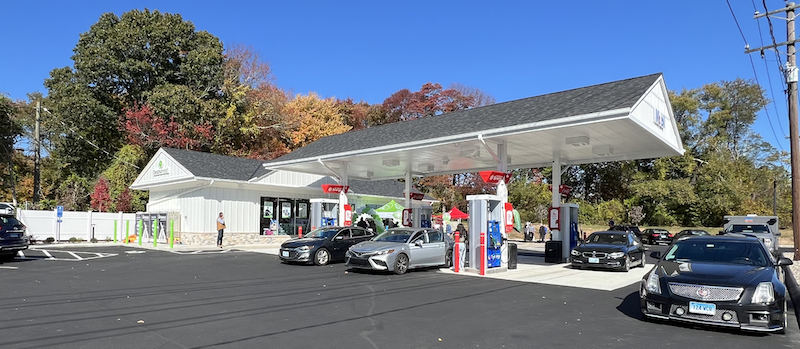
The exterior of the renovated Chestnut Market at 85 Halls Rd. in Old Lyme as seen in a 2024 file photo.
OLD LYME–Gas stations will be officially excised from the local zoning regulations, effective Aug. 11.
The Zoning Commission on Monday voted unanimously to amend the regulations to strike gas stations from the list of businesses that can operate in town.
Land Use Coordinator Eric Knapp said that means the existing four gas stations in town will remain, but no more will be allowed.
Gas stations were previously confined to Halls Road and certain parts of Shore Road.
Applications for new or improved gas stations are controversial in a town where residents have long objected to development that would entice drivers to get off Interstate 95 rather than continuing on to points north or south.
There was no comment at Monday evening’s public hearing.
The Planning Commission in a unanimous vote last month found the move consistent with the town’s Plan of Conservation and Development. The document, updated every 10 years, is meant to guide the community’s growth based on the vision of those who live there.
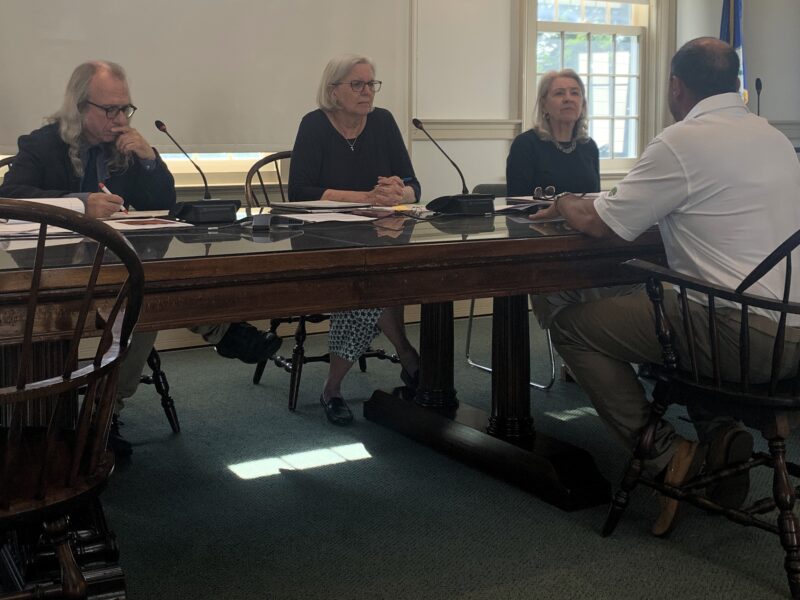
Old Lyme Water Pollution Control Authority Chairman Steve Cinami addresses a $7.6 million bond authorization request for sewers to First Selectwoman Martha Shoemaker, center, Selectman Jim Lampos, left, and Selectwoman Jude Read, right.
OLD LYME–6/22 UPDATED: Headline amended: Six years ago, a $9.5 million request to install sewers in the Sound View Beach area got the go-ahead from voters at a town-wide referendum – but the project stalled.
Now, amid inflation exacerbated by the COVID pandemic and other factors, the Old Lyme Water Pollution Control Authority (WPCA) is back with a request for another $7.6 million.
The state-led, decades-long charge to clean up Long Island Sound by ridding the area of septic systems involves a plan to require residents of three private beach associations and the public Sound View Beach community to install sewers. Continued concerns about the cost of the project and successive rounds of construction bids coming in higher than anticipated have dragged out the process.
Steve Cinami, chairman of the Old Lyme WPCA, visited the Board of Selectmen and Board of Finance this week to plead for approval to go to referendum for the bond authorization necessary to support the Sound View portion of the project. But selectmen balked at the lack of information about how the project will affect the Sound View residents who will have to repay the loan.
Old Lyme officials all along have said the cost of the Sound View project will be borne by the system’s users, not the town’s tax base.
This time around, significant additional funding from the state and federal government will leave those users responsible for about $8.5 million of the $17.06 million project, which Cinami has emphasized is less than the amount requested at the 2019 referendum.
He said the new numbers shake out to about $26,000 over 20 years, or $1,932 per year, for a property owner whose house has one bathroom, a kitchen, and four bedrooms or less.
In August of last year – before the latest round of bids came back and before state and federal funding was secured – Cinami at a public meeting told residents the WPCA was estimating the cost to a user would be about $22,556 over 20 years, or $1,368 a year, for a similarly sized home.
Assessing ‘affordability’
Selectman Jim Lampos at Monday’s selectmen’s meeting asked for more specifics about fees in addition to the annual project payments for which users will be responsible. He said connection costs and future capital spending for infrastructure improvements in the system flowing through East Lyme into New London will affect user’s sewer bills here in Old Lyme.
“Before we go to a referendum, I think we have to give the property owners a clear idea of what the affordability is going to be,” he said. “And the taxpayers are going to want to know this before going to a referendum. They’re going to ask for it.”
Cinami estimated the average yearly fee would be around $500 per year in the Sound View area. Beyond that, he said he would have to “try” to develop a rough cost structure.
State Department of Energy and Environmental Protection (DEEP) Project Engineer Carlos Esguerra last year said the agency sets the amount that residents can reasonably be expected to spend at 2% of the town’s median income, which he identified at the time as $122,000. That equated to $2,440 a year.
There is also a state law specifying a town cannot assess property owners for any amount higher than the percent increase in the property value attributed to the sewers. He said an assessor hired by the Old Lyme WPCA before the previous referendum estimated sewers would increase home values between 10 to 12%.
Documents from the Sound View Coalition, a grassroots group opposing the sewer project, show an assessor hired in 2020 by the group found sewers would increase residential property values by 7% and commercial properties by 10%.
Cinami, who has been criticized for his abrasive manner at meetings, also heard complaints at Monday’s meeting from Shoemaker and Old Lyme WPCA member Dennis Melluzzo about the chairman’s alleged attempts to quell questions and dissent.
Shoemaker said she was made to feel uncomfortable asking questions at the June WPCA meeting, while Melluzzo described feeling disrespected by Cinami while speaking up at last month’s WPCA meeting.
Cinami said he was just trying to run an efficient meeting.
“I feel, maybe it’s a misperception, but I feel as though I’m trying to get stuff across and I’m interrupted on a constant basis by members.”
He told Shoemaker he was sorry if she took offense, and said he owed Melluzzo an apology as well.
Capital Costs
At Tuesday’s finance board meeting, member David Kelsey expressed concern about the financial impact of any large-scale capital upgrades that could happen in the future at the New London wastewater treatment plant into which Old Lyme’s sewage will flow.
He said he’s heard for the past 10 years that DEEP was pushing for the installation of sewers in Old Lyme “because they wanted more users to spread the cost of upgrades in New London.”
Cinami said he wasn’t aware that the city was on the verge of any major capital projects.
New London Director of Public Utilities Joseph Lanzafame in a Wednesday phone call disputed Kelsey’s characterization of the situation.
“There’s no truth to that. Not from our standpoint,” he said. “Somebody else may have other motivations, but from our standpoint, the contribution that Old Lyme is going to give towards the facility is very marginal.”
A contract between New London and the four beach communities signed late last year calls for the beach associations to pay 1.2% of annual treatment plant capital costs and the town to pay 0.5%.
He estimated the city has spent $15 million over the past 10 years, but could not predict what the future holds in store.
“But as far as major upgrades, I mean, we’re not looking at hundreds of millions of dollars of work to be done,” he said.
He said the city does not have plans to upgrade the plant to be able to handle additional flow, which he described as an extremely difficult undertaking. But if that kind of upgrade did happen, he added that Old Lyme ratepayers would not be affected unless the beach associations or the town wanted to purchase some of the increased capacity.
The current contract with New London allows the beach associations to send up to 120,000 gallons of sewage per day to the treatment plant and the town to send up to 50,000. They have the right to purchase up to an additional 130,000 gallons per day as more people in the beach communities tie into the system.
Lanzafame said he’ll be happy if Old Lyme doesn’t ask for additional capacity in the future.
“I mean, I’m going to be quite frank. That’s just what it is. Wastewater capacity is a big deal, and it’s just not unlimited,” he said.
Back at the finance board meeting, Kelsey predicted the costs to each user – including the minimum $1,932 payment homeowners will need to pay for 20 years, the cost of tying into the system, the annual fees and the increased tax bills from their new property values – are likely to result in angry residents.
“It’s not going to be pleasant when all these numbers come out, is my basic point,” he said.
While Cinami acknowledged residents in the affected areas will be required to hook up to the system, he added a caveat.
“There are some new (septic) systems down there that cost sixty thousand dollars; We will probably not have them hook up immediately,” he said. “But any any system that’s in variance, which is, I would say, 97% of all the systems down there, will have to hook up.”
Next Steps
In addition to asking for more information on the financial impact for Sound View residents, the Board of Selectmen emphasized that the details of a Cost Sharing Agreement between the beach associations and the town must be finalized before they will ask residents to authorize more spending at a referendum.
Another issue still outstanding revolves around the portions of the sewer project to be undertaken by the Miami Beach and Old Lyme Shores Beach Associations, which Cinami said have not yet gone out to bid. He said the beach communities’ project officials, who are waiting for approval by the state DEEP before opening the bid process, are hoping to make their selections by the end of July.
Cinami assured selectmen that winning bids received earlier this year for the Sound View work will remain valid through October, though he acknowledged the bidder selected to build the system’s shared pump station has not formally committed to keep his bid open that long.
Shoemaker said Cinami’s request to schedule a referendum for August 14 won’t be possible because the traditional polling location in the middle school is being renovated and will not be available.
New Pier Provides Alternate Fishing Location While Old Lyme Boardwalk Closed During Construction of New Connecticut River Bridge
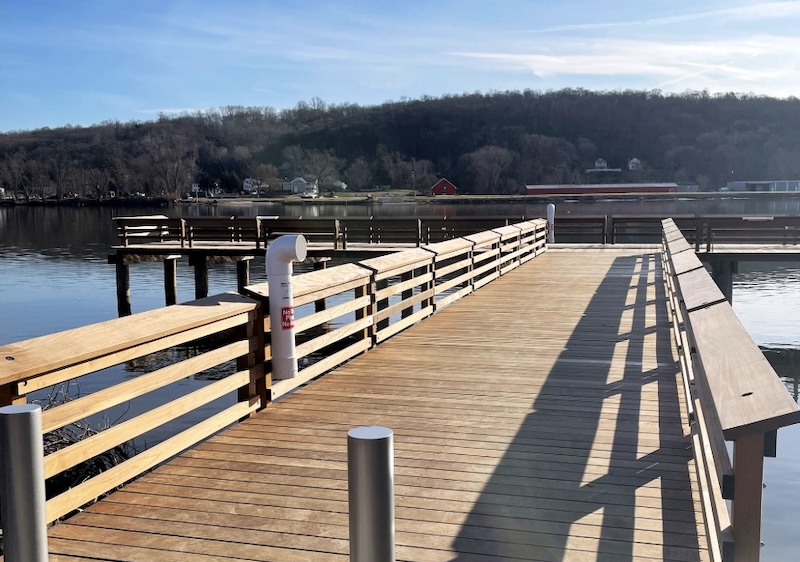
The new pier at Eagle Landing State Park in Haddam provides an alternative to the one at Ferry Landing State Park in Old Lyme, which is closed at least until 2030. Photo courtesy of Amtrak.
OLD LYME–The state Department of Energy and Environmental Protection (DEEP) has announced the opening of the pier at Eagle Landing State Park in Haddam as an alternate fishing location for local anglers and outdoor enthusiasts who have been displaced by the construction of the new Connecticut River Bridge between Old Lyme and Old Saybrook.
The DEEP in a press release said Ferry Landing Pier/Boardwalk in Old Lyme is closed to make way for Amtrak’s construction of a new Connecticut River Bridge between Old Lyme and Old Saybrook.
An announcement posted on the Old Lyme website earlier this month said reconstruction of the pier at the state park in Haddam was undertaken by Amtrak in anticipation of the temporary closure of the Ferry Landing Pier.
The DEEP said the new pier at Eagle Landing State Park, and Amtrak’s commitment to build it, resulted from public feedback during the environmental review phase of the Connecticut River Bridge Project.
This $1.3 billion project broke ground in September. It’s supported by an $826.64 million grant from the Federal Railroad Administration. The remaining portion will be funded by Amtrak and the State of Connecticut.
According to Amtrak, the bridge project will replace the existing 118-year-old bridge with a modern moveable bridge that will support a maximum train operating speed of 70 mph – a 55 percent increase from today’s maximum speed of 45 mph.
Maritime navigation and safety will also improve due to the increased vertical clearance of the new bridge compared to the existing bridge, the company said.
The DEEP said Amtrak will build an improved, fully accessible observation deck more than 1,000 feet long at Ferry Landing State Park in 2029, once the new Connecticut River Bridge is in service and the old bridge has been demolished.
The Ferry Landing Pier and boardwalk upgrade is expected to open in 2030 or 2031, according to the DEEP. Plans call for a 50% wider walkway with improved accessibility in a location slightly west of the existing site. The state agency promised better access to deep water, and stronger, more durable concrete piles for more support compared to the wooden piles used for the original structure.