

Talking Transportation: Jim Cameron Finally Boards the NextGen Acela

Jim Cameron

I finally had a chance to ride the new NextGen Acela and I have to admit, I was wrong: This really is Amtrak’s train of the future.

But here are a few tips for making your next ride frictionless. These tips are mostly about riding Acela, but many hold true for slower Northeast Corridor trains.

WHAT’S A NEXTGEN ACELA? These are the new trains built by Alstom, previously known as Avelia Liberty. They hold 25% more passengers than the existing Acela trains and can, at least for 32 miles with fast, straight track in New Jersey, travel up to 160 mph compared to the old Acela’s 150 mph.

Just a few of the new trains are running so far but 26 are more on the way, replacing the older Acelas, which will be retired.

BOOK EARLY: We booked our Acela tickets about two weeks in advance and scored senior fares (10% discount) of “only” $204 one way from Stamford to Washington DC. Waiting at the station to board I heard the ticket agent startle a younger passenger seeking a ticket to DC by quoting her the same-day walk-up fare of $402 one way. A minute later the helpful agent said she could make the same trip a half-hour later (on the slower train) for half as much.

RESERVED SEATS: Seats on all Acelas are now reserved. But don’t trust the seating chart you’ll see online. When we boarded the train we found our seats faced backwards (not in the direction of travel) and had no window. But a helpful conductor found us better seats right on his phone. Consult a third-party seating chart to make sure you get the seats you want.

If you want the Quiet Car, be aware there’s only one car with 59 seats. Otherwise you’ll be enjoying the “finance bro” across the aisle making deals enroute by phone.

BOARDING ADVICE: The cars on the NextGen Acela are much shorter than the regular trains, so position yourself carefully on the platform to minimize walking once the train arrives. I noticed Amtrak staff at each station helping minimize “dwell time” for the train by getting passengers off and on as quickly as possible.

USE THE RED CAPS: If your train originates at your station, like our return from DC, get priority pre-boarding with the help of the Red Caps. Avoiding the throngs queueing to board is worth a tip, even with reserved seats.

HOW’S THE RIDE?: In a word, spectacular. All the Acelas run no faster than Metro-North in Connecticut, but south of NYC it’s a whole different railroad. True to its promise our train hit 159 mph on the straightaways in New Jersey and the ride overall was very smooth, unlike the 25-year-old Amfleet cars or the 50-year-old Amfleet cars on the slower trains.

SERVICE: Enroute the cabin cleaning staff came around to collect trash and Café Car items were available (credit cards only) from a cart moving between the cars. The Café Car itself looked great with self-serve windows displaying the food items. But there are no tables to sit down, just some counters where you can perch and munch.

The food offerings were “premium” and priced accordingly.

The on-board Wi-Fi was spectacular… truly 5G.

ON-TIME?: Like many Amtrak trains, even the super-Acela tends to run a few minutes late in Connecticut because of Metro-North traffic. We departed about ten minutes late from Stamford but, because the schedule is padded, were on time out of Penn Station NY and arrived early in Washington DC.

IS IT WORTH TRYING?: Yes, at least once. Amtrak has a lot riding on these new trainsets, so try one soon and you’ll see what the future will be like.

Editor’s Notes: i) Jim Cameron is the founder of the Commuter Action Group and advocates for Connecticut rail riders. He writes a weekly column called ‘Talking Transportation,’ which is published by a number of publications in the state.
ii) ”Talking Transportation” recently won first place in the general column/commentary category in the Connecticut Society of Professional Journalists Excellence in Journalism Contest.

“Talking Transportation:’ Amtrak’s ‘New’ Acela Train Service Starts Aug. 28, But Was it Worth the Wait?

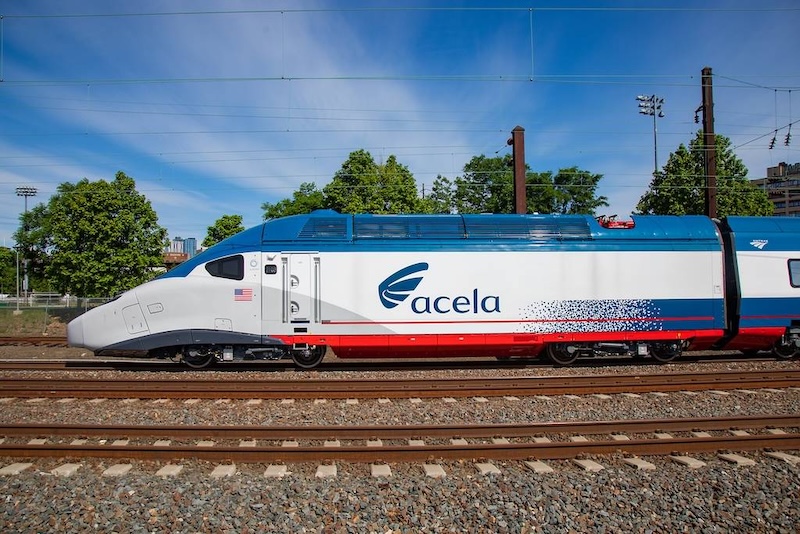
On Aug. 28, the NextGen Acela (pictured above) will start running between Washington and Boston. Photo courtesy of Amtrak.
Jim Cameron

Amtrak’s oldest new trains are arriving shortly: the NextGen Acela (finally) starts running between Washington and Boston on August 28.

Ordered in 2016 for $1.8 billion, the first trains arrived from the Alstom assembly facility in Hornell NY in 2020.  That meant jobs there for 1300 workers and business for 180 suppliers across 29 states.  These new trains are 95% “made in the USA”.

Like any new trains, the new Acelas required extensive testing, especially for crash worthiness and compatibility with the aging tracks and wires in the Northeast Corridor.  That’s when the problems started.

Even before field testing, it took Amtrak 14 attempts to finally pass computer simulations.  In road testing, windows shattered, there was water corrosion and leaks in the hydraulic tilting system.  Road testing also found issues with the trains’ wheels’ traction on our old tracks. And the pantographs (drawing electric power from the overhead catenary wires) kept losing contact at high speed.  Some 129 field modifications were ordered.  

That’s why these sleek new trains are about three or four years “late”.  But was it worth the wait?

Twenty-eight train sets are on order but only five will be in service to start, the rest going into service by 2027.  They’ll replace the first-gen Acelas which have been running for up to 27 years, accumulating millions of miles of travel.

Despite constant maintenance and repairs, the older Acelas have been showing their age.  Reports indicate that some train sets have been stored, cannibalized for spare parts to keep the other aging trains running.    Eventually the old trains will all be scrapped.  

Is the NextGen Acela ready for prime time?  We shall see. But beware of the PR hype coming your way from Amtrak, proclaiming NextGen Acela as the savior of American passenger rail.

Make no mistake… these are nice new trains.  The train sets will be bigger: nine cars vs.six, carrying up to 386 passengers vs 304.  And the new Acela trains can add three more cars if needed while the old Acela consists were permanently coupled.  And with more train sets, there will hopefully be a greater frequency of service.  

The interior of the new cars looks sweet… comfy seats, fold-down tables, power plugs and more wheelchair spots.  There will be a new Café Car and promised (free) 5G Wi-Fi connectivity.  Seating will be 2 x 2 in Business Class (there is no coach class) and 2 x 1 in First Class with meals there brought to your seat. The windows will be larger and the ride is said to be smoother, even at top speed.

But here’s where the hyperbole hits the tracks.

The NextGen Acelas are being described as offering “160 mph” speeds.  But there are only 32 miles of the 457 mile tracks from DC to Boston that can handle those speeds… four miles in New Jersey and 28 miles in Rhode Island and Massachusetts.  

In Connecticut the new Acelas, like the old ones, will go no faster than Metro-North… maybe up to 90 mph in a few stretches.  You can blame our many bridges and curving tracks for the lower speed limits.

There is no word yet on fares, though they will probably match existing Acela fares.  This is already an expensive ride:  one-way from Stamford to Boston is about $330 in Business class and $573 in First (compared to $134 and $227 on the slower, 50+ year old Amfleet Northeast Regional trains).  Running time on Acela, about three hours.  On the older trains, three and a half hours.

Are those fares worth the promised speed and comfort?  Maybe if you’re on an expense account.  But I’ll take it for a spin (on my own dime) and will let you know.

Editor’s Notes: i) Jim Cameron is the founder of the Commuter Action Group and advocates for Connecticut rail riders. He writes a weekly column called ‘Talking Transportation,’ which is published by a number of publications in the state.
ii) ”Talking Transportation” recently won first place in the general column/commentary category in the Connecticut Society of Professional Journalists Excellence in Journalism Contest.
Ferry Landing Pier/Boardwalk Closes in Old Lyme, Another Pier Opens in Haddam

New Pier Provides Alternate Fishing Location While Old Lyme Boardwalk Closed During Construction of New Connecticut River Bridge

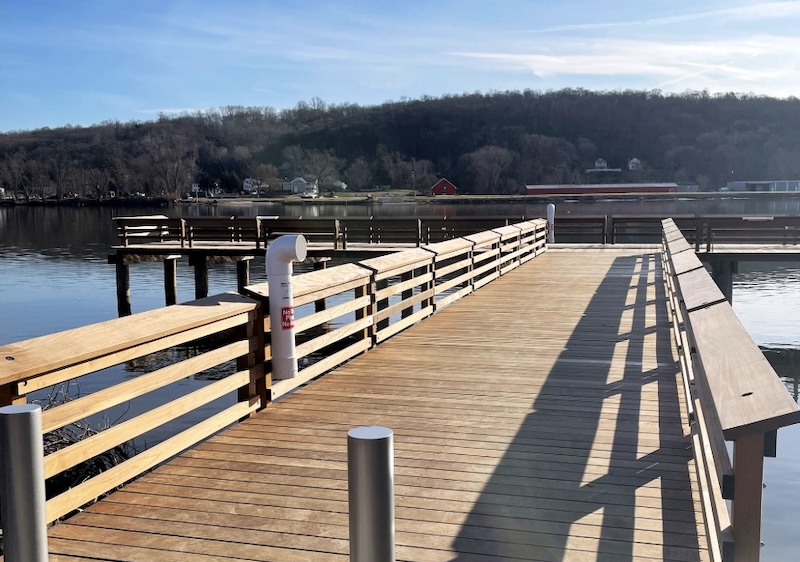
The new pier at Eagle Landing State Park in Haddam provides an alternative to the one at Ferry Landing State Park in Old Lyme, which is closed at least until 2030. Photo courtesy of Amtrak.

OLD LYME–The state Department of Energy and Environmental Protection (DEEP) has announced the opening of the pier at Eagle Landing State Park in Haddam as an alternate fishing location for local anglers and outdoor enthusiasts who have been displaced by the construction of the new Connecticut River Bridge between Old Lyme and Old Saybrook. 

The DEEP in a press release said Ferry Landing Pier/Boardwalk in Old Lyme is closed to make way for Amtrak’s construction of a new Connecticut River Bridge between Old Lyme and Old Saybrook.

An announcement posted on the Old Lyme website earlier this month said reconstruction of the pier at the state park in Haddam was undertaken by Amtrak in anticipation of the temporary closure of the Ferry Landing Pier. 

The DEEP said the new pier at Eagle Landing State Park, and Amtrak’s commitment to build it, resulted from public feedback during the environmental review phase of the Connecticut River Bridge Project. 

This $1.3 billion project broke ground in September. It’s supported by an $826.64 million grant from the Federal Railroad Administration. The remaining portion will be funded by Amtrak and the State of Connecticut.

According to Amtrak, the bridge project will replace the existing 118-year-old bridge with a modern moveable bridge that will support a maximum train operating speed of 70 mph – a 55 percent increase from today’s maximum speed of 45 mph. 

Maritime navigation and safety will also improve due to the increased vertical clearance of the new bridge compared to the existing bridge, the company said.

The DEEP said Amtrak will build an improved, fully accessible observation deck more than 1,000 feet long at Ferry Landing State Park in 2029, once the new Connecticut River Bridge is in service and the old bridge has been demolished. 

The Ferry Landing Pier and boardwalk upgrade is expected to open in 2030 or 2031, according to the DEEP. Plans call for a 50% wider walkway with improved accessibility in a location slightly west of the existing site. The state agency promised better access to deep water, and stronger, more durable concrete piles for more support compared to the wooden piles used for the original structure.