On July 9, Old Lyme resident Amy Gamerman will discuss her first book, “The Crazies: The Cattleman, the Wind Prospector, and a War Out West” in a presentation at the Old Lyme-Phoebe Griffin Noyes Library.
OLD LYME—On Wednesday, July 9, at 6:30 p.m. local writer and Old Lyme resident Amy Gamerman will discuss her newly-published and already highly-acclaimed book,The Crazies: The Cattleman, the Wind Prospector, and a War Out West at Old Lyme’s Phoebe Griffin Noyes Library.
Copies of the book will be available for purchase to benefit the Library.
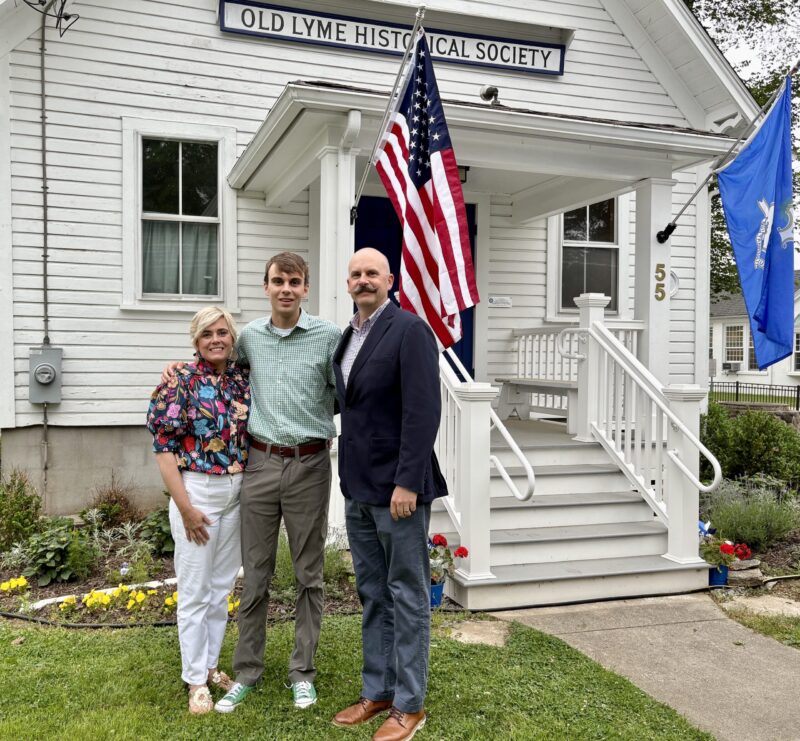
Readers may know Gamerman better as Amy Conley, Old Lyme resident and mother of Max, Sarah, Jack and Gloria. Her husband is writer and editor Kevin Conley,
A true story of conflict over competing interests in the rangeland of Montana, The Crazies combines a remarkable cast, a compelling setting, and an engaging story line.
But the book is not fiction—it is based on hard, solid fact and is truly a tale for our times.
The book has been drawing critical praise.
Elizabeth Kolbert, Pulitzer Prize-winning author of The Sixth Extinction, described The Crazies as, “A fascinating story about the new energy economy. If you want to understand why change does—or doesn’t—happen in America, read The Crazies.”
Gamerman is a longtime contributor to the WallStreet Journal‘s Mansion section. Prior to that, she was the WSJ’’s drama critic and a staff writer on the Leisure & Arts page.
Her work has been recognized with multiple awards from the National Association of Real Estate Editors. Her writing has also appeared in Vogue, Redbook and Departures. She attended Yale University and King’s College, Cambridge.
The Phoebe Griffin Noyes Library is located at 2 Library Lane, Old Lyme, CT 06371.
Editor’s Notes: i) On Sunday, July 6, we will publish an article by Elizabeth Regan about Gamerman and her book based on an interview Regan conducted with Gamerman earlier this week.
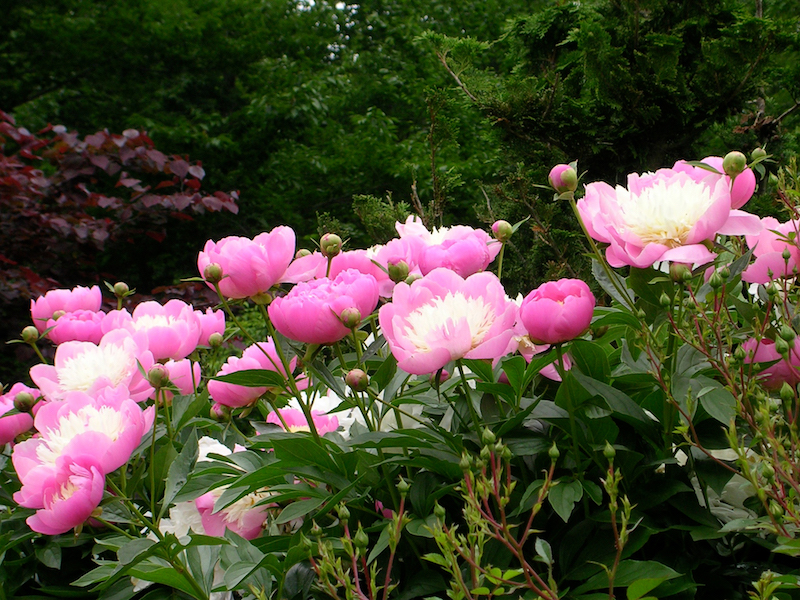
Peonies need careful attention at this time of year to create a stunning display like this. File photo.
Maureen Haseley-Jones is “The English Lady.”
We have had a few cool nights recently which are just wonderful, sleeping with the windows open. I cannot remember the last time we had a real spring like we experienced this year, with plenty of gentle rain. This beneficial rain is wonderful for all the spring plant growth and such a pleasure freshening the air for us all.
I am so in awe of the miracle of Mother Nature and the symbiotic relationship between plants and all of God’s creatures. When I looked out of my window from my old home in Old Lyme, a few years ago, I could see the buds opening on my long border of peonies which had been planted by the original homeowner in the early nineteen hundreds. As I looked, I recalled the symbiotic relationship between ants and peonies.
A question often asked of me is “Maureen, should I worry about ants on my peonies?” My answer, “That’s not a problem, lots of ants on the peonies just illustrate that you have healthy plants with big buds that are producing bountiful nectar which attracts the ants.” Ants are very useful creatures; their presence indicates that there are aphids and whiteflies in that area of your garden and the ants feed on these troublesome insects.
Make sure that your peonies get plenty of water, also check the PH of the soil which should register between 6.5 and 7.0. In early June, I pinched off the side buds of the Peonies, as by doing this, you will produce big terminal blooms on the plant. When the bloom has passed, apply a light application of composted manure to encourage the soil animals and the manure bacteria to keep your soil healthy.
A word of caution: Do not cut the peonies to about six inches from the ground, until after the first frost in November. Before then, in September, plant or transplant Peonies to barely cover the pink eyes on the roots with soil, just enough so the plant does not fall over.
Now, in late spring, many insect pests are appearing in large numbers in your garden. I just looked out of my patio door and noticed that it is past time for me to tend my perennial border there where my Nepeta, Salvia, daylilies and other perennials are getting inundated with weeds and insects of every denomination. I am the answer to the weeds, but a useful creature against the pests is the lowly toad.
I suggest putting some toad houses in and around your borders. You can purchase toad houses from the garden center, or you can use an old clay pot that is cracked and make sure that the crack is two to four inches wide to act as a door so the toad can enter. In addition, put a small saucer as a floor under the pot with some rocks, and keep the rocks damp, so that your friendly toad enjoying their toad abode will settle in comfortably and snack on all the pesky bugs.
June is always the month for roses.
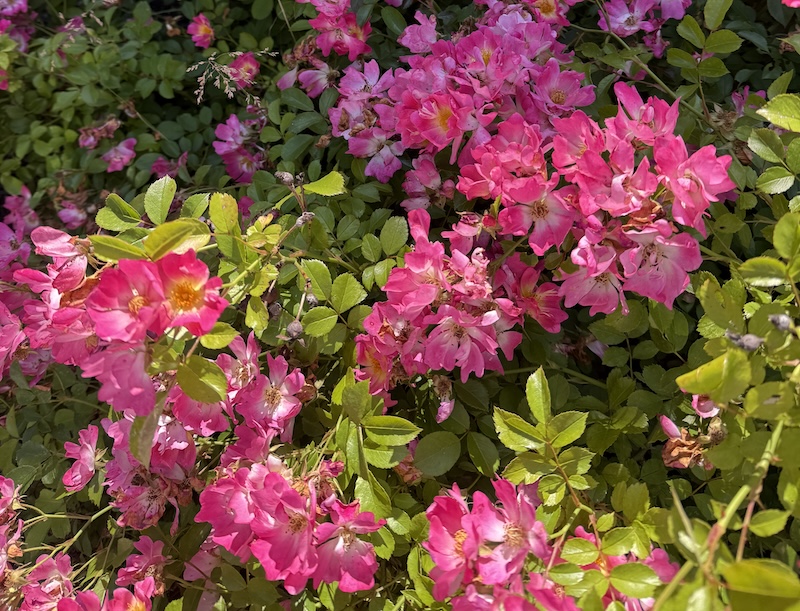
June is the month when roses begin to bloom. I have always used David Austin roses in my garden and in my landscape designs. I find David Austin roses are the most trouble-free roses and offer great rewards; among those rewards are that they are repeat bloomers with wonderful fragrances and colors.
Some of my favorite David Austin roses are:
‘A Shropshire Lad,’ a soft peachy pink.
‘Abraham Darby’ with petals that are a blend of apricot and yellow.
‘Fair Bianca,’ a pure white.
‘Heritage,’ which opens as a soft clear pink.
My favorite is ‘Evelyn’. Evelyn has a large apricot saucer shaped bloom with a fragrance that is second to none offering a luscious fruity tone, of fresh peaches and apricots.
Feed your roses with composted manure, keeping the manure and mulch about six inches away from the base of the rose and add a few more inches of manure once a month until mid-August. At that time stop feeding so the roses can gently move into a much-needed slow dormancy. No other rose food is required except the manure and the mulch which attracts carbon from the atmosphere which in turn produces the humus component.
Unfortunately, Japanese beetles are attracted to roses, so I suggest acquiring Japanese beetle traps which should be placed far away from your borders on the perimeter of the property. If you find some Japanese beetles have escaped the traps and landed on the rose, then in the early morning, quietly take a white sheet and place it under the rose and gently shake the bush. You will find the beetles do not awaken and will fall onto the sheet, which can be gathered up and the beetles dumped into your closed trash bin.
A tip for keeping cut roses fresh is to cut the roses in the early morning, just above a five-leaf cluster, and place stems in a container of lukewarm water. Then, when indoors, recut the stems at a one and half inch angular cut, under warm running water, and place cut roses in a vase filled with warm water. Do not remove the thorns from cut roses, removing the thorns reduces their indoor life by as much as three days.
Add peat moss to blue hydrangeas to increase the intensity of their color.
HYDRANGEAS: These need plenty of water, as before they were introduced to our gardens they flourished in wetland areas. Apply aged manure around the hydrangeas, which should be planted in full sun and spaced at least four feet apart for good ventilation to prevent mildew from occurring. If you have blue hydrangea macrophylla and want a more vibrant shade of blue, add some peat moss on top of the manure. The acidity in the peat will produce a lovely deep shade of blue.
WISTERIA: Regular pruning through spring and summer is the main factor to help this arrogant vine to flower. Prune several times during the growing season, which means pruning every two weeks by at least six inches on each stem.
CLEMATIS WILT: If you have this problem with the clematis, you will notice it early because the shoots wilt and die. This disease is impossible to cure, as it is soil born. Soil born means that it is not possible to plant another clematis of that variety in that area of the garden. However, you can plant the viticella variety; Clematis viticella are vigorous, free flowering blooms and are not susceptible to wilt. Some good choices of this variety are Blue Belle, Etoile Violette, both are purple and Huldine, which is white.
MULCHING: Mulch your gardens this month when the soil has warmed up to 55 degrees. As you perform that task, be careful around trees. Apply the mulch at least six inches from the base of the trunk; any closer can cause rot and disease to occur in the bark and roots of the tree.
Also, trees that are mulched too close to the trunk invite mice and other rodents to inhabit the tree and gnaw on the trunk. Your garden can be mulched to a depth of between two and three inches with a natural fine dark brown hardwood mulch. Please do not use dyed RED MULCH, which is poisonous. Keep your garden natural, without any poisonous herbicides and pesticides.
CONTAINER GARDENS: If you have room for one pot you have room for a number placed close together with different shapes and sizes creates your own miniature garden. Apart from regular pots, the most unexpected objects make interesting containers.
A friend who cut down trees this past winter left the stumps and hollowed them out to make containers. One large and two smaller stumps together made an interesting combo.
Also check in your basement, shed or barn to see if you have an old wheelbarrow, even if the wheelbarrow has a missing wheel like mine, which I painted blue with eco-conscious paint. Then I placed it near the kitchen door filled with bright colored vines, miniature grasses and small perennials.
Or you may unearth a large ceramic jar like the one I came across in one of the original cattle stalls of the stone and soil floored barn. This antique three-foot-tall ceramic vinegar container, replete with a hole where the vinegar tap was inserted, is ideal for drainage. I planted the jar with multi-colored perennials, which looked great on my newly painted blue bench alongside my red milk shed.
LAWN CARE: Do not forget to add organic grub control through July, so that you help to keep down the mole infestation; remember no grubs means less food for the moles.
POWDERY MILDEW: Keep an eye open for powdery mildew, especially after rain when humidity returns. My recipe for powdery mildew is as follows: In a sprayer, mix two tablespoons of baking soda, one tablespoon of vegetable or horticultural oil in a gallon of water and spray the mildew.
Hydrangeas and Summer phlox are particularly prone to develop this problem. To help counteract the mildew problem, I recommend using phlox Miss Lingard or phlox David, which are the white phlox and are the most mildew resistant.
Monarda, commonly known as bee balm, are also affected by mildew, and the one I have found to be the most resistant is “Cambridge Scarlet.”
I hope these tips are useful to you during this busy time of year in the garden. Remember to stretch, hydrate and enjoy the burgeoning promise of your garden and I’ll see you next month. If you would like some more gardening advice, contact my son Ian at LlandscapesbyIan.com. I am sure you would enjoy speaking with him as he is full of knowledge and, as the saying goes, “The apple does not fall far from the tree.”
About the author: Maureen Haseley-Jones is a member of a family of renowned horticultural artisans, whose landscaping heritage dates back to the 17th century. She is one of the founders, together with her son Ian, of The English Lady Landscape and Home Company. Maureen and Ian are landscape designers and garden experts who believe that everyone deserves to live in an eco-conscious environment and enjoy the pleasure that it brings. Maureen learned her design skills from both her mother and grandmother, and honed her horticultural and construction skills while working in the family nursery and landscape business in the U.K. Her formal horticultural training was undertaken at the Royal Botanic Gardens at Kew in Surrey.
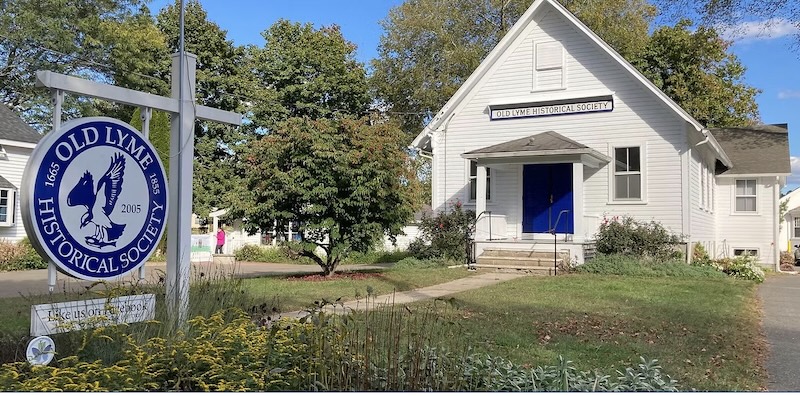
The Old Lyme Historical Society Inc.’s scholarship presentation was held at the Society’s building on Lyme Street.
OLD LYME—The Old Lyme Historical Society Inc. this week announced the recipients of two Carol Noyes Winters Scholarships. The scholarships are given to outstanding students from Lyme and Old Lyme, who intend to study history in college.
The society in a press release said scholarships were presented to Lyme-Old Lyme High School (LOLHS) seniors Chloe Datum and Simon Karpinski.
Both students were involved with the National High School Mock Trial competition as “major players” in the LOLHS team’s two state championships, according to the historical society.
Chloe Datum, center, with parents Jennifer and Michael Datum. Photo courtesy of James Meehan.
Chloe Datum is the daughter of Jennifer and Michael Datum. She hopes that her study of history will guide her toward a career in the the area of policy and law. Datum will attend George Washington University in Washington, D.C.
Simon Karpinski, center, with parents Sarah and Ben Karpinski. Photo courtesy of James Meehan.
Simon Karpinski is the son of Sarah and Ben Karpinski. He was the Valedictorian of the LOLHS Class of 2025 and hopes that his study of history will help him to attend law school and eventually practice law. He hopes to one day serve in public office. Karpinski will attend Harvard University in Cambridge, Mass.
Thomas Jerald “Jerry” Moore left this world peacefully on June 21, 2025, surrounded by his family. He was a loving son, husband, father, grandfather, and friend, and his impact on those who had the good fortune of knowing him was profound …
Jerry[‘s] true passion was his family. His wife of 63 years, Gail, and his daughters, Tracy Moore Chandler, Lesley Owens Moore, and Caroline Moore Broadfoot, were the center of his world … His love and devotion knew no bounds and included sons-in-law, Chisholm Chandler and Elliot Broadfoot, and nine grandchildren, Zachary, Halle, Rusty and Lily Chandler, Thomas Moore and Jack Montmeat, and Sumner, Marshall and CeCe Broadfoot …
Finally, he cherished the many wonderful friendships they made in the places that he and Gail called home including West Hartford, Palm City, Fayetteville, and most recently, Old Lyme. Their summer home at Old Black Point was uniquely special, as Jerry was determined to have a place for his daughters and their families to come home to no matter where his business career took them.
A celebration of Jerry’s life will be held for family and friends at the First Congregational Church in Old Lyme, CT on Monday, June 30th at 2pm. There will be a reception at The Old Lyme Inn immediately following the service.
OLD LYME –Photographer Beth Green’s Impressions of Connecticut exhibit will run at Saint Ann’s Episcopal Church through Labor Day.
The exhibit, located in the church’s Griswold Room, is open Monday through Friday from 9 a.m. to 3 p.m. and on Sundays from 8 a.m. to noon.
The church in a press release said the show focuses on scenes of shoreline Connecticut and the Connecticut River Valley, from a bend in the Lieutenant River, to a red barn in snow, to sunlight on the Long Island Sound.
It also includes several of her iconic sports photographs from the 1970s, when Green became known as the first female photographer allowed in a professional sports locker room.
A printed guide to the show includes a QR code for each photograph leading to audio narration by Green. All the photographs are available for sale.
Green’s career includes work as a photographer for international wire services and then as a photo editor for Newsweek magazine. After a decade with the magazine, she switched to architectural and corporate photography with a continued focus on using her photography skills to tell stories from a female perspective.
Green describes herself as a “a very traditional photographer” from the world of film and large format photography.
“With the advent of digital photography, the use of digital manipulations in my work is minimal,” she said. “I believe in the play of light on the subject to create my images. I crop entirely in my camera and turn my camera on the world around me as it exists. Light is my paintbrush and is the tool for my artistic license. My main interest is the image as it is in the world at that moment. There is nothing new in the world, it is how you arrange it in your viewfinder and capture the image forever at that moment.”
Green has served as a guest professor at Rutgers University and Fordham University, and has taught for the New York Institute of Photography.
A portion of the proceeds will be donated to the church.