New Pier Provides Alternate Fishing Location While Old Lyme Boardwalk Closed During Construction of New Connecticut River Bridge
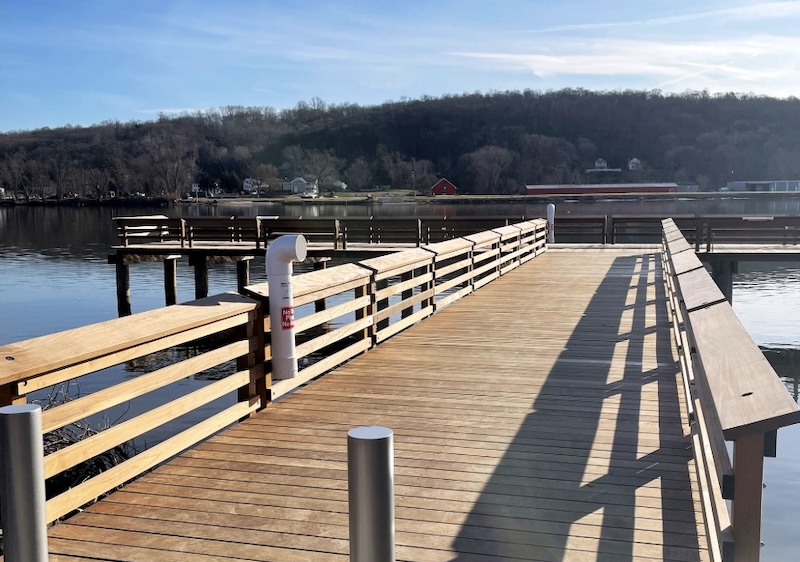
The new pier at Eagle Landing State Park in Haddam provides an alternative to the one at Ferry Landing State Park in Old Lyme, which is closed at least until 2030. Photo courtesy of Amtrak.
OLD LYME–The state Department of Energy and Environmental Protection (DEEP) has announced the opening of the pier at Eagle Landing State Park in Haddam as an alternate fishing location for local anglers and outdoor enthusiasts who have been displaced by the construction of the new Connecticut River Bridge between Old Lyme and Old Saybrook.
The DEEP in a press release said Ferry Landing Pier/Boardwalk in Old Lyme is closed to make way for Amtrak’s construction of a new Connecticut River Bridge between Old Lyme and Old Saybrook.
An announcement posted on the Old Lyme website earlier this month said reconstruction of the pier at the state park in Haddam was undertaken by Amtrak in anticipation of the temporary closure of the Ferry Landing Pier.
The DEEP said the new pier at Eagle Landing State Park, and Amtrak’s commitment to build it, resulted from public feedback during the environmental review phase of the Connecticut River Bridge Project.
This $1.3 billion project broke ground in September. It’s supported by an $826.64 million grant from the Federal Railroad Administration. The remaining portion will be funded by Amtrak and the State of Connecticut.
According to Amtrak, the bridge project will replace the existing 118-year-old bridge with a modern moveable bridge that will support a maximum train operating speed of 70 mph – a 55 percent increase from today’s maximum speed of 45 mph.
Maritime navigation and safety will also improve due to the increased vertical clearance of the new bridge compared to the existing bridge, the company said.
The DEEP said Amtrak will build an improved, fully accessible observation deck more than 1,000 feet long at Ferry Landing State Park in 2029, once the new Connecticut River Bridge is in service and the old bridge has been demolished.
The Ferry Landing Pier and boardwalk upgrade is expected to open in 2030 or 2031, according to the DEEP. Plans call for a 50% wider walkway with improved accessibility in a location slightly west of the existing site. The state agency promised better access to deep water, and stronger, more durable concrete piles for more support compared to the wooden piles used for the original structure.
Though April showers may come your way, They bring the flowers that bloom in May, So if it’s raining have no regrets, Because it isn’t raining rain you know, it’s raining violets. – Al Jolson
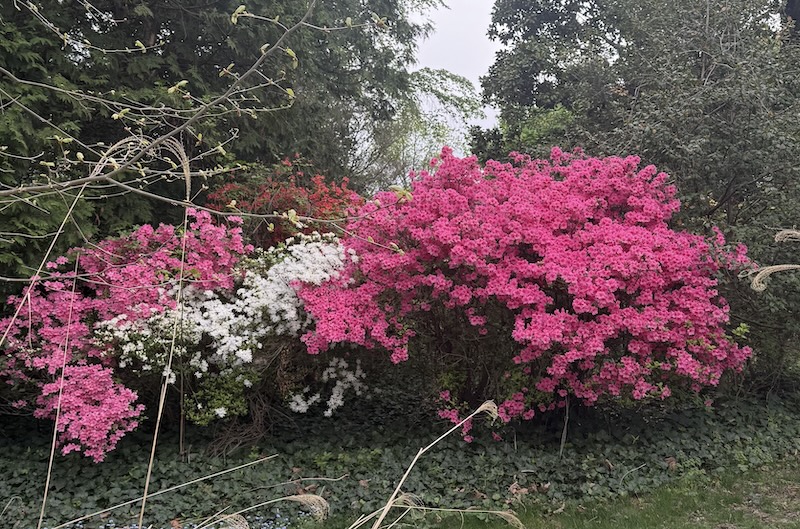
Azaleas in full bloom are a welcome sign of the approaching summer.
April was a month of activity in the garden, and our old nemesis, weeds are beginning to rear their heads, so we need to extract the little devils before they take hold and are difficult to remove.
Maureen Haseley-Jones
Having said that, I must point out the benefits of many weeds. Nettles are food for butterflies, clover extracts nitrogen from the air, which is then absorbed into the soil and the oil from jewel weed soothes poison ivy rash. The young foliage of Dandelions is great in salads and when lightly cooked it tastes like spinach with the added advantage of containing many healthy nutrients.
In this group, I do not want to forget our songbirds and other wildlife who depend on weed seeds as a food source.
WEED REMOVAL
Weeds must be pulled gently so that the weeds and roots do not break apart, because if this happens, thousands of weed seeds will reseed and you will find yourself with an endless cycle of unnecessary weeding. When careful weeding has been accomplished, apply an organic weed pre-emergent, with a corn gluten base by Bradfield Organics; this natural product will keep weeds at bay for about six weeks.
ROSES, RHODODENDRONS & MORE
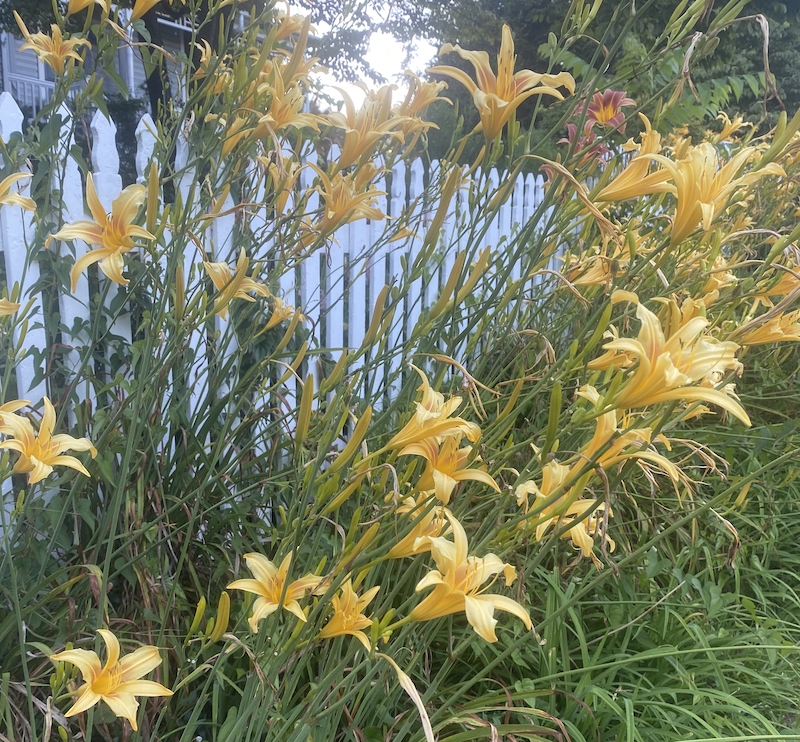
Day lilies bring a splash of color to spring gardens.
Plant bare root roses at the end of April or beginning of May and plant container roses in mid- May. In the middle of May when the soil temperature has reached 55 degrees, add manure and on top of the manure add a fine bark mulch about one foot from the base of the roses. Check my Early Spring tips to remind yourself on pruning roses.
Be careful clearing winter debris from around rhododendrons, mountain laurel and azaleas; these evergreens have shallow roots and do not appreciate having their roots exposed. If winter weather did erode soil around some roots, add soil to cover the exposed roots and at the same time resettle the plant in place. In the middle of May apply manure and fine bark mulch as well as some peat, which adds much needed acidity for evergreens.
Plant Gladioli corms at two-week intervals in late April. Planting in two- week intervals ensure you will get a succession of bloom. Plant the corms eight inches below the surface; this extra depth helps to keep the heavy blooms erect.
The Red Lily beetle will soon appear, and I suggest applying organic Neem oil on the Lilies when they are about four inches above ground, the oil helps to halt this beetle problem.
SOIL SOLARIZATION & MULCHING
This is an effective way to control many soil-borne problems, specifically the tomato blight that causes fruit rot. Covering the soil with clear plastic in the area where tomatoes are to be planted at the end of April, for one to two months can generate high enough temperatures in the top six to 12 inches of soil to kill pests, nematodes, weed seeds and many disease organisms like the tomato blight. This process has proved invaluable for home gardeners and the beneficial effects last for several seasons.
To solarize, dig a trench several inches deep around the soil bed, and spread a thin, clear plastic film (1-4mils) over the bed. Press the plastic into close contact with the soil and seal the edges by filling the trench with soil. Leave the plastic on the soil until you are ready to plant tomatoes or other vegetables in about six weeks.
With a soil thermometer checking to see when the soil temperature has reached 55 degrees, then manure all the borders with composted manure in bags from the garden center or aged manure from the bottom of the farmer’s pile, then mulch with a fine brown hardwood mulch. It is important to wait until the soil temperature has reached 55 degrees so that the valuable bacteria in the manure can work its magic in the soil.
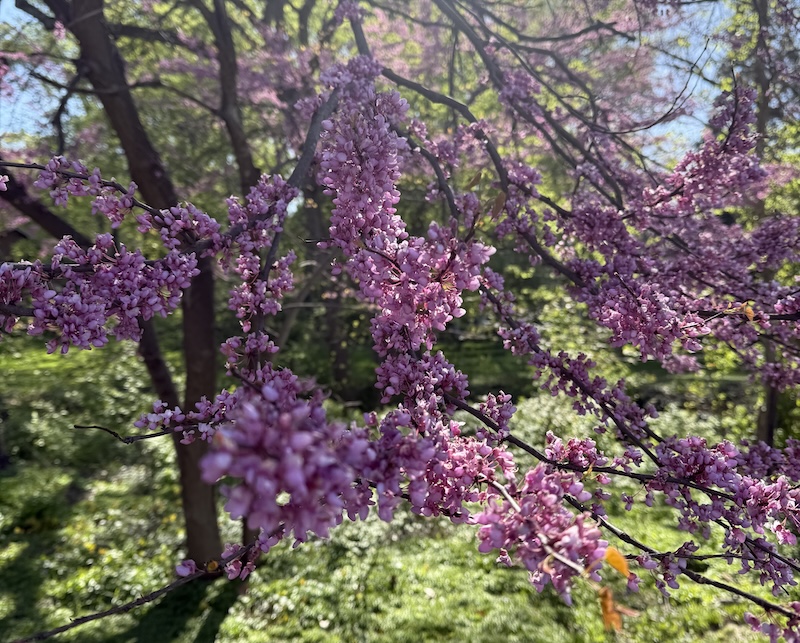
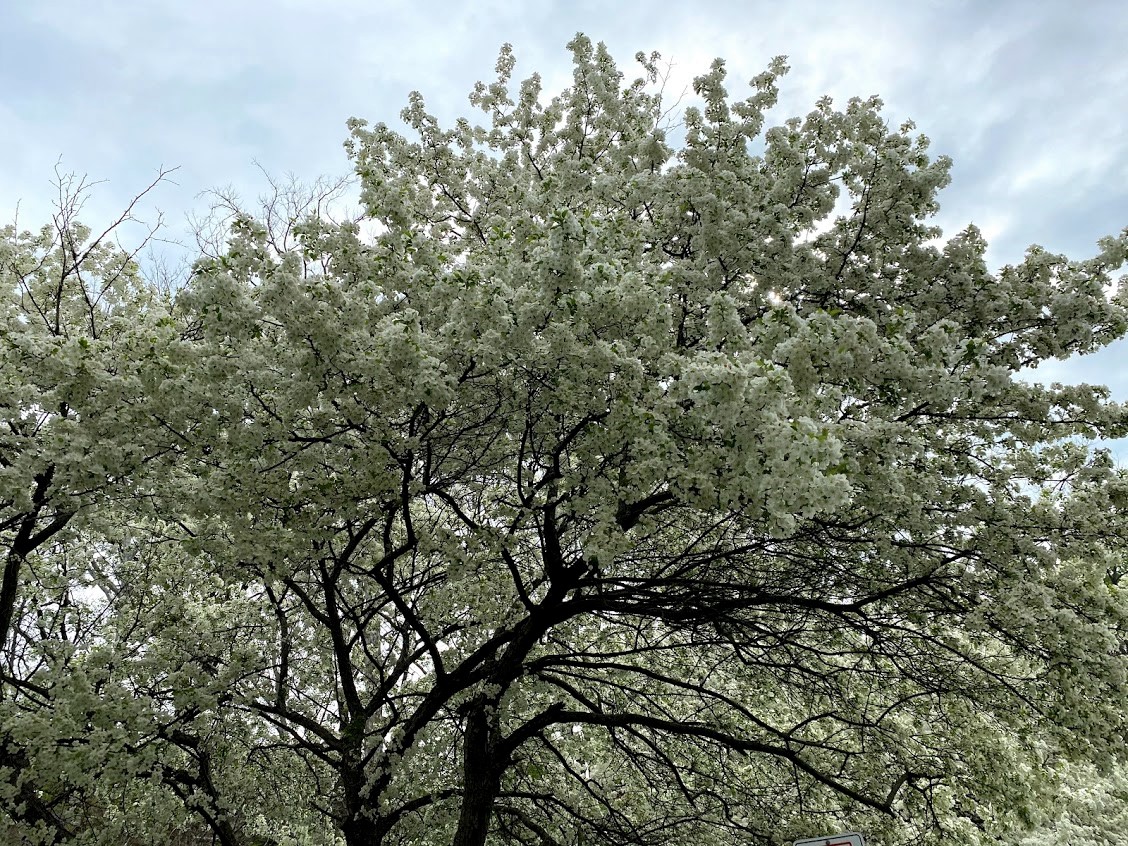
As spring temperatures rise, blossom begins to appear on trees.
In the vegetable garden, following soil preparation and planting, it is time to mulch. Mulch with composted manure that will not ‘cap,’ which means it does not form a crust like other mulches and air and water can penetrate through to the roots of the plants where it is needed for vegetable and fruit production.
If you did not apply an organic grub control on the grass in March, apply now to reduce the grubs, which is the food source for Moles; the grub control will help to cut down on the mole population.
Soil is the most important component of production in the garden; with compost, organic manure and peat to amend soil and rebuild its structure. The ratio to use is one part compost to three parts manure and apply peat to the planting mix in the ratio of one part peat to three parts manure when planting evergreens. And as mentioned above, peat adds the acidity which evergreens require.
Good soil structure assists with drainage, prevents compaction, and the rich nutrients with the amendments break down and encourage the soil animals beneath the surface to work at full capacity. In a sandy soil, humus is needed to produce micronutrients for this soil, which is the combination of manure, mulch and carbon from the atmosphere that binds the sand particles together which will produce a healthy workable soil. In heavy soil such as clay, the humus separates the clay particles which allow for air and drainage.
GROWING CONDITIONS IN LATE APRIL/EARLY MAY
These are very favorable for new plant-root development. This month is the best time to transplant evergreen shrubs and plant new evergreens. Apply composted manure and peat together with the topsoil in the planting hole. Then give the roots a workout with your hands before planting. Separating the roots in this way gives them the freedom to reach into the surrounding soil for nutrients and water remaining moist in the heat of summer.
Many years ago, when I moved into my farmhouse on the shoreline, I discovered that my soil was sandy, which is good for drainage but sadly lacking in nutrients. I began adding a few inches of manure to all planted borders in April, July and October. The result today is when I put a spade in the ground to check the color of the soil in spring it’s ‘black gold’.
Gloves should be worn when handling manure, as manure contains bacteria; the bacteria is great for the plants and the soil but not good for your health. These natural soil amendments tend to be slow acting; gradually making the nutrients available to the plants throughout the season with infinite rewards.. Composted manure is applied in spring around mid May when the soil temperature has reached 55 degrees and when the plants show about six inches of growth. This method allows the nutrients and soil animals to become active at the time when plant growth is occurring at a rapid pace.
DAFFODILS, FROSTS & ANNUALS
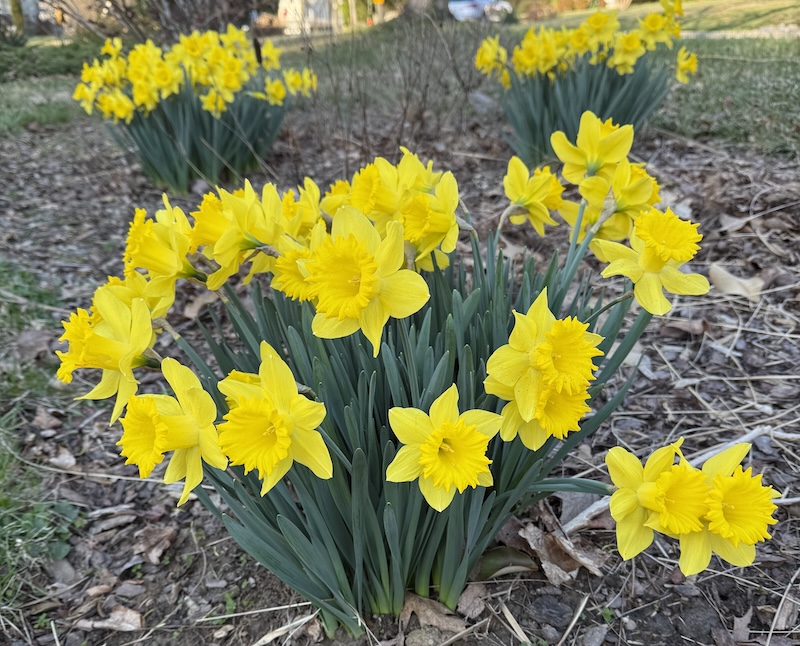
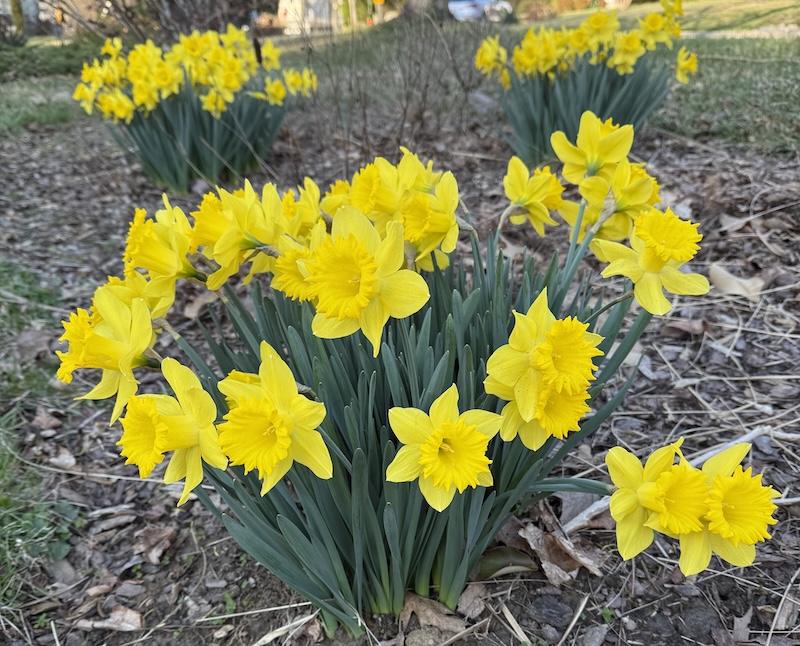
Daffodils are a sure sign of spring.
Daffodils, which are my favorite flower, are appearing in gardens and on roadways making a lovely spring time sight. When the Daffodil bloom has past, do not cut the leaves from the Daffodils or any of your spring flowering bulbs, the leaves send down energy in the form of food into the bulbs to store for next season’s growth.
This is the time to tackle a new lawn or patch seed, use only good quality grass seed, organic fertilizers and lime, which provide the alkaline, need for healthy grass growth.
Even after several consecutive warm days, frost can still occur. Having said that I suggest that you do not plant annuals until Memorial weekend. If you purchase annuals at the Mother’s Day sales, place the annual plants in a protected spot in the garden, like a wall, until planting. Do not cultivate around the perennials in the borders until mid May.
Do not panic if you are not able to get the April tasks done until May, your garden will wait for you and the constancy that is Mother Nature will continue to keep your patch of earth flourishing.
Enjoy the pleasure of being outdoors in warmer temperatures, inhaling the pungency of awakening soil and your connection with Mother Nature. Do not overdo it; warm up the body before the garden labor and stay well hydrated with lots of water.
We are inexorably entwined with the earth and know that even the smallest gesture of a garden has positive rewards; the effects are not only on you but on our planet.
It is important to have a well-thought-out plan before creating a new garden or landscape. Yo may wish to call my son Ian, who has followed in my footsteps as a landscape designer, and arrange a landscape consultation at LandscapesByIan.com
I will see you in your garden with more gardening tips later in May and if you have any gardening questions, please email MaureenHaseleyJones@gmail.com
About the author: Maureen Haseley-Jones is a member of a family of renowned horticultural artisans, whose landscaping heritage dates back to the 17th century. She is one of the founders, together with her son Ian, of, The English Lady Landscape and Home Company. Maureen and Ian are landscape designers and garden experts, who believe that everyone deserves to live in an eco-conscious environment and enjoy the pleasure that it brings. Maureen learned her design skills from both her mother and grandmother, and honed her horticultural and construction skills while working in the family nursery and landscape business in the U.K. Her formal horticultural training was undertaken at the Royal Botanic Gardens at Kew in Surrey.
A view looking south down the Connecticut River with Watch Rock Preserve to the left. Photo by Edie Twining.
OLD LYME — On Sunday, April 27, take a step back into the history of Old Lyme’s Native Americans with a presentation and walking tour led by Dr. John Pfeiffer, PhD, Anthropology, SUNY Albany.
At 1 p.m., Pfeiffer will give a lecture at the Old Lyme Historical Society, 55 Lyme St. Light refreshments will be offered.
At 2:15 p.m. take a guided walk led by Pfeiffer at Old Lyme’s Land Trust Watch Rock Preserve at 7 Joel Rd.
Pfeiffer has conducted over half a century of research as an anthropologist, historian, and archaeologist with our local Schaghticoke, Mohegan, and Nehantic tribes.
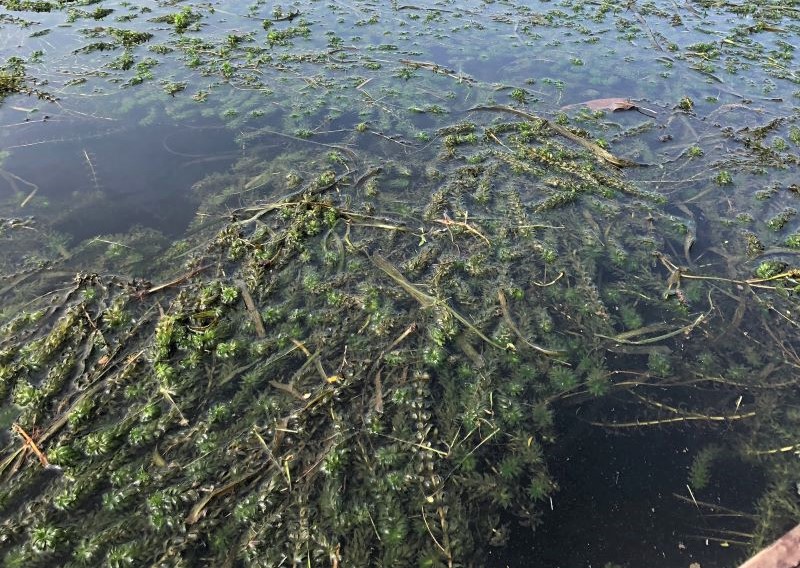
This photo was taken September 2020 during an inspection of Whalebone Cove when it was found 60 to 70 percent of the waterways were clogged with hydrilla vines.
LYME – Experts on the Connecticut River hydrilla will be at the Town Hall on Wednesday to talk about plans to include Hamburg Cove in a growing, multi-year effort to reduce and control the highly invasive water weed.
The presentation will begin at 7 p.m., according to a public notice filed by the U.S. Army Corps of Engineers (USACE). A question and answer period will follow.
The Connecticut River Hydrilla project, overseen by the Army engineers in partnership with the Connecticut Agricultural Experiment Station and the Lower Connecticut River Valley Council of Governments, began in 2023 to figure out which aquatic herbicides ― and how much of them ― are best suited to fighting off the uniquely pernicious aquatic species.
The USACE said herbicides will be introduced to Hamburg Cove this summer or fall. All herbicides being used are registered for aquatic use by the U.S. Environmental Protection Agency.
The project last year applied an herbicide treatment to Selden Cove and several other sites on the lower Connecticut River.
Hydrilla degrades water quality, chokes out native plants and threatens the habitat of migratory fish like shad and herring, according to the Connecticut River Conservatory. It’s been described by U.S. Sen. Richard Blumenthal, D, as, “the worst invasive aquatic species known to man.”
Wednesday’s meeting will be in-person only, according to the notice. There will be information on the project itself as well as the concerning effects of hydrilla on the Connecticut River system.
Registration is requested. Those interested in attending should email info@eightmileriver.org.
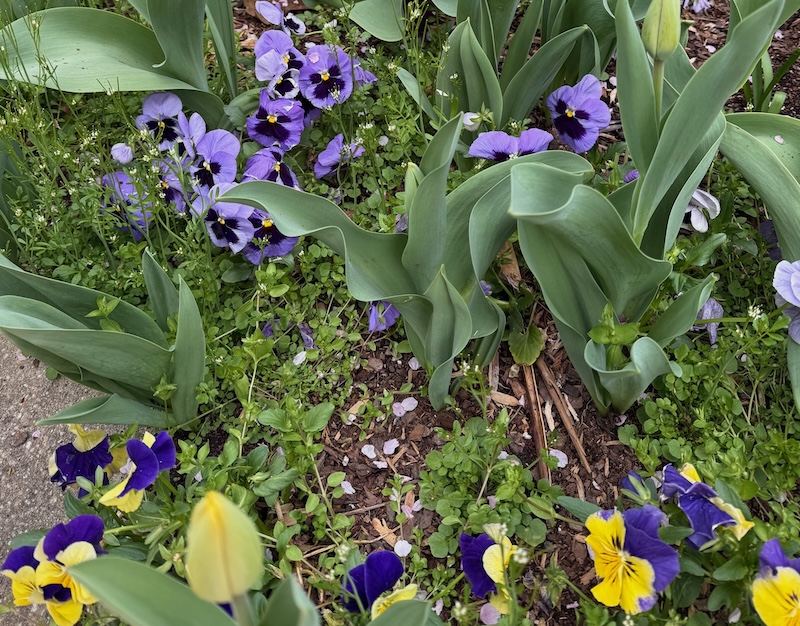
Tulips and pansies make a colorful spring display.
“Those March winds shall blow, and we shall have snow and what will the Robin do then poor thing? He’ll hide in the barn and keep himself warm and hide his head under his wing.”
Maureen Haseley-Jones
March was a month of “wait and see” as we anticipated walking around our gardens. This morning, I walked outside, into a westerly breeze and a gentle sun. I took a deep breath and as I did, I caught the rich fragrance of the soil beginning to awaken.
All of us are itching to get into the garden and I believe that foray will be earlier than last year since frost did not penetrate deep into the ground.
Please wait until April to clear the winter debris from your borders, as beneficial insects like the bees are hibernating there. Bees are our life blood; they pollinate 70% of the world’s food and we are losing them in the millions, due to climate, pollution, poisonous herbicides and insecticides and just human carelessness.
The sodden soil will dry out in the next few weeks, so tread gently on our precious commodity. I also am asking that you do not till the soil, as tilling damages soil structure and can break friable root systems.
Please be patient right now! I know you are chafing at the bit to get your hands into the soil, but, at this moment, continue planning for the upcoming season. Planning means organizing, which helps to prevent costly gardening mistakes during the growing season.
When you go outdoors to take a walk around the garden, check the trees and decide which ones might need pruning. For example, decide which limbs might need to be removed or the canopy lifted to allow more sunshine into a shady area of the garden. Having made some of those decisions, I suggest that you call in an arborist for tree work in March and April before foliage emerges. With a blank canvas, the work will be accomplished faster and is therefore less expensive.
You can use this time to check on broken or dead limbs and which branches require cabling. And if a tree appears to be 50% dead, then it should be removed.
A medium shade area can be changed to a dappled shade area, allowing more sunlight in by thinning out the upper tree branches or tree canopy.
Perhaps you would like a tree removed to transform a shady area to a sunny spot, giving you a larger choice of plants.
I always hesitate to remove a healthy tree, but sometimes a tree has been planted too close to the house which often results in the roots undermining the home’s foundation and the shading over the roof has resulted in mold and mildew.
Careful pruning allows trees to bloom freely.
At this juncture, I must point out that there is an art to tree work in knowing how, when and why to cut. Work on the trees should be carried out by a professional so that at the completion of the work, the effect is both practical and aesthetically pleasing. An experienced arborist will also take into consideration the health of the trees. Also by employing an arborist, you can avoid injury to yourself, from falling from ladders or avoiding tree branches or trees falling on you.
Pruning
Pruning is one task that you may feel you are able to accomplish yourself. Some tips include:
Hedges can be sheared for shape, so that any stubby ends will be concealed by new spring growth.
Please keep to the natural shape of the shrub – no round balls.
Prune Spirea to six inches from the ground.
In April, prune lavender down to three inches.
In late March, prune sweet pepper bush (Clethra), cutting out the oldest branches.
Lilac – Prune back all old branches to various lengths before leaf growth begins, from two to five feet, keeping to a natural shape. Sprinkle lime around the base of the lilac and add manure in May. Lilacs enjoy alkaline soil and benefit from a small amount of lime sprinkled about a foot away from the base of the lilac.
Prune butterfly bushes to two feet from the ground now and in May apply composted manure around the base.
Prune forsythia after it has bloomed, pruning out sparse flowering old wood.
Prune roses when the forsythia blooms. If the roses have only been in the ground for one year, do not prune, wait until October.
Do not remove the protective mulch from around the base of the roses. Wait until mid-May, and then apply a dressing of manure and fine bark mulch, about a foot away from the base of the rose.
You may be asking, “Why wait until May to apply manure?” The answer is that the soil needs to warm up to 55 degrees, otherwise the nutrient benefits of the manure bacteria that work with plant roots and soil organisms are not activated. I suggest you invest in an inexpensive soil thermometer to check the soil temperature. When the soil temperature reaches 55 degrees, apply a 3- to 4-inch layer of composted manure.
Tread carefully
When you have cleared away the debris in April, treading carefully on the soil, make a clean edge to the borders with a sharp spade; this makes such a difference to the look of your garden.
The best tool to use for this task is a sharpened lawn edger. The blade is a half-circle 9 inches wide and 4.5 inches deep with a flat top that creates a deep edge. Face the bed and thrust the edger down to its full depth and push the cut soil into the bed. Continue along the soil edge and then remove the spade and surplus clumps of soil and grass.
Edging was one of the first lessons I was taught at our family nursery in England; my great grandfather was a strict taskmaster standing over me, until I got the edge done to his particularly proper standard.
If you are contemplating locating a new planting bed or expanding an existing one, here are some tips:
Think about where you spend your leisure time outdoors, and where you may choose to sit, near to the new bed, enjoying the bloom, fragrance and structure of your plantings.
From indoors are you able to view and enjoy the new border?
Is it an area where there will not be drainage problems, erosion concerns or water pooling?
Is it convenient to tend and enjoy where you place a bench or chair?
Will you be able to water it with relative ease?
For an informal garden I prefer a curved bed – a curved line gives grace and fluidity. Lay out a garden hose in the desired shape and size of bed, adjusting the hose until you are satisfied with the gentle curves.
Manure
Rich manure works wonders for many plants and vegetables. Photo by Kyle Ellefson on Unsplash
When it comes to manure, many of you, who have been my radio listeners and lecture audiences, know how I feel about that wonderful natural product. Manure is not a fertilizer – it builds soil structure, aids in drainage and its bacteria encourage the millions of soil animals below the surface to come alive and work with the manure bacteria to produce nutrients for the roots of the plants.
Types of manure:
Poultry manure – I know the odor can be rather objectionable; however, this manure contains about 2% nitrogen, one of the highest levels in any manure. If you have access to poultry manure, allow it to age for two months and by that time, the odor will have dissipated and then add it to the garden.
Horse manure is about 0.5% nitrogen. If you obtain horse manure from a stable, which has sawdust on its floors – it should be pretty weed free. What I have done in the past is obtain horse and cow manure from stables and farms in April. When you get it home, spread manure out in a flat area (not in a planting bed) then cover it with a tarp for a month. Using this method, the tarp will suffocate the weed seeds and the sun on the tarp encourages the manures to continue to decompose. A week before using the horse and cow manure remove the tarp to allow the sun to further decompose it.
Cow manure is 0.25 % nitrogen and is the most available manure. If you get horse and cow manure from the farm, ask the farmer to give you manure from the bottom of the pile so that it is already partially decomposed.
Compost pile – If you do not have a compost pile, maybe it could go on your list for this season. Vegetable waste from the kitchen, plus grass clippings, and wood pruning can be added to the pile. The high temperature in the compost kills the weed seed and cooks all those other necessary ingredients. The ratio of compost and manure for your garden is 1 part compost to 3 parts manure – but if you do not have compost – manure will do the trick.
**DO NOT apply fresh manure to the garden, as it will burn the plants. If you do not have a source of manure from a farm, purchase composted manure in bags from the garden center.
In order to produce the best-planting environment, resulting in a soil that is ‘black gold’, apply three inches of composted manure to all planted areas in May, July and October.
Natural fine bark Mulch can be added later in May, the benefits of this mulch is that it helps to retain the beneficial moisture in the soil and aids to retard weeds. Regarding weeds, I also use a natural product, Bradfield Organics, which is a corn gluten weed pre-emergent, which keeps weeds sprouting for a few weeks.
Please do not use cocoa mulch, which is poisonous to dogs and cats, also do not use the chemically colored red mulch.
The Humus Component
I know I have written about the importance of the humus component for the soil but I feel I must continue to stress this fact.
In your own garden you can build and retain a rich growing environment by building the humus component as outlined last month. We are all carbon-based creatures as is all life on earth. Not only humans but also our soil microbes need carbon to flourish. To attract carbon from the atmosphere into your soil you need to build the humus component when the soil has reached a temperature of 55 degrees. If the soil has not reached that temperature, the soil organisms are not able to work with the bacteria in the manure to produce nutrients for the roots of the plants.
This year, as we have not experienced deep frost, the soil temperature may therefore reach 55 degrees by the end of April or early May.
Once again, I’m getting a little ahead of myself. So back to a cloudy day right now, when you may gradually begin to remove protective covering from shrubs and small trees. In exposed garden areas, where wind is a problem, leave the covering on until mid April. Cold wind is more damaging and drying to plants than extreme cold and frost.
Frost Heave
If some perennials, trees and shrubs have heaved out of the ground, cover the roots with fresh topsoil or mulch until mid May when they can be settled back in place.
I just walked around the corner of my house to check on my trellis on the chimney where I have roses and clematis planted together. Roses and clematis are a delightful combination in a companion planting. This planting method means that the rose and the clematis planted together have the same growing requirements, “feet in the shade and heads in the sun.” Beginning in May, add manure and mulch around the base of both. Discontinue feeding roses and clematis in mid-August; this enables both plants to go into a necessary slow dormancy.
Raking and Aerating
When the lawn has dried out in April, rake lightly to remove excess debris such as leaves and dead twigs. Raking gently raises the mat of the lawn, which enables the emerging grass to breathe. Aerating machines are useful to develop a healthy lawn. Puncture holes with the aerator which pulls out plugs of soil every four to six inches; following this treatment, root development takes off and thatch is reduced. Do not use large thatching machines, as these machines damage the grass.
Grass
In April, apply organic fertilizer, lime and organic grub control before the grass begins to grow. Reseed bare or sparse spots after gently loosening the soil, liming and fertilizing, then cover the seed with salt hay to keep the seed warm and to prevent wind from blowing the seed away. Water the seed for the first three weeks. Do not blast the area with water, which scatters the seeds. As with lilacs, grass enjoys alkaline soil which is why we use lime together with fertilizer and grub control.
Moles
To keep the mole population to a minimum in your garden; apply organic grub control once a month from March for two months which results in less food for the moles. When you see signs of moles, find the mole holes and insert Exlax, which contains senna, an organic herb. The moles eat the Exlax and become dehydrated from defecation and die.
Apply organic pre-emergent crabgrass killers in March and April.
Voles
Spread castor oil around the base of plants and keep mulch away from the base of the plants so that voles, which are canny creatures, are not able to hide there and gnaw on plants and roots.
Deadhead
Do not cut off the leaves of the crocus as they bloom; the leaves make food for the bulbs for next season’s bloom.
Daffodils
One of the joys of Spring—”A host of golden daffodils.”
When the green shoots emerge, spread composted manure around the plants.
For daffodil displays indoors, cut the stems at an angle before adding daffodils to an arrangement, and leave them in a vase half filled with lukewarm water for a couple of hours. This is because the stems release a sap like “goop” that harms other flowers. Discard that water and add the daffodils to the other flowers. If you recut the stems you will need to repeat the process. Change the water in the vase often.
Perennials
In May when perennials are about four inches above soil level and when the soil is 55 degrees, apply composted manure around them to encourage healthy growth.
Dividing Plants
At the end of April or beginning of May, you can divide late blooming perennials that have been in the ground for four years or more; these new divisions encourage stronger bloom.
Discard the older inner parts of the clumps and plant the new outside portions. Do not plant the new divisions any deeper than they were originally in the ground.
When dividing irises, barely cover the root system so they do not fall over. If irises are planted too deep in the soil, they will not bloom.
It is best to pick the flowers of pansies regularly to encourage more bloom.
March or early April are the time to plant the following seeds indoors: gaillardia, salvia, marigold, zinnia, petunia, snapdragon, stock and verbena. Before planting these seeds, soak them in warm water and plant them in sphagnum moss or coir. Coir is the outer shell or fiber of the Coconut, either of these two mediums prevents a disease called “damping off”, which can cause seeds to rot before germination.
Cover pots and seed trays loosely with plastic wrap, which creates a mini greenhouse, providing moisture which seeds require to germinate.
NOTE: Remove the plastic once the seeds have germinated, as the soil needs to drain and needs air circulation around the emerging stems.
If you are going away on business or on vacation, reapply the plastic wrap over the pots and trays and prop some sticks or skewers in the corners. While you are away the seedlings will stay moist, and the sticks or skewers ensure that the seedlings do not encounter the plastic.
Dormant Spring Spraying
Spraying of fruit trees, flowering cherry, crabapples, hawthorn, mountain ash and lilac can be done before the leaf buds open. Call a professional company and request that they use only organic products.
Houseplants
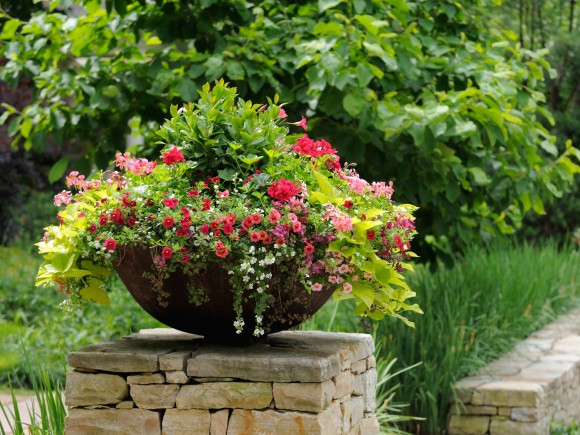
Prepare your geraniums that have spent the winter indoors for the move outside perhaps to add color to a pot like this.
Repot them if they need repotting in April.
If you brought geraniums indoors at the end of last season, check them for new side shoots, then cut them back to four inches and repot them in clean pots about an inch and a half larger with fresh potting soil.
Well, fellow gardeners, I know you are getting excited to be in your gardens this season and I hope that these tips have given you plenty to think about to keep you busy for a while. Enjoy photos of lovely gardens that my son Ian has designed. If you wish, contact him for a consultation at landscapesbyian.com.
Enjoy being outdoors in spring sunshine and I look forward to seeing you in your garden in April.
About the author: Maureen Haseley-Jones is a member of a family of renowned horticultural artisans, whose landscaping heritage dates back to the 17th century. She is one of the founders, together with her son Ian, of, The English Lady Landscape and Home Company. Maureen and Ian are landscape designers and garden experts, who believe that everyone deserves to live in an eco-conscious environment and enjoy the pleasure that it brings. Maureen learned her design skills from both her mother and grandmother, and honed her horticultural and construction skills while working in the family nursery and landscape business in the U.K. Her formal horticultural training was undertaken at the Royal Botanic Gardens at Kew in Surrey.