LYME, CT—With the town firmly entrenched on the front lines of the fight against the uniquely pernicious water weed known as hydrilla, federal authorities on Wednesday held a virtual public information session on their efforts to help local communities control the invasive plant using herbicides.
The Connecticut River Hydrilla Research and Demonstration Project, led by the U.S. Army Corps of Engineers (USACE), first came to Lyme’s Selden Cove in 2023 to apply a red dye mimicking the flow of herbicide. The lessons learned set the course for the following year’s treatment of dipotassium of endothall in the same area.
Ben Sperry, research biologist with the U.S. Army Engineering Research and Development Center, described Selden Cove as a unique site compared to four other water bodies in the pilot program that used different herbicides.
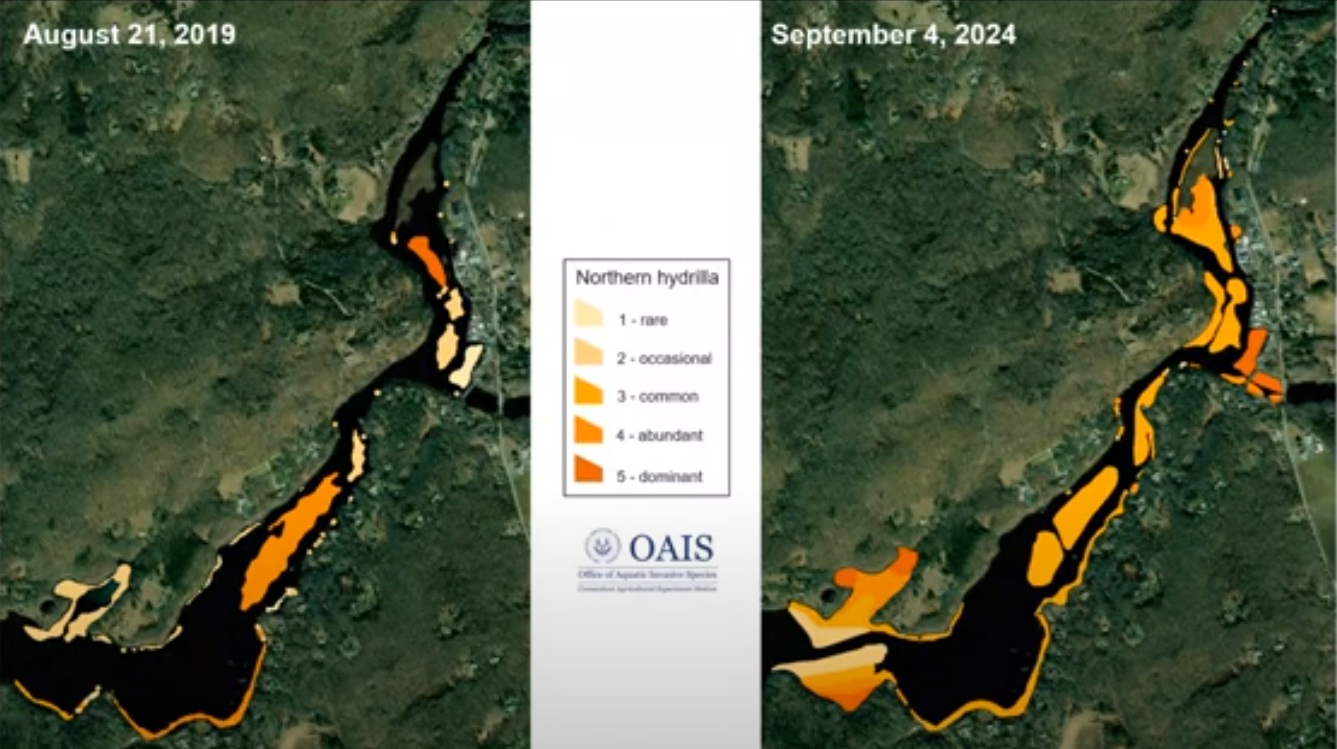
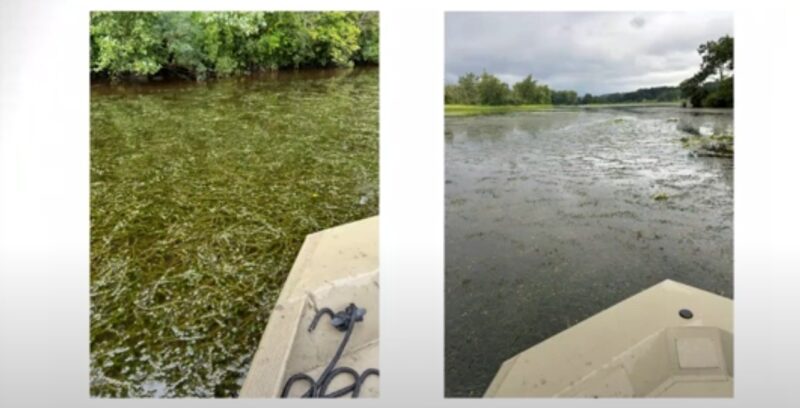
“We used endothall alone, got pretty good control of hydrilla, but the water exchange in Selden Cove is quite rapid,” he said. “Consequently, hydrilla has already come back this year up to 60% occurrence, closing in on pretreatment levels that we saw in 2024.”
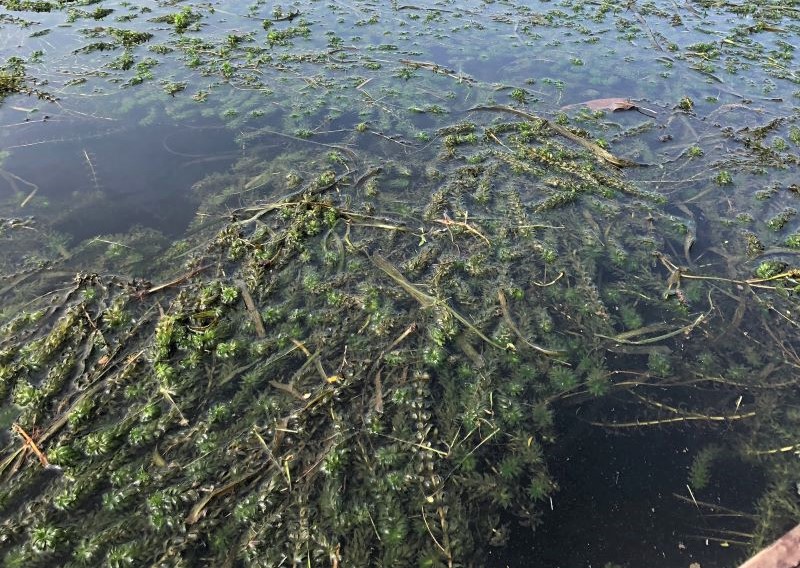
That’s when mats of hydrilla were so thick that waterside property owner Joe Standart said the cove was impassable to his power boat and to the sport fishermen who used to come around.
Project documents show the cove will be retreated the week of Aug. 18. But a plan to treat 12 additional sites – including Hamburg Cove, Joshua Creek and Selden Creek – will not happen this year due to federal funding limitations.
Hamburg Cove, however, will run red sometime between Sept. 15 and 19 as scientists return with the flourescent tracer dye administered by a certified contractor to gauge which herbicides, and how much of them, to use next year.
The Army engineers’ project is intended to gauge the safest, least toxic way to stem the hydrilla infestation choking off many areas of the river and being carried on the bottom of boats into lakes throughout the state.
Keith Hannon, USACE Project Manager, said the agency’s ultimate goal is to pass along the information from 17 test sites to state and local governments so they can address the problem on a larger scale.
Scientists describe the strain of hydrilla affecting the Connecticut River as genetically distinct from the one that emerged in the 1950s after a tropical fish dealer in Florida allegedly dumped an aquarium into a Tampa canal. It’s also removed from a second strain that emerged in the 1980s in the Potomac River.
The name comes from the Hydra serpent of Greek mythology, according to Hannon.
“When you cut off one of its heads, it would grow two more in place,” he said, describing the trait that can be seen in its namesake’s ability to break off easily into new plants.
Diquat Fears
It was over a month ago that an herbicide called diquat was launched into the internet’s viral vernacular by a rap artist originally from Fairfield County who started posting on social media about the chemical’s toxicity and a lack of government transparency.
An online petition from Chris Webby, which to date has amassed 20,112 signatures, calls on authorities to discontinue the use of the diquat while focusing on “non-toxic, mechanical and biological alternatives” to manage the plant.
Hannon during the virtual presentation said Sperry’s group has been studying the various ways to remove invasive aquatic plants for decades. Methods range from mechanical, like hand pulling, to biological, like using grass carp or weevils to kill the weeds.
“We know the effects and usefulness of those other mechanisms,” he said. “So we wanted to understand the use of herbicides on this new strain, because it’s unknown as to how effective that would be. But we know how effective the other methods could be. And how costly they are.”
He cited data from the Chester Boat Basin showing the cost to bring in a mechanical harvester three times during the summer cost $14,190, compared to $4,475 for an application of herbicide lasting for the season.
Hannon said hydrilla has the potential to wreak havoc on recreational opportunities, the tourism industry and aquatic habitats.
Local Concerns
Diquat is among the herbicides under consideration for Hamburg Cove, Joshua Creek and Selden Creek once funding and permits are secured, according to project documents.
Staff and board of directors members from Camp Claire during the presentation posed questions about safety.
Carol House, who identified herself as a board member at the Lyme-based camp, asked how long the herbicide poses a concern for children in the water.
Sperry, the research biologist, said there are no fishing or swimming restrictions associated with any of the herbicides being used on the project.
“We do prefer that recreational users kind of stay out of the way during treatment, just for boat safety,” he said.
Hannon said signs, like the one posted last year on a dead log at the entrance to Selden Cove during treatment, go up on the day of treatment but are not required to remain.
Anne Overstreet, with the U.S. Environmental Protection Agency’s Office of Pesticide Programs, said the results of the agency’s most recent evaluation of diquat in 2019 were published the following year as part of a regulatory framework designed to ensure there are no unreasonable adverse effects to human health or the environment.
“And there is no risk of concern for adults or children exposure to diquat from swimming immediately after application, from inhalation, contact with water, or potential incidental swallowing of the treated water,” she said.
She acknowledged “mild toxicity” to fish and other aquatic organisms.
“We look at a tremendous number of studies and we look at points of departure where effects are actually seen at very high doses in laboratory studies. And then we choose the dose that is ‘no-effect’ – where no effects are found. And then we regulate a thousand times below that threshold,” she said. “So there are no effects that would be seen.”
She said risks to those applying the chemical can be mitigated by following directions on the product label calling for precautions like eye protection.
“We ensure that folks that mix and load and pour those products also use respirators to protect from possible inhalation of the concentrated product before it is applied,” she said.
Responding to a question about using treated water to irrigate crops, Overstreet advised that, “If it isn’t toxic from a dietary standpoint from ingestion, then utilizing it for irrigation of crops would also not be a concern.”
Selden Cove
Sperry during a media briefing following the public presentation said endothall was the herbicide of choice for Selden Cove after the dye tests determined how quickly water moves through the inlet. Endothall worked best because it stays effective for the right amount of time and is safer for native plants.
Fast-acting diquat by itself is not effective on hydrilla, according to the biologist.
“With the plants that we were dealing with in Selden Cove, we felt that diquat would have been less selective and maybe not as effective as endothall at the rate that we chose to treat with,” he said.
Hannon said the delay in treating the 12 additional sites is not related to the public diquat pushback.
Earlier, he cited federal budgeting constraints exacerbated this year by the threat of a government shutdown and related costcutting measures, as well as permitting constraints.
“We would be at this point regardless of any pushback that came about,” he said.