TOP STORY: Old Lyme WPCA Chair Cinami Seeks to Get Sewer Project Finally Flowing, Requests Additional $7.6 Million

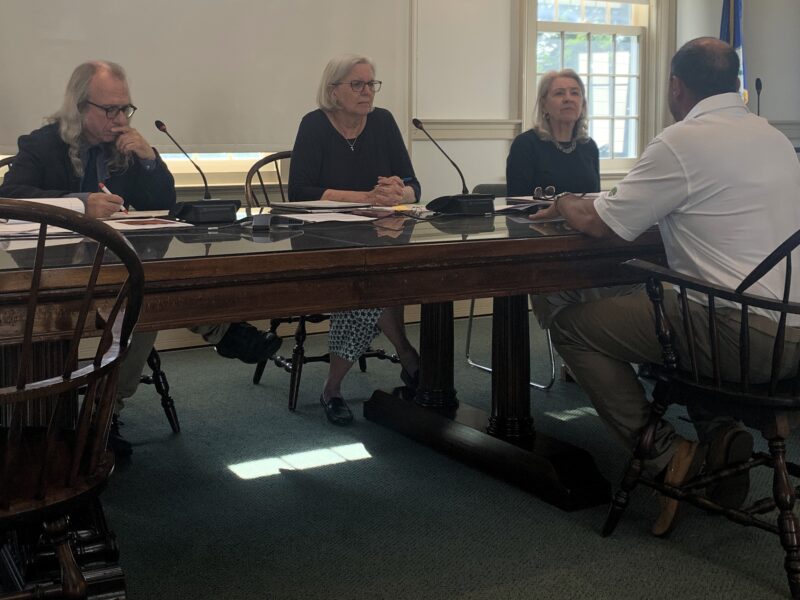
Old Lyme Water Pollution Control Authority Chairman Steve Cinami addresses a $7.6 million bond authorization request for sewers to First Selectwoman Martha Shoemaker, center, Selectman Jim Lampos, left, and Selectwoman Jude Read, right.

OLD LYME–6/22 UPDATED: Headline amended: Six years ago, a $9.5 million request to install sewers in the Sound View Beach area got the go-ahead from voters at a town-wide referendum – but the project stalled.

Now, amid inflation exacerbated by the COVID pandemic and other factors, the Old Lyme Water Pollution Control Authority (WPCA) is back with a request for another $7.6 million. 

The state-led, decades-long charge to clean up Long Island Sound by ridding the area of septic systems involves a plan to require residents of three private beach associations and the public Sound View Beach community to install sewers. Continued concerns about the cost of the project and successive rounds of construction bids coming in higher than anticipated have dragged out the process.

Steve Cinami, chairman of the Old Lyme WPCA, visited the Board of Selectmen and Board of Finance this week to plead for approval to go to referendum for the bond authorization necessary to support the Sound View portion of the project. But selectmen balked at the lack of information about how the project will affect the Sound View residents who will have to repay the loan.

Old Lyme officials all along have said the cost of the Sound View project will be borne by the system’s users, not the town’s tax base. 

This time around, significant additional funding from the state and federal government will leave those users responsible for about $8.5 million of the $17.06 million project, which Cinami has emphasized is less than the amount requested at the 2019 referendum. 

He said the new numbers shake out to about $26,000 over 20 years, or $1,932 per year, for a property owner whose house has one bathroom, a kitchen, and four bedrooms or less.  

In August of last year – before the latest round of bids came back and before state and federal funding was secured – Cinami at a public meeting told residents the WPCA was estimating the cost to a user would be about $22,556 over 20 years, or $1,368 a year, for a similarly sized home. 

Assessing ‘affordability’

Selectman Jim Lampos at Monday’s selectmen’s meeting asked for more specifics about fees in addition to the annual project payments for which users will be responsible. He said connection costs and future capital spending for infrastructure improvements in the system flowing through East Lyme into New London will affect user’s sewer bills here in Old Lyme. 

“Before we go to a referendum, I think we have to give the property owners a clear idea of what the affordability is going to be,” he said. “And the taxpayers are going to want to know this before going to a referendum. They’re going to ask for it.”

Cinami estimated the average yearly fee would be around $500 per year in the Sound View area. Beyond that, he said he would have to “try” to develop a rough cost structure. 

State Department of Energy and Environmental Protection (DEEP) Project Engineer Carlos Esguerra last year said the agency sets the amount that residents can reasonably be expected to spend at 2% of the town’s median income, which he identified at the time as $122,000. That equated to $2,440 a year.

There is also a state law specifying a town cannot assess property owners for any amount higher than the percent increase in the property value attributed to the sewers. He said an assessor hired by the Old Lyme WPCA before the previous referendum estimated sewers would increase home values between 10 to 12%. 

Documents from the Sound View Coalition, a grassroots group opposing the sewer project, show an assessor hired in 2020 by the group found sewers would increase residential property values by 7% and commercial properties by 10%.

Cinami, who has been criticized for his abrasive manner at meetings, also heard complaints at Monday’s meeting from Shoemaker and Old Lyme WPCA member Dennis Melluzzo about the chairman’s alleged attempts to quell questions and dissent. 

Shoemaker said she was made to feel uncomfortable asking questions at the June WPCA meeting, while Melluzzo described feeling disrespected by Cinami while speaking up at last month’s WPCA meeting. 

Cinami said he was just trying to run an efficient meeting. 

“I feel, maybe it’s a misperception, but I feel as though I’m trying to get stuff across and I’m interrupted on a constant basis by members.”

He told Shoemaker he was sorry if she took offense, and said he owed Melluzzo an apology as well. 

Capital Costs

At Tuesday’s finance board meeting, member David Kelsey expressed concern about the financial impact of any large-scale capital upgrades that could happen in the future at the New London wastewater treatment plant into which Old Lyme’s sewage will flow. 

He said he’s heard for the past 10 years that DEEP was pushing for the installation of sewers in Old Lyme “because they wanted more users to spread the cost of upgrades in New London.” 

Cinami said he wasn’t aware that the city was on the verge of any major capital projects. 

New London Director of Public Utilities Joseph Lanzafame in a Wednesday phone call disputed Kelsey’s characterization of the situation. 

“There’s no truth to that. Not from our standpoint,” he said. “Somebody else may have other motivations, but from our standpoint, the contribution that Old Lyme is going to give towards the facility is very marginal.” 

A contract between New London and the four beach communities signed late last year calls for the beach associations to pay 1.2% of annual treatment plant capital costs and the town to pay 0.5%.

He estimated the city has spent $15 million over the past 10 years, but could not predict what the future holds in store. 

“But as far as major upgrades, I mean, we’re not looking at hundreds of millions of dollars of work to be done,” he said. 

He said the city does not have plans to upgrade the plant to be able to handle additional flow, which he described as an extremely difficult undertaking. But if that kind of upgrade did happen, he added that Old Lyme ratepayers would not be affected unless the beach associations or the town wanted to purchase some of the increased capacity. 

The current contract with New London allows the beach associations to send up to 120,000 gallons of sewage per day to the treatment plant and the town to send up to 50,000. They have the right to purchase up to an additional 130,000 gallons per day as more people in the beach communities tie into the system.

Lanzafame said he’ll be happy if Old Lyme doesn’t ask for additional capacity in the future. 

“I mean, I’m going to be quite frank. That’s just what it is. Wastewater capacity is a big deal, and it’s just not unlimited,” he said. 

Back at the finance board meeting, Kelsey predicted the costs to each user – including the minimum $1,932 payment homeowners will need to pay for 20 years, the cost of tying into the system, the annual fees and the increased tax bills from their new property values – are likely to result in angry residents. 

“It’s not going to be pleasant when all these numbers come out, is my basic point,” he said. 

While Cinami acknowledged residents in the affected areas will be required to hook up to the system, he added a caveat. 

“There are some new (septic) systems down there that cost sixty thousand dollars; We will probably not have them hook up immediately,” he said. “But any any system that’s in variance, which is, I would say, 97% of all the systems down there, will have to hook up.” 

Next Steps 

In addition to asking for more information on the financial impact for Sound View residents, the Board of Selectmen emphasized that the details of a Cost Sharing Agreement between the beach associations and the town must be finalized before they will ask residents to authorize more spending at a referendum. 

Another issue still outstanding revolves around the portions of the sewer project to be undertaken by the Miami Beach and Old Lyme Shores Beach Associations, which Cinami said have not yet gone out to bid. He said the beach communities’ project officials, who are waiting for approval by the state DEEP before opening the bid process, are hoping to make their selections by the end of July.

Cinami assured selectmen that winning bids received earlier this year for the Sound View work will remain valid through October, though he acknowledged the bidder selected to build the system’s shared pump station has not formally committed to keep his bid open that long. 

Shoemaker said Cinami’s request to schedule a referendum for August 14 won’t be possible because the traditional polling location in the middle school is being renovated and will not be available.
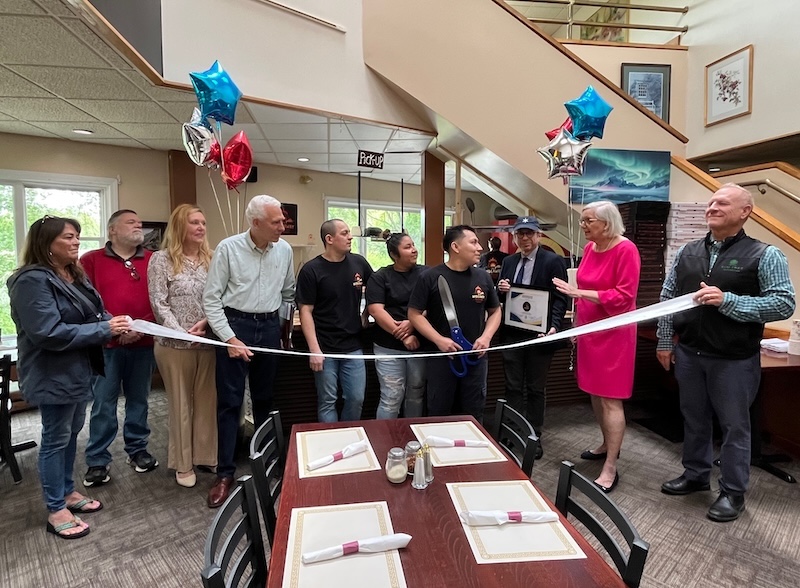
TOP STORY: Old Lyme EDC, BOS Welcome New Owners at ‘The Hideaway’ with Celebratory Ribbon-Cutting

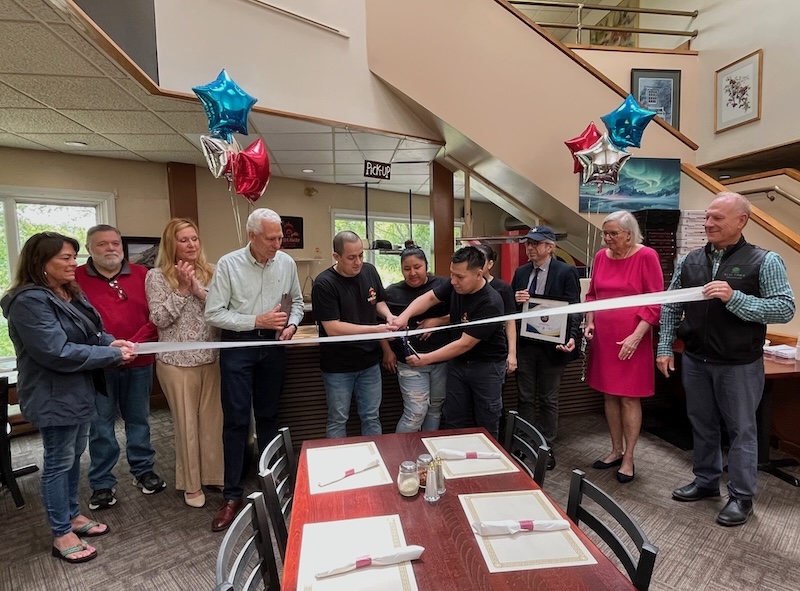
The four proud owners, José and Diana Plasencia and José Luis and Carolina Marin cut the ribbon together. L-R: Wendy Russell*, Scott Smith*, Mona Colwell*, Joe Camean*, José Luis Marin, Carolina Marin, José Plasencia, (Diana Plasencia behind José), Selectman Jim Lampos, First Selectwoman, Martha Shoemaker, Jeff Hartmann* (*connotes EDC member.) All photos by C. Poirier.

OLD LYME — Family, friends, and lunchtime diners joined the Town of Old Lyme in congratulating the new owners of The Hideaway on Saturday.

The Old Lyme Economic Development Commission (EDC) was joined by the Board of Selectmen in the ribbon cutting ceremony that celebrated both the new ownership and expanded Hideaway offerings of wood-fired pizza. Visit this link to read more about both of these.

Old Lyme First Selectwoman Martha Shoemaker shares her well wishes with the owners .

Economic Development Commission Co-Chair Joe Camean welcomed everyone to the celebration noting, “We are happy to see healthy businesses thrive in Old Lyme and want to thank you for doing business here.”

First Selectwoman Martha Shoemaker, after also offering her welcome, added, “As a mother of three boys, I know that pizza is a staple in our house and I appreciate we have another place to come and support.”

Co-owner José Plasencia shared his gratitude to those gathered, saying, “Thank you to the whole Old Lyme community for supporting us.”

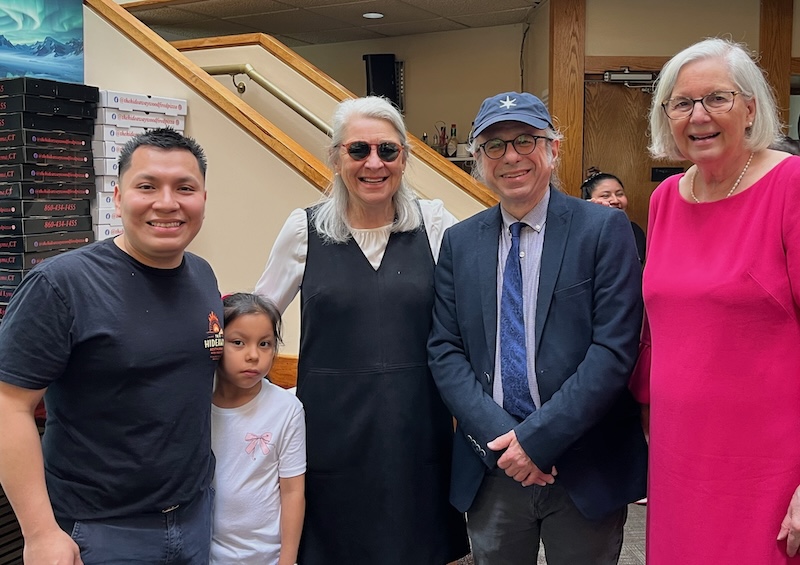
From left to right, José Plasencia and his daughter Sydney pose with Selectwoman Jude Read, Selectman Jim Lampos, and First Selectwoman Martha Shoemaker.

The four new owners, Jose and Diana Plasencia and José Luis and Carolina Marin cut the ribbon together. Jose and Diana run the daily operations of The Hideaway, and Jose Luis and Carolina do the same for The Stumble Inne across the street.

The previous owners of both establishments, Jim and Cyndie Caramante, were on hand for the ribbon cutting and recognized for ensuring the businesses continued through new ownership following the Caramante’s retirement. 

The Plasencias accepted a Certificate of Recognition from the Old Lyme EDC. From left to right, EDC Co-chair Joe Camean, José and Diana Plasencia, Selectman Jim Lampos, and EDC Co-chair Jeff Hartmann.

Following the ribbon cutting and presentation of a Certificate of Recognition, attendees were invited to partake in fresh pizza with a variety of toppings, including one created just the evening before—fresh shucked corn and tomato.

Delicious pizzas galore were on offer at the ribbon-cutting. Photo by Laurie Walker.
The selection of pizzas was truly mouth-watering!
The Plasencia Family had an array of pizza offerings for attendees of the ribbon cutting ceremony.

TOP STORY: Old Lyme Town Budget Passes Easily, Meeting Serves as Lesson in Small-Town Democracy

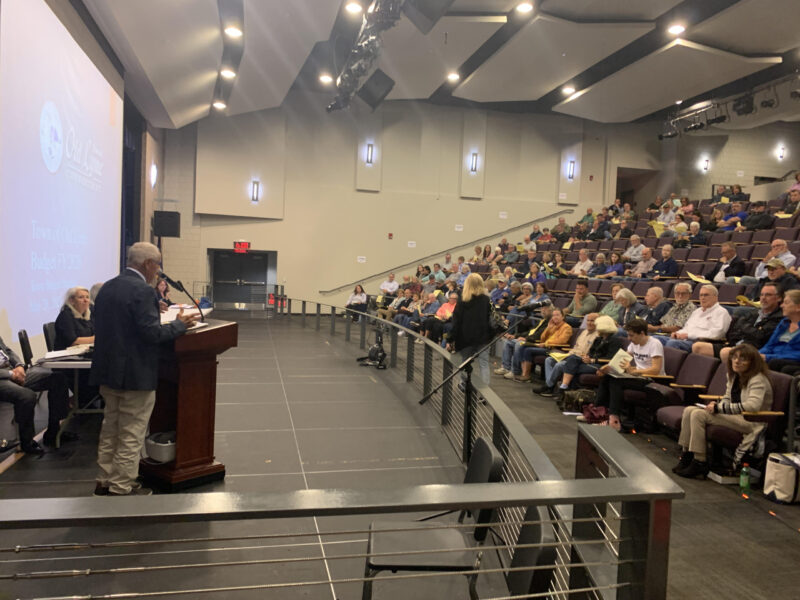
Old Lyme-based Attorney Fran Sablone served as moderator at Wednesday’s Town Budget Meeting.

OLD LYME–Two young men sitting with their parents in the auditorium of the Lyme-Old Lyme High School Wednesday night were recognized at the end of the 2.5-hour Town Budget Meeting for making it through a crash course in the New England town meeting form of government 

First Selectwoman Martha Shoemaker acknowledged the boys after a record-setting crowd of more than 200 residents and taxpayers approved the $45.39 million 2025-56 budget and five new or amended ordinances.

No meeting in the last seven years had drawn more than 60 people, according to Shoemaker.

“You have received the best education in what a town meeting can be like,” she told Joseph Jewett, 11, and Joshua Jewett, 9.  

The budget passed 167 votes to 40 in a year when a property revaluation left a majority of homeowners in town facing a tax hike in excess of 4.7%. Those whose property values rose more than average are looking at relatively higher tax increases.

The town meeting is a form of direct democracy that allows all eligible voters 18 years old and up to discuss and decide important matters rather than letting elected officials do it for them. 

While October 2024 data from the state Office of Policy and Management shows that 103 towns in the state have a town meeting form of government, many of them leave the ultimate budget decision up to a machine vote at a day-long referendum as a way to encourage more participation. 

Shoemaker applauded the Jewett family for showing the boys that their “voices matter.”

“Even though (the votes) may not go the way you want, your voices are heard,” Shoemaker said. 

Fire Marshal Dave Roberge said he counted 222 people in the auditorium Wednesday night. With 207 people voting on the budget, that leaves about 15 people like the Jewett children who were there to watch and learn.  

Procedural questions about how to vote dominated the early part of the meeting, with an early motion to use a paper ballot on all seven questions failing by a vote of 87 to 110. 

Voters decided to use a hand vote for the budget, which proved the most contentious issue on the call to meeting. They raised fluorescent green chits in the air to signify their voting status as Democratic Deputy Registrar of Voters Katherine Thuma and Republican Deputy Registrar of Voters John Mesham counted the chits row by row. 

When the results of the vote to approve the budget were counted, Town Meeting Moderator Fran Sablone put it this way: “The motion carries.” 

Voting down the budget would have required the town to bill taxpayers based on the current budget until a new spending plan was approved, according to town officials. That means the town would be locked into paying its share of the Region 18 education budget, which voters passed in a referendum earlier this month, even though the expense wouldn’t be reflected in tax bills. 

Board of Finance Chairman Bennett J. Bernblum, who during the meeting used the word “stupid” to describe such a scenario, was asked to clarify what he meant. 

“It would be stupid because it would put us into disarray,” he said. 

The meeting, originally scheduled for May 19, was postponed due to overcapacity at the Town Hall. Fire code there allows only 124 people in the meeting room and lobby.

Tax Impact

The finance board immediately after the Town Meeting convened to set the tax rate for the coming year at 16.23 mills. 

The current tax rate is 24.4 mills. After taking the property revaluation into account – and if spending did not increase at all in the coming budget – the tax rate would have been 15.5 mills. 

A mill represents $1 in tax per $1,000 of assessed property value.  

Bernblum in his presentation said a house appraised at $400,000 with a valuation mirroring the average 57.4% increase to the grand list is now worth $629,600. The tax bill for that homeowner based on the 2025-26 budget will be $7,153 – an increase of $321, or 4.7%, over the current tax bill. 

Assessor Melinda Kronfeld has said 3,312 properties in town will see their tax bills go up more than 4.7%, while 2,331 properties will be looking at an increase less than that, or even a tax decrease.

The finance board last month voted to use $800,000 from the town’s predicted $14.2 million ‘Rainy Day Fund’ to help mitigate the impact to taxpayers. The vote was a compromise between Republicans, who wanted to use less, and Democrats, who wanted to use more. 

Bernblum said the town’s healthy savings helped secure a AAA bond rating from S&P Global Ratings, which translates to the most favorable interest rates when the town goes out to bond. He said he was advised that the finance board’s decision to dip into the Rainy Day Fund should not adversely affect the town’s rating. 

Bernblum said the $800,000 allocation, combined with $171, 350 in cuts identified by Shoemaker and town hall department heads at the request of the finance board, reduced the original budget proposal’s impact on taxpayers by almost a million dollars. 

New and Amended Ordinances

The remaining issues on the meeting call were determined by voice votes. The most controversial was an ordinance codifying golf cart use in the Sound View and Hawk’s Nest beach areas. 

The golf carts must be outfitted with numerous safety features to qualify as the kind of “low speed vehicle” authorized last year by the state to operate on any public roads with speed limits of 25 mph or less. 

Previously, state statutes left it up to cities and towns to decide if they wanted to allow golf carts on local roads. Now, it’s up to those municipalities to specify if they don’t want them – or to limit where they can travel. 

Shoemaker said the ordinance adds several streets in Hawk’s Nest Beach to a program established by the Sound View Commission a few years ago in cooperation with the previous administration of the Board of Selectmen. 

Golf carts registered with the town will be allowed to travel on town-owned roads in the beach areas from sunrise to sunset. 

There will be an initial fine of $90 for those caught driving an unregistered golf cart, driving outside the allowed areas and hours, or missing necessary equipment. The second offense comes with a $180 fine, while the third offense will result in the golf cart being impounded. 

Golf carts must be registered annually and can only be operated with a valid driver’s license. 

Sound View Commission Chairman Frank Pappalardo said the program has “worked out very, very well safety-wise” without being a hardship on residents. He cited 25 golf carts registered currently, with more joining each year. 

Shoemaker described the ordinance as a way to keep communities safe in a town with only six full-time police officers to patrol the streets. She said voting the proposal down would result in the Board of Selectmen, which serves as the local traffic authority, outlawing golf carts completely.  

“A ‘no’ vote will mean that we will prohibit golf carts in the Soundview and Hawks Nest area,” she said. “Because we cannot have people riding around in golf carts without some rules.”

Resident Steven Ross objected to the take-it-or-leave-it approach on what he described as an overly restrictive ordinance. 

“That’s a threat. It’s heavy-handed. It’s inappropriate,” he said. “I think this ordinance should be reviewed and redrafted and brought to another town meeting.”

Shoemaker said the town can consider expanding the ordinance to include the Rogers Lake area in the future if enforcement goes smoothly this summer. 

Other changes outlined on the call to meeting and approved without controversy included updating the volunteer fire and ambulance tax abatement ordinance to increase the maximum amount of the abatement from $1000 to $2000 and to extend it to retirees; revising requirements regarding publication of notices of special and regular Town Meetings in newspapers read by seasonal residents; revising the Old Lyme Harbor Management ordinance to slow down boats and jet skis and increase fines for violations; and revising language affecting parking areas on private property in the Sound View Beach area to, among other things, provide for on-site attendants. 

A Learning Process 

Joseph Jewett after the meeting said he ended up at the meeting with his brother because their parents, Dave and Daphanie Jewett, didn’t give them a choice. 

While 9-year-old Josh Jewett said he really didn’t think they learned anything, Dave Jewett said the kids got a lesson about the importance of voting and having a say in where tax dollars go – even if they didn’t realize it. 

Dave Jewett said he voted in support of the budget. 

“I’ve been in the town my whole life,” he said. “Now I’ve got my kids growing up in this town.”

Editor’s Notes: i) Bennett Bernblum is a financial supporter of LymeLine.com, but has no input to the editorial process, which remains completely independent.

Old Lyme Town Meeting Postponed After ‘Larger than Expected’ Crowd Exceeds Capacity of Meeting Room, Delays Budget Vote

OLD LYME–With the crowd spilling out of Memorial Town Hall onto Lyme Street Monday evening, the Annual Town Budget Meeting was postponed as town officials put out the call for a venue large enough to accommodate the response to a sharp budget increase amid rising property values. 

Fire Marshal Dave Roberge immediately put a halt to the 7:30 p.m. town meeting with his announcement that the capacity of 124 people had been reached in the Town Hall Meeting Room and its lobby. He said an additional 25 to 40 people were still waiting in line. 

Against the background of a blue screen with a presentation slide warning that the meeting would be rescheduled in the event of a “larger than expected turnout,” the three-member Board of Selectmen made its unanimous vote to find another date and time for the meeting. 

First Selectwoman Martha Shoemaker, a Democrat, was joined by Democratic Selectman Jim Lampos and Republican Selectwoman Jude Read.

Shoemaker said no budget vote in the past seven years had attracted more than 60 people. She called for postponement “so that everyone can hear what they wanted to hear, and vote on what they want to vote on.” 

The $45.39 million 2025-26 proposed budget – which is up $3.28 million, or 7.8%, over the current year – was on the agenda along with several proposed changes to the local law books. The proposals on the agenda for the evening ranged from an ordinance on golf cart usage in the Sound View and Hawk’s Nest Beach areas to a $1,000 increase in the tax abatement available to volunteer first responders. 

Outside the Town Hall as the crowd dispersed, beach area resident Laura Parent said her taxes are going up 100% due to the recent revaluation. 

Assessor Melinda Kronfeld last week said the average tax increase townwide, based on the proposed budget, comes in at 4.7%. She said 3,312 properties in town would see their tax bills go up more than that, while 2,331 properties would be looking at an increase less than 4.7%, or a tax decrease.

Parent was one of the residents with sticker shock when she saw how much her home had increased in value. 

“My taxes are going to increase at least $1,800,” she said. 

She said she was concerned with the size of the town’s $31.52 million share of the regional Lyme-Old Lyme school budget, which is up $1.99 million, or 6.72%, from Old Lyme’s current payment. The hike is driven by debt, which is just starting to come due, on a large-scale renovation project affecting four of the district’s five buildings. The expense includes heating and ventilation system work in the four schools, plus the addition of classrooms at Mile Creek School. The project was approved by voters in 2022. 

Parent said enrollment numbers have not kept pace with estimates publicized at the time of the vote, based on numbers from the New England School Development Council.

She said she felt the district justified the new classrooms by saying attendance was going to increase.

“It’s not,” she said. “But we’re paying.”

Parent acknowledged she did not vote at the referendum on the school district budget, which passed earlier this month by a vote of 457 to 297. But she will next time, she said. 

Parent’s friend Mariella Shea said the town should have “planned a little better” for a town meeting crowd attracted by votes on several ordinances as well as the budget. 

“It’s regrettable that it has to be rescheduled,” Shea said. “So many things were on the agenda that they should have known.” 

Resident Michael Hansen said rescheduling the meeting was the appropriate thing to do. 

“There was obviously a big showing. People wanted to participate in their local democracy, which anyone should applaud,” he said. 

But he described as “disingenuous” the arguments by those who are opposing the proposed budget this late in the process. 

“We agreed several years ago that we were going to update the schools,” he said. “It’s time to start paying that bill. It’s not really something up for debate. The town has the money. If people were actually upset about it, it could have been addressed at the Board of Finance.”

A public hearing last month on the proposed budget by the finance board lasted just over a half hour in front of roughly two dozen people in the Town Hall meeting room. There were only a few questions from the public. 

Also last month, the finance board agreed to use $800,000 from the town’s predicted $14.2 million ‘Rainy Day Fund’  to help mitigate the impact to taxpayers. The vote was a compromise between Republicans, who wanted to take out less from the Rainy Day Fund, and Democrats, who wanted to use more. 

Hansen was critical of those on the finance board who did not want to use more than $800,000 to lower the tax increase for property owners. 

“And then some of those members are now also being, again, disingenuous, claiming that it’s (Democratic First Selectwoman) Martha Shoemaker’s fault that the mill rate’s going up, and that’s really not the case,” he said. 

Shoemaker after the meeting said the Board of Selectmen put together a fair budget. She cited scant attendance at public meetings throughout the months-long budget planning process.

She also pointed to a request from the finance board in April for the selectwoman to work with department heads to further reduce the budget, which resulted in a cut of $171,350 to the proposed budget. 

“So we did the best we possibly could for the budget,” Shoemaker said. 

With the school district budget approved by voters, the town is obligated to pay its $31.52 million share. 

“So where do you start cutting?” she said. “Do we cut capital projects? Do we cut people? Do we cut hours? If you do those things, you’re going to cut services.” 

The Board of Finance was initially set to formalize the new tax rate immediately after the town meeting. Instead, finance board members agreed to convene again after a vote at the rescheduled town meeting. 

Shoemaker said she has reached out to Superintendent of Schools Ian Neviaser to see if he has a larger space in the schools available on May 28, 29 or 30. State law requires notice of the meeting to be published in a newspaper at least five days before the meeting. 

Asked what would happen if the budget doesn’t pass, Shoemaker said she didn’t know. 

“I will have to call up to the state to find out,” she said.

Republican Board of Finance member Andy Russell after the meeting said he can’t remember residents voting down a budget in his 32 years as a resident. 

Old Lyme Board of Selectmen Approves Changes from Harbor Management to Bolster ‘Law and Order’ at Sound View Beach

Decision Delayed on Which Town Landings Fall Under Harbor Management’s Purview

Summertime on Sound View Beach. LymeLine file photo.

OLD LYME–The Board of Selectmen on Wednesday unanimously approved changes to a local ordinance that they hope will make it safer to swim and boat at Sound View Beach as early as June 3. 

Meanwhile, they deferred separate changes to the same ordinance that would have laid out which waterfront recreational destinations, known as Town Landings, are under the authority of the Harbor Management Commission. 

Selectmen gave the go-ahead to language drafted by Harbormaster Matthew Lynch to address concerns from the Sound View Commission about chaotic conditions wrought by water taxis, jet skis and swimmers at the public beach. 

The revised Harbor Management Commission Ordinance will be up for a vote by registered voters and qualified taxpayers at the Town Meeting on May 19. If approved, it will go into effect 15 days later. 

Harbor Management Commission Co-Chair Teri Lewis on Tuesday said Lynch had been working on the revision for months in collaboration with the state Department of Energy and Environmental Protection to get the new regulations in place in time for the summer season. 

“He has donated his own time – over 200 hours – along with Harbor Management Commission helping,” she said. “The Harbormaster has been really doing an amazing job trying to get some sort of law and order down at Sound View, the best that he can.” 

New language in the ordinances limits jet skis to no more than 6 mph within 200 feet of the shore, docks, piers, floats, swim zones or moored vessels. Boats are subject to the same speed restriction within 100 feet.

The changes limit motorboats to 6 mph on the Lieutenant River, Back River, Duck River, or Black Hall River. 

The boat lane at Sound View under the proposed ordinance is limited to vessels under 35 horsepower, which means jet skis don’t qualify to be there. Approved water taxis and emergency vessels are exempted from the regulation. 

The proposed ordinance gives the Harbormaster, Marine Patrol and Police the authority to enforce the rules. 

Any violations of the ordinance come with a fine of $150 each, or up to $750 in total in the case of three or more tickets on the same day. 

Certain violations, including traveling faster than 6 mph on rivers or operating jet skis in the boat lane, come with fines of $150 for the first offense, $250 for the second offense and $350 for each subsequent offense.

The proposed ordinance will go to voters at at the Town Meeting on May 19.  It will be held at 7:30 p.m. in the Town Hall meeting room.

The Town Landing Question

The decision to defer changes related to which Town Landings are under the Harbor Management’s jurisdiction, and to what extent, came after Selectman Jim Lampos raised alarm bells that the language had been inserted at the “last minute” into the ordinance revision.

Selectwoman Jude Read told her fellow selectmen it is important to have a broader discussion on the list of town landings to determine which ones should be under Harbor Management authority and which might be better suited to oversight by or in collaboration with other local agencies. 

The draft language, which was created by the Harbor Management Commission separate from Lynch’s efforts to regulate Sound View Beach, drew criticism from the Open Space Commission and Sound View Commission. 

The contested ordinance provisions would have codified the Harbor Management Commission’s authority over several specific town landings, as well as, “Any other property that the Town may acquire through purchase or donation that is specifically for use as a water access point” to tidal waters.

The Town Landings in Old Lyme’s inventory range from the tiny Pilgrim Landing, with enough space for parking and some racks for kayaks and dinghies, to the 3-acre Horseneck Creek Landing that includes undeveloped coastal forest, salt marshes, educational exhibits and plans for a kayak dock. 

Horseneck Creek Landing at 36-1 Buttonball Road was the subject of a dispute between the Open Space Commission and Harbor Management Commission several years back. The controversy revolved around how much access the public should have to the water, as well as who was responsible for it. The issue seemed to be resolved in 2023 by the now disbanded 36-1 Buttonball Road Committee and the Board of Selectmen through an agreement for the two entities to work together to manage the property

The Harbor Management Commission’s draft language specified the parcels subject to Harbor Management Commission oversight “shall include, but are not limited to” Pilgrim Landing, Horseneck Creek Landing, the town dock at Ferry Road, the Ferry Road Landing at the Lieutenant River, the landing for Back River at Town Landing Road and Old Bridge Landing at the Lieutenant River.  

Read, the selectwoman, agreed more time was needed to come to an agreement – but not too much time. 

“The only issue I have at this point with the revision is Horseneck Creek,” she said. “It’s supposed to be a collaboration of Harbor Management and Open Space. And, therefore, I don’t think Harbor Management should have complete control there.”

Another town landing on Tantummaheag Road is the subject of a property dispute between the town and the owners of the abutting property. Lewis, the Harbor Management co-chair, said Tuesday that the property wasn’t included on the list in the commission’s draft language because of the ongoing battle over property rights. 

Read emphasized the importance of quickly resolving the question regarding which Town Landings are under Harbor Management jurisdiction.

“I don’t want to kick these things down the road by six months or a year,” she said. 

Selectmen voted unanimously to put the jurisdiction issue on the agenda for upcoming Board of Selectmen meetings, with promises of “substantive progress” by July 4. 

Any changes to the ordinance would have to go back to a Town Meeting for a public vote once formalized. 

Lewis on Wednesday after the vote said she was amenable to the selectmen’s decision. 

“They need to do a bit more due diligence,” she said. “I’m OK with that.”

Editor’s Note: This article was updated to correct the name of the Black Hall River.