
Talking Transportation: There’s Still Some Unfinished Business

Jim Cameron

The end of June has a sense of finality. School wraps up, celebratory parties are held and everyone looks forward to the summer. But there’s a lot of unfinished business on the transportation front worth remembering.

AMTRAK AVELIA:
Whatever happened to Amtrak’s promise to have the new Acela trains in service “by the spring”? The initial contract for 28 train sets was signed in 2016 with the first prototype of the sleek nine-car sets delivered for testing in 2020. The plan was for all the new trains to be running between Washington and Boston by 2022.

Computer simulations found problems as real life testing continued. By 2024 the hope was for the new trains to be running by now. But we’re still waiting. Amtrak’s only explanation for the latest delays is “crew testing.”

The new trains have been sighted in New Jersey (where maximum speeds of 160 mph are possible on short stretches of track) but I’ve not seen Avelia on Connecticut tracks … yet.

DIGITAL DRIVERS LICENSES:
In September 2021 the Connecticut DMV and Governor Lamont announced that ours would be among the first states to allow smartphone users to show a digital version of their driver’s license on their devices. To date, 17 states offer such options. But still not Connecticut.

When I last asked DMV what was delaying the launch, their PR team gave me some boilerplate answer about “testing” and “security”… but no announced date for the launch.

How can California have solved those issues but we can’t?

WALK BRIDGE:
Built in 1896, this crucial rail bridge in South Norwalk has a history of problems. In one year alone the bridge was stuck 16 out of 271 times it opened. Now it’s undergoing a $1.5 billion rebuild, not just of the bridge but its supports and nearby tracks. The IMAX theater in the adjacent Maritime Museum was demolished to make way, but work on the bridge structure itself is still years away. The removal of the existing tower structure for overhead wires is scheduled to begin in 2026 with the new bridge (finally!) being finished in 2029.

DARIEN TRAIN STATION:
Last rebuilt in 2003, the station’s platforms were starting to crumble. By 2018 it was clear that CDOT would have to replace them. The $40 million contract called for first-of-their-kind heated platforms, obviating the need for corrosive salt to melt ice and snow. Half of the platforms were removed and the station waiting room was closed.

But now, years later, construction delays and problems with the electrical system have slowed the work, initially promised to be done by now. It’s hoped the first half of the new platforms may be ready later this summer. Then the other half of the platforms will be demolished and rebuilt. By March 2026 the work will (hopefully) be done and the station’s 1800+ daily commuters will be able to use the new station platforms.

Engineering projects take time. But with every ceremony celebrating the launch of a new project there are overly-optimistic promises of speedy completion. The pols take the credit while we just wait and grow more cynical watching the costs rise.

Editor’s Notes: i) Jim Cameron is the founder of the Commuter Action Group and advocates for Connecticut rail riders. He writes a weekly column called ‘Talking Transportation,’ which is published by a number of publications in the state.
ii) ”Talking Transportation” recently won first place in the general column/commentary category in the Connecticut Society of Professional Journalists Excellence in Journalism Contest.

‘David Ruggles Week’ Concludes at Lyme Library with Painting of Community Mural Celebrating Ruggles, Saturday

Acclaimed Local Artist Nancy Gladwell to Lead Mural Creation

LYME, CT—Lyme Public Library hosts a special ‘David Ruggles Week’ next week from Monday, June 23, through Saturday, June 28. To register to attend any of the events listed below in person ot to receive the Zoom meeting invitation, email programreg@lymepl.org or call 860- 434- 2272.

The schedule of programs is as follows:

June 23  (Monday) @ 6 p.m.
Local historian Jim Lampos will discuss the life, work and, historical impact of the African-American Abolitionist and Lyme native son David Ruggles.on American society
Lyme Library Community Room or Zoom

June 24  (Tuesday) @  6 p.m.
Professor and historian Dr. Jonathan Wells, Professor in the history of Afroamerican and African studies, will be appearing via Zoom to speak about his book “The Kidnapping Club: Wall Street, Slavery, and Resistance on the Eve of the Civil War”. Dr. Wells will recount how journalist, abolitionist and Lyme native son, David Ruggles, worked tirelessly, and at the risk of his own life to bring to light the injustices of institutional corruption that allowed slavery to continue to flourish in America on the eve of the American Civil War. 

Wednesday, June 25 @ 2 p.m. (Zoom)
Local historian Tom Schuch will be speaking about the Ruggles legacy and his genealogical connections to Lyme via Zoom.

Thursday, June 26th @ 6 p.m. (Zoom)
Dr. Graham Hodges, author of “David Ruggles: A Radical Abolitionist and the Underground Railroad in New York City” will speak about how David Ruggles saved lives via the Underground Railroad.

Saturday, June 28 2-4 p.m.
Calling artists of all ages to help make history happen at the library!

Local artist Nancy Gladwell, who is a member of PARJE (Public Art for Racial Justice Education), will be assisting all the artists (no age limit so adults and children are encouraged to attend) to come by and participate in painting a mural for the Lyme Library about the hero, abolitionist and Lyme native son, David Ruggles. The mural created will be proudly displayed in the library upon its completion.

Come in and help promote and participate in the legacy of racial justice that Mr. Ruggles fought so hard to uphold and make history happen at the Lyme Library.

Drop ins welcome. Refreshments will be provided.

Editor’s Note: This report was updated to correct the date of the final event.

Longstanding Foundation Gives Almost Half a Million Dollars to College Students From Lyme, Old Lyme

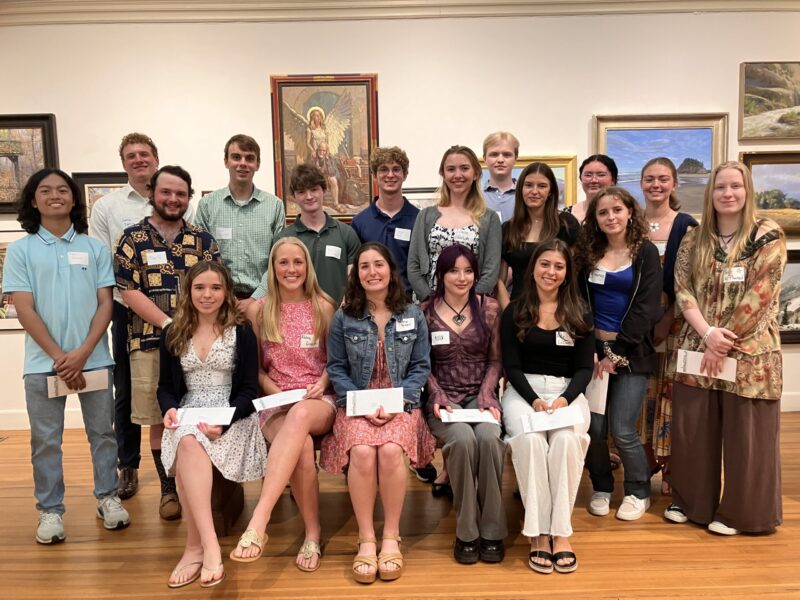
The MacCurdy Salisbury Educational Foundation recently awarded grants to 26 students. Standing, left to right: Manu Geronimo, Caleb Todzia, Mason Freer, Simon Karpinski, Ryan Shapiro, Micah Bass, Chloe Datum, Thomas Kabel, Tabitha Colwell, Erin Durant, Lily Esposito, Samantha Fiske and Paige Phaneuf. Seated, left to right: Abigail Greene, Abby Griffith, Audrey Spiegel, Nola Slubowski and Ada LaConti. Award recipients not pictured:
Gloria Conley, Caeli Edmed, Grace Ferman, Christopher Gibbons, Lana Lopes, Elias Sahadi, Kelly Sheehan and Charlotte Tinniswood.

LYME/OLD LYME—On June 17, the MacCurdy Salisbury Educational Foundation honored 26 graduating seniors during a reception at the Lyme Art Association.

Foundation President Fred Behringer said there are 94 students from Lyme and Old Lyme currently receiving grants through the program. The awards continue for all four years of college, trade school, or other post-high school training, as long as GPA and Lyme-Old Lyme residency requirements are met.

Total awards amount to $448,500 for the 2025-26 academic year, according to Behringer.

Behringer said grants for this year’s graduating seniors come in at $118,100.

The grants are based on need.

Evelyn MacCurdy Salisbury established the foundation in 1893.

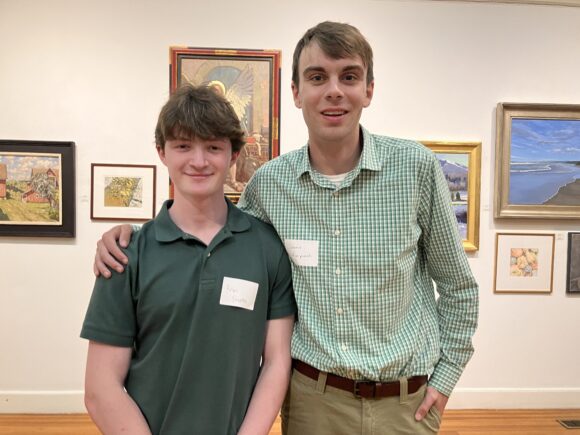
W.E.S. Griswold Award recipient Simon Karpinski, right, and Willis Umberger Award recipient Ryan Shapiro were honored June 17.

Three students also earned $500 special achievement awards.

Simon Karpinski, who will be attending Harvard University, received the W.E.S. Griswold Award. Incoming Columbia University student Ryan Shapiro received the Willis Umberger Award. Caeli Edmed was awarded the Rowland Ballek Leadership Scholarship for a student who has demonstrated leadership in the school and community by organizing, mobilizing or inspiring others. Edmed will attend Yale.

The special awards honor Bill Griswold, president of the foundation from 1965 to 1992; Willis Umberger, secretary/treasurer from 1966 to 1986; and Rowland Ballek, president for 20 years until he retired in 2022.

Essex Winter Series Now Under Leadership of Renowned Flutist With Retirement of 15-year Artistic Director Mihae Lee

Pianist Mihae Lee, left, has stepped down after 15 years as director of the Essex Winter Series. She will be succeeded by accomplished flutist Tara Helen O’Connor. Photo courtesy of the Essex Winter Series.

ESSEX–Tara Helen O’Connor has joined Essex Winter Series as its newest artistic director for the 2026 season following Mihae Lee’s retirement from the role. 

The organization in a recent press release said Lee held the leadership position for 15 years.

The group described Lee’s successor as an “exceptional musician who wishes to maintain the reputation, quality, and community commitment that her predecessor achieved.”

O’Connor, a flutist, is a charismatic performer noted for her “artistic depth, brilliant technique and colorful tone spanning every musical era,” according to the group. 

A recipient of Lincoln Center’s Avery Fisher Career Grant and two-time Grammy nominee, she was the first wind player invited to participate in the Chamber Music Society of Lincoln Center’s Bowers Program. She is a recurring featured artist with the Chamber Music Society. 

O’Connor is a regular participant in numerous chamber music festivals across the country. Along with her husband Daniel Phillips, she is the newly appointed co-artistic director of the Music From Angel Fire Festival in New Mexico.

She has premiered hundreds of new works and has collaborated with the Orion String Quartet, St. Lawrence Quartet, Emerson String Quartet, Jaime Laredo, Dawn Upshaw, Eliot Fisk, Jeremy Denk, Ida Kavafian, Peter Serkin and David Shifrin. Tara is a member of the woodwind quintet Windscape, the legendary Bach Aria Group and is a founding member of the Naumburg Award-winning New Millennium Ensemble. An advocate of new music, she is a member of the Talea and Cygnus Ensembles. 

O’Connor has appeared on A&E’s Breakfast with the Arts and PBS’ Live from Lincoln Center. She has recorded for Deutsche Grammophon, EMI Classics, Koch International, CMS Studio Recordings with the Chamber Music Society of Lincoln Center and Bridge Records. She has just released a solo CD of American flute works entitled The Way Things Go on Bridge Records with pianist Margaret Kampmeier.

She holds a doctor of musical arts degree from Stony Brook University in New York. At the Purchase College School of the Arts Conservatory of  Music, she is an associate professor of flute, head of the woodwinds department and the coordinator of classical music studies. She also serves on the faculty of Bard College Conservatory of Music, the Contemporary Performance Program at Manhattan School of Music and is a visiting artist, teacher and coach at the Royal Conservatory of Music in Toronto. 

Mihae Lee Legacy Concert

Lee, who became Artistic Director of Essex Winter Series in 2011 when president Fenton Brown stepped down, has been recognized by the Essex Winter Series Board of Trustees through the creation of the annual Mihae Lee Legacy Concert starting in the upcoming season. 

The group credited Lee with bringing in accomplished musicians and expanding community outreach to schools, senior communities and libraries. 

“With at least four concerts each winter and five days of outreach every year in Middlesex and New London Counties, reaching thousands, her success is clear,” the group said.

TOP STORY: Old Lyme Selectwoman’s Call to Disband Halls Road Improvement Committee Rejected by Shoemaker, Lampos

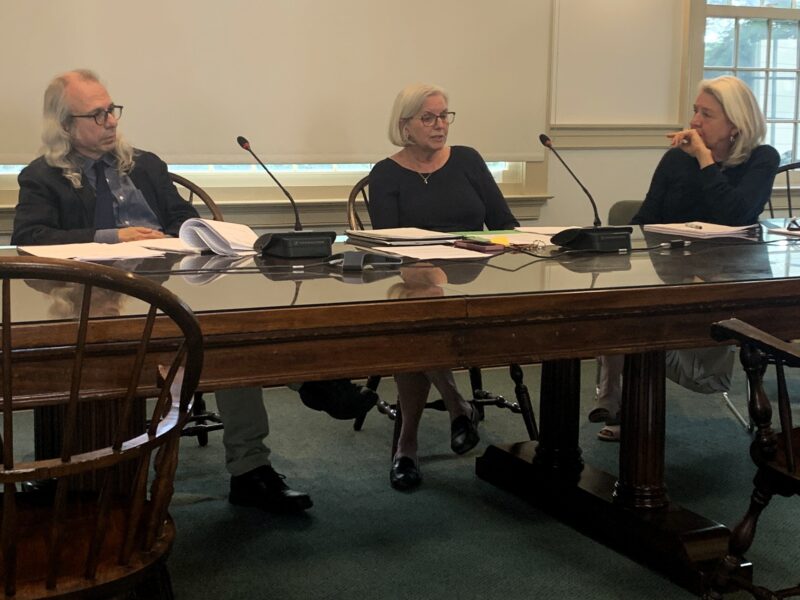
Old Lyme First Selectwoman Martha Shoemaker, center, with Selectman Jim Lampos, left, and Selectwoman Jude Read, right.

OLD LYME–Selectwoman Jude Read is calling for the dissolution of the Halls Road Improvements Committee (HRIC) as the Old Lyme Board of Selectmen continues to back away from big picture changes to the road that have evolved over the past decade. 

On the selectmen’s table now is a scaled-back plan that includes new sidewalks, but no other substantial upgrades like the bow bridge and trail system envisioned by the HRIC. First Selectwoman Martha Shoemaker in May signed off on a grant application to the Connecticut Department of Transportation (DOT) for $800,000 to install sidewalks on the north half of Halls Road. 

Josh Morgan, DOT Communications Director, said in a Tuesday email that he expects the award announcements to go out in the next several weeks. 

During their Monday evening regular meeting, the selectmen considered creating a new committee to guide the process if a grant is awarded. But Read emphasized the existing Halls Road committee should be disbanded before forming a new one. 

“The other thing I think would be helpful – these are my thoughts – is, if and when we start a new committee, we’re careful about the charge, what the goal is, (and) how many people are on that committee.” 

Read also suggested requiring a unanimous vote when appointing members to a new committee. She is the lone Republican on the board with Shoemaker and Selectman Jim Lampos, both Democrats. 

Lampos and Shoemaker declined to disband the committee right now because they need more information on the status of projects that were pending when selectmen voted to put the group on a hiatus in April.

The HRIC has been controversial since it started in 2015 under Democratic then-First Selectwoman Bonnie Reemsnyder with a charge to consider a master plan for the commercial span. The result – honed over the course of dozens of public meetings, information sessions, and workshops – evoked images of village-like storefronts and apartments, a pedestrian bridge, more greenspace and sidewalks. 

Reemsnyder successor Tim Griswold, a Republican, a few years later called the vision too grandiose. He said at the time that he preferred to focus on building sidewalks one segment at a time before considering such broad plans. 

But opposition came to a head earlier this year when more than 550 people filled the Lyme-Old Lyme High School auditorium for a public hearing on changes to the town’s zoning regulations that the committee hoped would turn their vision into reality. 

The proposal to create an overlay district in the commercial zone would have allowed as many as 40 housing units per acre to be built above, or behind, ground-floor businesses. 

The plan was rejected by the Zoning Commission, HRIC Chairwoman Edie Twining subsequently resigned, and the board of selectmen put the committee on hiatus while attempting to manage the fallout. 

Crossing That Bridge

Before making any decisions on whether to disband the HRIC, Shoemaker and Lampos on Monday said they wanted to get a better understanding of how much has been spent on Halls Road projects to date and which contracts remain outstanding. 

At the behest of the HRIC, selectmen in 2023 hired AI Engineers of Middletown to come up with plans for a pedestrian bridge over the Lieutenant River and a trail system between Lyme Street and Halls Road. The company’s work was funded with $135,000 in federal American Rescue Plan money and a $28,500 grant through the Connecticut Recreational Trails program.

Old Lyme Finance Director Anita Mancini said the committee spent $13,500 of the trails grant so far. 

The committee in an FAQ document said AI Engineers was tasked with taking charge of conceptual designs, formal designs, permitting and the construction bid process. No funding for construction has been secured. 

The decision to accept or reject the designs would be up to the public, according to the committee. Old Lyme’s form of government calls for the public to vote on major decisions at town meetings, with options to send the biggest issues to referendum. 

Shoemaker said the town could be responsible for returning $13,500 to the state if the town doesn’t complete the design project. 

Read argued it might be prudent in some cases “to take a loss.”

“Is it better to lose $13,500 or spend another $15,000, have it designed, and not be sure if the town’s going to approve it or not?” she said. 

Shoemaker and Lampos reiterated they need a better idea of the financial picture first. 

They said it’s been difficult to pinpoint how much has been spent, and in which line items, in a decade of budgets overseen by multiple administrations. 

Lampos credited the current selectmen with making the budget process and town procedures more transparent. 

“I think there’s a lot of clarity, but there’s just so much that we can answer for what happened before us,” Lampos said. 

LymeLine in April requested documents related to the amount expended so far on HRIC projects. Shoemaker on Monday said the information will be available next week. 

Lampos, who wrote the grant with Shoemaker’s executive assistant Katie Balocca, emphasized there is nothing in the grant to cover the HRIC’s bow bridge proposal. 

“It is currently on hiatus. We’re not addressing it,” he said. 

Building the bow bridge would require the state Department of Energy and Environmental Protection to transfer ownership of its property on the east bank of the Lieutenant River to Old Lyme, which the agency has agreed to do as long as the town agrees to put a fishing pier, a dock for portable boats and parking spaces there. 

Lampos acknowledged the idea, like other elements of the HRIC plan, is controversial. That’s why the grant application focuses solely on sidewalks. 

“Almost everybody was saying, ‘forget the overlay,’ half the people were saying, ‘forget the bridge,’ and just about everyone was saying, ‘but we want the sidewalks,’” he recounted. 

Read wondered if a new committee should be limited to overseeing only what’s in the grant or if they should be empowered to look at other improvements and funding sources. 

“We have requests for sidewalks, lighting, signage, beautification,” she said. 

Lampos put it this way: “If we don’t get the grant, I think we cross that bridge at that time.”