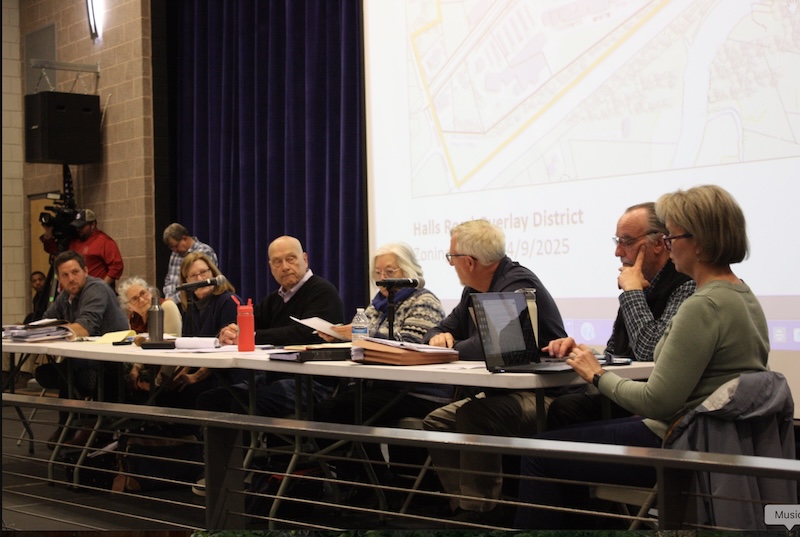
OLD LYME – The Zoning Commission on Monday evening voted decisively to quash a proposal intended by its proponents to transform Halls Road over time into a livable, walkable, ‘shoppable’ town center.
Members of the commission credited vocal opposition evident in the “No Way Overlay” movement and called for engagement from local land use officials and residents in crafting an alternate future for the short span of road between two highway interchanges.
The vote to deny the application passed 4-1. The lone dissenting vote came from Democrat Mary Jo Nosal.
The proposal hinged on the creation of a voluntary overlay district on Halls Road that would allow apartments and condominiums to be built above, or behind, ground-floor businesses set close to the street. The underlying commercial district that had allowed for construction of strip malls and mostly one- and two-story businesses over the latter half of the last century would have remained intact for property owners who weren’t interested in adding a residential component to their plans for retail shops, restaurants and offices.
The overlay district proposal, created by the Halls Road Improvements Committee, was approved by the Old Lyme Board of Selectmen in a 2-1 vote in November. The application to the Zoning Commission was signed by First Selectwoman Martha Shoemaker.
Zoning Commission member Jane Marsh, in explaining her decision, referenced the final session of a public hearing that concluded last week in front of an audience in the Lyme-Old Lyme High School auditorium that maxed out the room’s 550-person capacity and left upwards of 100 people unable to get in.
A majority of those in attendance at the time held “Vote No” signs. They spoke about the potential for too many apartments and condominiums – anywhere from 200 to 1,200 of them, depending on who was doing the calculation and which variables were considered – in a location with limited septic options and no public sewer system. They called out a lack of information throughout the years-long process and not enough opportunity for residents to get involved.
Marsh said she voted against the proposal, “Primarily because of everybody who came to that public hearing.”
Shoemaker after the vote said the Board of Selectmen will discuss how to move forward on improving Halls Road at a meeting over the next few weeks. She said Halls Road Improvements Committee Chairwoman Edie Twining has already expressed interest in working together to plan the next steps.
Twining on Monday night declined to give her own comment. But she referred to an impassioned speech from Zoning Commission member Denise Savageau, who called on members of the Planning Commission, Zoning Commission and other relevant agencies to work together with input from the public – instead of working in “silos” – to come up with a new plan.
Twining could be seen during the meeting taking notes as Savageau spoke.
“Denise was 100% correct,” she said afterward.
Editor’s Notes: i) This story has been updated with a change in the opening sentence. ii) Full story coming Tuesday. iii) A reminder of Our Policy on Comments.
Are the residents of Old Lyme being overtaxed? I would bet that most residents probably believe that our property taxes are relatively reasonable compared to other CT towns, but is that really correct? To try and find an answer to that question I Took a look at the town budget.
Reviewing the budget, the first thing that jumps out is that our “Unassigned Surplus Account” (UAS.) UAS is high. What does that mean and why is it important? Our town’s budget allocates funds for specific purposes. If revenues exceed expenditures that have already been accounted for, the town may assign the excess funds into an account titled an “unassigned surplus”. Think of it as a “rainy day fund” designated for unusual or unexpected expenditures. Our town’s current UAS is about 15 million dollars representing about30 % of the town’s total revenue.
Is 30 the right number or Is it excessive? Instead of maintaining a large surplus should the money be returned to the taxpayers in the form of lower taxes in the future or used to fund capital projects or some combination of the two?
How does our UAS compare to other CT towns? In 2020 The Office of Legislative Research for CT indicated the UAS number for CT. ranged from 0.1% for Stamford to 39.6% for Warren. The state auditors recommend that Connecticut towns aim for a surplus of 16%.
Why is ours on the high side? The reason given for keeping a high UAS is that in case of a catastrophic storm, that either temporarily or permanently wipes out our beach communities, our tax revenues will shrink. Even if that is correct, it is also true that in those circumstances our services and expenses would likely also decrease. Is it also reasonable to anticipate that FEMA or the state would compensate us for some portion of catastrophic losses? Other shoreline towns like Clinton and Old Saybrook, that have equal or greater risks than Old Lyme, maintain lower UASs. Why? How did the Town of Old Lyme determine that 30% is the optimal percentage? What was the formula or methodology employed to arrive at that number? Old Saybrook has a target of 15%, and if the UAS exceeds that amount, they have a plan in place to reduce it. They don’t let it continuously grow.
I realize the town faces some significant new upcoming capital expenditures, but that does not seem to explain why we have built up this level surplus over the last few years even before these projects were approved.
Alternatively, did the town look at possibly obtaining catastrophe insurance, limited to reimbursement for the loss of tax revenue, rather allocating millions of dollars to surplus? It might be a more economical solution.
Does a 30% surplus represent fiscal responsibility or irresponsibility? I don’t have the answers, but you may want to demand answers on the level of surplus and its impact on tax rates before deciding if you are being overtaxed.
OLD LYME – The Lyme-Old Lyme Schools Board of Education on Thursday voted unanimously to reinstate an elementary school music position to the district’s $39.7 million 2025-26 proposed budget while calling for harmony between the music department and district administration.
The district school board called for the special meeting amid vocal opposition from some community members after the position held by Mile Creek School music teacher Matthew Guevara was not included in the proposed budget. The school board approved the spending plan in February.
There are currently six music teachers in the district, including Guevara. He was hired in January.
Superintendent of Schools Ian Neviaser on Friday said the bottom line of the 2025-26 budget proposal will remain the same despite the added position. The cost, which he valued at $70,201 in salary and benefits, will be absorbed in the proposed budget.
It hasn’t yet been decided exactly where money will come from, according to Neviaser.
The budget proposal represents an increase of $2.7 million, or 7.39 percent, over the current spending plan. It’s the highest increase among comparable schools in the shoreline area, according to a presentation given by Neviaser earlier this week.
He said $1.8 million of the $2.7 million increase is attributable to debt payments for the renovation project happening in all district buildings except the high school.
The move to reinstate the music position came after school board members heard from members of the music department about how to enhance the program using the existing ensemble of six teachers.
The school board members were receptive to the music department’s plan and surprised it was the first they were hearing of it.
School board member Chris Staab, who made the motion to add the sixth teaching position and to require the administration and music department to work together in coming up with an implementation plan, voiced concerns about the dynamic he was seeing in the district.
“The departments don’t seem to be working in conjunction with the administration, at least in this case, and that’s concerning to me,” he said.
Kristine Pekar, music department chair and Lyme-Old Lyme High School choral teacher, said members of the department have not been asked for their thoughts like this before.
“It’s the first time anybody’s hearing it because when we put ideas out there, it doesn’t feel like they are really looked at for what they can do for kids,” she said.
Neviaser has cited underenrollment, rather than cost cutting, as the reason the district could not maintain current staffing levels.
Pekar said she’s heard over and over that the cut wasn’t a financial decision.
“We’re not asking for more finances,” she said. “We’re asking for the opportunity to grow this program.”
Critics said eliminating the music teacher at Mile Creek School would have negative implications at all grade levels by spreading the five remaining teachers too thinly across the district’s five schools.
Pekar gave an hour-long presentation on the structure of the district’s music program and how it compares to area districts. She also laid out how the program could better serve students whose musical education had been interrupted by the COVID-19 pandemic with lasting effects.
Some of the strategies to more fully utilize existing staff included introducing instrument lessons, band rehearsals and chorus classes earlier in elementary school; scheduling one-on-one lessons for students with disabilities at the middle school; and promoting existing music electives at the high school to make more students interested in taking them.
Key to increasing enrollment at the high school is classifying the high school’s music theory class as a Science, Technology, Engineering and Math (STEM) credit students can choose from to satisfy graduation requirements, Pekar said.
She used the example of a current student planning to study music in college who signed up for marine biology as his STEM credit.
“He’s going into music education and he had to take marine bio to fulfill his STEM credits, instead of taking music history to get ready for college, or AP music theory to get ready for college. And I think that is a huge disservice to our students,” she said.
Pekar pointed to data showing 121 of Lyme-Old Lyme High School’s 368 students, or 33%, are enrolled in chorus or band ensembles. She said the number compares favorably to area districts, including 11.7% in East Lyme and 20.4% in the Region 4 school covering Chester, Deep River and Essex.
Members of the school board agreed they can still cut the music position after the proposed budget is approved by voters if the administration and music department doesn’t come forward with a compelling plan for implementing the ideas laid out at the meeting.
Neviaser on Friday remained focused on enrollment.
“We look forward to building upon the creative ideas presented by the music department last night in order to grow student enrollment in this area,” he said.
The board did not discuss a suggestion from Mary Powell-St. Louis, a former district school board member from Lyme, to offset the cost of the sixth music teacher’s salary by paying for the high school sound system and middle school lighting system out of the district’s undesignated fund balance, or rainy day fund.
She said the move would end up lowering the overall budget increase to 6.85%.
There is $3.1 million in the undesignated fund balance, according to Neviaser.
He said it is “yet to be determined” whether the district will consider Powell-St. Louis’ suggestion.
The referendum on the proposed budget will be held May 6.
The Old Lyme Zoning Commission closed the public hearing on the Halls Road Overlay District application April 9, 2025 in front of a packed auditorium at the Lyme-Old Lyme High School. All photos by E. Regan.
OLD LYME—About 550 people converged in the Lyme-Old Lyme High School auditorium Wednesday evening, many of them armed with “Vote No” signs and deeply-held ideals about preserving their small town’s character, as they fought a plan to bring apartments and condominiums to Halls Road.
The Old Lyme Zoning Commission voted unanimously to close the public hearing on the Halls Road Overlay District around 9:45 p.m. after roughly 40 people got up to speak. The subject was a highly controversial application for the creation of an overlay district on Halls Road that could allow as many as 40 housing units per acre to be built above, or behind, ground-floor businesses set close to the street in the 40-acre zone.
Residents and vocal project critics Ron and Julie Malloy said they had about 500 of the “Vote No” signs printed. By the start of the meeting, only a few were left in their stack. There were also up to 100 people waiting in the hall because Old Lyme Fire Marshal Dave Roberge, per state fire code, could let no more people inside the room.
The intent of the proposal, which has evolved over multiple years under the guidance of the Halls Road Improvements Committee (HRIC) and its chairwoman Edie Twining, is to create over time a vibrant, walkable neighborhood where strip malls now stand.
The overlay district proposal, created by the HRIC, was approved by the Old Lyme Board of Selectmen in a 2-1 vote in November. The application to the Zoning Commission was signed by First Selectwoman Martha Shoemaker.
The HRIC was represented at the hearing by Attorney William Sweeney, who told the commission he’s been working with the group since 2022.
The long-awaited meeting was the culmination of a process that had invited public input since January. No new information can be presented now that the hearing has concluded. The commission has 65 days to consider the evidence and reach a decision.
While demands for a town wide referendum on the issue have been a popular refrain on social media and in public meetings, Land Use Coordinator Eric Knapp said that’s simply not possible.
Once a town creates a zoning commission, according to Knapp, state law is clear that only the zoning commission has the power to make or amend regulations.
“You can’t call a referendum on this. The only choice you have at this point is abolish the zoning commission, abolish zoning regulations and start over,” he said, adding, “Which I don’t recommend.”
Opposition Arguments
Differing interpretations of the overlay proposal estimate there could be anywhere from 200 to 1,200 apartments built if the plan goes into effect. But even on the low end, opponents decried what they characterized as a disastrous effect on the environment, school enrollment, traffic and their overall quality of life in the rural community of 7,628 year-round residents.
The lack of sewer service in the area was also cited as a roadblock by many residents.
Proponents argued the proposed district would bolster the local economy and meet a vital need in a state where demand for housing exceeds the supply — and in a town where a vast majority of places to live are single-family homes. They said young adults, who grew up here, can’t afford to come back and older people looking to downsize, can’t stay.
The arguments in favor of the overlay district didn’t sway an immigrant from Argentina, a young adult living with her grandmother, and a San Diego transplant who each called for Old Lyme not to change.
Elizabeth Rex said she couldn’t afford to live in California again—even if she wanted to.
“I couldn’t even afford a studio apartment there now. But I’m not going to go home and demand that housing is built to accommodate me because I want to move back,” she said. “No! I moved to glorious Connecticut, which I love. I love this small town. It’s stunning. I love the farms nearby. I love the rivers. It’s gorgeous. Keep it this way.”
Maddie Sylvestri came to Old Lyme to live with her grandmother after growing up in Pittsburgh. She said the component of the overlay plan, which calls for 10% of the housing units to be rented out at rates considered affordable by state standards, won’t make a dent in the housing problem.
“Only 10% affordable living is just not going to meet the needs of young people in this economy,” Silvestri said.
Under the affordable housing provisions of the proposed overlay district, a single person making $69,840 a year would qualify for a rent of $1,746 per month for a studio apartment, according to the most recent rent limits set by the US Department of Housing and Urban Development.
Resident Russell Todd, a member of the Historic District Commission who said he was speaking only for himself and his wife, said the proposal, “Represents a significant shift toward urbanization.”
He said the amount of housing, the size of the buildings and the lack of attractive green space threaten Old Lyme’s small-town identity that drew the couple to Old Lyme in the first place.
Robin Breeding, a familiar name on social media in posts bringing attention to the overlay district proposal, said the plan is full of contradictions.
“On one hand, advocates of the overlay say their plan calls for only a couple of hundred new apartments on Halls Road. On the other hand, they insist again, against the advice of this commission, to include parking garages,” she said. “That would only make economic sense if they build over a thousand units.”
She also argued against the contention that the overlay district would prevent construction of new gas stations and highway services. That’s because the underlying commercial district is still in place as an avenue for those who don’t want to build mixed-use developments on Halls Road.
The Pros
Proponents of the plan outlined a vision for a Main Street-type feel that was characteristic of nearby Lyme Street before most commercial offerings were pushed off the historic, tree-lined expanse and onto Rte. 1. They said the proposed regulation includes more modern requirements to protect the environment and relies on design guidelines that go further to enhance the town’s rural feel than the existing commercial zone.
In similar fashion to Breeding—but this time, supporting the proposal—Kimberly Thompson, chairwoman of the Old Lyme Democratic Town Committee, spoke of contradictory information from those against the plan.
She cited concerns from opponents about the lack of space for septic systems, proximity to the river and ensuring that open space remains protected.
“By definition, those things are going to limit the development in this area,” she said. “And I support the overlay district because those things exist, because there’s going to be review of septic and wastewater plans, because The Lieutenant River is governed by the Gateway Commission, and they are going to have input on what can go there. And because the land trust owns spaces here and their mission is to preserve that space.”
Alex Twining, a successful real estate developer and brother of the Halls Road Improvements Committee Chairwoman, said Halls Road is currently functional but not inviting.
“Imagine a better vision: A tree-lined Halls Road with sidewalks, bike paths, and shops you can stroll between, park once, stop in a few stores, meet your friend at a cafe, and maybe keep walking to the river or boat landing. Less driving, less hassle, and more pleasant,” he said.
This vision won’t happen overnight, and places like Big Y will be there for a long time. But with time, new shops and restaurants can begin to open along the street,” he added.
The businessman invoked the ire of the raucous crowd, which was again reprimanded by Zoning Commission Chairman Paul Orzel, to be respectful.
Edie Twining has been the subject of speculation on social media by those, who accuse her of seeking financial gain for her family, by advocating for the overlay district.
Nell Twining stood up to defend her husband and sister-in-law against what she described as, “Paranoid speculation, conspiracy theories, and repulsive accusations.”
“Neither Alex nor I own property nor have any financial interest on Halls Road or in the proposed overlay district,” Nell Twining said.
“And to those who express suspicions of why my sister-in-law has worked so hard as a volunteer on the Halls Road Committee: Volunteer community service has been important in the Twining family for generations,” she added.
The 550-person capacity of Lyme-Old Lyme High School ‘s auditorium was reached Wednesday night before the Old Lyme Zoning Commission’s Public Hearing on the Halls Road Improvements Committee Overlay District proposal began.
Being Heard
The public hearing had been open almost three times as long as the 35 days authorized in state statute. The commission was forced to close it when an extension already granted by the applicant was not renewed Wednesday.
Multiple people had called for the hearing to remain open so those who had been turned away would have time to hear and be heard.
Knapp, the land use coordinator, explained early in the meeting that technological limitations at the high school made it impossible to broadcast the meeting remotely.
The move to close the hearing came after Zoning Chairman Orzel, at the request of member Michael Miller, asked if the applicant would be willing to extend the public hearing. State statute specifies all extensions must be approved by the applicant.
Sweeney said his client was “not interested in extending” the hearing.
Edie Twining could not be reached for comment Thursday, and Sweeney said he was not authorized to speak for the committee.
Shoemaker, Old Lyme’s First Selectwoman, on Thursday acknowledged calls by residents like Shaun Mastroianni for her to withdraw the application she’d signed in November.
Mastroianni ran an unsuccessful campaign for state Senate as the Republican candidate in the 20th District race against Democrat Martha Marx.
Mastroianni used his two minutes at the microphone during the public hearing to emphasize he does not want to see Old Lyme become another Mystic and to ask residents to reach out to the Board of Selectmen to get them to withdraw the application.
“I urge you, tonight, tomorrow, to write to your first selectwoman that is sitting – hiding – in the back,” he said.
Shoemaker said she was in the first row of the balcony.
“I wasn’t hiding,” she said. “I was listening.”
Shoemaker said she would hold off on making any decisions on rescinding the proposal until Thursday’s 7 p.m. meeting of the Halls Road Improvement Committee was over.
“I’m waiting to hear their thoughts,” she said. “And I think that because they had put so much time and effort into it, I owe them the time for discussion.”
Tom Bushnell will replace Lyme-Old Lyme High School Assistant Principal Jeanne Manfredi on July 1. Photo courtesy of the Lyme-Old Lyme Schools.
OLD LYME – On April 3, Lyme-Old Lyme (LOL) Schools announced that Tom Bushnell of Old Lyme will replace Lyme-Old Lyme High School (LOLHS) Assistant Principal Jeanne Manfredi upon her retirement at the end of the current school year.
The district in a press release said Bushnell, who currently serves as an assistant principal at North Haven High School, will begin his new position on July 1.
Superintendent of Schools Ian Neviaser said the district received 160 applications.
He commented, “Tom’s calm and friendly demeanor, along with his passion for working with young adults, made him stand out from a very competitive field.” Neviaser added, “We look forward to Tom joining our team and continuing to build upon the success of Lyme-Old Lyme High School.”
With four years’ experience as assistant principal, Bushnell has also worked as a social studies and math teacher at Adams Middle School in Guilford and St. Thomas More School in Montville.
Bushnell has a sixth year certificate in educational leadership from the University of Connecticut, a master’s degree from Fairfield’s Sacred Heart University, and earned his bachelor’s degree from Connecticut College.
Bushnell lives in Old Lyme with his wife and two children.
Manfredi is retiring after more than 30 years in the district, including nine years as LOLHS Assistant Principal. She worked initially for LOL Schools from June 1991 to 1999, returning in 2003.
Editor’s Note: This article has been updated with the number of years of service of the retiring Assistant Principal.