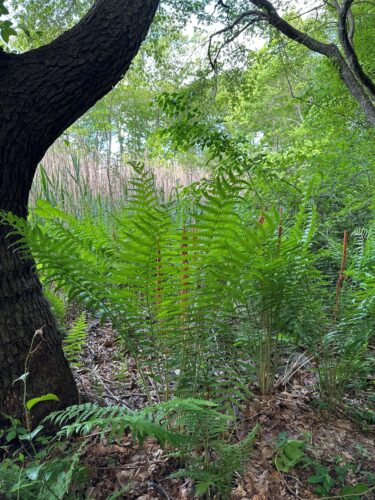
John Gluszak took this ‘Imagining Lyme’ photo of distinction while resting on a bench during a trek through Banningwood Preserve. All photos courtesy of the Lyme Land Trust.
LYME–The winners of the Lyme Land Trust’s “Imagining Lyme” spring photography contest have been announced.
The contest, which encourages amateur photographers to highlight the beauty of preserves, pollinator gardens and the skies of Lyme, is held quarterly.
Scott Martin’s photograph was taken in June 2021 at Ram’s Horn Creek Preserve.
This spring’s Photo of Distinction winners are:
“Sun Dappled Roaring Brook” by John Gluszak
“Jurassic Ravine Trail” by Sue Wyeth
“Doe and Fawn” by Scott Martin
Sue Wyeth took this photo while hiking Ravine Trail in May.
Jos Konst was awarded an honorable mention for “Mountain Laurel Blooming.”
This photograph from Jos Konst came from Selden Preserve in June 2023.
I recently volunteered to join the OLWPCA [Old Lyme Water Pollution Control Authority] because I wanted to serve my community and the town.
I was hoping that I could help decipher for my neighbors and friends the ambiguity regarding 10-year-old testing, affordable alternatives and ever-increasing project costs. I wanted to learn all I can, but it seems the more we hear, the less we understand. The issues are huge!
Sewers have become the hot topic on the beach, at the coffee shops and all over town.
As a WPCA member and a resident of Old Lyme I would like to provide my neighbors with answers to their questions. I cannot! My neighbors and I read the local news and listen to meetings and do our best to stay informed. But there seems to be so much that we still don’t know.
We know Miami Beach bids will be in early to mid August, but Old Lyme Shores has not even set a date yet to go out to bid. They both are supposedly going to be a part of the project. What if they don’t join in? Who pays for their potentially applicable shares of this project? I understand that the OLWPCA Chair is proposing town meetings and referendums for late August and early September, I wonder why, since significant financial factors to the Town may not be clarified by then.
We hear there is still uncertainty regarding the Cost Sharing Agreement [CSA}. The OLWPCA Chair tells us that the WPCA’s are reviewing and discussing the CSA.
I cannot do what I hoped to do as a member of the OLWPCA. I cannot help my community understand the why, the when or how much this project will cost them. I cannot tell them if it is ‘affordable’. Clearly there is a goal to make this project soundaffordable in order to meet the state’s 2% income guideline. My concern is that this ambitious goal will result in many expenses that should beconsidered part of the build and incorporated therefore also in the ‘EDU’ value, will be pushed under the blanket ofusage and maintenance. If included as part of the build costs, the entire project could ultimately be construed as UN-affordable! As residents of the beach communities under the gun to get sewers, un-affordability (which many of us already think it is) is very true. We are potentially looking at tens of thousands of dollars in costs! I don’t have that kind of money … do you?
Contractual fees to New London and East Lyme, are not usage. The estimated $700,000 that I think we may owe for bridge work, is not usage. The $100,000 in easements, is not usage. Change orders already identified (before a shovel even goes into the ground), are not usage.Whatever has already been spent in legal fees, consultants, etc., by the OLWPCA and or by Old Colony in regard to the Shared infrastructure,are not usage. Frankly I cannot see how any project expense incurred at this point can be categorized as usage since there has been no usage! That changes the affordability of the project.
My opinion and that of many is that the Town should take the lead and demand an audit of what the OLWPCA, both past and present and Old Colony with respect to the “Shared group” have spent to date, how much is owed and how much is projected to be owed. My opinion and that of others is that the Town should not move forward without that information.
Come to WPCA and Selectmen’s meetings and speak up, please.
OLD LYME—Kathryn “Kay” Tubridy of Old Lyme, formerly of Black Point Beach, Niantic, died Aug. 13, 2025, at home surrounded by loved ones.
Born Feb. 3, 1942, in Hartford, she was the daughter of the late Vincent E. Turley and the late Katharine McCarthy Turley, and the stepdaughter of the late Jane Nagle Turley. Kay was predeceased by her husband … She is survived by her loving children, Robert E. Tubridy of Cromwell; Matthew P. Tubridy and his partner, Miranda Merritt, of Bradenton, Fla.; and Meghan McCulloch and her husband, John J. McCulloch, of Old Lyme. She was a devoted grandmother … Kay is also survived by her brother Vincent E. Turley Jr.; and her sister-in-law C. Francis Barringer. She leaves behind her cherished friends …
… Kay dedicated much of her professional life to real estate … She also served as secretary and treasurer of the Black Point Beach Club Association …
Kay was a devoted member of Christ the King Parish in Old Lyme, where she served as a Eucharistic Minister and remained actively involved in church life.
A Funeral Mass and reception will be held at 2 p.m. Wednesday, Aug. 13, at Christ the King Church, 1 McCurdy Road, Old Lyme, with the reception to follow at 3 p.m. You are invited to celebrate Kay’s life by attending the Funeral Mass, joining the family at the reception following the service, or both. Please join them however you are able. A private burial will be held at a later date.
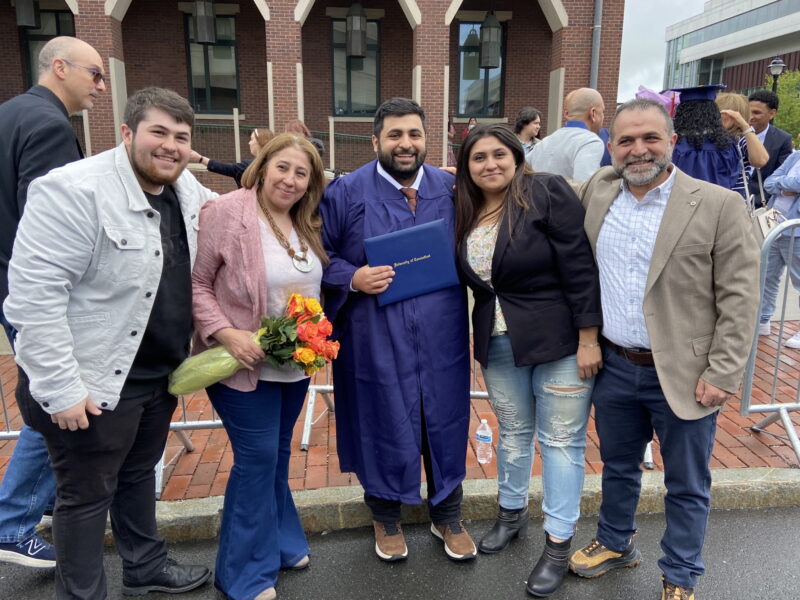
The Hamou family celebrates the graduation of Kamber Hamou from the University of Connecticut in May. From left to right: Mohamad, Yaldiz, Kamber, Darin and Hani Hamou. Photo courtesy of the family.
LYME, CT–Nine years ago, Syrian refugees Hani and Yaldiz Hamou arrived in Lyme after chasing an education for their three children from war-torn Aleppo to the cold, unwelcoming streets of Turkey.
This spring, Kamber Hamou, 25, became the first member of the family to earn a college diploma. His degree in computer science from the University of Connecticut led immediately to a full-time job in the digital department at Pfizer Inc.
“Dream, dream, dream,” Hani said in his slightly broken English in a July interview from the family’s living room overlooking the fields and silos of Tiffany Farm. “You need dream. Everybody needs to have dream.”
Hani called it “chance” when an application and multiple interviews with the United Nations High Commissioner for Refugees program landed the family in the United States.
But Lyme-Old Lyme Schools and the state university system have proven to be the family’s winning ticket, according to Hani.
“This is my big lotto,” he said.
Hani, a US citizen with his wife and three children since 2021, acknowledged the importance of material things in his new country. But for the father who arrived with nothing but his family, the priorities are different.
“Everybody like money, like car,” Hani said. “No, I like to see my children’s graduation. Everybody safe for future. Safe.”
He recalled flying from Istanbul to New York City in 2016. The family was soon greeted by members of the New Haven-based Integrated Refugee and Immigration Services (IRIS) and the Old Lyme Refugee Resettlement Committee.
“No English, no job, no anything,” he said. “Now, I have three children in college.”
Eldest daughter Darin, 26, is a certified nursing assistant at the Essex Meadows senior living facility who this fall will begin studying to become a registered nurse at Three Rivers Community College in Norwich. Mohamad, 20, is pursuing a business management degree at UCONN.
Importance of Education
Kamber said forging a life in a new country was challenging. But he gave credit to his family – the one he came over with as well as the people who became honorary members of the Hamou clan – for making it possible for him to succeed.
“I mean, it’s really not easy, but still, you do get through it,” he said. “You know that tomorrow is going to be different. And working hard pays off, always.”
Hani is employed as a custodian at Lyme-Old Lyme Middle School while Yaldiz holds a position in the laundry room at the same senior living facility where her daughter works.
Hani, one of six children born to an illiterate mother and a father who worked all the time, traced his unmet need for higher education back to his childhood.
“Nobody care about my dream,” he said of his roots in Syria. “I’m coming here, I promise myself: My children need to go to college. This is number one for me.”
For Darin, it was the family’s long waking hours after fleeing bombings in Aleppo, Syria, that made her brother’s graduation all the more powerful.
She recalled flashing back during the ceremony to the winter nights spent as refugees in Turkey. That’s when Kamber, then 12-years-old, would fall asleep in clothes soaking wet from his dishwashing job while she cried into a pillow after her own 16-hour shifts at a garment factory.
“There was a lot of nights that we didn’t have money to buy a small bread to eat,” she said.
Back then, the children were not allowed an education in Turkey due to their refugee status. Yaldiz, speaking in translation through Kamber, remembered the tears she’d shed when she watched her children walking to work while others the same age passed by on their way to school.
Hani pointed out that Mohamad only went to school in Syria for one year before the war broke out. But that didn’t stop the pre-teen from learning enough during his inaugural summer in the United States to enter school as a fifth grader.
“I cry,” Hani said of taking his youngest child to Lyme Consolidated School for the first time. “Mohamad (had) just one year in school, just one year. Now, Mohamad in college.”
Bombs Everywhere
Hani and Yaldiz Hamou returned to Syria for the first time earlier this summer. Their trip included a visit to the Aleppo Citadel. Photo submitted.
Hani said the civil war in Syria had been going on for a few years when fighting came to their hometown of Aleppo. The family escaped one night after missiles began to fly.
Kamber remembered the chaos.
“There was bombs everywhere, like, literally. People crying on the streets. People calling for help,” he said.
There was no question they needed to get out, according to Hani.
“It’s not safe. It’s not safe,” he said. “It’s not safe for my family.”
The Hamous retreated to northern Syria before fleeing to Turkey. It was there, during two years and six months that felt to the children like forever, that a friend told them about the United Nations program for refugees.
Hani said he didn’t know what the United Nations was, but that didn’t matter. His friend told him to fill out an application anyway.
“Go,” he recalled the man saying. “Go sign. It’s just paper.”
Hani was 43-years-old when that plane out of Istanbul – it was his first flight ever – took the family to their new home.
Yaldiz remembered the fear.
“Who’s going to take us?” she said. “Who’s going to take care of us?”
‘Missed Opportunity’
The same resettlement process that welcomed the Hamous has helped families from The Congo, Puerto Rico, Iraq and Afghanistan build a foundation in Lyme and Old Lyme since the Old Lyme Resettlement Committee began eight years ago as a tri-church initiative in partnership with IRIS.
Kamber cited a community of supporters that included the volunteers who brought the family to countless medical appointments and soccer games. It also included the first teacher to introduce him and Darin to the English language and to fractions.
The Hamou children now refer to two of those volunteers as grandmothers. The same teacher attended Kamber’s graduation as an honored guest.
“I had that dream in me,” Kamber said. “I knew that I would graduate. The amount of support I got is what I did not expect.”
But the volunteer committee disbanded earlier this year, according to a former member. The news came after an executive order from President Donald Trump suspended the nation’s refugee admissions program — a move that, according to the CT Mirror, led IRIS to shutter its main office space in New Haven and reduce its 100-person staff by half.
Affected refugees along with nonprofit aid groups continue to fight the move in federal court.
Kamber described the suspension as a “missed opportunity” for the country to make a difference in the lives of refugees, and for refugees to make a difference in the United States.
“I always promise myself that I’m going to give back to this community, even if I move out of the town,” he said. “I’m gonna be still connected. I’m gonna help when help is needed. And I’m gonna do my best to be remembered here.”
The Hamous said they are not unique.
“There are a lot of people, a lot of people, who are like us,” Kamber said. “So, I just feel like it’s going to be really hard on both sides: A missed opportunity for the United States itself to lose these people, and these people to lose their dreams.”
Hani, asked about his own plans for the future, said it doesn’t matter.
“Maybe I live here,” he said. “Maybe I’m going, after I’m retired, back to my country. Small house, me and my wife. I don’t know.”
The most important thing is his children, and the guarantees that only education can make against an uncertain future.
“Tomorrow you don’t know,” he said. “War coming, war happening. Nobody knows.”
As predicted, fares are going up on Metro-North by 5% starting Sept. 1, with another 5% hike coming next July.
The final approval came days ago from the MTA, parent of Metro-North, which rubber-stamped CDOT’s fare hike decision. At least one MTA Board Member called the hikes “scary” and another exclaimed that he was “actually kind of offended”. But, hey … there is nobody on the MTA Board representing Connecticut riders so they both voted to approve the hike as did the entire MTA Board. After all, it’s not their money.
Mind you, the MTA is also shortly expected to approve a 4.4% fare hike for New York’s Metro-North riders as well as a 25 cent increase for NYC subways and buses, so put that in your pipe of moral indignation and smoke it.
As I explained a few weeks ago, the Connecticut fare increase can be blamed on the Governor and legislature, which knowingly under-cut the CDOT budget, pretty much telling the agency to raise fares to make up the difference. After all, they seem to assume that everyone who rides Metro-North along Connecticut’s “gold coast” is a millionaire.
But a 10% increase in one year? On top of a 4.5% hike just two years ago? That adds up to a compounded 15.2% increase since 2023 … way more than inflation. Remember, Metro-North has a captive audience and can do anything it wants.
And adding insult to injury, there are new ticket rules coming!
With more and more commuters buying one-way e-tickets (57%) instead of monthly passes (36%), those tickets will automatically be activated on purchase, not when you get on the train and activate them yourself. Why? Because, the railroad says, 55% of ticket holders don’t activate their tickets until they see the conductor coming around.
But isn’t it the conductor’s job to collect those fares and put seat checks on each row?
According to MTA Deputy Chief Jessica Lazarus, “Conductors are spending more than 20,000 hours each year reminding customers to activate one-way mobile tickets”. Really? How did they come up with that metric?
Requiring activation of the ticket at time of purchase, she says, will, “recapture those hours that can be better put to use for fare collection and train safety operations.” Like enforcing the “no radios rule” and “no feet on seats”?
If you’re doing a same-day roundtrip, you won’t buy two one-way tickets but, instead, a new Day Pass. Good for unlimited travel until 4 am the next day, day-trippers using the pass will get a 10% fare discount compared to buying two one-way peak tickets.
For hybrid commuters, after buying 10 one-way tickets within two weeks the eleventh will be free. For Seniors, the disabled and those on Medicare the new reduced fare ticket will be valid at all times, even in the morning peak.
Make no mistake: fare evasion is a serious problem for MTA, which estimates they lose $700 million each year, most of it on buses ($315 M) and subways ($285 M). Metro-North losses are estimated at $44 M. Given that train fares are much more expensive than bus and subway, that’s not a lot of commuter scofflaws; just 6% of riders compared to 15% of subways riders and 37% of bus passengers.
Of course, bus riders can easily board by the rear door and subway riders can jump over turnstiles. On Metro-North we have conductors. It’s an hour-long ride from Stamford to Grand Central Terminal, plenty of time to look at everyone’s ticket … which they will still have to do even under the new rules.
But what about the Dashing Dan running to make his train, grabbing a seat and then trying to buy an e-ticket in a cellphone dead spot, nervously watching the conductor moving down the aisle? No ticket to show? You’ll get whacked with a $2 surcharge.
Here are the optics: CT lawmakers short-change the CDOT budget, basically saying “let the commuters pick up the tab.” Now MTA makes commuting less convenient with new ticket rules.
We all end up paying more and getting no improvement. The trains are no faster or reliable … and maybe less attractive as a transportation choice.
Editor’s Notes:i) Jim Cameron is the founder of the Commuter Action Group and advocates for Connecticut rail riders. He writes a weekly column called ‘Talking Transportation,’ which is published by a number of publications in the state. ii) ”Talking Transportation” recently won first place in the general column/commentary category in the Connecticut Society of Professional Journalists Excellence in Journalism Contest.