
LYME, CT–Nine years ago, Syrian refugees Hani and Yaldiz Hamou arrived in Lyme after chasing an education for their three children from war-torn Aleppo to the cold, unwelcoming streets of Turkey.
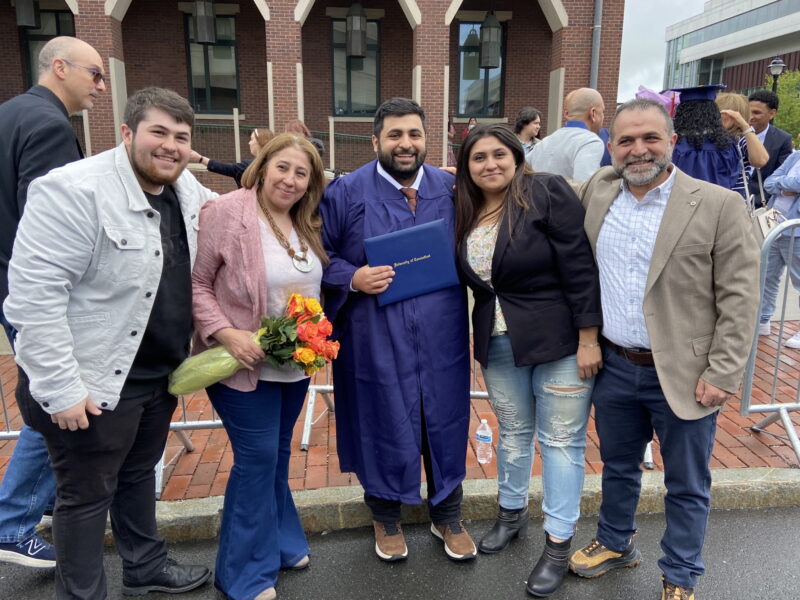
This spring, Kamber Hamou, 25, became the first member of the family to earn a college diploma. His degree in computer science from the University of Connecticut led immediately to a full-time job in the digital department at Pfizer Inc.
“Dream, dream, dream,” Hani said in his slightly broken English in a July interview from the family’s living room overlooking the fields and silos of Tiffany Farm. “You need dream. Everybody needs to have dream.”
Hani called it “chance” when an application and multiple interviews with the United Nations High Commissioner for Refugees program landed the family in the United States.
But Lyme-Old Lyme Schools and the state university system have proven to be the family’s winning ticket, according to Hani.
“This is my big lotto,” he said.
Hani, a US citizen with his wife and three children since 2021, acknowledged the importance of material things in his new country. But for the father who arrived with nothing but his family, the priorities are different.
“Everybody like money, like car,” Hani said. “No, I like to see my children’s graduation. Everybody safe for future. Safe.”
He recalled flying from Istanbul to New York City in 2016. The family was soon greeted by members of the New Haven-based Integrated Refugee and Immigration Services (IRIS) and the Old Lyme Refugee Resettlement Committee.
“No English, no job, no anything,” he said. “Now, I have three children in college.”
Eldest daughter Darin, 26, is a certified nursing assistant at the Essex Meadows senior living facility who this fall will begin studying to become a registered nurse at Three Rivers Community College in Norwich. Mohamad, 20, is pursuing a business management degree at UCONN.
Importance of Education
Kamber said forging a life in a new country was challenging. But he gave credit to his family – the one he came over with as well as the people who became honorary members of the Hamou clan – for making it possible for him to succeed.
“I mean, it’s really not easy, but still, you do get through it,” he said. “You know that tomorrow is going to be different. And working hard pays off, always.”
Hani is employed as a custodian at Lyme-Old Lyme Middle School while Yaldiz holds a position in the laundry room at the same senior living facility where her daughter works.
Hani, one of six children born to an illiterate mother and a father who worked all the time, traced his unmet need for higher education back to his childhood.
“Nobody care about my dream,” he said of his roots in Syria. “I’m coming here, I promise myself: My children need to go to college. This is number one for me.”
For Darin, it was the family’s long waking hours after fleeing bombings in Aleppo, Syria, that made her brother’s graduation all the more powerful.
She recalled flashing back during the ceremony to the winter nights spent as refugees in Turkey. That’s when Kamber, then 12-years-old, would fall asleep in clothes soaking wet from his dishwashing job while she cried into a pillow after her own 16-hour shifts at a garment factory.
“There was a lot of nights that we didn’t have money to buy a small bread to eat,” she said.
Back then, the children were not allowed an education in Turkey due to their refugee status. Yaldiz, speaking in translation through Kamber, remembered the tears she’d shed when she watched her children walking to work while others the same age passed by on their way to school.
Hani pointed out that Mohamad only went to school in Syria for one year before the war broke out. But that didn’t stop the pre-teen from learning enough during his inaugural summer in the United States to enter school as a fifth grader.
“I cry,” Hani said of taking his youngest child to Lyme Consolidated School for the first time. “Mohamad (had) just one year in school, just one year. Now, Mohamad in college.”
Bombs Everywhere
Hani said the civil war in Syria had been going on for a few years when fighting came to their hometown of Aleppo. The family escaped one night after missiles began to fly.
Kamber remembered the chaos.
“There was bombs everywhere, like, literally. People crying on the streets. People calling for help,” he said.
There was no question they needed to get out, according to Hani.
“It’s not safe. It’s not safe,” he said. “It’s not safe for my family.”
The Hamous retreated to northern Syria before fleeing to Turkey. It was there, during two years and six months that felt to the children like forever, that a friend told them about the United Nations program for refugees.
Hani said he didn’t know what the United Nations was, but that didn’t matter. His friend told him to fill out an application anyway.
“Go,” he recalled the man saying. “Go sign. It’s just paper.”
Hani was 43-years-old when that plane out of Istanbul – it was his first flight ever – took the family to their new home.
Yaldiz remembered the fear.
“Who’s going to take us?” she said. “Who’s going to take care of us?”
‘Missed Opportunity’
The same resettlement process that welcomed the Hamous has helped families from The Congo, Puerto Rico, Iraq and Afghanistan build a foundation in Lyme and Old Lyme since the Old Lyme Resettlement Committee began eight years ago as a tri-church initiative in partnership with IRIS.
Kamber cited a community of supporters that included the volunteers who brought the family to countless medical appointments and soccer games. It also included the first teacher to introduce him and Darin to the English language and to fractions.
The Hamou children now refer to two of those volunteers as grandmothers. The same teacher attended Kamber’s graduation as an honored guest.
“I had that dream in me,” Kamber said. “I knew that I would graduate. The amount of support I got is what I did not expect.”
But the volunteer committee disbanded earlier this year, according to a former member. The news came after an executive order from President Donald Trump suspended the nation’s refugee admissions program — a move that, according to the CT Mirror, led IRIS to shutter its main office space in New Haven and reduce its 100-person staff by half.
Affected refugees along with nonprofit aid groups continue to fight the move in federal court.
Kamber described the suspension as a “missed opportunity” for the country to make a difference in the lives of refugees, and for refugees to make a difference in the United States.
“I always promise myself that I’m going to give back to this community, even if I move out of the town,” he said. “I’m gonna be still connected. I’m gonna help when help is needed. And I’m gonna do my best to be remembered here.”
The Hamous said they are not unique.
“There are a lot of people, a lot of people, who are like us,” Kamber said. “So, I just feel like it’s going to be really hard on both sides: A missed opportunity for the United States itself to lose these people, and these people to lose their dreams.”
Hani, asked about his own plans for the future, said it doesn’t matter.
“Maybe I live here,” he said. “Maybe I’m going, after I’m retired, back to my country. Small house, me and my wife. I don’t know.”
The most important thing is his children, and the guarantees that only education can make against an uncertain future.
“Tomorrow you don’t know,” he said. “War coming, war happening. Nobody knows.”