Lyme, Old Lyme Democrats to Unveil Shared Campaign Headquarters, April 27

The campaign headquarters for Lyme and Old Lyme Democrats opens Sunday.

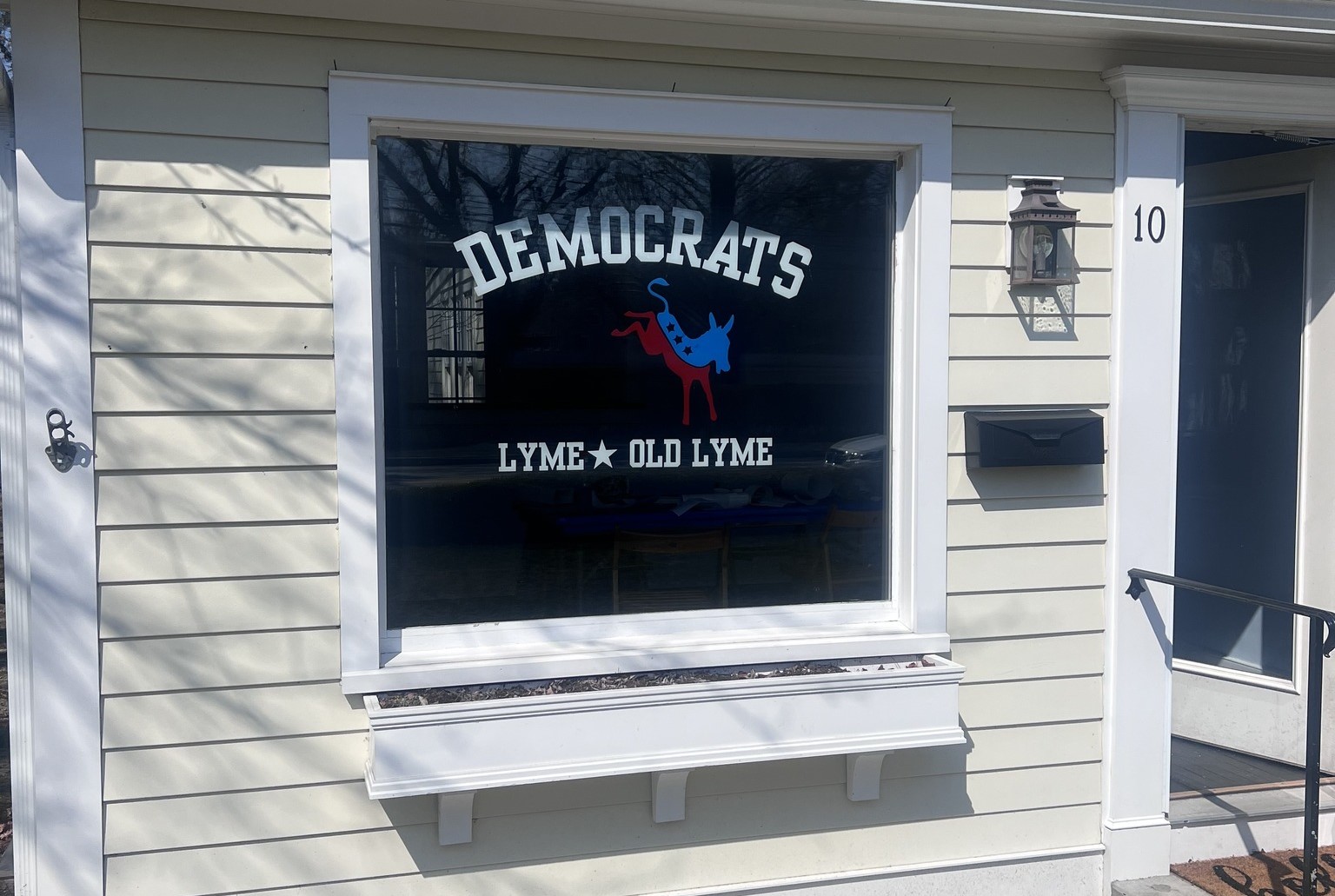
Old Lyme – Lyme and Old Lyme Democrats will celebrate their new campaign headquarters on Lyme Street with a grand opening Sunday. 

The event will be held from 4 to 6 p.m. at 10 Lyme St.

U.S. Sen. Richard Blumenthal, Lt. Gov. Susan Bysiewicz and Comptroller Sean Scanlon will be among the elected officials attending, according to publicity from the town committees.

Refreshments will be provided. 

Those interested in attending should register here.

Death Announced of Kathryn (Kathi) Tray Hill, Partner of Skip Broom of Hadlyme

HADLYME — Kathryn “Kathi” Tray Hill, a beloved mother, grandmother, partner, and friend, passed away on April 12, 2025 surrounded by love. She was predeceased by her devoted husband of 32 years, Thomas W. “Dutch” Hill …

Born and raised in Narberth, Pennsylvania, Kathi was a walking ray of sunshine …

Later in life, Kathi reconnected with her high school sweetheart, Skip Broom, and together they created a beautiful new chapter. She moved to Hadlyme, Connecticut, and through Skip and his children, she discovered the beauty of Fisher’s Island …

Kathi is survived by her loving children: son Justin Hill, and daughter Carlye Miller and her husband Matt. She was a deeply proud and doting Grandy to Trey (18) and Beckett (15) Miller, and Kai Hill (14). She is also survived by her brother, William Tray (Carol), her partner Skip Broom; his children Adrien Broom (Nico) and Margot Broom McClowry (Terry); and Skip’s grandchildren “T” and Cal …

Editor’s Note: Visit this link to read the full obituary published by Dignity Memorial.

‘Talking Transportation’ is Back! Five Worst Ideas for Solving Traffic Congestion

Editor’s Note: We are delighted to welcome transport guru Jim Cameron , pictured left, back to LymeLine. He was wrote for us regularly for almost 10 years starting in 2011 and his columns were always popular with our readers. He is the founder of the Commuter Action Group and advocates for Connecticut rail riders. He writes a weekly column called ‘Talking Transportation,’ which is published by a number of publications in the state. Here is the inaugural column of his second season with us.

Five Worst Ideas for Solving Traffic Congestion

While I’m on vacation this week I thought I’d revisit a commentary I wrote in 2014.  Judge for yourself how little has changed in 11 years.

Everybody loves to complain about our traffic.  And for some, the solutions are simple, if impractical.  If there were easy answers to our woes, they’d have been implemented by now.  

Look … this is really a matter of supply and demand: too much demand (highway traffic) and not enough supply (space on those roads).  I think the solution is to manage the demand.  But others say it’s a “supply side” issue. 

So here are a few of the crazier ideas for fixing our traffic that I’ve seen proposed over the  years:

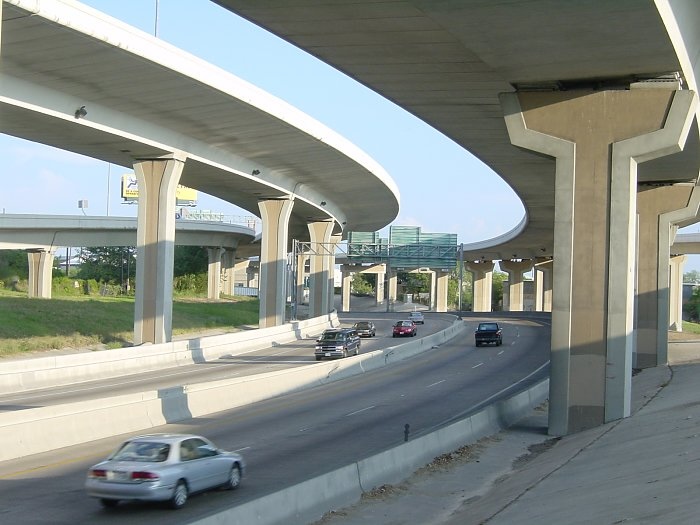
The photo shows a double-decker highway in Texas. Photo credit: TexasFreeway.com

1)    DOUBLE-DECK I-95:        
Seriously, this was once proposed by the Stamford Chamber of Commerce.  Can you imagine the decades of construction and billions in cost, with “upper level” roads having to soar hundreds of feet over existing bridges?

2)    ALLOW TRUCKS ON THE MERRITT PARKWAY:       
There are two words to explain why this can’t happen:  low bridges.

3)    BAN TRUCKS FROM OUR INTERSTATES:          
This was once suggested to me by a Fairfield County First Selectman.  But as I reminded him … trucks are high-occupancy vehicles delivering goods to the stores where you drive your single-occupancy vehicle to shop.  No trucks, no goods, no shopping.

4)    DRIVE IN THE BREAK-DOWN LANE: 
This was then-Governor Rowland’s idea in 2000 and he even wasted a million dollars studying it.  But if you think of that far right-hand lane instead as the “emergency rescue lane”, you’ll see why this doesn’t make sense.  This plan would also require re-striping the road to create narrower lanes, making driving even more dangerous.

5)    WIDENING I-95 TO FOUR LANES:       
Again, billions in cost and decades of construction.  And if you build it, they will come.  The immutable law of “induced demand” means that traffic will expand to fill available space.  Then what, a fifth lane?

There are better ways to manage congestion, some of them already being implemented:

OPERATIONAL LANES:     
Adding a fourth lane from on-ramps to the next off-ramps gives traffic a better chance of merging on and off the highway without blocking the through-lanes.

WIDENING CHOKE-POINTS:      
For example, the exit 14-15 bottleneck in Norwalk.  But this widening project (for less than one mile) cost $50 million and took three years.  The I-84 / Route 8 “Mixmaster” rebuild in Waterbury took six years and cost $253 million.  Both projects were funded mostly with Federal funds, but it’s anyone’s guess what will happen to that money pot under the new administration’s budget cutting.

ADD A ZIPPER LANE:      
Sure, this may require highway widening, but just one lane that’s reversible depending on demand, a system that was used successfully on the Tappan Zee Bridge before its reconstruction.  By moving the extra lane, capacity can be added to the direction where there’s the most traffic.

CHANGE COMMUTING HOURS: 
Does everyone really need to work 9 am – 5 pm?  How about starting earlier or later and spreading out the traffic?  Your employer should understand and you’ll be happier and more productive.

And the very best idea of all:  IMPROVE MASS TRANSIT TO ENCOURAGE DRIVERS to get off of the roads.

As I say, there are no simple solutions to highway congestion.  So when anyone says he or she has one, be skeptical.  It’s easy to identify the problems.  But fixing them will always be hard … and usually expensive.

Editor’s Note: Contact Jim at TalkingTransportationCT@gmail.com.

Scientists Continue Fight Against Hydrilla Scourge; Presentation in Lyme on Latest Efforts

This photo was taken September 2020 during an inspection of Whalebone Cove when it was found 60 to 70 percent of the waterways were clogged with hydrilla vines.

LYME – Experts on the Connecticut River hydrilla will be at the Town Hall on Wednesday to talk about plans to include Hamburg Cove in a growing, multi-year effort to reduce and control the highly invasive water weed. 

The presentation will begin at 7 p.m., according to a public notice filed by the U.S. Army Corps of Engineers (USACE). A question and answer period will follow. 

The Connecticut River Hydrilla project, overseen by the Army engineers in partnership with the Connecticut Agricultural Experiment Station and the Lower Connecticut River Valley Council of Governments, began in 2023 to figure out which aquatic herbicides ― and how much of them ― are best suited to fighting off the uniquely pernicious aquatic species. 

The USACE said herbicides will be introduced to Hamburg Cove this summer or fall. All herbicides being used are registered for aquatic use by the U.S. Environmental Protection Agency.

The project last year applied an herbicide treatment to Selden Cove and several other sites on the lower Connecticut River. 

Hydrilla degrades water quality, chokes out native plants and threatens the habitat of migratory fish like shad and herring, according to the Connecticut River Conservatory. It’s been described by U.S. Sen. Richard Blumenthal, D, as, “the worst invasive aquatic species known to man.”

Wednesday’s meeting will be in-person only, according to the notice. There will be information on the project itself as well as the concerning effects of hydrilla on the Connecticut River system.

Registration is requested. Those interested in attending should email info@eightmileriver.org.

Op-Ed: After HROD Defeat, Some Thoughts on Improving Old Lyme’s Approach to Managing Major Projects Going Forward

Editor’s Note: We originally published this op-ed submitted by Howard Margules of Old Lyme on July 12, 2024. After the 4-1 defeat of the Halls Road Overlay District proposal by Old Lyme’s Zoning Commission last Monday (April 14), several members of the Halls Road Improvement Committee, including its former chair Edie Twining—who resigned yesterday—suggested republishing it as a constructive contribution to the discussion regarding how to move forward from this point.

Is a Town Planner the Answer?

Our town’s major projects—Halls Road, sewers, Shoreline Gateway, and Affordable Housing—are all vital to our town’s future economic viability. 

They also share something else in common: they have been “works in process” for quite a while, and all remain unfinished. It is important to point out that these projects have been ongoing across multiple administrations, regardless of which political party is in power; so this is not a partisan issue but one that crosses party lines. 

Why do these projects take so long to complete, and what can be done to expedite them?

Over the last ten years I have been involved, one way or another, in most of these projects. 

I am a current member of both the Halls Road Improvement Committee and the Planning Commission and the former Chair of the Economic Development Commission. Thinking back on my front-row experiences has led me to some observations on those questions and suggestions for improving timely project completion.

Relying on Volunteers

Our town is very fortunate to have a motivated, engaged volunteer corps staffing our town Boards, Committees and Commissions. I have worked with good people from both parties, and I have been generally impressed with the competence, knowledge and commitment they bring to the job. And, they are doing this work for “free.” 

But, there are issues with relying on volunteers. 

First, there is a town requirement that the Boards and Commissions be balanced politically. This occasionally leads to appointments made simply to fulfill the political balance requirement rather than appointing the most qualified individual.

Additionally, there have been instances where the Committee or Board Chair has had no input in the selection, or, objected to the appointment, but was overruled, even though the person appointed was not the best candidate. 

Second, our town relies almost solely on volunteers to address some very complex projects which often require specific expertise and knowledge that may be absent in our volunteers. 

Additionally, most Boards and Commissions only meet once per month, which is acceptable for routine issues but inadequate for addressing major complex projects. 

Finally, it is also difficult to put too much pressure or expectations on volunteers since they can always elect to just bow out. Relying almost totally on volunteers makes it hard for the town to complete major projects successfully in a timely fashion.

Low Accountability

Many municipalities, especially larger ones, employ a full- or part-time professional planner, to lead major projects. They are professionals with the expertise required to address the complex issues major projects raise. Most importantly, they are held accountable as professionals for completing projects. 

Currently, we don’t have the structure or ability to hold any one person accountable. Accountability gets more complicated given the number of Boards and Commissions involved, various interests that have to be satisfied, and political agendas that occasionally get in the way.

Lack of Collaboration

All of these major projects require approvals from multiple Boards and Commissions Typically, this is done sequentially. One Board or Commission generates proposals that then require approval from another body. Of course, it is natural then for everyone to want to add their two cents. 

The sequential review and approval process frequently leads to varied opinions, occasionally to conflicts, and thus delays. Each set of potential conflicts must be resolved in sequence, drawing out the process and the projects unnecessarily. 

In my view, it would be more beneficial to provide a mechanism for the Boards and Commissions to collaborate initially, perhaps reaching broad consensus and some level of buy-in before the official approval process. 

The Board of Selectman should form a specific project committee for each major effort. We do have some such now, but they do not include representatives of the bodies that will have to provide approval later on. 

The relevant Boards and Commissions or representatives of those bodies need to be involved early in the project, if not from its inception. 

Relevant Expertise

Expert advice (engineering, law, environmental science, design, etc.) is required for these major projects. We are very fortunate in Old Lyme to have a wide range of skills represented in our citizenry and we have benefitted from their help over many years. 

Unfortunately, those with the most relevant skills are often still working, raising children, etc. and have little time to volunteer. We can take advantage of these local skills where they are available, but major projects need consistent and constant expert input, even if it means we must hire professionals to assist.  

Even to manage the work of hired experts can require Board or Commission members to climb a steep learning curve.This is another area in which a professional planner could be very helpful.

Leadership

Finally, these complex projects require engaged leadership from the Board of Selectmen. The Board of Selectmen needs to assist with coordination, monitoring, oversight, timetables, expense control, lobbying public officials for funding, and commit to completing projects on time and on budget.

Our town will face more challenges going forward. If we are to successfully face these challenges and secure our economic future, we need to enhance our approach to supporting and managing major projects.