Septic Truck Catches Fire on Halls Rd. in Old Lyme

Flames pour from a septic pumper truck parked in the Old Lyme Shopping Center Wednesday afternoon. Photo by K. Monson.

OLD LYME–The local fire marshal said a blaze that ignited in the engine compartment of a septic pumper truck was contained to the cab by firefighters in a Halls Road parking lot Wednesday afternoon. 

Old Lyme crews were called to the Old Lyme Shopping Center at 1:16 p.m., according to Old Lyme Fire Marshal David Roberge. Lyme and Old Saybrook fire departments also responded. 

Roberge said the driver of the Finkeldey Septic Service truck went in to get lunch at Papi’s Taqueria, then came out to find the truck on fire. 

No other property was damaged, the fire marshal said. 

Representatives of the state Department of Energy and Environmental Protection and a private contractor were still at the scene as of 4:30 p.m. cleaning up oil and firefighting foam, according to Roberge.  

He said the tank of the septic truck, which was empty, did not catch fire. 

“No poop was lost,” he said. 

Also Wednesday afternoon, fire departments from Old Lyme and Lyme were fighting a 100 ft. by 200 ft. brush fire on Burr Road in Old Lyme resulting from a lawnmower that caught fire. 

The call came in at 3:31 p.m., Roberge said. 

Old Lyme Selectmen Place Halls Road Improvements Committee on Hold

OLD LYME – The Old Lyme Board of Selectmen on Monday pressed pause on the Halls Road Improvements Committee (HRIC).

Selectmen at their regular meeting agreed to the move in the wake of months of controversy involving the future of a short span of road lined with outdated strip malls set between two highway interchanges. At the center of the dispute was a proposal from the Halls Road committee calling for the creation of an overlay district in the commercial zone that would allow apartments and condominiums to be built above, or behind, ground-floor businesses set close to the street. 

Months of vocal opposition to the group’s work culminated on April 14 when the committee’s vision for Halls Road was rejected in a 4-1 vote by the Zoning Commission. HRIC chairwoman Edie Twining resigned a few days later after six years at the helm. 

Many residents – more than 1,200 in an online petition and more than 500 packed into an April public hearing – did not see eye to eye with the committee.

First Selectwoman Martha Shoemaker in a phone interview Tuesday said the town’s three selectmen agreed to put the Halls Road committee on a “hiatus.”

There are currently four vacancies on the nine-member committee, according to the town website. 

“All three of us so much appreciate all the work the Halls Road Improvements Committee has done over the years, and we just want to plan for the best way forward,” she said. 

Shoemaker and HRIC member Paul Gianquinto will meet with the state Department of Energy and Environmental Protection (DEEP) on May 5 to discuss unfinished business involving a plan for physical improvements to Halls Road. Representatives of the DEEP have been in talks with town officials about the possibility of transferring ownership of the state’s property on the east bank of the Lieutenant River to Old Lyme, as long as the town agrees to build a fishing pier and parking spaces there. 

Shoemaker said she will bring the topic back to the Board of Selectmen for discussion after she and Gianquinto meet with the state. 

As part of the HRIC plan to make the road safer and more passable for walkers and bikers, selectmen in 2023 hired AI Engineers of Middletown to come up with plans for a pedestrian bridge over the Lieutenant River and a trail system between Lyme Street and Halls Road. The designs were funded with $135,000 in federal American Rescue Plan money and a $28,500 grant through the Connecticut Recreational Trails program.

Shoemaker said selectmen on Monday concurred with a longstanding call among residents to put sidewalks on the road. 

She said she’s had preliminary talks with the town engineer about what those sidewalks might look like but did not yet have specific details. She was also exploring grant options through the state to cover construction. 

The Halls Road Improvements Committee was introduced by Democrat Bonnie Reemsnyder in 2015 with the goal of advising the Board of Selectmen on how best to develop a master plan for the area. The result evoked images of village-like storefronts and apartments, a pedestrian bridge, more greenspace and sidewalks. 

But Reemsnyder successor Tim Griswold, a Republican, called the vision too grandiose. He said at the time that he preferred to focus on building sidewalks one segment at a time before considering such broad plans. He withdrew a previous zoning proposal to create a Halls Road Village District before it could go to public hearing. 

The recently rejected overlay district application was signed by Shoemaker in November. The proposal was represented at the public hearing by William Sweeney, the attorney for the Halls Road Improvements Committee since 2022.

Shoemaker emphasized HRIC members serve at the request of the Board of Selectmen. 

“We’re going to put them on pause for a little while,” she said.

BREAKING NEWS: Halls Road Improvements Committee Chair Edie Twining Resigns

OLD LYME — This afternoon, Halls Road Improvements Committee Chairwoman Edie Twining submitted her resignation in a letter to Old Lyme First Selectwoman Martha Shoemaker. Twining’s resignation from the volunteer position is with immediate effect.

The text of Twining’s letter is as follows:

“Dear Martha,  

It is with a heavy heart that I resign as a member and Chair of the Halls Road Improvements Committee (HRIC). My family has been part of Old Lyme for three generations. When I returned to Old Lyme after living in Boston for 40 years, I followed in my father’s footsteps volunteering for the town. My  commitment to this committee has spanned over 8 years and many thousands of unpaid hours of work. In that time, the committee held dozens of public outreach sessions, responded to feedback and created  a Vision Proposal that informed the Halls Road Master Plan. All of my efforts have been done as a volunteer and, contrary to false accusations on social media, I have never had or sought any monetary gain, direct or indirect, from my involvement on the committee.  

The committee has received multitudes of letters of support for both the Master Plan and the Halls Road Overlay District (HROD) proposals, Planning Board Approval, detailed Zoning Commission review and dozens of public outreach sessions. To those supporters; I am deeply grateful for your attention to this  committee’s work and for your ongoing support. You understood the HRIC was never a partisan project,  but sought the benefit of the whole town, regardless of political affiliation!  

Despite seven years of very public effort, well publicized by friends and foes, many people claim never to  have been aware of the HRIC and its efforts to improve pedestrian safety, add new crossings, and update our 1960’s commercial-only zoning with a mixed-use option. Those who have followed the HRIC process have seen the multiple layers of work we have done and provided constructive suggestions that have altered the plan. Many who opposed it and chose to never attend a meeting, never visit the town website (where all details were publicly available), claim, instead that all of this was proceeding covertly with no community outreach. The fact that they chose not to attend any public meetings, not to read the detail on the town website or get involved does not give them the excuse to say the public was not informed.  

Critics have relentlessly misrepresented and misunderstood the plan, its aims, the challenges faced by the town, and the nature of the solutions proposed. This pervasive disregard for facts culminated in the latest campaign of wild exaggerations meant to mislead our community about the goals and details of the HROD proposal. The social media avalanche of invented nightmares and half-truths is indicative of the poisonous, adversarial politics that is tearing our country – and now our town – to pieces. None of those opposing the proposal ever directly asked the committee to explain how the regulation works, nor did they ever suggest any concrete alternative proposals.  

They were not interested in squarely facing our Town’s future in a changing world. Instead, they created a monstrous fantasy version of the HROD proposal that no one could support, used it to whip up a storm of protest, and set out to bully the town’s officers into submitting to their fantasy. 

The Zoning Commission’s refusal to deliberate, and abandonment of their efforts to modify the HROD  proposal in any way, was, in my view, an abdication of the Commission’s rights and responsibilities. The most important statement about the whole process was made by Zoning Commission member Denise  Savageau. She blamed the dysfunctional Old Lyme bureaucracy for failing after 10 years to work together constructively to create a unified plan and new zoning for Halls Road. It was, is, and should have been treated from the beginning as a TOWN effort. Instead, an appointed committee of the Board of Selectmen was treated by other Boards and Commissions the same way they treat a private person applying for permission to make modifications to their house. That approach doomed the effort from the start, because it foreclosed the possibility of collaboration and working together to frame what was  needed. The separate silos of Planning, Zoning, and HRIC; the fiction that the town itself could not demand that the three cooperate with one another—all of these, in retrospect, were fatal errors.  

This “us vs. them” madness is such a sad and destructive trend both locally and nationally. There seems no way to fight back against waves of falsehoods. So, I am leaving all the work we have accomplished to those who come after. If they do nothing, outside forces will dictate our town’s future. Meanwhile I look forward to contributing my time to more productive pursuits in my board positions with the Old Lyme Land Trust, Old Lyme Historical Society and my design work for the New London Homeless Hospitality  Center.  

Respectfully,  

Edie Twining”

Editor’s Notes: i)Twining also provided a list of the committee’s accomplishments.
ii) A reminder of Our Policy on Comments.


Old Lyme Zoning Commission Resoundingly Rejects Overlay Proposal, Calls for Cooperation in Determining Future of Halls Road

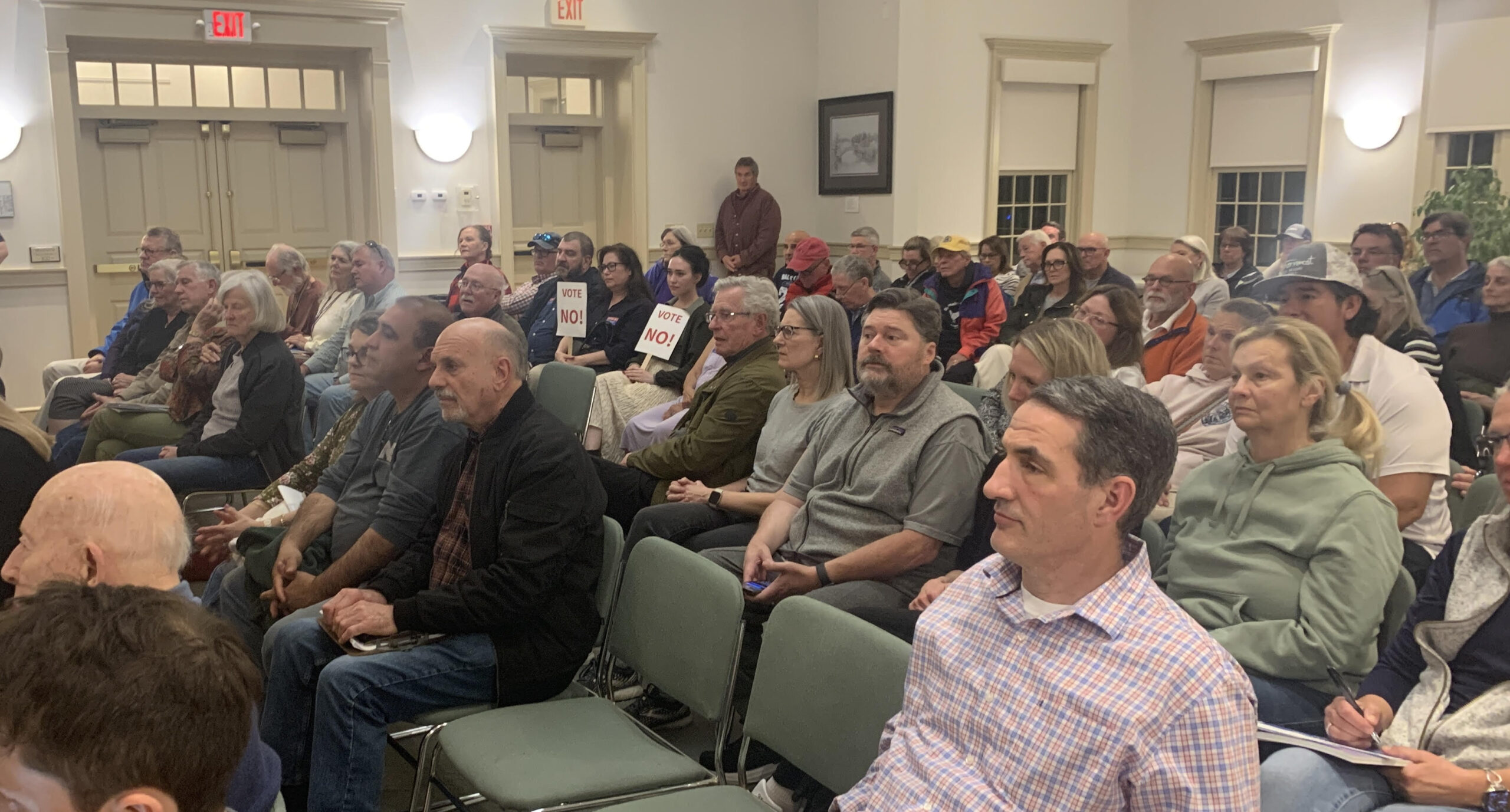
An audience of around 80 in the Town Hall Meeting Room and those watching remotely listened as the Old Lyme Zoning Commission voted 4-1 to reject the Halls Road Overlay District proposal.

Controlling Destiny … and Density

OLD LYME – Change is going to come to Halls Road, but the Zoning Commission on Monday said now is not the time. 

In front of an audience of around 80, the commission voted 4-1 to deny a proposal created by the Halls Road Improvements Committee (HRIC) for an Overlay District to allow apartments and condominiums to be built above, or behind, ground-floor businesses set close to the street. 

Commission members credited their decision to a groundswell of opposition manifested in “Overlay? No Way!” signs all over town as well as in comments on social media and at public meetings. Concerns revolved around the hazards of allowing multi-family residential development in a commercial area with limited septic availability and no sewers. Critics also called out a lack of information and not enough opportunity for residents to get involved in the process. 

Denise Savageau, a former alternate member, who was elected to a full seat last November, told commission members during their deliberations that she shared the frustration of residents that felt they were left out.

A retired environmental planner, who now serves on numerous state-level commissions concerned with natural resources, Savageau said there needs to be more involvement from the Planning Commission, Zoning Commission and other relevant agencies in coming up with changes to Halls Road regulations. And the discussions need to be conveyed clearly to the public at every step.

“I want to stress that this is not about the Halls Road Improvement Committee, but about the silos that have been created by all of the land use commissions in town,” she said. 

She described issues such as climate change and a lack of affordable housing options — both of which are subject to more state mandates with each passing year — that require local regulations to evolve. 

“The changes are going to come,” she said. “We need to plan.” 

The failed overlay district application is the latest in an effort going back more than a decade to improve the three-quarter-of-a-mile strip between two Interstate 95 interchanges that feed the town’s historic district and its shoreline. First there were calls for sidewalks; then came the possibility of village-like storefronts and apartments, a pedestrian bridge and more greenspace. Much disagreement and several discarded plans later, one of the only areas of widespread agreement is that Halls Road remains unattractive.

Some want big changes. Some want more modest aesthetic improvements. Others are fine with the way things are.

Member Jane Marsh in her deliberations recalled the commercial zone’s origin in the middle of the last century as a place people could easily access and find a place to park amid the rise of suburbanization. 

“It was created because it wasn’t going to be the most fabulously beautiful location in town. It was going to be functional and pragmatic for people, and that’s how it got built,” she said. “… It serves its purpose. It may not be very beautiful, but I don’t expect it to be beautiful, actually. I expect it to be the way it is.”

The overlay district proposal was approved by the Board of Selectmen in a 2-1 vote in November. It was endorsed 5-0 by the Planning Commission in January. 

Having a Conversation

One of the loudest voices against the overlay proposal was Robin Breeding, an artist whose social media posts and graphic design helped galvanize the opposition. Many people did not find out about the overlay district proposal until she began to publicize the issue after a sparsely attended public hearing in January. 

She welcomed the Zoning Commission’s decision in a phone interview Tuesday. 

“People didn’t know this was happening a month and a half ago,” she said of the overlay district proposal. “They thought it was going to be the sidewalks and that pretty stuff that they talked about in the beginning. And then they started to realize that it wasn’t that any longer. And they started to learn about what it was.”

She said the contention that the plan would help address a need for affordable housing was inaccurate. With the state pushing for towns to ensure at least 10% of their housing stock is affordable to lower income households, she argued the Halls Road Overlay District plan to require one out of every 10 housing units to be rented or sold at affordable rates wouldn’t advance the town’s obligation by even one percentage point. 

Only 1.58% of the town’s housing stock is currently affordable by state standards, according to data from the state Department of Housing. 

She said the overlay proposal threatened to drive out existing small businesses — many of them service providers in office settings — through its focus on new development and ground-floor retail options to be built over time if there’s enough interest from developers. 

“And so it was basically saying, ‘We don’t care about you now,’” she said of the plan. “‘We only care about some future pie-in-the-sky version of what this could be, but we can’t guarantee it.”

She said the ongoing overhaul of the zoning regulations by an outside firm presents a new opportunity for the public to learn about and become involved in the process of improving the town, including Halls Road. 

The $129,776 update of the town’s zoning regulations is being conducted by the Hartford-based FHI Studio. 

The planning and design firm was hired late last year to embark on a year-and-a-half-long project to clean up existing language in the regulations and then engage the public in discussion about potential changes as to what can be built in town, and where. 

When it comes to the kind of changes that residents of Old Lyme have a tolerance for, Breeding cited sidewalks as a good place to start. 

“And let’s have a conversation with the town, and talk to the town about how they want to move forward,” she said. 

For and Against

Commission Chairman Paul Orzel during the hearing said the public opposition brought to light some questions that have gone unanswered. 

Estimates for how many units could be built under the overlay application range from 200 to 1,200, depending on who’s doing the calculation and which variables are considered. 

“I’m a firm believer in controlling my destiny,” Orzel said. But the proposal as he saw it left too much to chance. 

Member Mike Miller applauded the residents, who spoke up against the plan. He said he shared their concerns related to the environment, tax increases and the effect of more residents on the school system and the delivery of public safety services. 

He called for a return to the basics. 

“There are many things that the HRIC brought up to our attention that are good. For example, the original charter of sidewalks and landscaping,” he said. “I think we need to have a safe corridor for pedestrian traffic for the kids from school. We have our students that come into town and work the shops. There are things that we can do.”

The lone vote not to deny the application came from Mary Jo Nosal, a former selectwoman who disputed the contention that the public hadn’t been a part of the process. She cited public surveys, various workshops, town update meetings, annual budget approvals, and reviews and input by local agencies including the Zoning Commission, Planning Commission and Board of Selectmen. 

She recalled that a master plan to guide improvements on Halls Road emerged as a response to efforts from the Federal Railroad Administration (FRA) to run high-speed trains through Old Lyme. 

Fears of the FRA’s plan slowed home sales and threatened business closures, according to Nosal. 

“The town also faced a scarcity of housing and office space options, and still does,” she said. “Long time residents had nowhere to live once they sold the family home; our children could not return to their hometown as there was nowhere for them to live and certainly afford; and community workers — teachers, healthcare workers, beauticians, grocery store workers — could not find an affordable home in town. Electric Boat was beginning its exponential growth but these professionals could not find a home here.”

She said the guiding question at the time was how to maintain and attract business and make housing more available, “While making it harder for the FRA to bulldoze our community.”

“The result was the development of the master plan for Halls Road and the effort to protect and improve our town center while being able to apply for state and federal grants for various improvements and bring in design experts to guide the process,” she said.

Nosal acknowledged many in the community feel the process behind the overlay proposal was flawed. 

“The Town of Old Lyme could look to improve the process for future town regulations and assure that more town meetings, land use joint meetings and significant planning occur as a lead-up to planning and zoning review,” she said. “But it cannot be denied nor should we dismiss the fact that many residents, the non-profits and business owners were represented in the process.”

Next Steps

After the vote First Selectwoman Martha Shoemaker said the Board of Selectmen will discuss the issue at a meeting over the next few weeks. She said Halls Road Improvements Committee Chairwoman Edie Twining has already expressed interest in working together to plan the next steps.

Twining on Monday night declined to give her own comment. But she referred to Denise Savageau’s speech on the need for town boards and commissions to work together — rather than in silos — so they could better inform and invite participation from the public. 

Twining could be seen during the meeting taking notes as Savageau spoke.

“Denise was 100% correct,” Twining said.

Editor’s Notes: i) Mary Jo Nosal is a financial supporter of LymeLine.com, but has no input to the editorial process, which remains completely independent.
ii) A reminder of Our Policy on Comments.

Controversial Overlay Proposal Comes to a Crossroads at Public Hearing in Old Lyme Wednesday

OLD LYME – A long-awaited hearing is scheduled for Wednesday as residents remain enmeshed in a fractious debate over the meaning of progress on a short span of road stuck between two interchanges of the state’s busiest highway. 

The Old Lyme Zoning Commission on Wednesday is slated to invite public opinion on a controversial proposal to reenvision Halls Road as a mixed-use town center with businesses on the ground level and apartments above. The plan involves the creation of an overlay district that gives business owners and developers in the commercial zone more ways to use their property than are currently allowed. 

Opposition to the plan is evident in “Overlay? No Way!” signs all over town and a petition that has amassed 1,204 signatures at the time of writing. 

Critics say the plan has the potential to create more than 1,000 apartments on 40 acres if it goes through. Proponents argue topography and regulatory realities would effectively limit development to less than 400.

The proposal was developed by the Halls Road Improvements Committee (HRIC) and submitted to the Zoning Commission in November by First Selectwoman Martha Shoemaker after approval by the Board of Selectmen. The public hearing, which began in January, was continued to the end of February. But the meeting was postponed at the request of Shoemaker and the HRIC, who informed residents the move was prompted by “strong interest” in the topic that required a larger venue and more time for the commission to review communications from residents. 

Deadlines contained in state statute require the public hearing to be closed no later than the end of next week, according to Old Lyme Land Use Coordinator Eric Knapp. The commission then has 65 days to make a decision on the proposal. 

The discussion on how best to guide development in one of the town’s main commercial districts has been ongoing for over a decade. Proponents of the latest iteration of the plan are pitching it as a way to entice developers to build a livable, shoppable, walkable hub over time, while those opposed decry its potential to drive out existing small businesses and bring in enough new residents to decimate the small town’s “character.”

The petition on change.org says the signers strongly oppose development of Halls Road as submitted by the HRIC. 

“While we understand the need for thoughtful progress and economic growth, we believe this specific project will negatively impact the character, environment, and quality of life in our cherished community,” the petition says. 

But HRIC chairwoman Edie Twining describes the proposal as a positive change that would benefit businesses through increased foot traffic while providing more diverse housing options in a town dominated by single-family homes. 

“We have people every day trying to find a place to live, to downsize to, and it’s not available,” she said in a phone interview Monday. 

The three-quarter-mile-long thoroughfare currently is lined with strip malls and parking lots that hark back to the mid-20th century rise of suburbanization. Back then, developers sought to capitalize on the distance between where Americans lived and where they worked by creating commercial zones in between. 

Now, the mixed-use philosophy of development seeks to close the gap with the goal of creating more vibrant, self-sufficient communities. 

At the crux of the proposal is an amendment to zoning regulations that would create the overlay district as an alternative set of guidelines and design specifications that property owners can choose to follow if they wish to undertake certain projects currently prohibited in the zone, namely residential construction. 

Overlay zoning is an increasingly popular municipal planning mechanism to address specific community goals in sections of town that would otherwise be limited to one type of use.

The overlay district would require at least 10% of the apartments or condominiums to be set aside at rates affordable to lower-income households. That means up to 90% could be rented at market rates attractive to developers in a landscape dominated by a shortage of housing. 

‘Out of Scale’

Sloan Danenhower, a former alternate member of the Zoning Commission and vocal opponent of the overlay proposal, said the problem can be boiled down to the sheer size of the buildings that would be allowed in the overlay district. 

“If (a building) is 200 feet long, and it’s 100 feet deep, that’s 20,000 square feet of a footprint. You take that and you multiply it by three because you can go three stories up. Now you’re talking about a 60,000 square foot building,” he said in a phone interview Monday. “It’s just out of scale.”

The overlay district proposal was approved by the Old Lyme Board of Selectmen in a 2-1 vote in November. The overlay concept that month earned a letter of support from the Economic Development Commission, and the proposal was endorsed 5-0 by the Planning Commission in January. 

Republican Selectwoman Jude Read in her dissenting vote argued that the swell of support from municipal leaders and data points from outdated, selective community survey results did not tell the whole story. Read, who is married to Danenhower, said voices from residents opposed to the change were not being heard. 

Now, residents are speaking out through petitions and a steady stream of social media posts dissecting the motivations behind the move to alter Halls Road. They object to the scope of the proposed changes and the effect of new construction on the Lieutenant River’s delicate ecosystem. 

The petition calls on residents to attend Wednesday’s public hearing. 

“We are not opposed to change – but we must find a better solution than this developer-driven urbanization of our charming, rural town,” the petition states.  

According to the proposed regulation, the overlay district would allow developers to build up to 40 apartments or condominiums per acre as long as they follow specific guidelines and design standards. It also includes allowances for parking garages and drive-through establishments. 

But possible modifications to the proposal submitted in February by Attorney William Sweeney, who represents the applicant, reduced the density from 40 units per acre to 30 units per acre. 

Opponents like Danenhower multiply 30 units per acre by the roughly 40-acre footprint to estimate the proposal could bring up to 1,200 units to Halls Road. 

Marketability

Twining contends the simple math used by critics to predict the impact of the zoning proposal does not take into account numerous factors laid out in the 12-page text amendment that can limit the number of units allowed on any given property. Factors such as building size, lot coverage and parking requirements combine to allow for far fewer units.

Twining and her partner, Mark Terwilliger, calculated a maximum of about 400 units could be built once all factors are analyzed. 

Terwilliger said the conservative figures don’t take into account the issue of septic or sewer availability, which would further limit the number of units. 

Terwilliger guessed that incorporating septic requirements into the equation would likely bring the allowable number of units down to around 200. 

Asked to respond to the suggestion by some opponents to reduce the allowable number of units if it’s impossible to build that many anyway, he said each parcel is different. 

Some properties are better suited for more apartments and others can accommodate far fewer, he said. 

“To be honest, I couldn’t figure out how to get more than 22 units per acre on even the best site,” he said, based on a typical apartment size just under 1,000 square feet. 

But that could change over time, according to Terwilliger. 

“The average apartment size that we’re talking about is what’s marketable now,” he said. “Who knows, in 25 years people may be renting apartments that are 400 square feet.” 

A Long Road

The effort to re-envision Halls Road has spanned multiple first selectmen. The Halls Road Improvements Committee was introduced by Democrat Bonnie Reemsnyder in 2015 with the goal of advising the Board of Selectmen on how best to develop a master plan for the area. The discussion grew from initial calls for sidewalks to include the possibility of village-like storefronts and apartments, a pedestrian bridge and more greenspace. 

But Reemsnyder successor Tim Griswold, a Republican, called the vision too grandiose. He said at the time that he preferred to focus on building sidewalks one segment at a time before considering such broad plans. 

Twining since then has led the group through grant applications, multiple proposals for zoning changes, numerous vacancies and the election of a new first selectwoman, Democrat Martha Shoemaker.

A previous HRIC proposal, which was pulled by Griswold in 2021, would have imposed building specifications and design standards that anyone developing on the street would have to follow. The overlay concept emerged in a follow-up application as a voluntary way to bring change to Halls Road, but was rejected by the Zoning Commission in 2023 after a negative referral from the Old Lyme Planning Commission.

The Halls Road committee in the current proposal addressed some concerns about its predecessor by specifying a 35-ft. height restriction. But opponents say some other changes – including increasing the maximum building footprint 10,000 sq. ft. to 20,000 sq. ft., and a maximum length from 125 ft. to 200 ft. – make the pending application even worse than the previous one. 

Danenhower last month filed a petition with the town to require a two-thirds voting majority on the application rather than a simple majority, according to commission documents. State statute allows property owners to petition for a more stringent voting threshold if those owners represent at least 20% of the area within 500 feet of the proposed overlay zone. 

“If it takes four out of five instead of three out of five, it’s a higher bar for them to get to in order to pass this,” Danenhower said. 

Land Use Coordinator Eric Knapp in a March 25 memo said the property owners, who signed the petition, represented 25.8% of the affected area. He advised the commission to discuss the petition and how to address it after the public hearing is closed. 

Danenhower, who is unaffiliated, served as an alternate member on the Old Lyme Zoning Commission until the board of selectmen made its yearly appointments of local non-elected positions in February. Meeting minutes show a motion by Read to reappoint three standing alternate members – including her husband – was not seconded. Read was the lone nay vote when Shoemaker and Selectman Jim Lampos (D) reappointed standing alternate members Michael Barnes (U) and Michael Fogliano (U) but did not return Danenhower to his position. Instead, they chose Mary-Gardner Coppola (D).

The Overhaul

Both Read and Danenhower have stated publicly that the town should not vote on changes to the zoning regulations on Halls Road while there is an comprehensive $129,776 overhaul of the current regulations being conducted currently by the Hartford-based FHI Studio. 

The planning and design firm was hired late last year to embark on a year-and-a-half-long project to clean up existing language in the regulations and then engage the public in discussion about potential changes to what can be built in town and where. 

“What they should do is withdraw this proposal and roll it into that plan to revisit and rewrite the zoning regulations,” Danenhower said. 

Knapp, the land use coordinator, said the firm is on track to conclude the clean-up phase by the fall. That’s when the “heavier lifting” on a resident-informed review of the town’s zoning philosophy will begin.

Twining said waiting for the completion of the overhaul project would needlessly prolong a process that’s already been delayed many times. 

She noted the Big Y plaza and Old Lyme Marketplace across the street are currently for sale. The only options currently available to a developer are commercial ones. 

“We could end up with a major medical center right in the middle of our commercial center. We could end up with gas stations or convenience stores to serve the highway,” she said. “In the meantime, we could have had the opportunity to bring in some housing that we desperately need.”

Extremes

Terwilliger lamented that the divisive and oftentimes vitriolic debate leading up to Wednesday’s public hearing relies on what he described as an inaccurate and incomplete reading of the proposed regulation by opponents. 

He said the actual number of units that could be accommodated on Halls Road is “miles away” from the 1,200 to 1,600 figure cited by critics. 

“It’s too bad that we didn’t have the opportunity to have a conversation about whether or not it is a good idea to have a couple hundred apartments in a mixed-use neighborhood that’s walkable, which is all we were really trying to do,” he said. 

Danenhower, for his part, said the current proposal is far removed from the committee’s original charge of addressing pedestrian safety through measures like the installation of sidewalks, lighting and signage. 

“Nobody disagrees that Halls Road needs improvement,” he said. 

Twining said the public hearing will be an opportunity to speak with the Zoning Commission about changes they want to make to the proposal. 

“They have every right to make as many changes as they want,” she said. “The hope is they don’t make it so extreme that no developer wants to be involved with the project.”

Editor’s Notes: i)The public hearing will be held Wednesday at 6:30 p.m. in the Lyme-Old Lyme High School auditorium at 69 Lyme St., Old Lyme.
ii) A reminder of Our Policy on Comments.

This article was updated to correct information about the petition calling for a two-thirds voting majority by the Zoning Commission and to clarify the Economic Development Commission’s letter of support for the overlay concept.