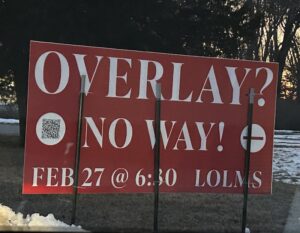
There has been so much negativity posted in the press this campaign season in Old Lyme, that it makes me wonder – actually makes me worry. And then I realized that it’s because the Republican candidates have no plans, just vague accusations. That’s why Mesham and Read won’t debate with Martha and Jim. Because they have no answers, only questions.
Think back to two years ago, when Republicans Griswold and Ward were in charge. Were they present in your neighborhood when there was an issue? Did they answer your questions or even acknowledge receipt of your letter or phone call? Did they offer any solutions to the town issues of sewers or Halls Road? Did they ensure adequate funding for town projects? Pave streets in the south end of town? Fix the Grassy Hill Bridge? Deal with flooding at Cross Lane and in the beach areas? No they did not. Just kicked the can down the road leaving the new Democratic-majority board with a pile of complex issues to solve.
In the past two years, Martha and Jim rolled up their sleeves and tackled these tough issues head on. They listened to the people of Old Lyme. They inherited these leftover problems that had been festering for years under previous boards, and which “conveniently” came to a head this year due to debt service and other contractual issues taken on by the previous administration. This was not easy. Halls Road was a complex issue made worse by lots of misinformation, but in the end, the process worked. The community’s voice was heard. Is there an overlay still in planning? No. Let’s move on. When a crowd of angry homeowners crowded a Selectmen’s meeting last year, voicing concerns about speeding, they listened and created the Road and Public Safety Committee to address the issue. Martha and Jim personally showed up multiple times with shovels in hand to alleviate flooding at the Hawks’ Nest Sluiceway (AKA “the crib”), and oversaw the building of a new engineered structure there. They have increased security at the beaches, completed the Senior Center project, constructed the soon to be open Emergency Operations Center at Boughton Road, and were awarded grants to protect our fragile marshes and coastline. But it’s hard to hear about these and other accomplishments through the fog and noise of negativity from naysayers with no ideas of their own.
On Saturday, October 18th, millions of Americans took part in “No Kings Day” to celebrate democracy – leadership by the people, for the people. Let’s not go backward to the government by the “old boys network.” Let’s move forward Old Lyme!
OLD LYME — 10/22 UPDATE: Wednesday’s debate will be live streamed at this link: https://www.youtube.com/channel/UCF2_W7yYtFwx067Ici9776Q/live. The link will continue to be available after the debate so the recording can viewed at a later date as convenient by anyone interested.
Lymes’ Youth Service Bureau (LYSB) is hosting a “Meet the Candidates for Board of Education” forum on Wednesday, Oct. 22, at 7 p.m. at the Lyme-Old Lyme Middle School auditorium.
The event will be moderated by Eric Parker of WFSB and both livestreamed and recorded.
All community members are invited to attend the event.
The forum provides a valuable opportunity for the public to hear directly from the candidates running for the Region 18 Board of Education. Attendees will gain insight into each candidate’s positions, priorities, and plans for the future of our schools.
In advance publicity information about the event, LYSB states, “Don’t miss this chance to make an informed decision and help shape the future of education in our community.”
For more information and to submit questions, visit:www.lysb.org/boeThe deadline to submit questions was Monday, Oct. 20.
olwenonline.com/ is proud to sponsor this important event.
All five open spots on the board of education are for four-year-terms.
The eight candidates running for the four Old Lyme spots open on the board of education are:
Jason Kemp, Old Lyme, Democrat, Incumbent
Jarod Bushey, Old Lyme, Republican
Brandy Campbell, Old Lyme, Republican
Michael Hansen, Old Lyme, Democrat
Shaun Mastroianni, Old Lyme, Republican
Cynthia Love McCollum, Old Lyme, Democrat
Carlos Piña, Old Lyme, Unaffiliated — endorsed by the Old Lyme Republicans
Sheryl Shyloski, Old Lyme, Democrat
The two candidates running for the single Lyme spot open on the board of education are:
Anna James, Lyme, Democrat, Incumbent
Lannie Mossberg, Lyme, Unaffiliated — endorsed by the Lyme Republicans
Editor’s Note: This article was updated to correct Mossberg’s affiliation.
Republican John Mesham is challenging incumbent Democratic First Selectwoman Martha Shoemaker in Old Lyme.
OLD LYME–In a rematch for the town’s top spot, this year’s election pits Democratic incumbent First Selectwoman Martha Shoemaker’s record of flooding fixes and open budgeting against Republican John Mesham’s calls for “common sense” improvements that don’t alter Old Lyme’s small-town identity.
Shoemaker is running on the Democratic ticket with incumbent Selectman Jim Lampos. Mesham is once again teamed up with Jude Read, the incumbent Republican selectwoman.
Shoemaker declared victory last time around with 51.8% majority. She brought in 1,820 votes compared to Mesham’s 1,697.
The first selectwoman last week at the Town Hall said she’s been accessible to residents and has worked to keep them informed through public meetings and email communications.
“I’d just really like to continue to serve the people for another two years,” she said.
From the Republican headquarters on Halls Road — a flashpoint in this year’s election — Mesham said his campaign is driven by opposition to a now-defeated proposal that would have allowed hundreds of apartments or more in the commercial zone.
“I hear from a lot of people that they’re just kind of ready for a change,” Mesham said.
Shoemaker, a retired 35-year teacher and 12-year union president, was selectwoman from 2021-23 before being elected first selectwoman. She is not running again for the regional school board, where she is finishing her second term.
Shoemaker cited solutions to multiple flood-related concerns as key accomplishments over the past two years. She said she held up a 2023 campaign promise to address flooding on Cross Lane at the Amtrak bridge underpass, where numerous closures that summer affected the ability of first responders to get to Route 156 from the Cross Lane fire station.
Town crews brought in a vacuum excavation contractor to clean out the storm drains and underground drainage lines to restore proper flow into Swan Brook, according to the first selectwoman.
“Within two days we corrected a problem that had existed for years and we’ve only had one flooding situation since then,” she said.
The town also engineered an improved drainage structure at Hawk’s Nest Beach that had been costing the town time and money for years as sand continually clogged the pipes. Voters at a town meeting last year approved the $144,500 project to rebuild the sluiceway.
She acknowledged the structure still floods at extremely high tides, but said the problem is now short-lived instead of perpetual.
She counted resurrecting the Flood and Erosion Control Board as another significant step. She said members are working to become part of FEMA’s Community Rating System, which can qualify residents for a discount on their flood insurance premiums in towns that prove they are taking steps to manage their flood risk. The board had been dormant since 2019 before meetings resumed early last year.
Transparency in the budget process is also a hallmark of her administration, she said. The Board of Selectmen now discusses budget planning with department heads in public meetings rather than having the finance director and first selectman draft the preliminary town budget without the opportunity for public scrutiny and input.
She was proud of working with department heads, at the Board of Finance’s request, to find an additional savings of $171,350 during this year’s budget planning process.
“Everybody was willing to find – whether it was $50,000 or $2,000 – something that we could eliminate that wouldn’t affect our services but would certainly help the budget. And that’s teamwork,” she said.
She cited the creation of the Road and Public Safety Committee to address speeding and other traffic-related concerns as another accomplishment. She keeps residents up to date on those and other issues in a weekly newsletter that goes out to about 500 subscribers and is posted on social media.
She said coming up with a plan for sidewalks on Halls Road will be a priority in the coming term. She also cited the need to look at the idea of dredging the Hain’s Park section of Rogers Lake that has deteriorated since her grown sons used to play there as children.
“It definitely wasn’t as shallow as it is now, but it was a great place to go in the afternoon after naps to just sort of hang out for an hour and a half and splash around,” she said. “So hopefully we can bring that back without causing too many environmental issues.”
Slow Growth, Transparency and Public Access
Mesham, a U.S. Marine Corps veteran, retired from the Connecticut State Police in 2020 as a master sergeant after 29 years in law enforcement. He is a member of the Inland Wetlands Commission and a deputy registrar of voters.
“I’m running because I’ve really been in public service my whole life, and this is an extension of that,” he said. “But specifically, I wasn’t happy, like a lot of people, with the direction of Old Lyme seems to be going, especially with overdevelopment.”
Mesham also called out Shoemaker’s administration for making what he’s called a “closed door agreement” in a years-long dispute involving a spit of land bisecting a Tantummaheag Road property that has been used by generations as a public landing on Lord Cove.
A draft agreement struck by Lampos, as selectman, and George Frampton, the owner of the surrounding property, would have allowed people to use the road on foot from 8 a.m. to sunset while limiting cars to the paved cul-de-sac at the entrance to the landing.
“We’ve had access to that property for hundreds of years, and I don’t really see a reason to try to make a deal,” Mesham said.
The town going back to previous Republican Old Lyme First Selectman Tim Griswold’s tenure has claimed ownership of the landing amid opposition from Frampton, a prominent litigator and government official with more than a half century of experience, who has signaled his intent to take the case to federal court.
Ultimately, the draft agreement failed when Read and Shoemaker voted against it, leaving Lampos as the only supporter. Executive sessions to discuss the potential lawsuit have continued.
Shoemaker refuted Mesham’s description of the draft as a closed-door agreement.
“That is a lie,” she said. “It wasn’t a backroom land deal.”
She said the draft agreement with Frampton was created through a transparent process, with all three selectmen regularly briefed in executive sessions. Once attorneys finalized a draft, Lampos shared it with the Harbor Management Commission, neighborhood representatives, and the public before selectmen voted it down.
Mesham said he has made open government as a central campaign tenet.
“Town Hall needs to definitely be transparent. I think there’s been less than transparent things going on, especially with Freedom of Information,” he said. He cited a state Freedom of Information Commission (FOIC) fine lodged this summer against Shoemaker as an example.
Shoemaker continues to take responsibility for the $250 fine after FOIC members agreed with a complaint from the Connecticut Examiner that she withheld public records related to alleged misconduct at the local ambulance association.
She said she acted in good faith when she provided all relevant information to state police within 36 hours, and went above what was required when she provided membership rosters maintained by the independent fire and ambulance companies.
She said she did not initially disclose March incident reports, which ended up at the center of the FOIC case, because she forgot about them while compiling numerous information requests in June.
She acknowledged making a mistake in not providing the information.
“As far as the FOIA is concerned, we’ve changed the process here,” she said.
Mesham, citing his experience handling public information requests as a state police sergeant and master sergeant, described himself as “dismayed as to why it was such an issue to get information out about a very public concern.”
The Sewer Question
The highest profile issue left to be resolved in the coming months revolves around a years-long effort to bring sewers to several beach communities in response to demands from the state Department of Energy and Environmental Protection.
Shoemaker earlier this month told selectmen that state elections timelines and scheduling for the registrars of voters will require pushing the public Sound View Beach portion of the sewer project to at least January. Separate parts of the total $70 million project involve three private beach associations.
She said the town is close to reaching a cost sharing agreement with the private beach associations and has a better idea how much individual Sound View users, who will be funding the town’s share, will have to spend over the 20-year life of the project loan.
Shoemaker in her election interview said approving a referendum date requires approval from selectmen and then the Board of Finance.
“Now we have to analyze it and say, ‘is this affordable for people?’” she said. “That’s something that all three of us have to decide: Jim (Lampos), Jude (Read), and I. It’s not just me.”
Meanwhile, the state has warned delays could cost millions in promised federal funding and a forgivable loan.
Mesham said it’s time to have the referendum “and let the town decide.”
“If it’s a no vote, then we need to show that we’re taking steps to address the issue. And that would be a sewer avoidance program, at least in part,” he said.
He said the state’s pressure for Old Lyme to install sewers is undermined by reports of raw sewage being introduced to the Connecticut River from treatment plants in Massachusetts and Connecticut.
He said the state agency should realize it’s “viewed right now as being pretty hypocritical with the amount of sewage coming down the Connecticut River that affects us and Long Island Sound and the communities around us,” he said.
A sewer avoidance program could involve inspections and an examination of non-conforming systems to ensure septic systems are not polluting the area, according to Mesham.
He said it’s premature to address questions about whether the town as a whole will ultimately be required to foot the bill if the state continues to push a project that is not affordable to Sound View residents alone.
“I don’t wanna get too carried away with ‘what ifs,’” he said. “I like dealing more with what’s ahead of us.”
I’m writing as a neighbor who appreciates anyone willing to serve our town—and as a 20-year Lyme resident, who hopes that our local government stays balanced and transparent.
With that in mind, I’m concerned about a married couple, Mary Powell-St. Louis (“MARY”) and Tom St. Louis (“TOM”), seeking two of our three top seats (First Selectman and Selectman). Concentrating that much authority in one household can weaken the checks and balances small towns like Lyme rely on. Even the appearance of that concentration (of potential power) is troubling. National politics may be beyond our control; our local choices aren’t.
I attended the Republican Town Committee Open Forum hoping to hear two independent voices. Aside from a difference over how to address hydrilla in Hamburg Cove, I heard no meaningful policy distinctions between these husband and wife candidates. Several times, Mary interrupted Tom to display greater subject-matter familiarity—not to disagree on policy. When I asked what significant town issues they differed on, Mary replied, “good question,” but neither candidate was able to identify any substantive policy differences.
This matters for civic discourse. Healthy government needs open, independent debate—ideas tested in public, not settled privately. If domestic partners hold two of three seats, dissent can feel domestic rather than civic, which may chill participation, narrow options, and weaken accountability.
Relatives sometimes serve together in small towns; that’s part of community life, and I value that spirit of service, particularly when it is multi-generational. But granting two executive seats to spouses is different: it concentrates power, increases the likelihood of conflicts and recusals, and reduces the chance for genuine pushback.
This isn’t about party politics, it is about principle. And it would be the same for couples of either red or blue stripe; it’s about our town. Lyme deserves multiple, independent voices—people free to disagree and compelled to persuade. For balance, accountability, and healthy public discourse, please support independent representation, not a household slate.
OLD LYME–When Democratic First Selectman candidate Martha Shoemaker beat Republican challenger John Mesham by 123 votes two years ago, plans to transform Halls Road into a livable, pedestrian-friendly village center were still being hashed out in committee meetings and consultants reports.
Now, following the defeat earlier this year of a Zoning Commission application for the Halls Road Overlay District (HROD) that would have allowed developers to build apartments in the commercial zone, the issue has become a flashpoint in the rematch between Shoemaker and Republican challenger John Mesham.
The “Overlay? No Way!” crowd was evident over the winter in signs across town and at a Zoning Commission public hearing that filled the high school auditorium to maximum capacity. A vast majority of the 550 attendees came out in opposition.
According to Mesham, it never should have gotten to that point.
“If I was on the Board of Selectmen, I would definitely not have ever voted to present that project to Planning and Zoning,” he said last week in an interview at the Republican headquarters on Halls Road.
Mesham, who spent 29 years in law enforcement before retiring from the Connecticut State Police in 2020, said experience as an executive officer in the Bridgeport and Montville barracks has prepared him to run a public agency like the Town Hall. His current term on the Inland Wetlands and Watercourses Commission has taught him about the regulatory process.
Shoemaker is a retired 35-year teacher, 12-year union president, and two-term member of the Region 18 Board of Education. She was selectwoman from 2021-23 before being elected first selectwoman.
The overlay proposal drafted by the Halls Road Improvements Committee (HRIC) was submitted to the Zoning Commission late last year by Shoemaker after a 2-1 vote of the selectmen. Shoemaker and fellow Democrat Jim Lampos were in support; Republican Jude Read cast the lone nay vote.
Lampos and Read are both running for reelection as selectmen.
Part of the Process
Shoemaker at the Town Hall last week said she followed statutory guidelines and local precedent for submitting the proposal to the Zoning Commission.
The first proposal in 2021 was submitted, and then pulled, by then-First Selectman Tim Griswold after critics described it as an overreach, and a revised 2023 version that first floated the overlay zone was later rejected by the Zoning Commission. Members cited concerns about its effectiveness and the lack of water and sewer infrastructure.
The commission is empowered to approve, deny or modify applications. Shoemaker said she put the proposal in their hands so they could do their job.
“And I know that the zoning board would have moved and pulled things out of it, or tweaked it to something that they could have been more comfortable with, because they weren’t going to put Old Lyme in jeopardy,” Shoemaker said.
Asked if she would have done anything differently in retrospect, the first selectwoman said she said she would not have delayed the continuation of the public hearing for as long as she did.
The hearing, which began in January, was initially continued to the end of February. But the meeting was postponed to April at the request of Shoemaker and the HRIC, who informed residents the move was prompted by “strong interest” in the topic that required a larger venue and more time for the commission to review communications from residents.
“I think there were a group of people who sort of defined it as something that it wasn’t, and placed fear into the minds of some of the people in this town,” she said.
Critics said the plan had the potential to create more than 1,000 apartments on 40 acres if it went through. Proponents argued topography and regulatory realities would effectively limit development to under 400 apartments at the most.
Shoemaker said she should have educated the public more about the project instead of letting misinformation spread.
“I think the most important thing is providing the facts,” she said.
Mesham during his interview disputed the idea that forwarding the project to the Zoning Commission was largely a procedural issue bound by statute and the other applications that have come before it.
“So, you know, you can say it’s part of the process, but really, part of the process is the Board of Selectmen reading the room and saying ‘we’re not gonna move ahead with this,’” he said.
Sidewalk Consensus
He said his first order of business if elected will be to call for a “shovel-ready” plan for sidewalks, lighting and “probably some greenery” to improve Halls Road.
“I think people move to Old Lyme because they like Old Lyme,” he said. “And we don’t need to drastically change Old Lyme.”
Sidewalks, too, are at the top of Shoemaker’s priority list for a second term. In May, she signed off on a grant application to the Connecticut Department of Transportation (DOT) for $800,000 to install sidewalks on the north half of Halls Road.
“I think there’s total consensus on sidewalks,” she said.
Less clear is the future of a pedestrian bridge – sometimes referred to as the bow bridge – proposed by the HRIC, according to Shoemaker.
“It’s something that’s nice to have, but is it a need or a want? And we have to weigh that out,” she said.
The state Department of Energy and Environmental Protection this year transferred ownership of the state’s property on the east bank of the Lieutenant River to Old Lyme, as long as the town puts a fishing pier and parking spaces there. The land swap is a necessary component of designs for the walking bridge and trail system funded with $135,000 in federal American Rescue Plan money and a $28,500 state grant.
“If we want the walking bridge, we have to do the fishing pier,” she said. “So do we want the fishing pier? What do we do to the environment if we start to build a fishing pier? There’s a lot of questions that still need to be answered.”
Mesham reiterated it’s time to get back to basics on Halls Road.
He said what started as a call for greenery, signage, and lighting “spun out of control” with efforts to attract developers and add large-scale improvements like the bridge.
“It clearly got too big for what people want, so I think we need to get back to the original intent of the Halls Road Improvement Committee,” he said.