
Old Lyme Zoning Commission Resoundingly Rejects Overlay Proposal, Calls for Cooperation in Determining Future of Halls Road

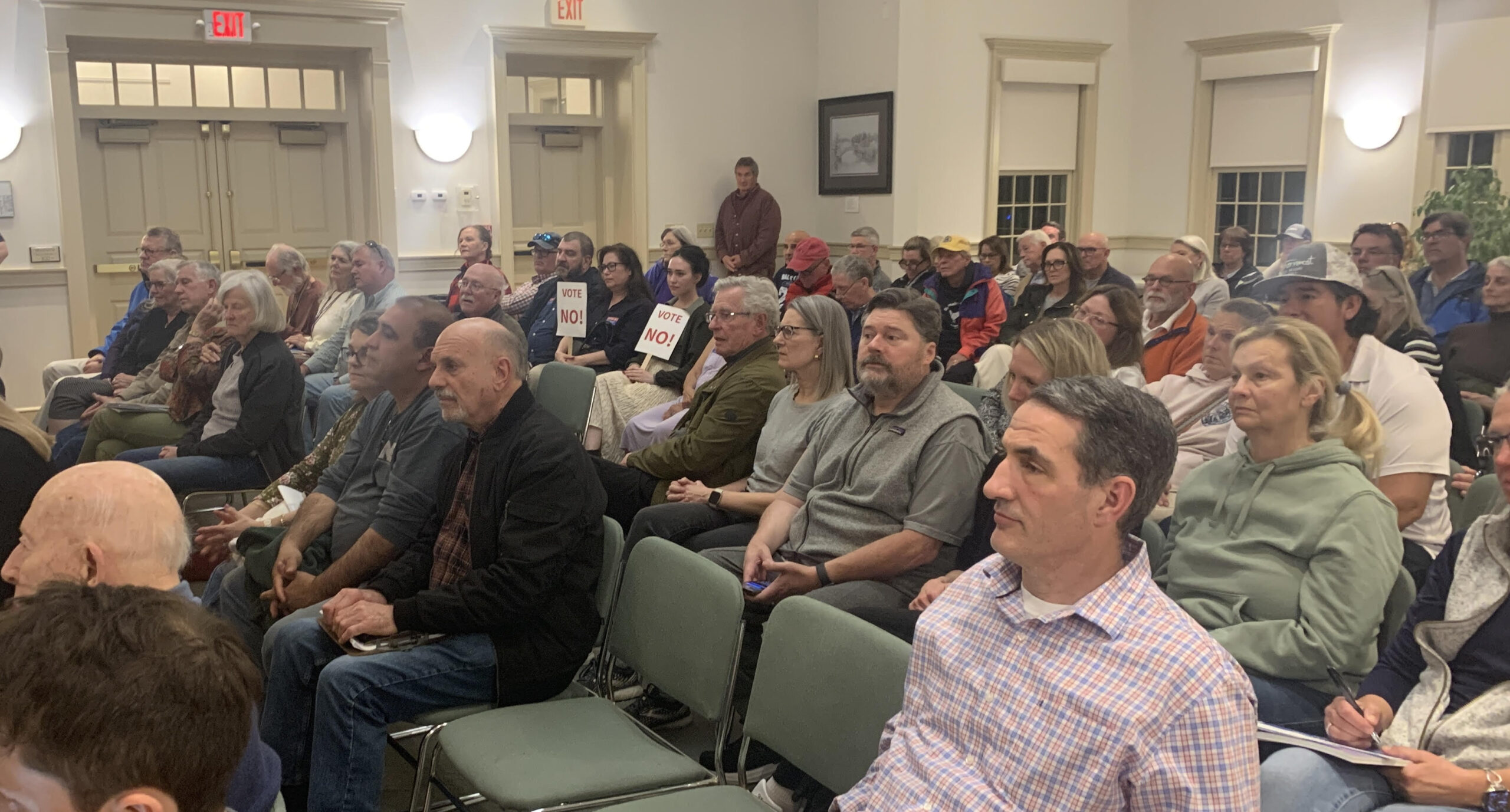
An audience of around 80 in the Town Hall Meeting Room and those watching remotely listened as the Old Lyme Zoning Commission voted 4-1 to reject the Halls Road Overlay District proposal.

Controlling Destiny … and Density

OLD LYME – Change is going to come to Halls Road, but the Zoning Commission on Monday said now is not the time. 

In front of an audience of around 80, the commission voted 4-1 to deny a proposal created by the Halls Road Improvements Committee (HRIC) for an Overlay District to allow apartments and condominiums to be built above, or behind, ground-floor businesses set close to the street. 

Commission members credited their decision to a groundswell of opposition manifested in “Overlay? No Way!” signs all over town as well as in comments on social media and at public meetings. Concerns revolved around the hazards of allowing multi-family residential development in a commercial area with limited septic availability and no sewers. Critics also called out a lack of information and not enough opportunity for residents to get involved in the process. 

Denise Savageau, a former alternate member, who was elected to a full seat last November, told commission members during their deliberations that she shared the frustration of residents that felt they were left out.

A retired environmental planner, who now serves on numerous state-level commissions concerned with natural resources, Savageau said there needs to be more involvement from the Planning Commission, Zoning Commission and other relevant agencies in coming up with changes to Halls Road regulations. And the discussions need to be conveyed clearly to the public at every step.

“I want to stress that this is not about the Halls Road Improvement Committee, but about the silos that have been created by all of the land use commissions in town,” she said. 

She described issues such as climate change and a lack of affordable housing options — both of which are subject to more state mandates with each passing year — that require local regulations to evolve. 

“The changes are going to come,” she said. “We need to plan.” 

The failed overlay district application is the latest in an effort going back more than a decade to improve the three-quarter-of-a-mile strip between two Interstate 95 interchanges that feed the town’s historic district and its shoreline. First there were calls for sidewalks; then came the possibility of village-like storefronts and apartments, a pedestrian bridge and more greenspace. Much disagreement and several discarded plans later, one of the only areas of widespread agreement is that Halls Road remains unattractive.

Some want big changes. Some want more modest aesthetic improvements. Others are fine with the way things are.

Member Jane Marsh in her deliberations recalled the commercial zone’s origin in the middle of the last century as a place people could easily access and find a place to park amid the rise of suburbanization. 

“It was created because it wasn’t going to be the most fabulously beautiful location in town. It was going to be functional and pragmatic for people, and that’s how it got built,” she said. “… It serves its purpose. It may not be very beautiful, but I don’t expect it to be beautiful, actually. I expect it to be the way it is.”

The overlay district proposal was approved by the Board of Selectmen in a 2-1 vote in November. It was endorsed 5-0 by the Planning Commission in January. 

Having a Conversation

One of the loudest voices against the overlay proposal was Robin Breeding, an artist whose social media posts and graphic design helped galvanize the opposition. Many people did not find out about the overlay district proposal until she began to publicize the issue after a sparsely attended public hearing in January. 

She welcomed the Zoning Commission’s decision in a phone interview Tuesday. 

“People didn’t know this was happening a month and a half ago,” she said of the overlay district proposal. “They thought it was going to be the sidewalks and that pretty stuff that they talked about in the beginning. And then they started to realize that it wasn’t that any longer. And they started to learn about what it was.”

She said the contention that the plan would help address a need for affordable housing was inaccurate. With the state pushing for towns to ensure at least 10% of their housing stock is affordable to lower income households, she argued the Halls Road Overlay District plan to require one out of every 10 housing units to be rented or sold at affordable rates wouldn’t advance the town’s obligation by even one percentage point. 

Only 1.58% of the town’s housing stock is currently affordable by state standards, according to data from the state Department of Housing. 

She said the overlay proposal threatened to drive out existing small businesses — many of them service providers in office settings — through its focus on new development and ground-floor retail options to be built over time if there’s enough interest from developers. 

“And so it was basically saying, ‘We don’t care about you now,’” she said of the plan. “‘We only care about some future pie-in-the-sky version of what this could be, but we can’t guarantee it.”

She said the ongoing overhaul of the zoning regulations by an outside firm presents a new opportunity for the public to learn about and become involved in the process of improving the town, including Halls Road. 

The $129,776 update of the town’s zoning regulations is being conducted by the Hartford-based FHI Studio. 

The planning and design firm was hired late last year to embark on a year-and-a-half-long project to clean up existing language in the regulations and then engage the public in discussion about potential changes as to what can be built in town, and where. 

When it comes to the kind of changes that residents of Old Lyme have a tolerance for, Breeding cited sidewalks as a good place to start. 

“And let’s have a conversation with the town, and talk to the town about how they want to move forward,” she said. 

For and Against

Commission Chairman Paul Orzel during the hearing said the public opposition brought to light some questions that have gone unanswered. 

Estimates for how many units could be built under the overlay application range from 200 to 1,200, depending on who’s doing the calculation and which variables are considered. 

“I’m a firm believer in controlling my destiny,” Orzel said. But the proposal as he saw it left too much to chance. 

Member Mike Miller applauded the residents, who spoke up against the plan. He said he shared their concerns related to the environment, tax increases and the effect of more residents on the school system and the delivery of public safety services. 

He called for a return to the basics. 

“There are many things that the HRIC brought up to our attention that are good. For example, the original charter of sidewalks and landscaping,” he said. “I think we need to have a safe corridor for pedestrian traffic for the kids from school. We have our students that come into town and work the shops. There are things that we can do.”

The lone vote not to deny the application came from Mary Jo Nosal, a former selectwoman who disputed the contention that the public hadn’t been a part of the process. She cited public surveys, various workshops, town update meetings, annual budget approvals, and reviews and input by local agencies including the Zoning Commission, Planning Commission and Board of Selectmen. 

She recalled that a master plan to guide improvements on Halls Road emerged as a response to efforts from the Federal Railroad Administration (FRA) to run high-speed trains through Old Lyme. 

Fears of the FRA’s plan slowed home sales and threatened business closures, according to Nosal. 

“The town also faced a scarcity of housing and office space options, and still does,” she said. “Long time residents had nowhere to live once they sold the family home; our children could not return to their hometown as there was nowhere for them to live and certainly afford; and community workers — teachers, healthcare workers, beauticians, grocery store workers — could not find an affordable home in town. Electric Boat was beginning its exponential growth but these professionals could not find a home here.”

She said the guiding question at the time was how to maintain and attract business and make housing more available, “While making it harder for the FRA to bulldoze our community.”

“The result was the development of the master plan for Halls Road and the effort to protect and improve our town center while being able to apply for state and federal grants for various improvements and bring in design experts to guide the process,” she said.

Nosal acknowledged many in the community feel the process behind the overlay proposal was flawed. 

“The Town of Old Lyme could look to improve the process for future town regulations and assure that more town meetings, land use joint meetings and significant planning occur as a lead-up to planning and zoning review,” she said. “But it cannot be denied nor should we dismiss the fact that many residents, the non-profits and business owners were represented in the process.”

Next Steps

After the vote First Selectwoman Martha Shoemaker said the Board of Selectmen will discuss the issue at a meeting over the next few weeks. She said Halls Road Improvements Committee Chairwoman Edie Twining has already expressed interest in working together to plan the next steps.

Twining on Monday night declined to give her own comment. But she referred to Denise Savageau’s speech on the need for town boards and commissions to work together — rather than in silos — so they could better inform and invite participation from the public. 

Twining could be seen during the meeting taking notes as Savageau spoke.

“Denise was 100% correct,” Twining said.

Editor’s Notes: i) Mary Jo Nosal is a financial supporter of LymeLine.com, but has no input to the editorial process, which remains completely independent.
ii) A reminder of Our Policy on Comments.

News in Brief: Old Lyme Zoning Commission Rejects Controversial Overlay Proposal

OLD LYME – The Zoning Commission on Monday evening voted decisively to quash a proposal intended by its proponents to transform Halls Road over time into a livable, walkable, ‘shoppable’ town center. 

Members of the commission credited vocal opposition evident in the “No Way Overlay” movement and called for engagement from local land use officials and residents in crafting an alternate future for the short span of road between two highway interchanges. 

The vote to deny the application passed 4-1. The lone dissenting vote came from Democrat Mary Jo Nosal.  

The proposal hinged on the creation of a voluntary overlay district on Halls Road that would allow apartments and condominiums to be built above, or behind, ground-floor businesses set close to the street. The underlying commercial district that had allowed for construction of strip malls and mostly one- and two-story businesses over the latter half of the last century would have remained intact for property owners who weren’t interested in adding a residential component to their plans for retail shops, restaurants and offices. 

The overlay district proposal, created by the Halls Road Improvements Committee, was approved by the Old Lyme Board of Selectmen in a 2-1 vote in November. The application to the Zoning Commission was signed by First Selectwoman Martha Shoemaker. 

Shoemaker earlier in the day resisted calls to withdraw the application. She said she would let the zoning process come to its own conclusion.

Zoning Commission member Jane Marsh, in explaining her decision, referenced the final session of a public hearing that concluded last week in front of an audience in the Lyme-Old Lyme High School auditorium that maxed out the room’s 550-person capacity and left upwards of 100 people unable to get in. 

A majority of those in attendance at the time held “Vote No” signs. They spoke about the potential for too many apartments and condominiums – anywhere from 200 to 1,200 of them, depending on who was doing the calculation and which variables were considered – in a location with limited septic options and no public sewer system. They called out a lack of information throughout the years-long process and not enough opportunity for residents to get involved. 

Marsh said she voted against the proposal, “Primarily because of everybody who came to that public hearing.”

Shoemaker after the vote said the Board of Selectmen will discuss how to move forward on improving Halls Road at a meeting over the next few weeks. She said Halls Road Improvements Committee Chairwoman Edie Twining has already expressed interest in working together to plan the next steps.

Twining on Monday night declined to give her own comment. But she referred to an impassioned speech from Zoning Commission member Denise Savageau, who called on members of the Planning Commission, Zoning Commission and other relevant agencies to work together with input from the public – instead of working in “silos” – to come up with a new plan.

Twining could be seen during the meeting taking notes as Savageau spoke.

“Denise was 100% correct,” she said afterward.

Editor’s Notes: i) This story has been updated with a change in the opening sentence.
ii) Full story coming Tuesday.
iii) A reminder of Our Policy on Comments.

Letter to the Editor: Are Old Lyme Residents Being Overtaxed? Demand Answers to Why Town Surplus Fund is so High, How it Impacts Tax Rates

To the Editor:

Are the residents of Old Lyme being overtaxed?  I would bet that most residents probably believe that our property taxes are relatively reasonable compared to other CT towns, but is that really correct? To try and find an answer to that question I Took a look  at the town budget.

Reviewing the budget, the first thing that jumps out is that our “Unassigned Surplus Account” (UAS.) UAS is high. What does that mean and why is it important? Our town’s budget allocates funds for specific purposes. If revenues exceed expenditures that have already been accounted for, the town may assign the excess funds into an account titled an “unassigned surplus”.  Think of it as a “rainy day fund” designated for unusual or unexpected expenditures. Our town’s current  UAS is about 15 million dollars representing about30 % of the town’s total revenue.

Is 30 the right number or Is it excessive? Instead of maintaining a large surplus should the money be returned to the taxpayers in the form of lower taxes in the future or used to fund capital projects or some combination of the two?

How does our UAS compare to other CT towns?  In 2020 The Office of Legislative Research for CT indicated the UAS number for CT. ranged from 0.1% for Stamford to 39.6% for Warren. The state auditors recommend that Connecticut towns aim for a surplus of 16%.

Why is ours on the high side? The reason given for keeping a high UAS is that in case of a catastrophic storm, that either temporarily or permanently wipes out our beach communities, our tax revenues will shrink.  Even if that is correct, it is also true that in those circumstances our services and expenses would likely also decrease. Is it also reasonable to anticipate that FEMA or the state would compensate us for some portion of catastrophic losses? Other shoreline towns like Clinton and Old Saybrook, that have equal or greater risks than Old Lyme, maintain lower UASs. Why? How did the Town of Old Lyme determine that 30% is the optimal percentage? What was the formula or methodology employed to arrive at that number? Old Saybrook has a target of 15%, and if the UAS exceeds that amount, they have a plan in place to reduce it. They don’t let it continuously grow.

I realize the town faces some significant new upcoming capital expenditures, but that does not seem to explain why we have built up this level surplus over the last few years even before these projects were approved.

Alternatively, did the town look at possibly obtaining catastrophe insurance, limited to reimbursement for the loss of  tax revenue, rather allocating millions of dollars to surplus? It might be a more economical solution.

Does a 30% surplus represent fiscal responsibility or irresponsibility? I don’t have the answers, but you may want to demand answers on the level of surplus and its impact on tax rates before deciding if you are being overtaxed.

Sincerely,

Howard Margules,
Old Lyme.

Death Announced of Christine Ann ‘Cookie’ Grem, Her Nursing Career Spanned Continents

OLD LYME – Christine Ann “Cookie” Grem, 68, passed away peacefully on April 13, 2025, in Old Lyme.

Born on January 2, 1957, in New Britain, Christine dedicated her life to the care and well-being of children around the world …

Christine’s nursing career was marked by compassion and global outreach. She traveled extensively on medical missions that took her as far as Africa and Russia …

She is lovingly remembered by her brother William J. Grem III and his wife Joyce of Berlin; her sister Kim Jensen of Berlin; nephews Bill Grem and Matthew Grem of Newington; and niece Ashley Jensen of Berlin …

Editor’s Note: Visit this link to read the full obituary published by Legacy Remembers on Apr. 14, 2025.

Letter to the Editor: First Selectwoman Not Withdrawing Halls Rd. Overlay District Application, Review Process to Continue Per State Regulations at Zoning Meeting Tonight

To the Editor:

An Open Letter to the Residents and Taxpayers of Old Lyme:

During the past few weeks, hundreds of residents have expressed their opinions, both positive and negative, to the Board of Selectmen, the Planning Commission and the Zoning Commission regarding the Halls Road Overlay District (HROD) application. 

As interest in the application has grown, so have questions about the application process. 

I want to take a moment to assure all residents of two things. 

First, the Town of Old Lyme is following the application process that every town in Connecticut is required to follow when it comes to potentially changing zoning regulations. The process is designed so that elected officials on all relevant boards and commissions can review the application in the context of a town’s Plan for Conservation & Development, solicit public input and then make the best decisions for the town. 

Second, everyone’s opinions – whether of concern or support – have been reviewed and carefully considered by the members of the Board of Selectmen, the Planning Commission, the Zoning Commission and the Halls Road Improvement Committee. Public input and feedback are an integral part of the application process. 

After the most recent Zoning Commission meeting on April 9, which was attended by some 550 residents, I have received multiple requests from opponents of the application to withdraw the application from further consideration. 

I am not planning to do that for the two reasons I just mentioned. We are following the required process, and the appropriate boards and commissions are soliciting and considering everyone’s opinions. 

I will also add that, in recent weeks, some of the public comments being made on social media have morphed into personal attacks against the volunteers who have served on the Halls Road Improvements Committee. These comments are unkind and do not relate to the issue. 

As the application process moves forward, I would like to request that everyone be respectful of the dedicated volunteers who give their time and skills to our town, even when and if their opinions may be different from your own. 

Sincerely,

Martha H. Shoemaker,
Old Lyme.

Editor’s Note: The author is the First Selectwoman of Old Lyme.