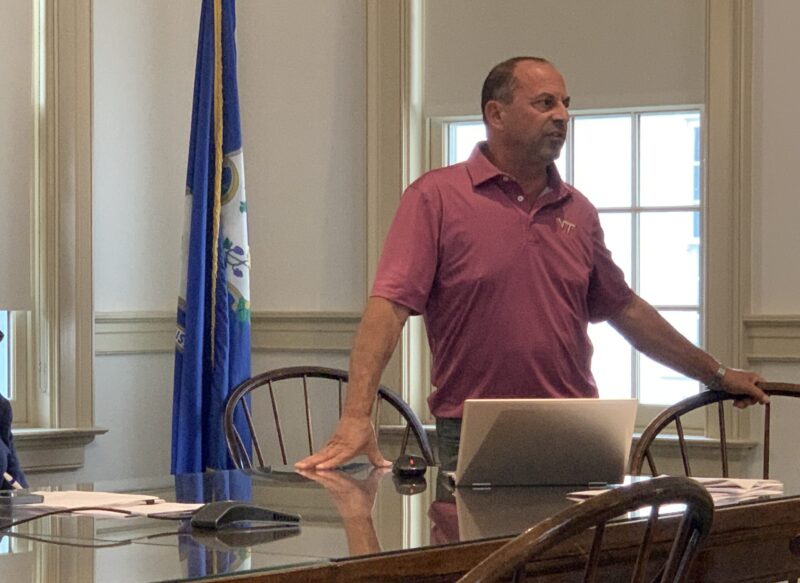
Historic postcards like these will be featured in Jim Lampos’s talk on Monday at the Old Lyme Historical Society.
OLD LYME —UPDATED 8/17 with details of where to see a preview of the postcards: On Monday, Aug. 18, at 7 p.m., the Old Lyme Historical Society Incorporated (OLHSI) hosts an historic postcard presentation by Jim Lampos titled, “Having a Swell Time.”
The presentation will be followed by a Vintage Postcard Sale when a selection of ‘extras’ from a recently-purchased collection will be available for sale. The postcards variously offer views of Old Lyme streets, landmarks, and beaches circa 1902-1970.
Visit Old Lyme Memorial Town Hall to enjoy a preview of much of the postcard collection. A selection of the postcards is on display in the front foyer and behind first floor staircase.
The event will take place at the Society’s building at 55 Lyme St. in Old Lyme. All are welcome and admission is free.
This is another in a series of speaker events sponsored by the OLHSI.
There is no charge for admission but donations are welcome to the Carol Noyes Winters Scholarship Fund.
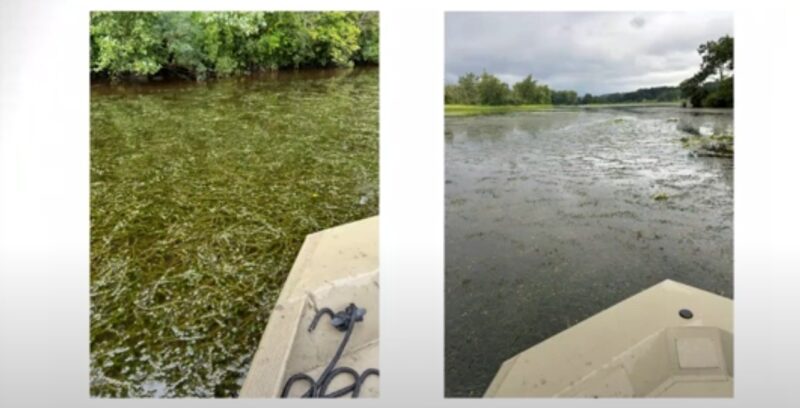
This comparison provided by the U.S. Army Corps of Engineers shows how hydrilla spread in Hamburg Cove between 2019 and 2024. The cove is on a list of sites to be treated with herbicide as part of a pilot project once funding and permitting comes through. Selden Cove, which received an herbicide application last year, will receive another this month.
LYME, CT—With the town firmly entrenched on the front lines of the fight against the uniquely pernicious water weed known as hydrilla, federal authorities on Wednesday held a virtual public information session on their efforts to help local communities control the invasive plant using herbicides.
The Connecticut River Hydrilla Research and Demonstration Project, led by the U.S. Army Corps of Engineers (USACE), first came to Lyme’s Selden Cove in 2023 to apply a red dye mimicking the flow of herbicide. The lessons learned set the course for the following year’s treatment of dipotassium of endothall in the same area.
Ben Sperry, research biologist with the U.S. Army Engineering Research and Development Center, described Selden Cove as a unique site compared to four other water bodies in the pilot program that used different herbicides.
“We used endothall alone, got pretty good control of hydrilla, but the water exchange in Selden Cove is quite rapid,” he said. “Consequently, hydrilla has already come back this year up to 60% occurrence, closing in on pretreatment levels that we saw in 2024.”
That’s when mats of hydrilla were so thick that waterside property owner Joe Standart said the cove was impassable to his power boat and to the sport fishermen who used to come around.
Project documents show the cove will be retreated the week of Aug. 18. But a plan to treat 12 additional sites – including Hamburg Cove, Joshua Creek and Selden Creek – will not happen this year due to federal funding limitations.
Hamburg Cove, however, will run red sometime between Sept. 15 and 19 as scientists return with the flourescent tracer dye administered by a certified contractor to gauge which herbicides, and how much of them, to use next year.
The Army engineers’ project is intended to gauge the safest, least toxic way to stem the hydrilla infestation choking off many areas of the river and being carried on the bottom of boats into lakes throughout the state.
Keith Hannon, USACE Project Manager, said the agency’s ultimate goal is to pass along the information from 17 test sites to state and local governments so they can address the problem on a larger scale.
Scientists describe the strain of hydrilla affecting the Connecticut River as genetically distinct from the one that emerged in the 1950s after a tropical fish dealer in Florida allegedly dumped an aquarium into a Tampa canal. It’s also removed from a second strain that emerged in the 1980s in the Potomac River.
The name comes from the Hydra serpent of Greek mythology, according to Hannon.
“When you cut off one of its heads, it would grow two more in place,” he said, describing the trait that can be seen in its namesake’s ability to break off easily into new plants.
Diquat Fears
It was over a month ago that an herbicide called diquat was launched into the internet’s viral vernacular by a rap artist originally from Fairfield County who started posting on social media about the chemical’s toxicity and a lack of government transparency.
An online petition from Chris Webby, which to date has amassed 20,112 signatures, calls on authorities to discontinue the use of the diquat while focusing on “non-toxic, mechanical and biological alternatives” to manage the plant.
Hannon during the virtual presentation said Sperry’s group has been studying the various ways to remove invasive aquatic plants for decades. Methods range from mechanical, like hand pulling, to biological, like using grass carp or weevils to kill the weeds.
“We know the effects and usefulness of those other mechanisms,” he said. “So we wanted to understand the use of herbicides on this new strain, because it’s unknown as to how effective that would be. But we know how effective the other methods could be. And how costly they are.”
He cited data from the Chester Boat Basin showing the cost to bring in a mechanical harvester three times during the summer cost $14,190, compared to $4,475 for an application of herbicide lasting for the season.
Hannon said hydrilla has the potential to wreak havoc on recreational opportunities, the tourism industry and aquatic habitats.
Local Concerns
Diquat is among the herbicides under consideration for Hamburg Cove, Joshua Creek and Selden Creek once funding and permits are secured, according to project documents.
Staff and board of directors members from Camp Claire during the presentation posed questions about safety.
Carol House, who identified herself as a board member at the Lyme-based camp, asked how long the herbicide poses a concern for children in the water.
Sperry, the research biologist, said there are no fishing or swimming restrictions associated with any of the herbicides being used on the project.
“We do prefer that recreational users kind of stay out of the way during treatment, just for boat safety,” he said.
Hannon said signs, like the one posted last year on a dead log at the entrance to Selden Cove during treatment, go up on the day of treatment but are not required to remain.
Anne Overstreet, with the U.S. Environmental Protection Agency’s Office of Pesticide Programs, said the results of the agency’s most recent evaluation of diquat in 2019 were published the following year as part of a regulatory framework designed to ensure there are no unreasonable adverse effects to human health or the environment.
“And there is no risk of concern for adults or children exposure to diquat from swimming immediately after application, from inhalation, contact with water, or potential incidental swallowing of the treated water,” she said.
She acknowledged “mild toxicity” to fish and other aquatic organisms.
“We look at a tremendous number of studies and we look at points of departure where effects are actually seen at very high doses in laboratory studies. And then we choose the dose that is ‘no-effect’ – where no effects are found. And then we regulate a thousand times below that threshold,” she said. “So there are no effects that would be seen.”
She said risks to those applying the chemical can be mitigated by following directions on the product label calling for precautions like eye protection.
“We ensure that folks that mix and load and pour those products also use respirators to protect from possible inhalation of the concentrated product before it is applied,” she said.
Responding to a question about using treated water to irrigate crops, Overstreet advised that, “If it isn’t toxic from a dietary standpoint from ingestion, then utilizing it for irrigation of crops would also not be a concern.”
Selden Cove
Sperry during a media briefing following the public presentation said endothall was the herbicide of choice for Selden Cove after the dye tests determined how quickly water moves through the inlet. Endothall worked best because it stays effective for the right amount of time and is safer for native plants.
Included in Wednesday’s virtual presentation by the U.S. Army Corps of Engineers were photos from Selden Cove to illustrate the extent of the hydrilla infestation prior to treatment.
Fast-acting diquat by itself is not effective on hydrilla, according to the biologist.
“With the plants that we were dealing with in Selden Cove, we felt that diquat would have been less selective and maybe not as effective as endothall at the rate that we chose to treat with,” he said.
Hannon said the delay in treating the 12 additional sites is not related to the public diquat pushback.
Earlier, he cited federal budgeting constraints exacerbated this year by the threat of a government shutdown and related costcutting measures, as well as permitting constraints.
“We would be at this point regardless of any pushback that came about,” he said.
Old Lyme Water Pollution Control Authority Chairman Steve Cinami addresses concerns about a plan to bring sewers to several Old Lyme beach communities at Monday’s Board of Selectmen meeting.
OLD LYME–The Old Lyme Board of Selectmen on Monday decided they need more time – and more transparency – before a years-long push to install sewers in the Sound View Beach area comes back up for a townwide vote.
The three-member board – composed of First Selectwoman Martha Shoemaker and Jim Lampos, both Democrats, and Republican Jude Read – declined to send to the Board of Finance a resolution that could trigger a referendum on whether to add $7.6 million to the $9.5 million approved by voters in 2019.
The costs are part of a broader plan that would require residents of three private beach associations and the public Sound View community to install sewers at a total cost of $70 million, according to estimates from the Fuss & O’Neill engineering firm released Monday.
About half of the new $17.1 million price tag for Sound View will be covered by federal grants and a forgivable loan from the state Department of Energy and Environmental Protection (DEEP).
Shoemaker at the meeting said selectmen will not move forward until “further information is made available” by the Old Lyme Water Pollution Control Authority (WPCA), which has been working with the other beach communities to address concerns from the state that their septic systems are threatening the health of the Long Island Sound.
Sound View residents have long asked for more specific information about how much they will have to shell out as the municipal bond is repaid over 20 years. They’ve also questioned the data underlying the state’s contention that sewers are necessary to resolve the potential for pollution in the area.
The WPCA is set to host a public information session at 6:30 p.m. on Monday, Aug. 18, to answer questions including those raised Monday by selectmen and residents. Shoemaker said selectmen and finance board members would have to agree to send the question to a public vote by Aug. 28, in order to stay on track for the tentative Sept. 9 referendum.
WPCA Chairman Steve Cinami said about $4.05 million has been spent on the total project so far. That includes $1.1 million in shared planning costs for a pump station and force main to be located in the Sound View area, as well as $406,412 in estimated out-of-pocket expenses. The Old Lyme WPCA itself spent $615,200.
Part of the WPCA’s urgency to hold the referendum stems from contractor quotes for the Sound View project that will expire in October, which could lead to more price increases if officials have to go back out to bid. The project has already been through multiple rounds of bids.
The bid process for two of the three private beach associations is ongoing.
The sewer plan stalled following the first referendum due to economic fallout from the pandemic, which had the effect of galvanizing grassroots opposition to the already expensive project.
Taxpayers approved the Sound View plan at referendum six years ago based on the assurance that only residents of the affected beach community would foot the bill.
Sound View property owner Kathleen Tracy during a public comment portion of the meeting called for leaders to “slow down,” even as she acknowledged the project has been going on for years.
“It’s very complex, but even in its complexity, it should be transparent,” she said.
Mary Daley and Dennis Melluzzo, both Sound View residents appointed to the Old Lyme Water Pollution Control Authority by the current selectmen, said the authority’s membership has a history of putting a “rubber stamp” on decisions made by project leadership without public inspection or input.
“I did not volunteer to be on the WPC board to rubber stamp documents that will change the history of this town,” Daley told selectmen. “This has to change. We need strong leadership that listens and works with the team, not in solitude.”
Sound View resident Frank Teti argued it’s unfair for residents across town to decide whether Sound View residents should be forced to pay for sewers.
“I feel that since the whole town had to vote on this referendum, it should come out of our taxpayer money.”
Others argued officials have not done enough to explore alternative septic system options.
Old Lyme WPCA member Andrea Lombard, speaking virtually, reiterated the “very complex” nature of the longstanding project.
She said the authority started out with the goal to avoid sewers, but state directives narrowed the options. “For many years we explored alternative systems, and they were not accepted by DEEP,” she said.
She acknowledged the unique position in which the Sound View residents find themselves. “There’s a lot of anger and tension, and that’s being received. We’re trying very hard to work through what we can, but we can’t always give you what you’re requesting,” she said.
The authority’s goal, according to Lombard, is to be “100% transparent.”
By the Numbers
The latest estimates from the authority put the project cost at around $1,939 per year over 20 years for a typical user. That’s someone whose house has one bathroom, a kitchen, and four bedrooms or less, which Cinami said applies to about 70% of Sound View households.
He said additional fees to operate and maintain the system are likely to come out to $500 to $600 per year, per household.
Expenses include the town’s portion of capital costs for infrastructure in East Lyme and New London through which Old Lyme’s wastewater will run. Also included is electricity, maintenance, and corrosion and odor control at the planned pump station in Sound View.
DEEP Project Engineer Carlos Esguerra last year said the agency sets the amount that residents can reasonably be expected to spend at 2% of the town’s median income, which he identified at the time as $122,000. That equated to $2,440 a year.
Cinami said the state does not consider annual operations and maintenance fees as part of its affordability calculation when it comes to installing a municipal system.
Esguerra could not be reached Tuesday for more information on how the agency determines if a project is affordable for residents.
Cinami also told selectmen the issue will not go away if they don’t act. The current plan for a shared sewer system is the result of formal consent orders from the DEEP requiring the private beach communities to fix the pollution issue, with the town participating voluntarily under the threat of a similar mandate.
Cinami said voting down the plan at a referendum could result in fines and increased oversight from the state that would force the issue.
“We will probably lose the 25% forgivable loan. Any delay will probably increase the cost over time. And there’s continued environmental and property risk,” he said.
Unpopular Decisions in an Election Year
Lampos said he’d be concerned about moving this project forward without knowing the status of the bids for Miami Beach and Old Lyme Shores that will affect whether they can afford to continue with the project. Bids are expected to be opened at Miami Beach later this month, while Cinami said Old Lyme Shores has been ordered by the DEEP to award a contract by Oct. 10.
But Cinami countered that the townwide referendum is separate from what happens in the private beach associations because it is contingent on participation by all four entities. That means the Sound View project has to come back to voters with adjustments if any of the participating beach associations drops out.
He said he expects all four entities to remain as part of the project.
“But if one doesn’t, we will not be able to move forward without having another referendum,” he said.
Lampos emphasized the importance of getting all questions answered up front when he likened the sewer situation to another longstanding and as-yet unproductive project on Halls Road.
Both initiatives, according to Lampos, put unfinished business from previous administrations in front of the current Board of Selectmen.
The Halls Road Improvements Committee began under then-First Selectwoman Bonnie Reemsnyder, a Democrat, to chart a new course for the commercial strip. The committee’s plan evolved in subsequent years to include a vision for first-floor shops and upper level apartments, but the idea ended up going nowhere while Republican Tim Griswold was in office.
Opposition to an application to modify zoning regulations to allow for the mixed-use approach on Halls Road reached a fever pitch at a meeting of the Zoning Commission attended by 550 people this spring. The proposal, which was ultimately denied by the commission, had been endorsed by selectmen in a 2-1 party line vote.
“When Halls Road came to us, the notion was, ‘Well, this has been funded under Griswold. It was all put together before you came in. It’s been voted on in town meetings. You have to move this along,’” Lampos recounted. “And rather than bog it down here, we moved it along to zoning. In the end, we got blamed for it, or at least Martha and I got blamed for it.”
Lampos emphasized intermunicipal agreements were signed and the previous referendum occurred under Griswold’s leadership.
“Halls Road is just like sewers. This is going on long before this administration. But it’s in our lap, and we get blamed for it if it goes wrong. So we have to make sure that it goes right,” he said.
He reiterated there are questions selectmen need answered before they can set the referendum. Included are whether Miami Beach will remain involved in the project, whether a cost sharing agreement will be reached to the satisfaction of all parties, and whether language for the sewer ordinance is in place.
“If we have those three legs of the stool, I would feel more comfortable moving this to a referendum because people will have the information they need to make an informed decision,” he said.
Editor’s Note: This article was updated to correct the total project cost and clarify the cost per user.
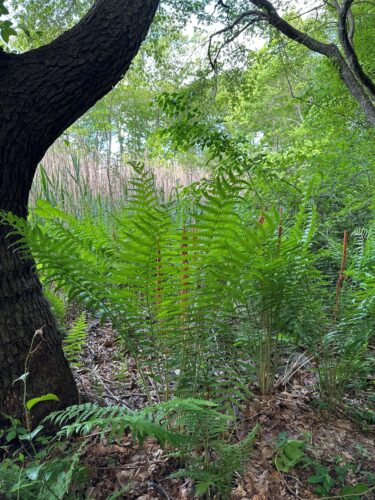
John Gluszak took this ‘Imagining Lyme’ photo of distinction while resting on a bench during a trek through Banningwood Preserve. All photos courtesy of the Lyme Land Trust.
LYME–The winners of the Lyme Land Trust’s “Imagining Lyme” spring photography contest have been announced.
The contest, which encourages amateur photographers to highlight the beauty of preserves, pollinator gardens and the skies of Lyme, is held quarterly.
Scott Martin’s photograph was taken in June 2021 at Ram’s Horn Creek Preserve.
This spring’s Photo of Distinction winners are:
“Sun Dappled Roaring Brook” by John Gluszak
“Jurassic Ravine Trail” by Sue Wyeth
“Doe and Fawn” by Scott Martin
Sue Wyeth took this photo while hiking Ravine Trail in May.
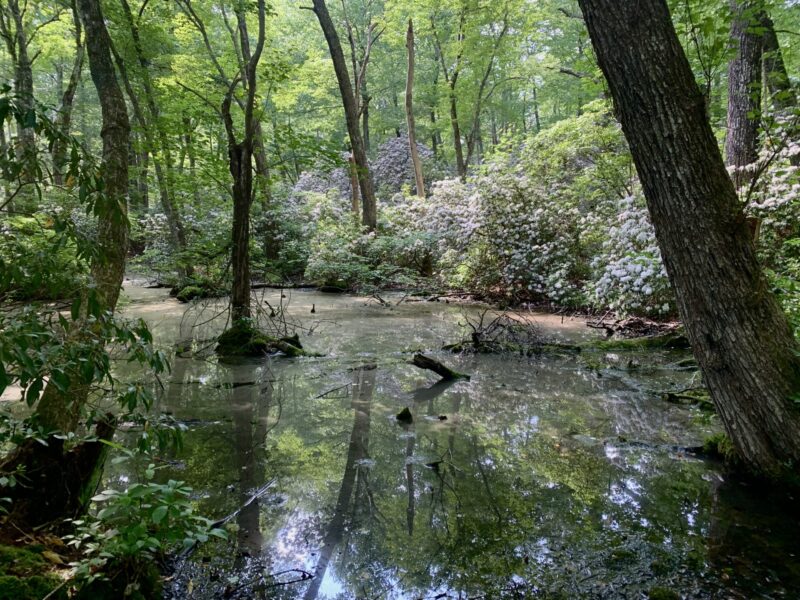
Jos Konst was awarded an honorable mention for “Mountain Laurel Blooming.”
This photograph from Jos Konst came from Selden Preserve in June 2023.