
Lyme-Old Lyme Schools Announce Quarter 3 Honor Rolls

Lyme-Old Lyme High School

2024-25 Quarter 3 Honor Roll

HIGH HONORS

Grade 12:  Ella Austin, Gavin Biega, Molly Boardman, Nathaniel Bradley, Mark Burnham, Chase Calderon, Andrew Clougherty, Tabitha Colwell, Gloria Conley, Chloe Datum, Caeli Edmed, Anna Eichholz, Davis Fallon, Grace Ferman, Benedict Frazier, Manu Geronimo, Christopher Gibbons, Elias Goldberg, Nicolas Hatch, Kaela Hoss, Yucheng Hou, Shyla Jones, Thomas Kabel, Simon Karpinski, Ella Kiem, Skylar Kobelia, Peter Kuhn, Elise Leonardo, Andrew Liu, Lana Lopes, Colette Marchant, Tirill Mundal, Abigail O’Brien, Kanon Oharu, Sophie Pennie, Madelin Salazar Cajamarca, Ryan Shapiro, Drea Simler, Andrew Sprankle, Charlotte Tinniswood, Kathleen Walsh, Giovanni Winters, Ava Wood-Muller, Wenyao Zhang, Gabriella Ziegler

Grade 11: Tyler Cann, Julia Clark, Maya Cook, Annabelle Coppola, Colman Curtiss-Reardon, Christopher Dagher, James Dahlke, Sophia D’Angelo, Rose Dimmock, Alexa Donovan, Alexander Glaras, Elizaveta Gregoire, Christopher Kachur, Jayden Livesey, Poveda Lucas, Ian Maeby, Daniela Marin Yanza, Serena Mazzi, Carter McGlinchey, Samuel McKenzie, Ryan Miller, Isabella Presti, Jacob Prokopets, Luca Signora, Andrew Taylor, Madeleine Trepanier, Connor Vautrain, Oliver Wyman, Stella Young

Grade 10: Ceciley Buckley, Morgan Buerger, Brooke Burgess, Anna Bussmann, Lillian Calabrese, Aidan Carpentino, Isaac Chartier, Samson Edmed, Lauren Fulara, Angeline Gencarella, Gavin Goulis, Tessa Grethel, Owen Holth, Josephine Kiem, Olivia Lovendale, Autumn Newbury, Grace Osborne, Ainsley Rinoski, Cameron Russell, Owen Shapiro, Carli Teixeira, Magdalena Tooker, Kaylyn Vernon, Caterina Wilson

Grade 9: Lillian Acosta, Lauren Belval, Scarlett Blatter, Vivian Boller, Lana Brunza, Trevor Camarra, Gabrielle Clark, Nathaniel Condon, Katharine Ferman, Jonah Filardi, Cortland Forbes, Avery Goiangos, Frederick Goss, Gavin Gray, Sawyer Graybill, Kinsley Grenier, Maia Guisti, Colleen Harrington, Morgan Harris, Sophia Huang, Henrik Hummervoll, Fiona Judge, Jillian Kleefeld, Kaedyn Koproski, Alice Li, Graham Macadam, Benjamin Mattox, Menzi Mbele, David McAdams, Charles McEwen, William McKeever, Addyson Morosky, Grace Morrissette, Marielle Munster, Mattea Parnoff, Remi Patz, Nicholas Porto, Jonah Scheckwitz, Avery Spooner, Hailey Suisman, Charlotte Thuma, Ella Ziolkovski

HONORS

Grade 12: Hannah Bonilla, Andrea DeBernardo, Zoe Eastman-Grossel, Hoshena Gemme, Abigail Greene, Hannah Johnston, Gage Kaulfuss, Olivia Kelly, Evan LeQuire, Nola Slubowski, Josephine Small, Erika Teixeira, Nicholas Turtoro

Grade 11: Charlotte Antonino, Max Bartlett, Zoe Brunza, Trevor Buydos, Makayla Calderon, Caden Camarra, Braden Dawson, Michael DeFiore, Benjamin Goulding, Oliver Hatchel, Anne-Marie Hinckley, Thomas Kelly, Maya LeQuire, Emily Looney, Sebastian Lopez-Bravo, Madeline Murphy, Sybil Neary, Ryan Olsen, Ryan Ortoleva, Quenten Patz, Tanner Snurkowski, Addison Spooner, Carson St. Louis, Sydney St. Pierre, Meredith Thompson, Margaret Thuma, Carl Zapatka, Katherine Zhang

Grade 10: Addison Arndt, Phineas Barrett, Zachary Belval, William Burgess, Johanna Coker, Amirah D’Lizarraga, Brady Donovan, Elliot Dunn-Sims, Edward Fiske, Harrison Goulis, Marley Iaia, Callahan Lacourciere, Patrick Lynch, Matilda Miller, Michael Millerick, John Morosky, Cara Paonessa, Vincenzo Pietrowicz, Arthur Riccio, Alexandria Sanford, Allegra Schaedler, Kevork Shegirian

Grade 9: Naomi Cameron, John Comstock, Alistair Grenier, Reese Holland, Henry Kyle, Treyton LaConti, Holden Leonardo, Sadie Lukasiewski, Rowan McCormick, Clarissa Mock, Theodore Neary, Ava Novak, Gwenevere Osborne, Mila Pacelli, Logan Patana, Caiden Pelletier, Marguerite Sevigny, Audrey Sheehan, Delilah Tooker, Renee Viera, Ashlynn Ward, Charles Zapatka

Lyme-Old Lyme Middle School

2024-25 Quarter 3 Honor Roll

HIGH HONORS

Grade 8: Josie Arndt, Anna Block, Emily Bonatti, Cassidy Buckley, Ewan Cabell, Trent Cameron, Emily Campbell, Finnegan Choisnet, Reagan Christopher, Eliana Cicchiello, Emerson Coker, Miles Coppola, Nadia Daily, Maya Desai, Parker Fedorich, Jackson Fiske, Samantha Fulara, Ava Fuller, Olivia Gerardo, Victoria Glaras, Cayden Graybill, Kylie Grethel, Olivia Griffith, Cole Haslam, Charles Holth, Quinn Hoss, Mary Kane, Griffin Karpinski, Collin Langley, Zoey Langley, Curran Livesey, Ellison Lodge, Isabel Martel, Grant Maxwell, Harland McKenna, Maxwell Mooney, Oliver Newbury, Thomas O’Connor, Kanato Oharu, Giovanni Orlando, Jack Ouellette, Jack Parker, Benson Reis, Tristan Reyes, Lillian Reynolds, Beatrix Rubino, Addison Sapia, Juliette Small, Mia Stokes, Natalie Suisman, Cooper Thomas, Olive Vautrain, Benson Wang, Reagan Weinstein, Samuel Zelek, Lily Zerkowski

Grade 7: Jack Antonino, Annalisa Archbald, Miella Bard, Sawyer Barreto, Cole Barris, Jackson Basham, Zakary Benedetto, Conor Buckeridge, Thomas Calabrese, Rowan Cantner, Mason Catalano, Jackson Chapps, Ainsley Conroy, Oliver Constantine, Daniel Crisp, Ella Davis, Amy Diaz, Daphne Eisensmith, Kate Ewers, Camryn Fedorich, Estelle Filardi, Beckett Goss, Delana Green-Oldfield, Julia Haslam, Sean Hunter, Rowan Kilfoil, Eva Levonick, Yago Lobo, Jamie Maloney, Mary McAdams, Ariana McEwen, Finn McLaughlin, Henry Miller, Broderick Morris, Maya Munster, Maura Murphy, Avery Olson, Gunnar Palmer, Juul Parrott, Quin Parrott, Quinn Quarto, Caliana Rand, Emily Randak, Charlotte Reynolds, Olivia Rozanski-Rose, Linden Sarnoski, Ari Shegirian, Maya Smith, Weston Taylor, John Young, Kingsley Zheng

Grade 6: David Acosta, Mylo Awwa, Cecelia Bradley, Brody Burr, Finn Cabell, Luz Cajamarca, Finn Celic, Liang Chang, Maizie Curtiss-Reardon, Croix Demars, Catherine Fisher, Maxwell Garvin, Natalie Gibbons, Gabriella Gonzalez, Gerald Holland, Joseph Jewett, Callie Kelo, Aiden Lapinski, Parker Lee, Colton Lodge, Benjamin Lott, Siena Maguire, Linnea McLachlan, Emma Morales, Nico Orlando, Alexander Reid, Jack Reiter, Brandon Reyes, Connor Rice, Taylor Rooney, Magnolia Sahl, Kate Scheckwitz, Colton Schroder, Madison Seckla, Leif Sullivan, Audrey Thuma, Tobias Tooker, Carina Vakili, Henry Whalen

HONORS

Grade 8: Samuel Dunn-Sims, Colin Farrell, Parker Forbes, Jared Fulara, John Osborne, Charlotte Sanford, Adrianna Squarciafico

Grade 7: Liam Carpentino, Hunter Emma, Aibhlinn Hall, Thomas Hayes, August Jungkeit, Tristan Montanaro, Ryann Montesanto, Isla Morrissette, Roman Schlachter, Reed Snurkowski, Lucius Stebbins-Wallen, Grace Strekel, Molly Supersano, Kolbein Vigen, Jack Walter, Liam Ward

Grade 6: Dylan Boisseau, Ella Boudo, Ryan Campbell, Andrew Chonka, Connor Christopher, Ryan Dawson, Lucia D’Onofrio, Walter Glenn, Niall Hallahan, Ofelia Karsten, Roosevelt Lowry, Aidan Mulligan, Loretta Newbury, Gabriella Norris, EmmaLeigh Reed, Michael Soriano, Piper Spiegel
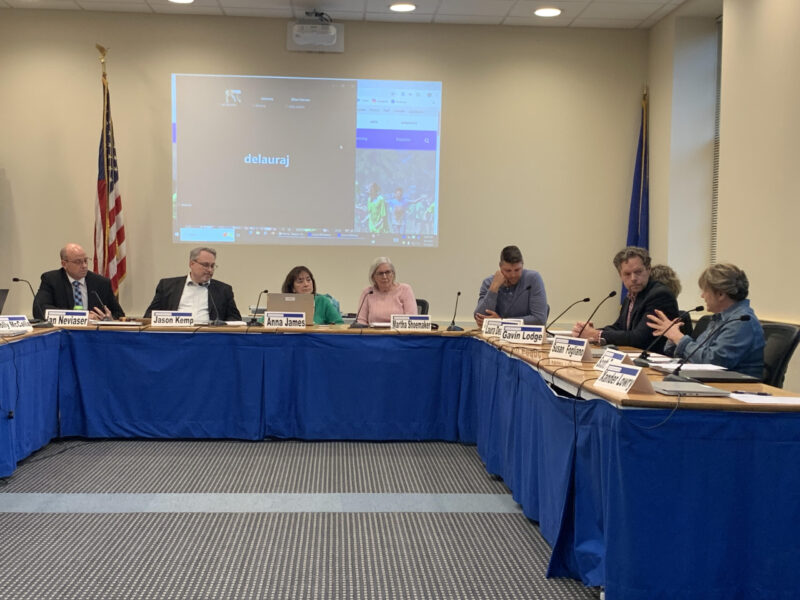

Lyme-Old Lyme Schools’ Board Sends Unchanged Budget Proposal to Tuesday Referendum

The Region 18 Board of Education on Monday declined to take upwards of $700,000 from the district’s ‘Rainy Day Fund’ to mitigate the impact to taxpayers of a $39.7 million budget proposal.

OLD LYME–The Region 18 Board of Education on Monday evening unanimously sent the proposed $39.7 million 2025-26 budget to referendum unchanged despite calls from several residents to take money out of its reserve funds to reduce the impact on taxpayers going forward. 

The referendum will be held Tuesday from noon to 8 p.m. Old Lyme residents and qualified taxpayers will vote at the Lyme-Old Lyme Middle School Gym, 53 Lyme Street. The vote in Lyme will be held at the Lyme Town Hall, 480 Hamburg Road.

Of the proposed budget’s $2.7 million or 7.39% increase, $1.8 million is attributable to debt payments on the extensive renovation project affecting all the district’s schools except Lyme-Old Lyme High School. 

Old Lyme resident Andy Russell, a member of the Old Lyme Board of Finance and the District Building Committee, who said he was speaking for himself, asked the board to use $700,000 of its $3.1 million undesignated fund – colloquially referred to as the ‘Rainy Day Fund’ – to offset the anticipated increase in the district’s special education spending. 

State law beginning in 2023 empowered each regional school board to create a reserve fund for “educational expenditures.” The law previously specified reserve funds could only be used for one-time capital expenses. 

Special education is up $726,721, or 58.67%, in the proposed budget. Superintendent of Schools Ian Neviaser has attributed the increase to the number of students, who need to be placed in programs outside the district to meet their needs. There are four students requiring outplacements in the coming year compared to the single student identified when the current budget was approved. 

Russell said the school board could dip into its undesignated fund balance for the next several years until the debt payments stop increasing. 

He said the district typically ends each year with a healthy surplus. 

“I’m reminded that you’ll probably end up – because the school district is very well run – with another $700,000 put back in that budget following this year,” he said. 

David Kelsey, another Old Lyme Board of Finance member, who also said he was speaking for himself, said the school board needs to be more “healthily skeptical” of the enrollment projections from the New England School Development Council (NESDEC) that helped justify the need for the renovation project. 

He said the NESDEC forecast overestimated the number of students in the district.

“Going forward, we have a high school that’s going to need to be renovated as well, and I do not think that we need to rely upon projections that are not commensurate with an obvious skepticism that’s required,” Kelsey said. 

District Building Committee Chairwoman Susan Fogliano before Monday’s vote to send the budget proposal to referendum laid out the school board’s case for not dipping into the ‘Rainy Day Fund.’ 

She said the school board over the past two years used reserve funds to reduce the overall amount of money that would have to be borrowed for the project, which resulted in the proposed 2025-26 budget coming in lower than the 10% increase originally anticipated. 

She also cited grant funding and advantageous interest rates that helped bring down costs. Neviaser said the district will be spending about $17 million less than the $57.5 million price tag approved by voters at referendum in 2022. 

Neviaser said the district’s bond rating – which district business manager Holly McCalla said has stood at an AA2 rating from Moody’s since 2017 – is influenced by the size of the district’s undesignated fund balance. 

“Keep in mind too, we will be bonding again this summer, so they will be looking at what’s in our undesignated fund, and that does impact our rating,” he said. “We’ve confirmed that with our bonding agent, so that’s another consideration.”

Fogliano pointed out the school board has earmarked $1 million of the undesignated fund balance to be used if necessary for security upgrades to the school vestibules. 

She said the district hopes to cover the expense out of the total project budget. 

“We hope, but we can make no promises,” she said. 

She cited the potential impact of tariffs enacted under the administration of President Donald Trump. 

“A great number of our materials have already been purchased, but it’s possible we may see overruns that we don’t anticipate based on future purchases that we can’t control,” she said. 

Fogliano and Neviaser said state law allows the district to put an amount not exceeding 2% of the prior fiscal year’s education budget into its reserve fund. But they said the school board is willing to put less than that into the fund in the coming year – if it makes financial sense at the time based on district needs – so that it can return more of the surplus to Lyme and Old Lyme. 

“I just wanted to have that out on the table so everyone understands that we are thinking about this concept, and that we are doing as well as I think anyone could expect under the present circumstances,” Fogliano said.

Op-Ed: Dip Into Region 18 ‘Rainy Day Fund’ to Dampen Debt Impact

Mary Powell St. Louis

Town residents have received their postcard reminder about the 2025-2026 district budget meeting and referendum vote from Regional 18 school district both scheduled for May 5 and May 6 respectively.   

By means of background information on the school budgeting process, it is important to understand some of the Connecticut school laws defined by the general statutes. According to the Connecticut General Statutes Section 10-262(j) on minimum budget requirements, a school budget may not be less than the budget from the prior fiscal year except for limited circumstances defined in the statute. 

Additionally, section 10-51(d)(1) was amended in 2024, such that a regional school district can create a “reserve fund for educational purposes” rather than the prior designation of such fund for only “capital and nonrecurring expenditures.” The statute had also been amended in 2021 to change the amount regional school districts are allowed to appropriate from the current fiscal year’s budget from 1% to 2%.   

Key takeaway: Outside of exceptional circumstances, a school budget can never go down and there has been expansion for a regional school district like Lyme/Old Lyme in terms of how a budget surplus can be used.  

The Region 18 school district has long taken the opportunity to fund their “undesignated fund,” or reserve fund, for at least the last 10 years (per the annual October Board of Education meeting minutes on the district website). For the last four years since the change in the statute to support 2% funding of the reserve fund, Region 18 has appropriated approximately $700,000 annually to the reserve. The current reserve fund balance stands at $3.1 million. Although the Board of Education has not formally approved any of the current earmarked projects in the reserve, they are formulated in the five-year facilities plan for the district. There is no reason to doubt that at the October 2025 Board of Education meeting, the board will again vote to fund the reserve based on past experience and determination of a budget balance (unaudited at the time of the decision) in a similar range of $700,000.   

You may ask why these details matter. The 2025-2026 school district budget up for referendum stands at a 7.39% increase over the previous year’s budget and over half of the increase represents debt service (bonds) predominantly related to the $57.5 million PK-8 building project.  Debt service obligation (principal and interest) for the district is estimated to increase annually for the next five years then start to drop dramatically.

Rather than increasing the budget as proposed to cover the current year debt service requirement, I recommend the board consider the use of a portion of the reserve funds to dampen the impact of debt service on the budget in the next five years.  

Why not use all the reserve? Well, we don’t want to do that as it could adversely impact the credit rating of the district for future debt service.  Further, the forecasted campus improvement projects could not be funded for the foreseeable future.    

My suggestion is to use a portion of the reserve, equivalent to the maximum allowable 2% of budget holdback. Instead of increasing the budget by 7.39% to $39,650,803, the requested budget could be about $38.5 million, or a 5.5% increase.  Presuming the recent historical trend of budget surplus continues, this strategy would limit the growth of the budget until the debt service started to decline in five years, at which time the contribution to the reserve fund could be resumed.   

I hope that the residents of Lyme and Old Lyme consider contacting the Board of Education members about the above issues and that the board takes this into consideration at the district budget meeting on Monday May 5.  

Editor’s Note: The author, Mary Powell-St. Louis, was a member of the Region 18 Board of Education for eight years.

Old Lyme Town Budget Hearing Uncontentious Despite Proposed 7.8% Increase Over Current Spending

OLD LYME – Board of Finance Chairman Bennett J. Bernblum on Monday presented the proposed $45.39 million budget along with its potential implications on taxes in this and coming years. 

The proposed $45.39 million 2025-26 budget – which includes town operations and capital expenses as well as the town’s share of the regional Lyme-Old Lyme school district – represents an increase of $3.28 million, or 7.8%, over current spending. It is heavily influenced by large-scale renovation projects affecting the schools and the Lymes’ Senior Center. 

The public hearing on the budget lasted just over a half hour in front of roughly two dozen people in the Town Hall meeting room. Bernblum opened with the acknowledgement that it was not the kind of “sell out crowd” that drew more than 550 people to the Lyme-Old Lyme High School earlier this month to discuss for more than three hours a controversial proposal to allow apartments on the commercial strip of Halls Road. 

Amid the apparent lack of controversy Monday night, Bernblum laid out the budget proposal he said would likely raise tax bills for the average property owner by around 4.7% based on the recent townwide property revaluation. But residents whose home values increased more than the average will see a heftier hike in their tax bills. 

He said the projected tax rate, which won’t be set until immediately after the proposed budget is approved by voters, will be 16.2 mills.

A mill represents $1 in tax per $1,000 of assessed property value.  

Bernblum has said the tax rate would be going up 6.8% if the finance board didn’t offset the increase by taking $800,000 out of the undesignated fund balance, or Rainy Day Fund.

The current tax rate is 24.4 mills. After taking the revaluation into account – and if spending did not change at all in the coming year – the tax rate would be 15.5 mills. 

The town’s grand list of taxable property grew by 57.4% as a result of the revaluation, according to final assessor’s data that takes into account adjustments by the Board of Assessment Appeals. The board finished its final hearings earlier this month. 

That means a house appraised at $400,000 with a valuation mirroring the average 57.4% increase to the grand list is now worth $629,600, according to Bernblum’s presentation. The tax bill for that homeowner based on the proposed budget would be $7,153 – an increase of $321, or 4.7%, over the current tax bill. 

Illustrating the complexity of a revaluation year, Bernblum said a house valued at $600,000 that went up 65% in value due to the revaluation is now worth $990,000. The owner of such a home can expect a $11,247 tax bill if the proposed budget goes through. That’s an increase of $999, or 9.8%, over the current tax bill. 

Old Lyme’s government operations expenses come in at $11.39 million, an increase of $835,260 million, or 7.9%, over the current budget. That includes debt service amounting to $702,350, which is up $271,168, or 62.9%, over current payments. The increase is driven largely by debt payments on the Lymes’ Senior Center renovation project.

The proposal includes an additional $107,000 increase in health insurance expenses over the current year.

The budget proposal, along with new language related to several town ordinances, will go to voters at a town meeting on May 19. 

The Impact of Education

The proposed budget in Old Lyme includes education costs of $31.52 million, which is up $1.99 million, or 6.72%, from the town’s current share of the regional school district budget. The increase is driven by debt payments on a multi-building renovation project approved by voters at a cost of $57.5 million. 

A referendum on the $39.7 million Region 18 budget proposal – which represents an increase of $2.7 million, or 7.39%, over the current spending plan for the district – is scheduled for May 6 in Lyme and Old Lyme.

The Region 18 Board of Education earlier this month voted unanimously to send the budget proposal to referendum.

Earlier objections to a decision to cut an elementary music teacher from the proposed budget were muted after the school board agreed to put the position back into the spending plan. The district will find savings elsewhere in the proposed budget to cover the cost, according to Superintendent of Schools Ian Neviaser. 

Neviaser in a Tuesday email said the regional school board has opted not to use any of its $3.1 million undesignated fund balance to offset the spending increase despite calls to explore the option.

“The board has not chosen to make any changes to the current proposed budget and plans to go to referendum with what we believe is a fiscally responsible and reasonable request of a 2.69% increase in the operating budget coupled with a 4.7% increase in debt service, which is the main driver for the overall 7.39% increase,” he said. 

School board Chairman Jason Kemp, who said he was speaking for himself rather than the full board, wrote in an email Tuesday that the undesignated fund is generally used for projects that might be too large for an annual budget, but too small to go to referendum and bonding. 

“While nothing is planned at the moment, an example of such a project would be to replace the track which we are told can’t really be resurfaced again. It would be fiscally irresponsible to spend that down significantly to cover a year of debt service on the PK-8 school project,” he said. 

He noted the proposed budget is less than the projected 10% increase for the coming year that had been presented to the towns prior to the referendum vote on that project. He cited lower than expected interest rates and grant funding that helped defray costs.

Rainy Days in Old Lyme 

On the town side, the finance board on April 15 voted to use $800,000 from its own undesignated fund balance to soften the impact of the proposed budget increase on taxpayers. 

Budget figures from Finance Director Anita Mancini show the allocation will bring the predicted $14.2 million Rainy Day Fund from 35.15% of the total operating budget at the end of this budget year to an estimated 29.6% in the coming budget year.

Bernblum said maintaining a healthy undesignated fund balance will help the town mitigate the effect of increasing budgets on taxpayers going forward. 

“And that will still leave (a) surplus of a significant amount to hedge against future needs,” he said. 

He emphasized that debt payments from the schools’ renovation project will continue to increase through the 2028-29 budget year. 

“So debt service for Region 18 is going to continue to go up significantly, but not astronomically, over the next several years, and then finally it will begin to come down,” he said. 

A philosophical schism between the two major parties on the finance board has pitted Democrats against Republicans. The decision to dip into the Rainy Day Fund for $800,000 represented a compromise among the three Democrats, who wanted to use more of the surplus to mitigate tax increases, and the three Republicans, who would have preferred to use less in order to save for the future. 

Some finance board members at the time said the town could be facing costs in coming years related to a years-long effort to bring sewers to several beach communities under pressure from the state Department of Energy and Environmental Protection. 

While town officials have long said the expense would be covered by property owners in the affected beach areas, Bernblum on Monday acknowledged there could be costs to residents at large. 

State law specifies towns cannot assess property owners for any amount higher than the percent increase in the property value attributed to the sewers.

“It is possible that something could go wrong in the formula and that…the (Old Lyme Water Pollution Control Authority) won’t be able to bill the homeowners all of the costs necessary to recover 100%, in which case then the town could have some liability,” he said. 

Shoemaker said costs related to connecting town-owned properties to the sewer system, including the Old Lyme Police Department on Shore Road and a planned bathroom facility at Sound View Beach, would also be covered by the town. 

She said the town’s proposed capital plan includes $20,000 for initial engineering designs related to the Sound View bathrooms and contemplates spending an additional $20,000 on designs the following year. 

Uncertain Expenses

Proposed capital costs come in at $2.49 million in the proposed budget. That’s up $456,792, or 22.5%, from the current budget.

The capital spending plan includes $443,500 to save for the purchase of three fire department apparatuses over the next several years. Also included in the budget is an additional $200,000 for road-paving projects, bringing the total line item to $1 million.

The plan earmarks $70,200 toward architectural designs sought by the Halls Road Improvements Committee (HRIC) for a plan to add a pedestrian bridge, sidewalks and other amenities, according to Bernblum. 

But the Board of Selectmen last week agreed to put the work of the HRIC on hold in the wake of a groundswell of opposition to a separate proposal to amend the town’s zoning regulations and the subsequent resignation of HRIC Chairwoman Edie Twining. 

“What is going to happen with Halls Road is in the hands of the Board of Selectmen primarily at this point,” Bernblum said. “So what they decide to do, or we decide to do, with respect to Halls Road at the moment has not been decided.” 

Proposed capital expenses also include $80,000 to supplement $95,000 approved last year at a town meeting for the design and construction of a replacement gazebo at White Sands Beach. 

First Selectwoman Martha Shoemaker said the town engineer’s original estimates were upended when it was discovered the town would have to follow state and federal flood zone requirements in updating the structure. 

Subsequent estimates came in at $173,000 for the project, according to Feb. 24 Board of Selectmen meeting minutes. 

Shoemaker attributed the steep increase to more stringent guidelines for installing the footings and holding the gazebo in place. 

Shoemaker said the plan is to complete the engineering designs using last year’s allocation so the project can go out to bid. 

Bernblum put it this way: “We’ll go out to bid when the designs are completed and cross our fingers that there’s enough money. And if not, we’re going to have to come back to you guys and beg for more.” 

Bernblum said the finance board remains open to public feedback on the proposed budget through the May 19 town meeting. 

“Historically, we haven’t gotten negative feedback in regards to it, but we certainly invite that,” he said.

Editor’s Notes: i) Bennett Bernblum is a financial supporter of LymeLine.com, but has no input to the editorial process, which remains completely independent.
ii) A reminder of Our Policy on Comments.

After Much Disagreement, Old Lyme Board of Finance Decides to Take $800K From ‘Rainy Day Fund’ to Offset Tax Increase

OLD LYME – With many residents concerned by the recent revaluation that hiked the value of taxable property in town by more than 60%, the Old Lyme Board of Finance on Wednesday evening agreed to use $800,000 from the town’s ‘Rainy Day Fund’ to help mitigate the impact to taxpayers of a proposed $45.39 million 2025-26 spending plan. 

The proposed budget – which includes town operations and capital expenses as well as the town’s share of the Lyme-Old Lyme Schools regional district budget – represents an increase of $3.28 million, or 7.8%, over the current budget. 

It includes education costs in the amount of $31.52 million, which is up $1.99 million, or 6.72%, from the town’s current share of the regional school district budget. The increase is driven by debt payments on a multi-building renovation project approved by voters at a cost of $57.5 million. 

The Old Lyme budget proposal will now go to a public hearing on Monday, April 28, at 7:30 p.m. in the Town Hall meeting room. 

Based on preliminary numbers provided by Finance Board Chairman Bennett J. Bernblum, a Democrat, the  decision to use $800,000 from the town’s reserves will result in a projected tax rate of 16.2 mills, an increase of 4.5%. 

The tax rate would be going up 6.8% if the finance board didn’t move to offset the increase, he said.

A mill represents $1 in tax per $1,000 of assessed property value.  

The current tax rate is 24.4 mills. After taking the revaluation into account – and if spending did not change at all in the coming year – the tax rate would be 15.5 mills. 

The board of finance will not set the final tax rate until immediately after the budget is approved at the Town Budget Meeting on May 19. The Lyme-Old Lyme Schools budget referendum is scheduled for May 6.

Contacted by phone on Wednesday, Assessor Melinda Kronfeld said that she will not be able to detail the potential tax impact until the town’s Grand List of taxable property is finalized after the Board of Assessment Appeals concludes its hearings next week. 

She said the median increase in real estate values was 64% based on preliminary numbers. That means anyone whose property value went up more than that will see a tax bill higher than the projected 4.5% increase. 

Finance board member David Kelsey, a Republican, said during this week’s meeting that about 2,200 of the 5,500 households in town were looking at above-average property tax increases. 

First Selectwoman Martha Shoemaker on Thursday said the budget increase is driven by debt service on the school renovation project as well as the renovation to the Lymes’ Senior Center that is nearing completion. On the town side, the $702,350 debt service line that includes the senior center project represents a 62.9% increase over current spending.

In the capital budget, the town allocated $443,500 to save for the purchase of three fire department apparatuses. Also included in the budget is an additional $200,000 for road-paving projects, bringing the total line item to $1 million.

Shoemaker last week carried out a finance board directive to come up with some last-minute cuts by working with Finance Director Anita Mancini and department heads to slash $171,350 from the proposed budget. While decreases to individual line items were typically less than $5,000 each, a notable savings came from paying for a $50,746 equipped police cruiser using revenue collected from the fund for officers’ road construction detail assignments rather than the capital budget.

‘Who Knows?’

Finance Director Anita Mancini in budget documents estimated the Rainy Day Fund, known in accounting parlance as the Undesignated Fund Balance, currently represents 35.15% of the total operating budget. 

Using $800,000 to offset the tax increase will bring the Rainy Day Fund balance to an estimated 29.6% of the total operating budget, according to budget numbers. 

The move was a compromise between Republicans, who wanted to take out less from the Rainy Day Fund, and Democrats, who wanted to use more. 

Democrat Kimberly Thompson put it this way: “There are a lot of people who’ve had major adjustments to their evaluation of their property. And I think whatever we can do to minimize the impact of that this year, we should try and do.”

Republicans Kelsey and Andy Russell said they want to make sure there’s enough money in reserve in case a catastrophic storm wipes out the shoreline tax base. 

Russell invoked the idea of a 100-year storm when he said the Hurricane of 1938 occurred almost a century ago. A storm of that magnitude has a 1% chance of occurring each year, but hasn’t happened since. 

“Well, here we are,” he said. “That’s only 13 years away. So who knows?” 

Kelsey pointed to large-scale projects that could impact future budgets such as the installation of sewers in the town’s beach communities which will require extensive appropriations in coming years.  

He also pointed to unknown costs that could hit at any time. This year, those unexpected costs amounted to $1.65 million. Included in that amount were the construction of the Emergency Operations Center, reconstruction of the Hawk’s Nest sluiceway, construction and paving of accessible parking spaces in the Sound View parking lot and a comprehensive revision of the town’s zoning regulations.  

Finance Board Chair Bernblum said the town’s bond attorney advised him creditors like to see undesignated fund balances in the amount of 30% of the total budget, but that the town’s AAA rating with S&P Global Ratings would be unlikely to change if the amount went down to 25%. 

“In general, I’m informed by what I think the sentiment of the taxpayers would be, and without having done a study, my gut tells me that they would argue for a larger withdrawal in order to mitigate their taxes this year,” he said. 

He cited those on fixed incomes as the most vulnerable to the tax increase. He said he was less worried about himself and fellow finance board members Kelsey and Russell. 

“I don’t care too much about Dave or me or Andy, for that matter, if our houses went up in value because we can afford to pay it,” he said. “But there are folks in town who can’t, and for them it’s a real burden.” 

Thompson, who also serves as chairwoman of the Democratic Town Committee, expressed confusion about the unwillingness of the Republicans to agree to a larger withdrawal from the Rainy Day Fund when the finance board under Kelsey’s leadership set aside money to mitigate tax increases several times, including $600,000 in 2023 and $800,000 each year in 2022, 2020 and 2019. 

“And in all those years, I don’t think we ever actually ended up needing that money,” she said. 

Meanwhile, the Undesignated Fund Balance (Rainy Day Fund) has grown from 22.2% in 2020 to the current 35.2%. 

Finance board member Anna Reiter, a Democrat, pushed for a $1 million withdrawal from the Rainy Day Fund. 

“We could take out another million next year and another $900,000 a year after that, assuming we don’t increase this fund at all. And we would still be at over 25%,” she said. 

But Kelsey and Russell pointed to debt levels in the school district and the town that will be felt for years to come. 

“I think the stakes have changed,” Russell said. “I think the increases we’re seeing and are going to see in the next few years are going to be more significant consistently than we’ve seen in the past.”

Ultimately, the group decided against a suggestion from First Selectwoman Martha Shoemaker to let voters decide at the budget referendum how much to take out of the Rainy Day Fund and then against Bernblum’s subsequent idea to leave it up for discussion at the public hearing. 

The vote to set aside $800,000 was endorsed by Republicans Kelsey, Russell, and Matthew Olson along with Democrats Bernblum and Thompson. Reiter (D) was the lone nay vote.

Editor’s Notes: i) This article has been updated to correct some budget terminology and figures
ii) Bennett Bernblum is a financial supporter of LymeLine.com, but has no input to the editorial process, which remains completely independent.
ii) A reminder of Our Policy on Comments.