
Lyme-Old Lyme Schools’ Board Sends Unchanged Budget Proposal to Tuesday Referendum

The Region 18 Board of Education on Monday declined to take upwards of $700,000 from the district’s ‘Rainy Day Fund’ to mitigate the impact to taxpayers of a $39.7 million budget proposal.

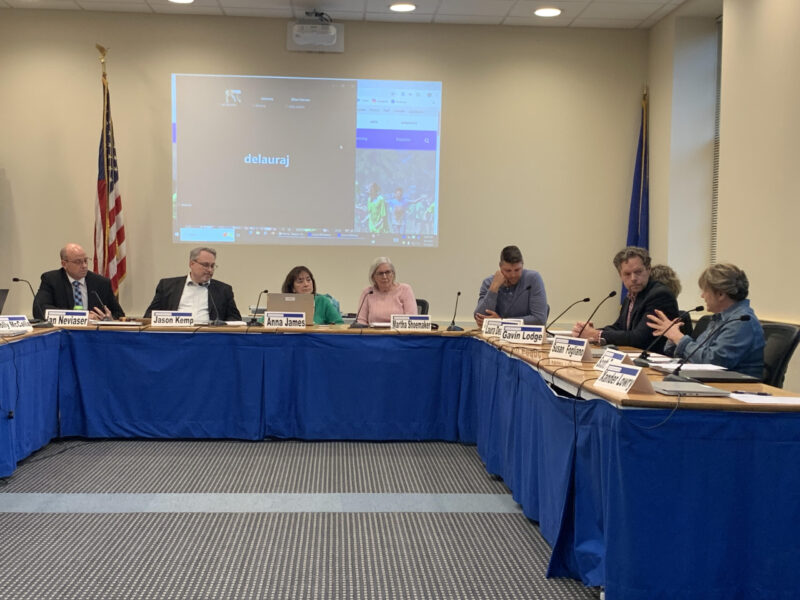
OLD LYME–The Region 18 Board of Education on Monday evening unanimously sent the proposed $39.7 million 2025-26 budget to referendum unchanged despite calls from several residents to take money out of its reserve funds to reduce the impact on taxpayers going forward. 

The referendum will be held Tuesday from noon to 8 p.m. Old Lyme residents and qualified taxpayers will vote at the Lyme-Old Lyme Middle School Gym, 53 Lyme Street. The vote in Lyme will be held at the Lyme Town Hall, 480 Hamburg Road.

Of the proposed budget’s $2.7 million or 7.39% increase, $1.8 million is attributable to debt payments on the extensive renovation project affecting all the district’s schools except Lyme-Old Lyme High School. 

Old Lyme resident Andy Russell, a member of the Old Lyme Board of Finance and the District Building Committee, who said he was speaking for himself, asked the board to use $700,000 of its $3.1 million undesignated fund – colloquially referred to as the ‘Rainy Day Fund’ – to offset the anticipated increase in the district’s special education spending. 

State law beginning in 2023 empowered each regional school board to create a reserve fund for “educational expenditures.” The law previously specified reserve funds could only be used for one-time capital expenses. 

Special education is up $726,721, or 58.67%, in the proposed budget. Superintendent of Schools Ian Neviaser has attributed the increase to the number of students, who need to be placed in programs outside the district to meet their needs. There are four students requiring outplacements in the coming year compared to the single student identified when the current budget was approved. 

Russell said the school board could dip into its undesignated fund balance for the next several years until the debt payments stop increasing. 

He said the district typically ends each year with a healthy surplus. 

“I’m reminded that you’ll probably end up – because the school district is very well run – with another $700,000 put back in that budget following this year,” he said. 

David Kelsey, another Old Lyme Board of Finance member, who also said he was speaking for himself, said the school board needs to be more “healthily skeptical” of the enrollment projections from the New England School Development Council (NESDEC) that helped justify the need for the renovation project. 

He said the NESDEC forecast overestimated the number of students in the district.

“Going forward, we have a high school that’s going to need to be renovated as well, and I do not think that we need to rely upon projections that are not commensurate with an obvious skepticism that’s required,” Kelsey said. 

District Building Committee Chairwoman Susan Fogliano before Monday’s vote to send the budget proposal to referendum laid out the school board’s case for not dipping into the ‘Rainy Day Fund.’ 

She said the school board over the past two years used reserve funds to reduce the overall amount of money that would have to be borrowed for the project, which resulted in the proposed 2025-26 budget coming in lower than the 10% increase originally anticipated. 

She also cited grant funding and advantageous interest rates that helped bring down costs. Neviaser said the district will be spending about $17 million less than the $57.5 million price tag approved by voters at referendum in 2022. 

Neviaser said the district’s bond rating – which district business manager Holly McCalla said has stood at an AA2 rating from Moody’s since 2017 – is influenced by the size of the district’s undesignated fund balance. 

“Keep in mind too, we will be bonding again this summer, so they will be looking at what’s in our undesignated fund, and that does impact our rating,” he said. “We’ve confirmed that with our bonding agent, so that’s another consideration.”

Fogliano pointed out the school board has earmarked $1 million of the undesignated fund balance to be used if necessary for security upgrades to the school vestibules. 

She said the district hopes to cover the expense out of the total project budget. 

“We hope, but we can make no promises,” she said. 

She cited the potential impact of tariffs enacted under the administration of President Donald Trump. 

“A great number of our materials have already been purchased, but it’s possible we may see overruns that we don’t anticipate based on future purchases that we can’t control,” she said. 

Fogliano and Neviaser said state law allows the district to put an amount not exceeding 2% of the prior fiscal year’s education budget into its reserve fund. But they said the school board is willing to put less than that into the fund in the coming year – if it makes financial sense at the time based on district needs – so that it can return more of the surplus to Lyme and Old Lyme. 

“I just wanted to have that out on the table so everyone understands that we are thinking about this concept, and that we are doing as well as I think anyone could expect under the present circumstances,” Fogliano said.

After Much Disagreement, Old Lyme Board of Finance Decides to Take $800K From ‘Rainy Day Fund’ to Offset Tax Increase

OLD LYME – With many residents concerned by the recent revaluation that hiked the value of taxable property in town by more than 60%, the Old Lyme Board of Finance on Wednesday evening agreed to use $800,000 from the town’s ‘Rainy Day Fund’ to help mitigate the impact to taxpayers of a proposed $45.39 million 2025-26 spending plan. 

The proposed budget – which includes town operations and capital expenses as well as the town’s share of the Lyme-Old Lyme Schools regional district budget – represents an increase of $3.28 million, or 7.8%, over the current budget. 

It includes education costs in the amount of $31.52 million, which is up $1.99 million, or 6.72%, from the town’s current share of the regional school district budget. The increase is driven by debt payments on a multi-building renovation project approved by voters at a cost of $57.5 million. 

The Old Lyme budget proposal will now go to a public hearing on Monday, April 28, at 7:30 p.m. in the Town Hall meeting room. 

Based on preliminary numbers provided by Finance Board Chairman Bennett J. Bernblum, a Democrat, the  decision to use $800,000 from the town’s reserves will result in a projected tax rate of 16.2 mills, an increase of 4.5%. 

The tax rate would be going up 6.8% if the finance board didn’t move to offset the increase, he said.

A mill represents $1 in tax per $1,000 of assessed property value.  

The current tax rate is 24.4 mills. After taking the revaluation into account – and if spending did not change at all in the coming year – the tax rate would be 15.5 mills. 

The board of finance will not set the final tax rate until immediately after the budget is approved at the Town Budget Meeting on May 19. The Lyme-Old Lyme Schools budget referendum is scheduled for May 6.

Contacted by phone on Wednesday, Assessor Melinda Kronfeld said that she will not be able to detail the potential tax impact until the town’s Grand List of taxable property is finalized after the Board of Assessment Appeals concludes its hearings next week. 

She said the median increase in real estate values was 64% based on preliminary numbers. That means anyone whose property value went up more than that will see a tax bill higher than the projected 4.5% increase. 

Finance board member David Kelsey, a Republican, said during this week’s meeting that about 2,200 of the 5,500 households in town were looking at above-average property tax increases. 

First Selectwoman Martha Shoemaker on Thursday said the budget increase is driven by debt service on the school renovation project as well as the renovation to the Lymes’ Senior Center that is nearing completion. On the town side, the $702,350 debt service line that includes the senior center project represents a 62.9% increase over current spending.

In the capital budget, the town allocated $443,500 to save for the purchase of three fire department apparatuses. Also included in the budget is an additional $200,000 for road-paving projects, bringing the total line item to $1 million.

Shoemaker last week carried out a finance board directive to come up with some last-minute cuts by working with Finance Director Anita Mancini and department heads to slash $171,350 from the proposed budget. While decreases to individual line items were typically less than $5,000 each, a notable savings came from paying for a $50,746 equipped police cruiser using revenue collected from the fund for officers’ road construction detail assignments rather than the capital budget.

‘Who Knows?’

Finance Director Anita Mancini in budget documents estimated the Rainy Day Fund, known in accounting parlance as the Undesignated Fund Balance, currently represents 35.15% of the total operating budget. 

Using $800,000 to offset the tax increase will bring the Rainy Day Fund balance to an estimated 29.6% of the total operating budget, according to budget numbers. 

The move was a compromise between Republicans, who wanted to take out less from the Rainy Day Fund, and Democrats, who wanted to use more. 

Democrat Kimberly Thompson put it this way: “There are a lot of people who’ve had major adjustments to their evaluation of their property. And I think whatever we can do to minimize the impact of that this year, we should try and do.”

Republicans Kelsey and Andy Russell said they want to make sure there’s enough money in reserve in case a catastrophic storm wipes out the shoreline tax base. 

Russell invoked the idea of a 100-year storm when he said the Hurricane of 1938 occurred almost a century ago. A storm of that magnitude has a 1% chance of occurring each year, but hasn’t happened since. 

“Well, here we are,” he said. “That’s only 13 years away. So who knows?” 

Kelsey pointed to large-scale projects that could impact future budgets such as the installation of sewers in the town’s beach communities which will require extensive appropriations in coming years.  

He also pointed to unknown costs that could hit at any time. This year, those unexpected costs amounted to $1.65 million. Included in that amount were the construction of the Emergency Operations Center, reconstruction of the Hawk’s Nest sluiceway, construction and paving of accessible parking spaces in the Sound View parking lot and a comprehensive revision of the town’s zoning regulations.  

Finance Board Chair Bernblum said the town’s bond attorney advised him creditors like to see undesignated fund balances in the amount of 30% of the total budget, but that the town’s AAA rating with S&P Global Ratings would be unlikely to change if the amount went down to 25%. 

“In general, I’m informed by what I think the sentiment of the taxpayers would be, and without having done a study, my gut tells me that they would argue for a larger withdrawal in order to mitigate their taxes this year,” he said. 

He cited those on fixed incomes as the most vulnerable to the tax increase. He said he was less worried about himself and fellow finance board members Kelsey and Russell. 

“I don’t care too much about Dave or me or Andy, for that matter, if our houses went up in value because we can afford to pay it,” he said. “But there are folks in town who can’t, and for them it’s a real burden.” 

Thompson, who also serves as chairwoman of the Democratic Town Committee, expressed confusion about the unwillingness of the Republicans to agree to a larger withdrawal from the Rainy Day Fund when the finance board under Kelsey’s leadership set aside money to mitigate tax increases several times, including $600,000 in 2023 and $800,000 each year in 2022, 2020 and 2019. 

“And in all those years, I don’t think we ever actually ended up needing that money,” she said. 

Meanwhile, the Undesignated Fund Balance (Rainy Day Fund) has grown from 22.2% in 2020 to the current 35.2%. 

Finance board member Anna Reiter, a Democrat, pushed for a $1 million withdrawal from the Rainy Day Fund. 

“We could take out another million next year and another $900,000 a year after that, assuming we don’t increase this fund at all. And we would still be at over 25%,” she said. 

But Kelsey and Russell pointed to debt levels in the school district and the town that will be felt for years to come. 

“I think the stakes have changed,” Russell said. “I think the increases we’re seeing and are going to see in the next few years are going to be more significant consistently than we’ve seen in the past.”

Ultimately, the group decided against a suggestion from First Selectwoman Martha Shoemaker to let voters decide at the budget referendum how much to take out of the Rainy Day Fund and then against Bernblum’s subsequent idea to leave it up for discussion at the public hearing. 

The vote to set aside $800,000 was endorsed by Republicans Kelsey, Russell, and Matthew Olson along with Democrats Bernblum and Thompson. Reiter (D) was the lone nay vote.

Editor’s Notes: i) This article has been updated to correct some budget terminology and figures
ii) Bennett Bernblum is a financial supporter of LymeLine.com, but has no input to the editorial process, which remains completely independent.
ii) A reminder of Our Policy on Comments.