Lyme, Old Lyme Democrats to Unveil Shared Campaign Headquarters, April 27

The campaign headquarters for Lyme and Old Lyme Democrats opens Sunday.

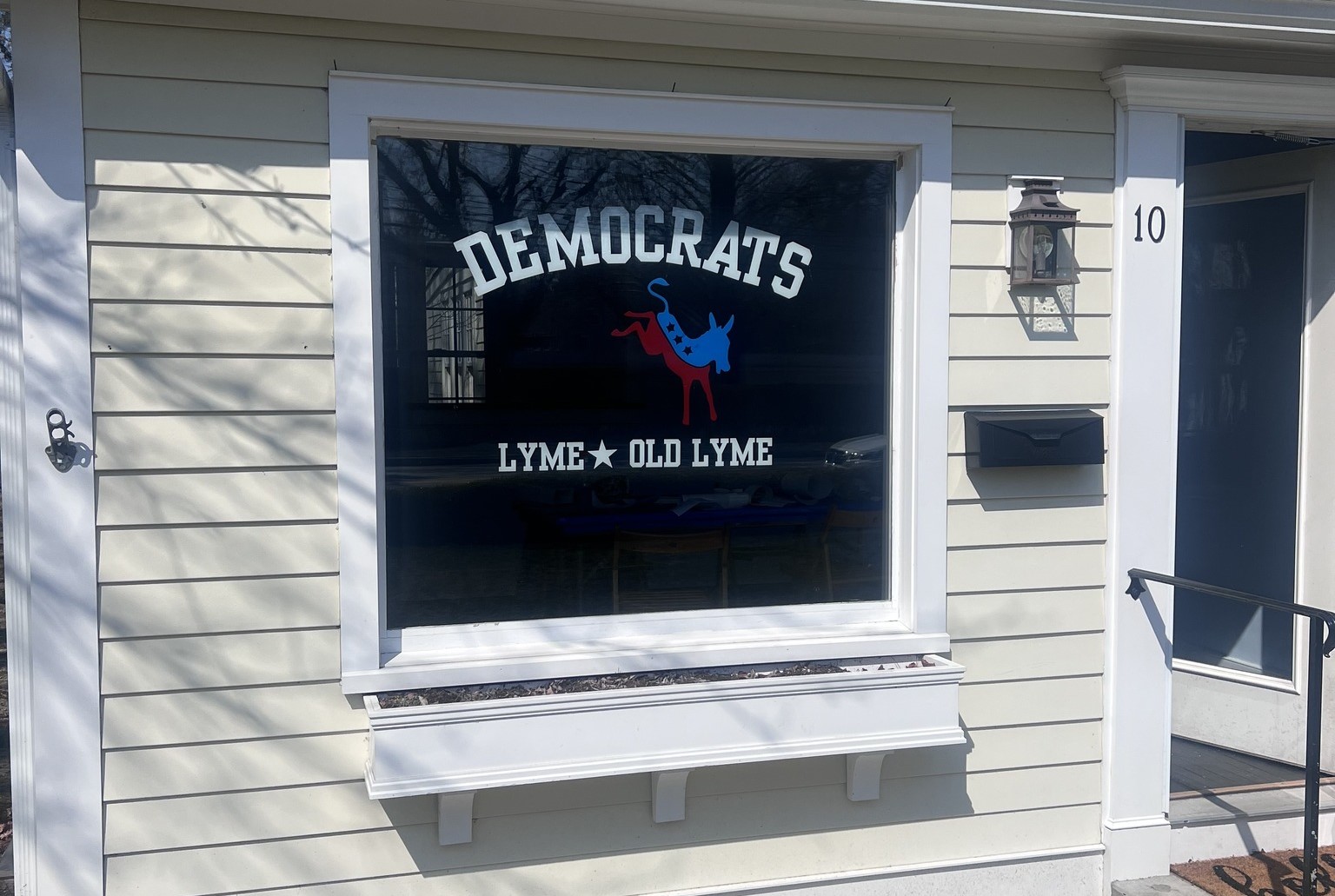
Old Lyme – Lyme and Old Lyme Democrats will celebrate their new campaign headquarters on Lyme Street with a grand opening Sunday. 

The event will be held from 4 to 6 p.m. at 10 Lyme St.

U.S. Sen. Richard Blumenthal, Lt. Gov. Susan Bysiewicz and Comptroller Sean Scanlon will be among the elected officials attending, according to publicity from the town committees.

Refreshments will be provided. 

Those interested in attending should register here.

Scientists Continue Fight Against Hydrilla Scourge; Presentation in Lyme on Latest Efforts

This photo was taken September 2020 during an inspection of Whalebone Cove when it was found 60 to 70 percent of the waterways were clogged with hydrilla vines.

LYME – Experts on the Connecticut River hydrilla will be at the Town Hall on Wednesday to talk about plans to include Hamburg Cove in a growing, multi-year effort to reduce and control the highly invasive water weed. 

The presentation will begin at 7 p.m., according to a public notice filed by the U.S. Army Corps of Engineers (USACE). A question and answer period will follow. 

The Connecticut River Hydrilla project, overseen by the Army engineers in partnership with the Connecticut Agricultural Experiment Station and the Lower Connecticut River Valley Council of Governments, began in 2023 to figure out which aquatic herbicides ― and how much of them ― are best suited to fighting off the uniquely pernicious aquatic species. 

The USACE said herbicides will be introduced to Hamburg Cove this summer or fall. All herbicides being used are registered for aquatic use by the U.S. Environmental Protection Agency.

The project last year applied an herbicide treatment to Selden Cove and several other sites on the lower Connecticut River. 

Hydrilla degrades water quality, chokes out native plants and threatens the habitat of migratory fish like shad and herring, according to the Connecticut River Conservatory. It’s been described by U.S. Sen. Richard Blumenthal, D, as, “the worst invasive aquatic species known to man.”

Wednesday’s meeting will be in-person only, according to the notice. There will be information on the project itself as well as the concerning effects of hydrilla on the Connecticut River system.

Registration is requested. Those interested in attending should email info@eightmileriver.org.

Op-Ed: After HROD Defeat, Some Thoughts on Improving Old Lyme’s Approach to Managing Major Projects Going Forward

Editor’s Note: We originally published this op-ed submitted by Howard Margules of Old Lyme on July 12, 2024. After the 4-1 defeat of the Halls Road Overlay District proposal by Old Lyme’s Zoning Commission last Monday (April 14), several members of the Halls Road Improvement Committee, including its former chair Edie Twining—who resigned yesterday—suggested republishing it as a constructive contribution to the discussion regarding how to move forward from this point.

Is a Town Planner the Answer?

Our town’s major projects—Halls Road, sewers, Shoreline Gateway, and Affordable Housing—are all vital to our town’s future economic viability. 

They also share something else in common: they have been “works in process” for quite a while, and all remain unfinished. It is important to point out that these projects have been ongoing across multiple administrations, regardless of which political party is in power; so this is not a partisan issue but one that crosses party lines. 

Why do these projects take so long to complete, and what can be done to expedite them?

Over the last ten years I have been involved, one way or another, in most of these projects. 

I am a current member of both the Halls Road Improvement Committee and the Planning Commission and the former Chair of the Economic Development Commission. Thinking back on my front-row experiences has led me to some observations on those questions and suggestions for improving timely project completion.

Relying on Volunteers

Our town is very fortunate to have a motivated, engaged volunteer corps staffing our town Boards, Committees and Commissions. I have worked with good people from both parties, and I have been generally impressed with the competence, knowledge and commitment they bring to the job. And, they are doing this work for “free.” 

But, there are issues with relying on volunteers. 

First, there is a town requirement that the Boards and Commissions be balanced politically. This occasionally leads to appointments made simply to fulfill the political balance requirement rather than appointing the most qualified individual.

Additionally, there have been instances where the Committee or Board Chair has had no input in the selection, or, objected to the appointment, but was overruled, even though the person appointed was not the best candidate. 

Second, our town relies almost solely on volunteers to address some very complex projects which often require specific expertise and knowledge that may be absent in our volunteers. 

Additionally, most Boards and Commissions only meet once per month, which is acceptable for routine issues but inadequate for addressing major complex projects. 

Finally, it is also difficult to put too much pressure or expectations on volunteers since they can always elect to just bow out. Relying almost totally on volunteers makes it hard for the town to complete major projects successfully in a timely fashion.

Low Accountability

Many municipalities, especially larger ones, employ a full- or part-time professional planner, to lead major projects. They are professionals with the expertise required to address the complex issues major projects raise. Most importantly, they are held accountable as professionals for completing projects. 

Currently, we don’t have the structure or ability to hold any one person accountable. Accountability gets more complicated given the number of Boards and Commissions involved, various interests that have to be satisfied, and political agendas that occasionally get in the way.

Lack of Collaboration

All of these major projects require approvals from multiple Boards and Commissions Typically, this is done sequentially. One Board or Commission generates proposals that then require approval from another body. Of course, it is natural then for everyone to want to add their two cents. 

The sequential review and approval process frequently leads to varied opinions, occasionally to conflicts, and thus delays. Each set of potential conflicts must be resolved in sequence, drawing out the process and the projects unnecessarily. 

In my view, it would be more beneficial to provide a mechanism for the Boards and Commissions to collaborate initially, perhaps reaching broad consensus and some level of buy-in before the official approval process. 

The Board of Selectman should form a specific project committee for each major effort. We do have some such now, but they do not include representatives of the bodies that will have to provide approval later on. 

The relevant Boards and Commissions or representatives of those bodies need to be involved early in the project, if not from its inception. 

Relevant Expertise

Expert advice (engineering, law, environmental science, design, etc.) is required for these major projects. We are very fortunate in Old Lyme to have a wide range of skills represented in our citizenry and we have benefitted from their help over many years. 

Unfortunately, those with the most relevant skills are often still working, raising children, etc. and have little time to volunteer. We can take advantage of these local skills where they are available, but major projects need consistent and constant expert input, even if it means we must hire professionals to assist.  

Even to manage the work of hired experts can require Board or Commission members to climb a steep learning curve.This is another area in which a professional planner could be very helpful.

Leadership

Finally, these complex projects require engaged leadership from the Board of Selectmen. The Board of Selectmen needs to assist with coordination, monitoring, oversight, timetables, expense control, lobbying public officials for funding, and commit to completing projects on time and on budget.

Our town will face more challenges going forward. If we are to successfully face these challenges and secure our economic future, we need to enhance our approach to supporting and managing major projects.

BREAKING NEWS: Halls Road Improvements Committee Chair Edie Twining Resigns

OLD LYME — This afternoon, Halls Road Improvements Committee Chairwoman Edie Twining submitted her resignation in a letter to Old Lyme First Selectwoman Martha Shoemaker. Twining’s resignation from the volunteer position is with immediate effect.

The text of Twining’s letter is as follows:

“Dear Martha,  

It is with a heavy heart that I resign as a member and Chair of the Halls Road Improvements Committee (HRIC). My family has been part of Old Lyme for three generations. When I returned to Old Lyme after living in Boston for 40 years, I followed in my father’s footsteps volunteering for the town. My  commitment to this committee has spanned over 8 years and many thousands of unpaid hours of work. In that time, the committee held dozens of public outreach sessions, responded to feedback and created  a Vision Proposal that informed the Halls Road Master Plan. All of my efforts have been done as a volunteer and, contrary to false accusations on social media, I have never had or sought any monetary gain, direct or indirect, from my involvement on the committee.  

The committee has received multitudes of letters of support for both the Master Plan and the Halls Road Overlay District (HROD) proposals, Planning Board Approval, detailed Zoning Commission review and dozens of public outreach sessions. To those supporters; I am deeply grateful for your attention to this  committee’s work and for your ongoing support. You understood the HRIC was never a partisan project,  but sought the benefit of the whole town, regardless of political affiliation!  

Despite seven years of very public effort, well publicized by friends and foes, many people claim never to  have been aware of the HRIC and its efforts to improve pedestrian safety, add new crossings, and update our 1960’s commercial-only zoning with a mixed-use option. Those who have followed the HRIC process have seen the multiple layers of work we have done and provided constructive suggestions that have altered the plan. Many who opposed it and chose to never attend a meeting, never visit the town website (where all details were publicly available), claim, instead that all of this was proceeding covertly with no community outreach. The fact that they chose not to attend any public meetings, not to read the detail on the town website or get involved does not give them the excuse to say the public was not informed.  

Critics have relentlessly misrepresented and misunderstood the plan, its aims, the challenges faced by the town, and the nature of the solutions proposed. This pervasive disregard for facts culminated in the latest campaign of wild exaggerations meant to mislead our community about the goals and details of the HROD proposal. The social media avalanche of invented nightmares and half-truths is indicative of the poisonous, adversarial politics that is tearing our country – and now our town – to pieces. None of those opposing the proposal ever directly asked the committee to explain how the regulation works, nor did they ever suggest any concrete alternative proposals.  

They were not interested in squarely facing our Town’s future in a changing world. Instead, they created a monstrous fantasy version of the HROD proposal that no one could support, used it to whip up a storm of protest, and set out to bully the town’s officers into submitting to their fantasy. 

The Zoning Commission’s refusal to deliberate, and abandonment of their efforts to modify the HROD  proposal in any way, was, in my view, an abdication of the Commission’s rights and responsibilities. The most important statement about the whole process was made by Zoning Commission member Denise  Savageau. She blamed the dysfunctional Old Lyme bureaucracy for failing after 10 years to work together constructively to create a unified plan and new zoning for Halls Road. It was, is, and should have been treated from the beginning as a TOWN effort. Instead, an appointed committee of the Board of Selectmen was treated by other Boards and Commissions the same way they treat a private person applying for permission to make modifications to their house. That approach doomed the effort from the start, because it foreclosed the possibility of collaboration and working together to frame what was  needed. The separate silos of Planning, Zoning, and HRIC; the fiction that the town itself could not demand that the three cooperate with one another—all of these, in retrospect, were fatal errors.  

This “us vs. them” madness is such a sad and destructive trend both locally and nationally. There seems no way to fight back against waves of falsehoods. So, I am leaving all the work we have accomplished to those who come after. If they do nothing, outside forces will dictate our town’s future. Meanwhile I look forward to contributing my time to more productive pursuits in my board positions with the Old Lyme Land Trust, Old Lyme Historical Society and my design work for the New London Homeless Hospitality  Center.  

Respectfully,  

Edie Twining”

Editor’s Notes: i)Twining also provided a list of the committee’s accomplishments.
ii) A reminder of Our Policy on Comments.


Letter to the Editor: Old Lyme Selectman Thanks Board of Finance for ‘a Job Well Done’ at Tuesday’s Budget Meeting

Editor’s Note: This letter was published April 17, after the Board of Finance meeting held April 15.

To the Editor:

I’d like to thank the Old Lyme Board of Finance for a job well done, completing work begun jointly with the Board of Selectmen in December to produce a prudent, fiscally-sound budget.  Through good compromise and the identification of additional savings, the budget for our upcoming fiscal year maintains a healthy surplus while keeping our taxes as low as possible. 

Our new proposed mill rate of 16.2 is among the lowest in the state, and holding taxes to a modest 4.52% increase is quite an accomplishment in this inflationary environment.   

Two voter-approved projects:  renovation of schools and Senior Center expansion, both hit the budget this year, presenting a special challenge.  Over the course of several hours-long, publicly-held budget workshops through January and into early February, the Board of Selectmen and Board of Finance met together with the heads of all departments, boards, commissions and committees to discuss, analyze and justify each expenditure.   These joint meetings were conducted with mutual respect and fair-mindedness from all parties.   

The Board of Finance continued their deliberations through April, culminating in a contentious meeting this past Tuesday night.   At the 11th hour, a compromise was reached:   $800,000 from the surplus would be dedicated to mill rate reduction, which along with over $170,000 in additional savings identified by First Selectwoman Shoemaker, would bring us close to the $1,000,000 in tax relief we were seeking for our townspeople.   The budget now goes to the voters for a public hearing on April 28th at 6:30pm at Town Hall.   The final vote by town residents will take place at a May 19th town meeting at the LOL Middle School.  I believe we are presenting a solid budget that meets the needs of our citizens while keeping taxes as low as possible, and I appreciate the effort of all those involved.

Sincerely,

Jim Lampos,
Old Lyme.

Letter to the Editor: Old Lyme Selectman Recommends Transferring $1.3M from Town’s Surplus to Reduce Residents’ Tax Burden

Editor’s Note: This letter was published April 13, prior to the Board of Finance meeting held April 15.

To the Editor:

An Open Letter to the Residents of Old Lyme

On Tuesday, the Board of Finance will meet to set the mill rate which will determine Old Lyme residents’ property tax burden.  Over the past two years, the Board of Selectmen has worked cooperatively with the Board of Finance to craft fiscally-prudent budgets that have resulted in hefty surpluses. Indeed, this year through the concerted efforts of not only these two boards but also all town staff and volunteers, we have a record surplus of nearly $15 million, or 33% of next year’s budget.

This surplus is not an accident. Knowing that the next two fiscal years would present challenges due to expenses incurred by voter-approved projects such as the school renovation and Senior Center expansion, the Board of Selectmen and Board of Finance concurred that we would need to have a hefty surplus going into this period in order to have the ability to provide some tax relief when setting the mill rate.

Most towns are expected to have a surplus of 15%. Being a shoreline community with exposure to potential loss of revenue due to hurricanes, Old Lyme has maintained a higher surplus. A 30% surplus is extraordinary and ideal for bond rating agencies to maintain Old Lyme’s AAA rating. With this year’s very healthy surplus, we can afford to move $1.3 million from surplus to tax relief and still maintain a 30% surplus.   

Doing so would also allow the town to set a mill rate of 16.09. This is substantially lower than our current mill rate of 24.4, but due to this year’s state mandated revaluation, many people’s property values have also increased significantly. In real terms, a mill rate of 16.09 would reflect a very modest 3.81% tax increase from last year.   This modest increase fully accounts for all burdens, including the school budget.

Surveying other towns in our regions, this is very good news indeed. We are faring far better than towns that are experiencing 10% tax hikes or more.  While it has been common practice to use surplus to offset tax increases in the past ($600,000-$800,000 was common two or three years ago), at the most recent Board of Finance meeting there were members who were reluctant to approve anything over $600,000.   Settling for this would only allow us to cut the rate to 16.38, and would reflect a 5.65% real increase.  This is still not bad in terms of what we are seeing in neighboring towns, but since revaluation has doubled some homeowner’s property values, we need to provide as much tax relief as we possibly can while maintaining services and fiscal prudence.

It is important to remember that the surplus is excess money that the town has collected from taxpayers.  We need to provide our taxpayers a dividend.   As we speak, numbers are still not completely finalized and we are still working to identify further budget cuts as well.  And while I understand that, even though we would still maintain a very robust 30% surplus, some may find moving $1.3 million to tax relief to be too much.  But I think many would agree that $600,000 is far too little.   I encourage those who are interested in this question to attend this Tuesday’s Board of Finance meeting.

Sincerely,

Jim Lampos,
Old Lyme.

Editor’s Note: The author serves on the Old Lyme Board Selectmen.